
The WISE CDT Programme
Student Recruitment
WISE enrolled 84 students in total across five annual cohorts, with each cohort numbering between 15-18 entrants. 39.3% of recruited students were female and 60.7% were male. The proportion of females recruited to the WISE CDT is pleasingly high compared with an average of around 25%-28% for engineering and technology postgraduate research degree programmes*. Students’ ages on entry ranged from 21 to 50. 59.5% of successful applicants were UK nationals, with 40.5% coming from mainland Europe (Belgium, Denmark, France, Germany, Greece, Italy, the Netherlands, Slovenia and Spain).
Entrants’ backgrounds and academic qualifications have been varied, covering engineering (civil, chemical, environmental) and related disciplines such as biochemistry, environmental science, geography, hydrology, mathematics, physics, and robotics. Some students joined the programme with previous industry experience (e.g. Chemical Engineer, Repsol; Flood Risk and Drainage Engineer, WYG Group; Senior Engineer, Hydroplan), while others came directly from academia.
Two recruited WISE CDT students in Cohort 4 were subsequently transferred to an EPSRC National Productivity Investment Fund (NPIF) training grant, so do not appear in the formal statistics that WISE reported to EPSRC. However, as these two ‘WISE-aligned students followed exactly the same programme as our other students and contributed fully to WISE, they are included in the CDT’s own reporting data.
Recruitment Process
The WISE CDT recruited five annual cohorts between September 2014 and September 2018. Student recruitment administration was coordinated centrally at the University of Exeter, ensuring that applicants had a single point of contact throughout the process. A bespoke CDT application form was used, covering educational background, research interests, research experience and motivation to undertake a PhD with the WISE CDT. Applicants were also asked to indicate their desired ‘home’ PhD research university in order of preference.
The four WISE universities subsequently considered and interviewed their allocated applicants, with each successful applicant then formally registering at that university. Once a WISE university had filled its own studentship allocation for the year, it was possible for remaining applicants to be considered and interviewed by their second or third choice PhD research university.
Year One Co-Location
The WISE CDT programme for each cohort commenced with a week-long induction at the University of Exeter. All entrants were located together at Exeter for the first year Postgraduate School and shared a dedicated office space. Beyond year one, students were based full-time at their registered university to work on their PhD project for the following three years. WISE students report benefiting greatly from belonging to a cohort with varied backgrounds and experiences. Students’ co-location for their first year has proved to be fundamental to cohort-building, enabling them to support one another and learn from others’ knowledge and experience, while at the same time building long-standing friendships.
Postgraduate School
The Postgraduate School in Water Informatics ensured that students gained a solid understanding of water informatics and wider research methodology before they began their PhD research project. This was particularly important given WISE students’ varied academic backgrounds and experience. In designing the CDT programme, a key aim was to develop students’ skills and understanding in addition to furthering their knowledge, including an appreciation of both present and future needs of the water industry.
The Postgraduate School in Water Informatics programme accounted for 120 credits of taught Master’s level modules (National Qualification Framework Level 7). The eight modules covered Hydroinformatics Tools, Urban Drainage and Waste Water Management, Water Supply and Distribution Management, Environmental and Computational Hydraulics, Computational Hydrology, Mathematical Modelling of Wastewater Treatment Processes, Programming for Engineering and Research Methodology. The modules on Environmental and Computational Hydraulics, Computational Hydrology and Mathematical Modelling of Wastewater Treatment Processes were created specifically for the WISE CDT and were only available to WISE students, being delivered by academics from Cardiff, Bristol and Bath respectively. All other modules were shared with students following the University of Exeter’s MSc in Water Engineering and other MSc/MEng programmes, giving WISE students wider educational and social interactions.
New entrants to the WISE CDT developed their PhD project proposal during their first year. Students presented their research proposals to the CDT management group and Advisory Board members at Summer School following completion of their Postgraduate School modules and examinations. The PhD research projects were then developed and refined during years two-four. However, the CDT programme ensured that students continued to join up as a cohort for regular training and activities, plus for multi-cohort events, throughout their studentship.
Transferable Skills
Transferable skills training has been an essential component of the WISE CDT programme. Key generic skills such as communication, commercial awareness, negotiation, problem solving and teamwork have been invaluable for students’ development and their future careers, whether in industry or academia. In each year students completed a Transferable Skills and Engineering Leadership module, with all four partner universities designing and delivering a module. Modules were designed to be distinct, build on earlier learning and align to students’ PhD progression:
Year 1 (Exeter): Acquisition of a deeper understanding of the research process and methodology. Communication, including supervisory relationships, science communication and public engagement, and overseas collaboration. Patenting and intellectual property, negotiating and influencing skills, and developing a business model. This module was conducted jointly with Stream Industrial Doctorate Centre (IDC) students to widen the mix of participants’ backgrounds and experiences.
Year 2 (Bristol): Maintaining motivation and independence; visualising data; preparation and delivery of conference papers and posters; writing and refereeing of journal articles and grant applications.
Year 3 (Cardiff): Developing resilience; reducing stress; excelling as a researcher; leadership, management and team skills; professional etiquette; planning and writing a thesis; thinking of one’s career; entrepreneurship and leadership skills.
Year 4 (Bath): PhD thesis writing and completion; Viva preparation; career opportunities and career development.
Research Culture
WISE students have been able to pursue specialist skills training through attending taught Master’s level modules relevant to their research, either at their registered university or at another WISE partner university. They have participated in a variety of additional activities at their registered university, including seminars, research group events and teaching, and have been an integral part of an active water engineering research community:
- University of Bath’s Water Innovation & Research Centre
- University of Bristol’s Cabot Institute for the Environment’s Water Theme
- Cardiff University’s Hydro-environmental Research Centre
- University of Exeter’s Centre for Water Systems.
Summer School
The WISE CDT programme has incorporated a mix of cohort and multi-cohort events to encourage students from all universities to interact, supporting discussion and exchange of ideas across disciplinary boundaries. WISE has run six residential Summer Schools for its students, organised by each of the partner universities in turn. Summer Schools have also hosted the CDT Advisory Board meeting of industrial and academic partners and Board of Examiners’ meetings, which have reviewed Postgraduate School marks and annual progression for all students.
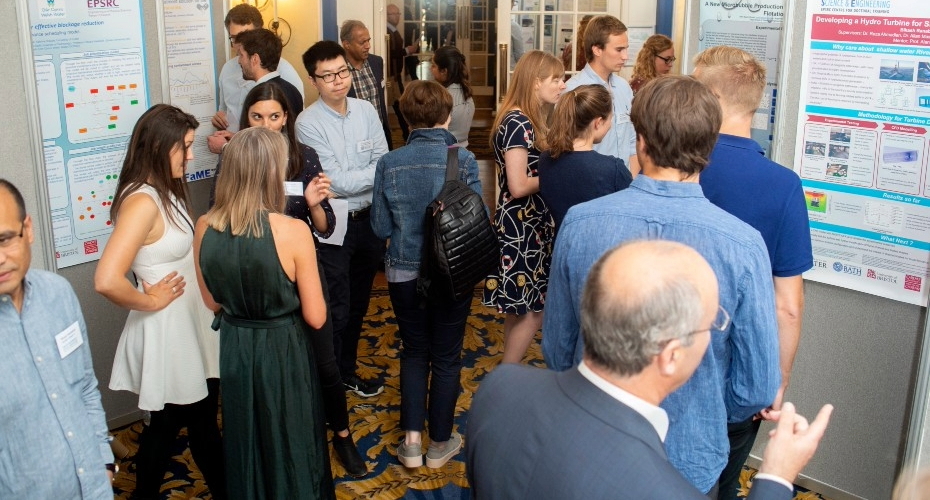
Summer Schools have incorporated student research presentations and poster displays, water-themed team challenges, site visits and talks from leading water industry figures. Recent team challenges have encompassed:
- creating an educational board game, designed to enable players to explore the issues surrounding water resources management, the challenges and possible solutions.
- developing a new business plan for a water utility company, anticipating future demands and climate change effects, in order to achieve a significant reduction in water abstraction from natural resources and increase water efficiency;
- in the role of a consultancy company, developing and presenting proposals for intervention to improve resilience to flooding to different clients and stakeholders.
The final planned Summer School, organised by the University of Bristol, had to be postponed in 2020 due to Coronavirus pandemic restrictions. However, it successfully took place a year later in September 2021. This was the first in-person WISE event following the pandemic and was designed with this in mind. Participants expressed their appreciation for the relaxed atmosphere and looser scheduling, which enabled everyone to get used to being in a large group again and to have the chance to reconnect. Students also greatly valued the WISE alumni panel session, where graduates shared their experiences and answered the many questions posed by current students.
Industry Engagement
Integral, ongoing engagement with industry has been essential to the WISE CDT, with its aim of being a postgraduate programme that would fill the skills gap by fostering new levels of innovation and collaboration. In establishing a vibrant research and learning community, the CDT has provided training at the boundary of water informatics, science and engineering. Central to both the training programme and to students’ research projects has been the involvement of leading industry, business, government and other stakeholders. Students’ exposure to real industry challenges and projects - and the networking and career development opportunities arising from engagement with industry - have therefore been highly valuable and necessary components of the programme.
Industry engagement for all students has included:
- A series of seminars and invited lectures from industry and water stakeholders during the first year Postgraduate School;
- Regular Industry Days, where students have presented their research to water industry and practitioner stakeholders via poster and networking sessions. Industry Day hosts have included Atkins, HR Wallingford and Arup, while the 2020 event was run in conjunction with Wet Networks Bristol;
- Engagement with Advisory Board members at Summer Schools, including presentations of PhD research project proposals and poster sessions displaying current research and emerging results;
- Engagement with key professional organisations such as CIWEM, IWater, British Hydrological Society, UK Water Industry Research (UKWIR), International Association for HydroEnvironment Engineering and Research (IAHR), and the IWA.
In December 2017, WISE CDT students were joined by University of Exeter MSc Water Engineering students for an evening Enrichment Event focusing on careers in the water industry. Hosted by IWater, ‘A Life in Water’ gave students an insight into the many challenges and opportunities within the sector and the range of jobs on offer. Students also benefited from the chance to meet local employers and a broad range of industry professionals to find out more about specific roles.
Smaller groups of WISE students, meanwhile, have taken up opportunities to participate in significant industry gatherings, such as annual Dŵr Cymru Welsh Water Annual Innovation Events, and to network with industry speakers and delegates at conferences.
Research Visits
The universities of Bath, Bristol, Cardiff and Exeter have strong links with the international academic community, as well as with consulting engineering and IT companies, water companies, government departments and agencies involved in managing and improving the water environment. All WISE CDT students have been strongly encouraged to undertake a research visit of up to three months as they developed their PhD project.
Before undertaking a research visit, students were required to complete a bespoke application form in liaison with their primary supervisor. To maintain CDT oversight, applications were scrutinised and approved by Cardiff University - or by the University of Exeter for Cardiff applications - to ensure that each visit would be beneficial, that the costs were appropriate and that the student would receive sufficient support and contact whilst away.
Research visits have been funded by the CDT, some with supplementary support from the host organisation or the British Council, and have been made either to a UK-based industrial or government agency partner or to an overseas academic institution. During their visit students have worked on their research under the guidance of their primary PhD supervisor, the supervisor at the host institution and experts in their research area. On their return, students have written and submitted a report evidencing the impact and outcomes of their visit. The WISE CDT Programme Management Group has reviewed research visit applications and outcomes at each meeting.
Public Engagement
One of EPSRC’s key objectives is to ‘generate public awareness; communicate research outcomes; encourage public engagement and dialogue; and disseminate knowledge’. EPSRC therefore expects and encourages its researchers to engage with the public. The WISE CDT has achieved this in a variety of ways, with the aim of both stimulating interest and educating. Public outreach activities have enabled students to develop their communication skills through disseminating their research in an understandable way to very different audiences. Students have found these experiences extremely enjoyable and wholly worthwhile.
WISE students have participated in annual festivals such as FUTURES science events, Festivals of Nature, British Science Weeks, National Engineering Days and World Water Days. In addition to in-person participation, students have engaged through a variety of channels, including online presentations and discussions, radio, acting, puppetry and volunteering. The WISE CDT also joined forces with the Stream IDC at New Scientist Live 2019 in London. Students from both CDTs managed an exhibition stand - under the umbrella of ‘EPSRC Water Engineering’ - to share their research with the public via a wealth of engaging posters, demonstrations and experiments.
Competitions and Conferences
The CDT has deliberately incorporated an element of competition within the programme, setting both group and individual challenges. These have included ‘best poster’ and ‘best presentation’ competitions, as well as varied Summer School group challenges in association with industry partners. In going on to submit papers or posters to journals and conferences, WISE students have been exposed to competition at a national or international level.
WISE students have attended and presented at many significant UK and overseas conferences. This has offered superb networking opportunities and valuable preparation for future careers, as well as recognition for the quality of their posters and presentations.
Guided Freedom
The WISE CDT’s philosophy of ‘guided freedom’ has given students the responsibility and resources to influence their training programme, thereby gaining valuable skills, exploring innovative ideas and methodologies and creating new contacts. Supporting this principle has been students’ generous financial support, comprising a stipend and fees for the equivalent of four years’ full-time study, plus a Research Training Support Grant to cover additional training costs, such as conferences and the research visit.