
Talk about Writing: Repertoires and Principles
Dialogic (Metalinguistic) Talk about Writing
Talk about writing – or what we call ‘metalinguistic talk’ - promotes understanding of the relationship between language and meaning. We consider this talk to be ‘dialogic’ because it opens up thinking about linguistic possibilities, and the multiplicity of effects that can be achieved by writers. By deepening what we call ‘metalinguistic understanding’, talk about writing strengthens learners’ thinking about authorial decision-making and being a writer.
Drawing on Robin Alexander’s notion of repertoire (2020), we consider writing classrooms to be ‘dialogic’ when teachers purposefully utilise and interconnect different ways of talking to open widespread spaces for learners to explore, think about, and reflect on writing. The repertoires of talk described below, underpinned by pedagogical principles, capture some of the ways that teachers can offer opportunities for thinking and talking about writing. For a more detailed account of these repertoires at a macro and micro level, see A (Developing) Framework for Talk about Writing.
Repertoires of Talk about Writing
- Whole class talk about model texts stimulates (metalinguistic) thinking, supporting learners to explore, verbalise and develop understanding about the relationship between writerly choice and rhetorical effect. Model texts can act as springboards for learners’ own writing, both as scaffolds and stimulus.
- Whole class talk about model texts is characterised by a range of ‘talk moves’ that invite learners’ speculative or intuitive responses, open up discussion about linguistic choice and effect, and verbalise the relationship between language and meaning.
- Teacher-led metalinguistic modelling makes explicit authorial decision-making, supporting learners to think about and develop control of their own writing choices.
- Metalinguistic modelling is an essential pedagogical step in teaching sequences that support writerly independence. For example, metalinguistic modelling can be used to ‘bridge’ whole class talk about model texts and related writing tasks.
- Metalinguistic modelling involves teachers making explicit their thinking about writing intentions, language choices, and intended effects. In doing so, teachers might share already completed writing or they might write ‘live’ during the lesson; teachers might also incorporate ‘dialogic modelling’, in which teacher and learners discuss the teacher’s choices, or generate text together.
- Writing conversations provide spaces for learners to share, verbalise and reflect on their own writing choices. Writing conversations may support learners to generate and refine ideas, intentions and language choices, and may help learners to better recognise the effects of their writerly decisions.
- Writing conversations may usefully precede or follow a writing task, or be used at intervals in the writing process to support reflection and revision.
- Writing conversations may take place between teacher and learner, between peers, or as a whole class. Teachers and learners may draw on a range of talk moves during writing conversations, including questions that invite learner-writers to verbalise their authorial choices and intentions.
- By modelling metalinguistic talk, teachers make explicit ways of talking about writing choices. Modelling writing conversations also supports learners to engage with and respond to the writing of others.
- This modelling, like the metalinguistic modelling described above, is a bridging mechanism in learning sequences. For example, teachers might model metalinguistic talk to ‘bridge’ individual writing and peer writing conversations, to prepare learners to talk together about their writing, independent of the teacher.
- To model talk, teachers can use prompts and talk scaffolds, lead live demonstration of writing conversations, and/ or foster explicit consideration of the ‘talk moves’ that encourage verbalisation and reader-writer dialogue.
General principles
The general principles outlined below are intended to support teachers’ use and understanding of talk about writing repertoires. Further guidance and exemplification can be found in these pages.
- Talk, in various forms, is a mechanism that may mediate learning about writing. Talk may support learning transfer between model texts and writing, and between writing and analysis of model texts.
- It is the planned sequencing and responsive use of talk about writing repertoires that may support and mediate understanding, progression, and independence.
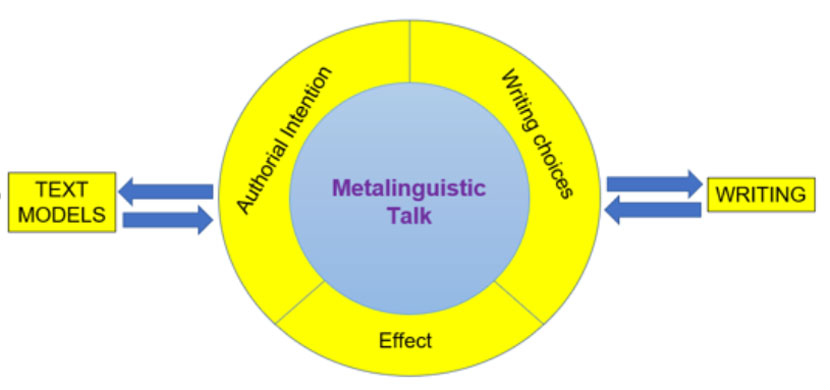
Figure 1: Metalinguistic talk: mediating learning about writing.
- Dialogic and motivational writing environments provide extended opportunities to write, scaffolded as necessary, and spaces for learners to think about, reflect on and talk about writing.
- Teaching might acknowledge that learners might be ‘moved’ to write, verbalise their thinking, or discuss their writing, at various points in a lesson – not only in ‘permitted’ spaces.