
Political Theory Reading Group
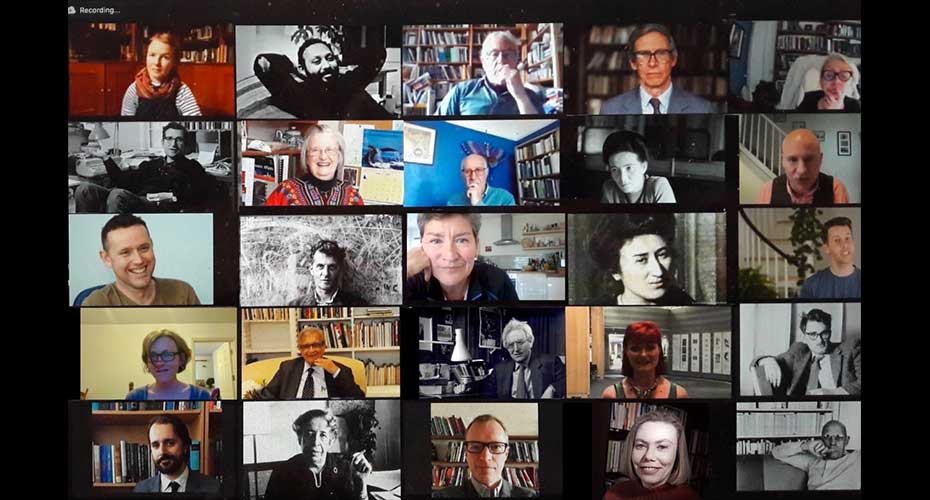
The Reading Group in Political Theory is a term-time weekly meeting of the staff and postgraduate students (both research and taught) working in political theory, also open to colleagues and students from other areas in politics, and from any other discipline. It often welcomes the participation of speakers from other Universities.
The Reading Group started as an experiment in conversation between colleagues in the political theory cluster with very different interests and approaches to the subject. Even when disagreeing profoundly and not fully understanding each other, we carry on enjoying these conversations.
Over the years, the Reading Group has become the focus of our research culture, an opportunity to exchange ideas and look at political and theoretical issues from many different perspectives. Thanks to the participation of colleagues and speakers from a variety of disciplines besides politics (philosophy, law, classics, economics, history, business, English, theology, geography, the arts), the Reading Group provides an invaluable opportunity for interdisciplinary explorations and dialogue.
The format of the Reading Group varies from week to week. The standard format is for one member of the group or an external speaker to briefly introduce a pre-circulated text, followed by a (more or less heated and controversial) discussion on any issue that seems relevant to the text itself. Often, however, we have internal or external speakers (academics and postgraduates) presenting their own papers. The format of this meetings following the same format: pre-circulated papers, a brief introduction, and an open and wide-ranging discussion. Occasionally, the Reading Group takes the form of a workshop with more than one speaker, or a symposium about a published book.
The Reading Group gives an opportunity to research students at Exeter to present their own work or to discuss texts in which they are interested. It helps them to discover new texts and a variety of ways of looking at familiar subjects. It is a way of socializing postgraduates into the discipline by exposing them to different texts and detailed discussions about them. Master students in political theory are required do a presentation at the Reading Group as part of their degree. This may be intimidating for some, but they all find it an interesting and formative experience. And even the senior staff finds it still a stimulating and refreshing experience.
Unless otherwise stated, sessions take place on Wednesdays, 12:40 to 14:00 in Amory B310. Most meetings will be hybrid. Zoom link will be circulated via the CPT mailing list.
Week 1
[No event this week]
Week 2
Wednesday 21st January
Catherine Owen (University of Exeter), ‘Regimes and Participatory Governance: Democracies, Autocracies, and Converging Practices’ (co-authored with Sonia Bussu, University of Birmingham)
Week 3
Wednesday 28th January
Jamie Draper (Utrecht University), ‘Green Industrial Policy Without Inequality’ Joint event with RENEW
Week 4
Wednesday 4th February
Edward Skidelsky (University of Exeter), ‘Justice’ – chapter from forthcoming book, The Language of the Virtues
Week 5
Wednesday 11th February
Kuang Guangyao (Fudan University, visiting researcher at HaSS Cornwall, UoE), ‘Re-thinking Open Marxism’s Organisational Strategy through China’s Materialist Practice’. With response from Harry Pitts (University of Exeter)
Week 6
[No event this week]
Week 7
Wednesday 25th February (12.30-14.30, Queen's LT7.2)
Manuscript Workshop: Catriona McKinnon (University of Exeter), Postericide: a new international crime to protect future people
In this book, Catriona McKinnon argues for a new international crime of ‘postericide’ committed by intentional or reckless conduct fit to bring about human extinction. Postericide could be committed by acceleration of the climate crisis, escalating risks of nuclear conflict, AI gone rogue, and in many other domains in which powerful subsets of humanity are acting in ways that shock the normal conscience of humanity. In this book, McKinnon asks: Why should international criminal law be expanded to include a new crime to register postericidal wrongdoing? Who should be prosecuted for this crime? And what's wrong with human extinction anyway? The book will be published by MIT Press in 2026/7.
Discussants:
Satiago Truccone (University of Graz)
Thomas Gilloch Boyle (University of Exeter)
Alex McLaughlin (University of Exeter)
Week 8
Wednesday 4th March
[No event this week]
Week 9
Wednesday 11th March
Robert Lamb (University of Exeter) introducing John Rawls’ ‘Hegel II: Ethical Life and Liberalism’ from his Lectures on the History of Moral Philosophy (Harvard University Press, 2000), pp. 349-371
Week 10
Wednesday 18th March
Two events this week on republicanism and the current state of representative democracy, organised by the Centre for Political Thought and the Horizon REDIRECT Project:
12:30–13:30, Queen’s Senior Common Room
Book discussion of Stuart White’s The Wealth of Freedom: Radical Republican Political Economy (OUP, 2025)
13:30–14:00 Buffet Lunch, Queen’s Senior Common Room
14:00–17:15, Digital Humanities Seminar Room 1, Queens
Research workshop: The Trouble with Liberal Democracy
Presentations by: Ruth Kinna (Loughborough University), Stuart White (University of Oxford), and Clementina Gentile Fusillo (UCL)
Week 11
Wednesday 25th March (time and location TBC)
MA students’ dissertation symposium
Download programmes from previous years.
- PTRG Programme Autumn 2025
- PTRG Programme Spring 2025
- PTRG Programme Autumn 2024
- PTRG Programme Spring 2024
- PTRG Programme Autumn 2023
- PTRG Programme Spring 2023
- PTRG Programme Autumn 2022
- PTRG Programme Autumn 2021
- PTRG Programme Spring 2021
- PTRG Programme Autumn 2020
- PTRG Programme Spring 2020
- PTRG Programme Autumn 2019