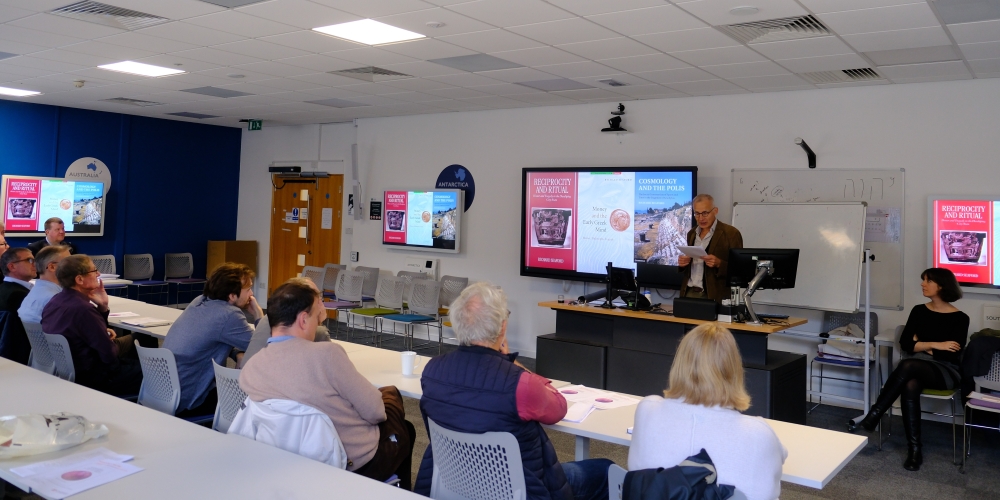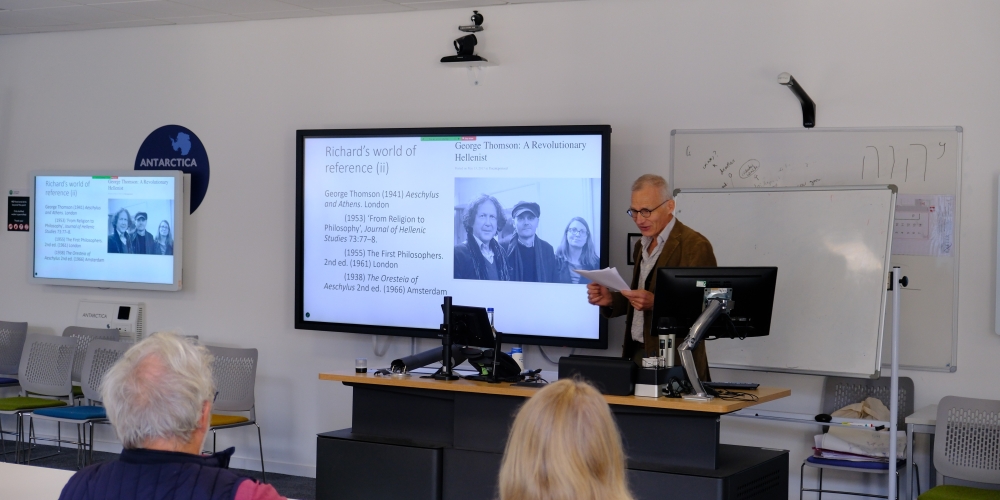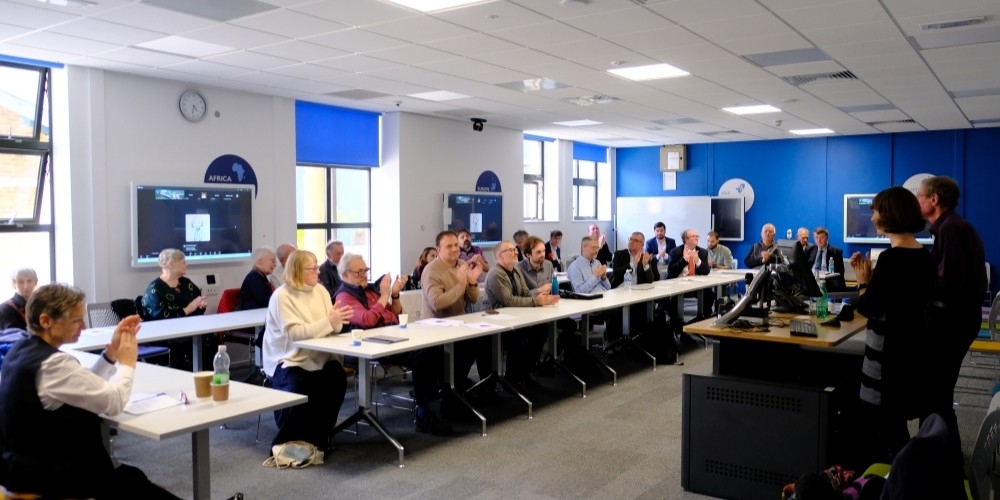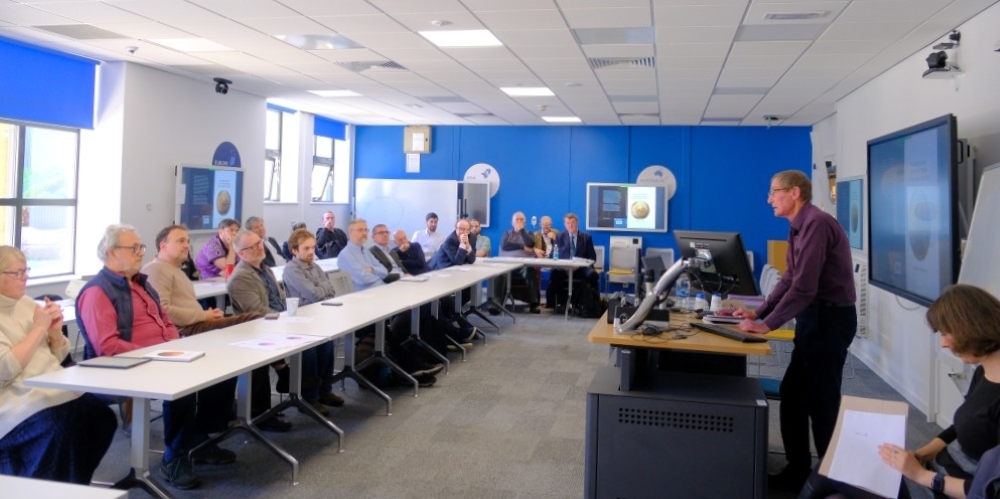
Book Launch for Richard Seaford’s final book: Aggregation and Antithesis in Ancient Greece.
Wednesday, October 8, in Streatham Court, 0.28, 2.30-5.30 pm, followed by a reception.
Organised by Classics, Ancient History, Religion and Theology (CAHRT) and the Centre for Political Thought
There will be presentations on the composition and publication of the book. Robin Osborne, Emeritus Professor of Ancient History at the University of Cambridge, will give the main presentation, discussing the distinctive contribution of this book within Richard Seaford’s work, its innovative treatment of ancient art, and its political implications.
If you would like to attend, please notify C.J.Gill@exeter.ac.uk for catering purposes. If you would like a Zoom link, please contact C.Meccariello@exeter.ac.uk.
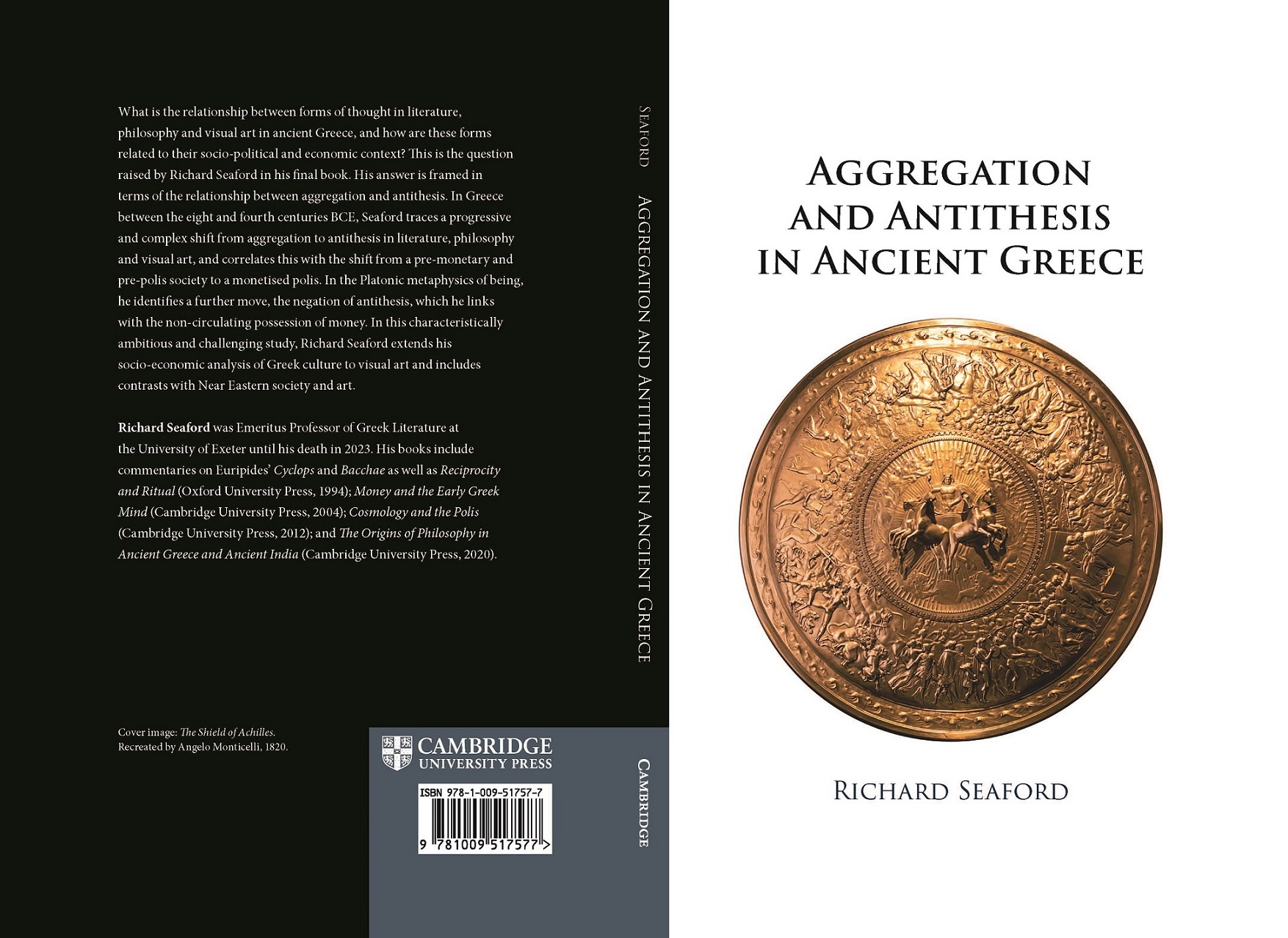
Richard Seaford’s final monograph (just published by Cambridge University Press) is Aggregation and Antithesis in Ancient Greece. (Another book, One God, No King: The Origins of Monotheism in Greece and Judah, co-authored with Joachim Schaper, a theologian at Aberdeen University, is to appear soon also with Cambridge University Press.) Both books were completed shortly before Richard’s death, and he was strongly committed to completing the books and ensuring they were published in due course.
Find below a summary of the book and an obituary of Richard Seaford.
Like all Richard’s books, this was wide-ranging and synthesising, highlighting links between society, politics, religion and philosophy. As elsewhere, he gave a key role to the socio-economic basis of cultural life, and especially, the transformative role of the invention of money in Greek society. This book is innovative in its conceptual framework (the categories of aggregation and antithesis are new to his work and to scholarship on this subject). The idea of a gradual transition from a culture dominated by aggregation to antithesis is also new. Also new in this book is the contrast between Near Eastern society, with its hierarchical, top-down, political framework, linked with ‘aggregation’ in its artistic patterns, and Greek culture, which progressively moved towards ‘antithesis’, giving a role to the framing and working out of opposites, and to debate and disagreement in politics, art and cultural life generally. The elaboration of this contrast in terms of visual art (ch. 5) is another entirely novel feature of this book. This development is seen as one in which the progressive introduction of money and monetary exchange plays a strong, shaping influence. Although this book is historical in focus, Richard no doubt saw the contrast between aggregation and antithesis as one which is still very much current on our own world. He would, certainly, have developed the implications of this contrast in terms of his powerfully felt, and trenchantly expressed, views on contemporary politics and society and would have been happy if they contributed to ongoing debate on these topics.
Here are summaries of the chapters:
Ch. 1. Defining Terms
This chapter defines the terms used throughout the book to analyse prevalent patterns in literature, thought and visual art in Ancient Greece (eighth to fourth centuries bce) and correlate them with the contemporary economic and political situation. Aggregation is defined as a paratactic sequence or assemblage of otherwise unrelated items. Antithesis is defined as the symmetrical representation of opposites. Antithesis is subdivided into antagonistic or peaceful, balanced or unbalanced, focused or unfocused. These are the central terms for this book. A further category, of less importance for this purpose, is asymmetrical opposition, which is subdivided into antagonistic and balanced or antagonistic and unbalanced or non-antagonistic.
Ch. 2. Homer
Homer’s epics constitute a combination of aggregation and antithesis. The most obvious expression of aggregation is the Catalogue of Greeks and Trojans in Iliad 2, which has Near Eastern parallels. This is combined with antithetical (balanced) duels between pairs of warriors. The shield of Achilles (Iliad 18) presents a series of human activities, sometimes in paired form, that suggest symmetrical oppositions (e.g. between war and peace, town and country), though these are introduced in aggregative, list-like language. The shield as a whole edges towards comprehensiveness of a kind we can associate with the emerging polis. The shield of Achilles can be compared with contemporary Phoenician bowls which also convey, in visual form, the combination of aggregation and antithesis. However, the different form of the epic, including extended and structured narrative, gives scope for less bounded forms of antithesis. One such example is the meeting of Achilles with Priam in Iliad 24, replacing extreme violence with peaceful reconciliation. Another, very striking, example is the meeting in battle of former guest-friends Diomedes and Glaukos in Iliad 6 and exchange of armour, gold for bronze. The second incident combines verbal antithesis with a transaction that prefigures commercial exchange.
Ch. 3: Opposites in Ionian Cosmology
Antithesis in the form of the unity of opposites appears to a limited extent in the early mythic cosmogonies. However, this theme emerges much more strongly in subsequent presocratic thought. This phenomenon was analysed closely by Geoffrey Lloyd without being explained; here, presocratic speculation on the cosmos is explained as ‘cosmisation’, that is, interpretation shaped by a combination of political and economic factors alongside mystery cult. Anaximander’s idea of the universe as apeiron (‘unlimited’) is interpreted as a projection of the qualities of money, reflecting the emerging process of monetisation. Anaximander’s characterisation of the interchange of different elements within the unlimited in terms of ‘order’ and ‘retribution’ reflects both monetisation and emerging political structures. Similar factors underlie Herakleitos’ sustained focus on antithesis in the sense of the unity of opposites. Herakleitos’ universe is one of continuity within constant change, unity within interchange, expressed as fire or logos (‘reason’ or ‘calculation’). This worldview reflects the expanding influence of commercial exchange that underpins the emergence of a unified polis. It also reflects the paradoxical combination of unity and opposites within mystery cult, which is formulated in ritual language and gestures couched as antithetical dyads.
Ch. 4: Opposites in the Cosmology of Magna Graecia
This chapter focuses on presocratic thinkers living in Magna Graecia (Sicily and southern Italy) in the sixth and fifth centuries bce. The main theme is the unity of opposites (a form of antithesis), treated in various ways by these thinkers, and the economic, political and mystic influences on their treatments. Parmenides’ radical separation between the one and plurality (or the paths of truth and opinion) reflects the contrast between possession of money and its circulation. This is informed by Parmenides’ aristocratic outlook; his account of the two paths is also modelled on mystic initiation. The Pythagoreans and Empedokles both adopt a more inclusive framework that embraces opposites within an overall unity, symbolising both the possession and circulation of money and a broad political structure. The Pythagorean cosmos, conceived in terms of fire, harmony and order or calculation, accommodates both poles in their table of opposites. Empedokles’ cosmic cycle includes the opposed subjectivities (with political connotations) of love and strife, while reincarnation accommodates divergent and opposed states of selfhood within an overall wholeness. Unity of opposites is framed by these thinkers in terms of the (introjected) inner self and (projected) cosmos, matching the wholeness offered by mystic initiation.
Ch.5: Visual Art from the Near East to Greece
In this chapter, the focus shifts from literature and philosophy to visual art, in the Near East (Mesopotamia and surrounding area) and Greece in the eighth to the sixth century bce. The approach centres on correlating the ideas of aggregation and antithesis with recurrent visual patterns and with underlying socio-political factors. In Near Eastern art in this period, aggregation predominates, though with some scope for antithesis. This pattern is similar to Homeric epic; however, Near Eastern patterns (by contrast with Homeric ones) reflect the dominance of kingly power, expressed in accumulation or in subordination. Lions are taken as a salient example: the Near Eastern king either overcomes the lion’s violence or exercises lion-like power. The lion-motif is also sometimes adopted in Archaic Greek art but incorporated in structural groups that do not express kingly power; similarly, in Homer, the lion-motif appears without stress on unitary kingly power. In Greek vase-painting of the Eighth-Seventh Century (the Geometric period), exemplified by a series of artefacts, we also find a predominance of aggregation, though with some antithesis. However, neither of these Greek patterns express unitary, kingly power; and the antithetical patterns especially reflect interactions within the family or local group.
Ch.6: The Unity of Opposites in the Fifth Century: Historiography, Tragedy and Vase-Painting
This chapter discusses the increasing presence of antithesis, rather than aggregation, in fifth-century Greek historiography, tragedy and vase-painting. In certain key incidents and in narrative patterns in Herodotus and Attic tragedy, we find antithesis in the form of the unity of opposites and the reversal of an apparently stable situation. This reflects the influence of mystic initiation, Pythagorean thinking (in the case of Aeschylus), and, in a broader sense, the emergence of the polis, in which social oppositions are contained within a political unit. In fifth-century Attic vase-painting and sculptural groups, there is also a progressive shift from aggregation to antithesis, paralleling the pattern found in the newly emerging genres of historiography and tragedy. This too reflects the increasing prevalence of monetary exchange and interactions within the unified framework of the polis.
Ch.7: Plato
Fifth-century Greek tragedy and visual art centres on interaction between people, including antithetical relations, reflecting a society shaped by monetised exchange and commerce. Platonic metaphysics is focused on unchanging being, placing supreme value on the possession of money and devaluing or excluding exchange and interaction. Although dialogues such as the Phaedo contain the idea of the unity of opposites, and binary opposites such as body and soul, Platonic metaphysics aims at the negation of opposites, and thus of antithesis. The contrast between being and seeming emerges in fifth-century tragedy and philosophy, but it is given much greater prominence by Plato and is linked with the theory of Forms. One of the Platonic accounts of the relationship between Forms and particulars is in terms of original (Form) and copy or image (particulars). Plato is the first to offer a theorization of the idea of the image (in the Sophist) and to define the idea of mere image (not reality). Plato’s treatment of the being-seeming relation, like the theory of Forms generally, expresses the reification of the value of money, treated as the basis of possession, excluding exchange.
Richard Seaford (1949-2023)
.jpg)
The Classics community has been greatly saddened by the passing of Professor Emeritus Richard Anthony Skipton Seaford at the age of 74 (1949-2023) after a struggle with pancreatic cancer.
Richard spent his youngest years with his family in Nigeria. His older sister Jane recalls him ‘putting a chameleon on a bright pink bucket to see if it would change to that colour, it didn’t, chameleons don’t do pink’. This energetic intellectual curiosity was to become a marker of Richard’s career.
After preparatory school in Devon, Richard’s secondary schooling was at Repton School, where he studied Classics together with James Fenton, and Richard spoke warmly of their schoolboy companionship. From Repton, Richard went on to Brasenose, Oxford, where he read Greats, and then completed a DPhil on Euripides’ satyr play, Cyclops, in 1974, which was published by OUP in 1984 to critical acclaim. This edition of the Cyclops, however, was not Richard’s first monograph. In 1978 he published Pompeii which considered mystery cult, one of his life-long scholarly interests, through the lens of the Villa of the Mysteries at Pompeii.
Many more articles, commentaries and monographs were to follow. Tragedy and ritual, especially those associated with the god Dionysus, figured prominently in his work. As well as writing over 100 articles (some of which were collected and edited by his student, Robert Bostock, in the volume Tragedy, Ritual and Money in Ancient Greece: Selected essays (CUP 2018)), his scholarly output was wide-ranging and prodigious: Reciprocity and Ritual: Homer and tragedy in the developing city-state (OUP 1995); Euripides, Bacchae (Aris & Philips 1996); Money and the Early Greek Mind: Homer, philosophy, tragedy (CUP 2004); Dionysos (Routledge 2006); The Origins of Philosophy in Ancient Greece and Ancient India: A historical comparison (CUP 2020); Cosmology and the Polis: The social construction of space and time in the tragedies of Aeschylus (CUP 2012); and (his final work, completed only weeks before his death) Aggregation and Antithesis in Ancient Greece (CUP forthcoming).
One of the hallmarks of Richard’s scholarly originality was to try to understand what made Greek society work at its most fundamental levels, and how these ideas and practices then shaped this society. That is, he believed that only by understanding the social, religious, political and economic phenomenology of Greek society could one understand its literary, artistic and philosophical outputs. For example, he understood tragedy as an essentially ritual and religious activity which was also political, and the development of the abstraction implicit in the economic phenomenon of ‘money’ as the precursor to the abstract thinking of the pre-Socratic philosophers.
Richard also enjoyed collaboration, and the energy generated by discussing his ideas with others, especially in the context of research seminars and conferences. He himself organised a number of conferences, generally with others, and edited a number of conference volumes: Reciprocity in Ancient Greece (with Christopher Gill and Norman Postlethwaite, OUP 2007); Selfhood and the Soul: Essays on ancient thought and literature in honour of Christopher Gill (with John Wilkins and Matthew Wright, OUP 2017); and Universe and Inner Self in Early Indian and Early Greek Thought (Edinburgh UP 2016). He was also an active and passionate participant at such events. Even in the months and weeks before he died he was giving international conference papers with his usual enthusiasm, vigour and puckish humour, even if he was constrained to some extent by the medium of zoom.
Richard’s approach to life was fundamentally intellectual. After a period as a JRF at Queen’s College, Oxford, he was appointed lecturer at Exeter in 1978, where he remained until his retirement in 2014. Peter Wiseman recalls:
‘My job [as Head of Department] was to reorganise the degree programmes, just to get the undergraduate numbers in, but Richard and Su [Morton Braund] immediately started a research seminar (there were only five of us, with no graduate students!), and it was thanks to them (Richard in particular) that Exeter became not only a viable Classics department but also an intellectually exciting place to be. The department's success in the eighties and nineties, in very challenging times … was very largely his doing.’
A charismatic teacher of undergraduates, he particularly enjoyed working with his graduate students. Georgia Petridou writes:
‘Richard was an attentive and truly inspirational teacher and he will be terribly missed by all his students! His internationally renowned research on all matters related to ritual attracted large groups of international PGR students to Exeter. Moreover, Richard's excellent comparative work on ancient Greek religion and philosophy and Hinduist religious traditions and texts has given rise to an impressive number of research articles and books on the topic. Richard was one of these charismatic cultural leaders who opened up the study of ancient Greek religious ideas and practices to other disciplines, such as archaeology, anthropology, sociology, and linguistics. Richard's research on Near Death Experiences (NDEs) is still considered groundbreaking and cited widely among scholars of Greek and Roman religion. Those close to him and those who admired his work would like to imagine that Richard felt no fear in his last moments and that he was comforted by a beautiful bright light like that he investigated in his pioneering research on NDEs.’
Fiona McHardy, another of his students, also recalls Richard with great affection:
‘Richard was an inspirational teacher who set many students onto new pathways and ways of thinking based upon his teaching style and encouragement. He never aimed low but set the highest bar for achievement. His research projects were strikingly ambitious taking on multiple sources and ideas and suggesting radical new ways of seeing things. His impact on scholars reading Greek tragedy within an Athenian social context has been profound, though not all have agreed with the prioritising of ritual over poetry in his readings. His knowledge of Greek was remarkable especially his ability to recite ancient Greek poetry so beautifully.
I can think of so many more little things, such as when he used to have us all at his house and he played the piano - I can remember singing something by sight there - and it always used to be one long party in those days - or so it seemed, he just drew people to him and was such an interesting person holding forth on multiple topics.’
And Robert Bostock:
‘As a student of Richard's, my overarching memory is of a man who would always take a recondite academic question and turn it into a direct and important human problem. As a PhD student of his it was exhilarating to present a piece of work which used all the techniques of classical scholarship to arrive at a new solution to an old problem, and to come out of the supervision feeling like you had only scratched the surface and the real work had now to begin. You walked in feeling like a giant, and came out feeling like a dwarf, but you were more eager than ever to grow again. Ancient Greece was for him always only a microcosm for studying the pressures faced by individuals living in an integrated human society. The apparatus of classical scholarship, which he had mastered, allowed him to bring out in more detail the otherness, and the particular value of, the Greek response to the timeless problems of oppression and inequality. These were his real concern, and few classical scholars have combined with the same degree of sincerity their passion for the academic discipline and their philosophical approach to contemporary life.’
Richard’s impact was not only felt among students but also colleagues in Classics. Richard approached life in the department with unrelenting and characteristic vehemence and passion. Matthew Leigh, a colleague at Exeter in Classics in the 90s, says:
‘For me what mattered most about Richard was the scintillating quality of his disquisitions about Classics and politics as the Classics team sat around the table eating our sandwiches over lunch in the Queen's Building Common Room. That and the extraordinary intellectual energy that he brought to seminars and to his writing. He had a wonderfully eloquent indignation to him and the sense that scholarship mattered if and when it addressed serious themes seriously.’
Richard’s influence was also felt in the wider classical community. Malcolm Schofield talks about Richard’s role in transforming the Classical Association conference:
‘Richard played a key role in transforming the annual conference of the Classical Association. By the 1980s the traditional format, of just half a dozen or so invited plenary lectures over three days, delivered to a dwindling band mostly of faithful regulars, had plainly lost its attractions. In April 1989 Richard was appointed a member of a CA working group tasked with addressing the problem. His advocacy of an 'intellectualised and democratised' model, with parallel panel sessions of shorter papers volunteered in answer to a call from the organising team (rather on the APA [= SCS] model), ably supported by Marion Gibbs in particular, was what prevailed. Numbers of Classicists of many different hues, attending an event with real buzz, now regularly top 400.’
Richard was also president of the Association in 2008-9, and Douglas Cairns says of his presidential address,
‘The Ancient Greeks and Global Warming’, delivered to the combined CA and CAS conference in Glasgow in April 2009, that it ‘… was a characteristic example of his approach to scholarship: utterly original, deeply thought-provoking and inspiring, personally and politically engaged, and delivered with the absolute clarity and precision that was typical of his style as a lecturer. He will be remembered as one of the most consistently original and intellectually ambitious Classicists of the last 50 years …’.
In fact, Richard had a deep interest in politics, both as an academic subject and in the contemporary world. Iain Hampsher-Monk, Professor Emeritus of Politics at Exeter, writes:
‘I first met Richard shortly after he arrived in the seventies. He offered a third-year option in Pre-Socratic philosophy, a subject which both I, and later Janet Coleman, tried to teach in our outline History of Political Thought 1…. Richard took on Janet, myself, and a single third year student and we had a wonderful time. His capacity to combine his extraordinary specialist knowledge with patience and interpretive openness made him a tremendous teacher. As a colleague he moved with justified confidence across disciplinary boundaries both in seminars and in some of his pathbreaking research - Surely not since Moses Finley has economic thought been applied so insightfully to problems in classical culture.’
He remained an activist for intellectual autonomy. He served many times on University Senate and always maintained its importance as the democratic voice of academics in the increasingly managerial context of higher education. He also served twice as Head of Department at Exeter. Although initially he took on the role reluctantly (after the first week of his first term he requested that a ‘vote of no confidence’ be proposed against his headship), he came to enjoy organising Departmental affairs (which he did with a great sense of fair-play and remarkable patience) and defending the Department against what he saw as the intrusion of the University on the autonomous decision-making of academic departments.
Richard was fearless in pursuit of what he saw as injustice. He regularly harangued the local MP for Exeter about matters he regarded as of national importance, but his support for Palestine, the plight of the Palestinians and Palestinian academics became a deeply held passion.
Richard adored an audience, whether it was the weekly ‘Thursday’ lunch club in Exeter, or the theatre audiences of the plays he produced, directed or acted in. Notable, in Oxford, was the Ion, in which he acted, the Alcestis, which he produced, directed and also played a part, and the Cyclops, which he directed. As a young man he played Dionysus in the Bacchae, and in his maturity reprised the play, but not the role of the god, instead wonderfully hamming up the part of Teiresias in the student production of the play at Exeter University. In fact, also at Exeter (and again in London), he played the part of the ‘Just Man’ in the professional production of Aristophanes’ Wealth, which was given to him as a 50th birthday present and performed at the conference Money & Culture in Ancient Greece.
Oliver Taplin has the final word:
‘… we have known each other for some 50 years; and through all that time we have thought well of each other – at least I hope that the esteem has been mutual! We have often crossed paths in a wide spread of places over the years. And we have quite often disagreed… but only over relatively detailed and minor matters of scholarship – academic life would be unbearably cosy if everyone always agreed.
And I think that we have shared fundamental attitudes towards many more important matters, and larger issues in our contemporary world. We have both looked to the larger picture: to the setting and thoughts and artistries of the remarkable culture we have primarily worked on: that of the ancient Greeks, and especially fifth-century Athens. We have both asked “why does all this matter?”; “what may it reveal about people and their thoughts and priorities?”; and “what might that convey and teach the present?” I greatly admire the many intertwined ways in which Richard has brought out the social and political and economic ramifications of these questions, and his refusal to let the ephemeral fads of the present obscure the recurrent lessons of the past. I have admired his scholarship, his passion, his honesty, and his strong sense of social justice. It is the impetus of those that have made his life’s work not only original and cogent but of lasting significance.’
Richard was a scholar and true intellectual. He also had a great sense of fun, and a zest for life which he believed in living to the full. He is survived by his wife, Laura, to whom he was deeply committed, and Artemis, his daughter by an earlier marriage, of whom he was extremely proud. He will be greatly missed by all who loved and admired him.
Lynette Mitchell (Emeritus Professor, Classics, University of Exeter)