Model studies suggest that intense fires subsequent to the detonation of nuclear warheads would create so-called ‘nuclear-winters’ that could persist for many years leading to global famine. Even regional-scale wars could pose an existential threat to ecosystems and humanity.
SHIVER utilises a fully-coupled version of the UKESM1 Earth System model to assess the impacts of three different nuclear scenarios i) all-out USA-Russia nuclear war, ii) war between India-Pakistan, iii) more limited nuclear conflicts in eastern Europe. Different numbers of nuclear detonations, vertical profiles, and seasons of conflict are assumed over each area and the climate response are analysed over the subsequent twenty year period. Analyses are likely to include the physical evolution and longevity of the stratospheric plume and the response in terms of near-surface temperatures, precipitation, stratospheric ozone, induced changes in atmospheric and ocean dynamics, impacts on net primary productivity, ecosystem adaptability and impacts on crop productivity.
The University of Exeter affiliated post-doctoral research associate is Ananth Ranjithkumar.
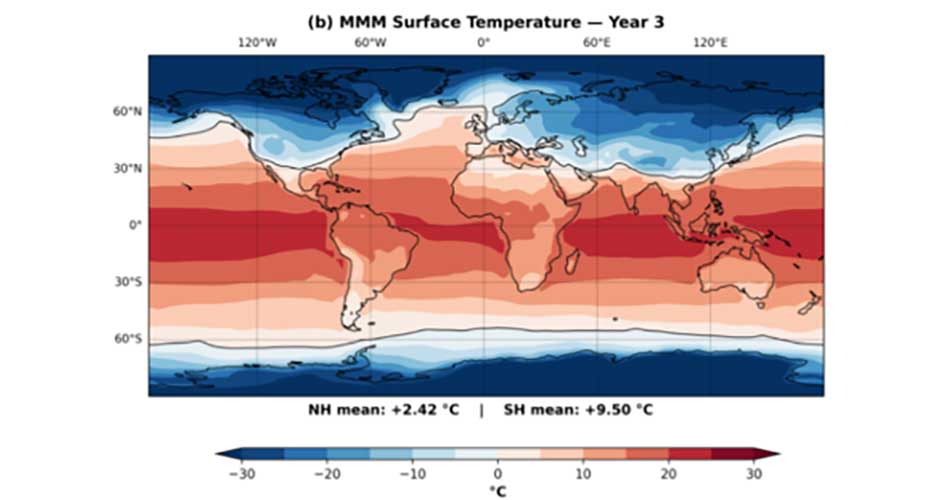
Image: A multi-model mean (3-climate models) projection of surface temperature subsequent to a full scale nuclear war between nuclear super-powers that is assumed to release 150Tg of soot into the stratosphere. The bold line represents the 0degrees Celsius isotherm indicating that much of land mass of the northern hemisphere would be frozen.
View full version