

Postgraduate research opportunities in Astrophysics
The Exeter Astrophysics group is one of the largest and most vibrant groups in the UK studying stars and planets. The group’s research activities are mainly devoted to four areas: star formation, exoplanets, stellar physics, and the interstellar medium. At Exeter, the PhD normally lasts for 3.5 years of full-time study (maximum of four years), and “funded” positions typically include a living stipend (and payment of course fees) for that time. International students are encouraged to apply, but may not be eligible for all potential sources of funding.
Current funded opportunities
We are now accepting applications for entry in 2026. Please have a look through our available projects below and submit your application by Friday 23rd January 2026.
- Characterizing exoplanetary systems with current and next generation high contrast imaging platforms - Dr Sasha Hinkley
- Formation of exoKuiper belts - Dr Sebastian Marino
- A comprehensive hydrodynamical study of convection, convective penetration and waves in stars - Prof Isabelle Baraffe and Dr Thomas Guillet
- Planet formation in dusty discs around young stars - Prof Matthew Bate
- Signs of life in Deep Time and Deep Space - Prof Nathan Mayne and Dr Eric Hébrard
Information for self-funded students
Entry requirements
In general, applicants must have obtained, or be about to obtain, a First or Upper Second Class UK Honours degree, or the equivalent qualifications gained outside the UK. All students must meet the University’s minimum English language requirements by the start of the project. We receive many more applications than it is possible to accept or fund. As a rough guide, virtually all successful applicants will have undertaken a substantial research project before beginning the PhD, will have excellent reference letters attesting to their work, and will have strong academic records in relevant coursework.
Why choose to study an Astrophysics PhD at Exeter?
Funding and investment
- Exeter astrophysics has been particularly successful recently in both STFC and EU funding. The group has been awarded eight prestigious ERC grants, funding a number of Postdoc and PhD positions.
- £1.3million investment from the University for research into extrasolar planets.
Research expertise
- Opportunity to work with experts at the forefront of their fields of research.
- Exeter astrophysics is continuously expanding, branching into new and upcoming areas of astrophysics such as exoplanet atmospheres, the galactic interstellar medium and stellar magneto-hydrodynamics.
Development opportunities
- Use telescopes in places such as Hawaii and Chile.
- Travel to conferences around the world to present research.
- Access the £1million supercomputer at Exeter and the UK DiRAC high performace computing facilities.
- Many PhD students go on to do postdoctoral research.
A fantastic location
- As well as being a thriving university city, Exeter is also situated in one of the most attractive parts of the UK, with Dartmoor National Park and the South Devon coast less than an hour away.
Hear from our past PhD researchers about their time at Exeter
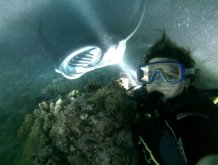
The Astrophysics group at Exeter combines all aspects you could want from a work environment. Relaxed yet hard-working, supportive yet giving you the freedom to develop yourself as an individual scientist, social yet still slightly stereotypical of an academic environment. There is always something going on that you can get involved with, and the balance between work and social life is well maintained.
You are surrounded by people who are experts in their field and still love what they are doing, and any one of them is happy to lend an ear or a thought if needed. I doubt I would be working where I am today without the support and knowledge of this group.
Hannah, 2015 graduateNASA Postdoctoral Fellow at Goddard Space Flight Center, USA
Image shows Hannah scuba diving with manta rays in Hawaii after observing on Mauna Kea

A key factor for me when I was deciding where I would do my PhD was a department in which I would be able to carry out research that would allow me to gain direct observing experience. The observational research that is carried out within the astrophysics department at Exeter uses many different techniques across a wide range of wavelengths. As many of the researchers work with data that has been obtained from world-class, ground based observatories, I knew that I would have the opportunity to gain hands-on observing experience.
The skills and knowledge that I have developed over the course of my PhD have not only provided me with the expertise to continue my career as an observational astronomer, but also during my time in Exeter I have gained a network base of both colleagues and friends that stretches around the world.
Joanna, 2014 graduatePostdoctoral researcher at Arizona State University, USA
Image taken by Joanna Bulger: capturing sunrise after a night of observing at Mauna Kea, Hawaii, USA
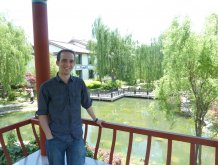
The astrophysics department in Exeter is an excellent environment full of great people. The staff are certainly experts in their fields but, perhaps more importantly, still have the time to lend an ear and sound advice at the drop of a hat. The department has a great atmosphere: lively PhD students and knowledgable postdocs, with lots of occasions for social gathering as well as hard graft!
The Devon coast is a lovely place too, and the view from the astro floors of the coast is quite something. While a PhD is not without its bumps in the road, the experience at Exeter is one I would recommend without hesitation.
Alex, 2014 graduatePostdoctoral researcher at Hokkaido University in Japan
Image shows Alex at the IAU298 conference in Lijiang, China

My time at the University of Exeter was exceptional. I was able to work on my research in a place where academic quality is high and the surrounding nature is amazing. The astrophysics school is leader in star and planet formation and exoplanets. Being part of the department was exciting as you knew that everyone in the group was working on cutting edge science. To relax I would go to Cornwall or North Devon to surf, or go for a run along the quay.
Eli, 2012 graduateBolton Fellow at CSIRO in Sydney, Australia
Image shows Exeter quay at night, taken by Eli Bressert
Doing a PhD in Exeter was great - I enjoyed the campus, the city and the nearby countryside. After spending many years in Paris it was nice to be surrounded by trees and wildlife. The PhD at Exeter offered me many opportunities, from travelling abroad to collect data and present my work, to being involved in astronomy outreach, making a direct impact on people's lives.
Aude, 2010 graduateTeacher of Science at Newton Abbot College, Devon
An excellent group with world leading researchers and a friendly social atmosphere. The group is large enough to provide a broad range of stimuli for research, such as a full list of visitors and speakers, but small enough that we have retained an excellent group identity, with regular social events and discussions. I loved, and continue to love, working in the astrophysics department at the University of Exeter.
Nathan Mayne, 2008 graduateSenior Lecturer in Astrophysics at the University of Exeter

After completing a PhD on exoplanet atmosphere modelling at the University of Exeter I continued my scientific career at the Met Office. I now work on forecasting and understanding air pollution in the UK. Though I am no longer working in astronomy, the scientific and technical skills that I gained during my PhD provide a firm foundation that allows me to perform well in my career now. The exoplanet group at Exeter gives the rare opportunity to explore the universe while using a world-leading weather and climate model. Simulating the exotic atmospheres of hot Jupiters with the same model that is used to produce our daily weather forecasts, predict severe weather events and give long-term climate projections was, simply put, really cool. In addition to the pure scientific thrill of the research, building experience with such complex models and systems opens the door to careers right across the science and technology sector, not just in astrophysics. There are many places to study a PhD, but it is the people and place that make a difference. The welcoming and positive culture of the astrophysics group is great. The open and friendly environment makes it easy to work hard, but importantly to also enjoy it and make new friends. As for the place… the campus is green and with a great view, Exeter has everything of a city that you need, and the moors and coasts of Devon are just over the horizon! Regardless of whether you are already decided on an academic career in astronomy, or are on a less clear trajectory, I would recommend studying for a PhD in the Exeter astrophysics group to anyone who wants to solve problems, learn key transferrable skills and work with great people.
Ben, 2017 graduate
Senior Scientist at the Met Office
Image shows Ben hiking on Dartmoor

I started my PhD in the Astrophysics group at the University of Exeter in 2015, moving from India to the UK. I was very excited to join this position as it was in the field of Exoplanet Atmospheres and Exeter is one of the best places in the world for this research. Initially, I was a bit nervous moving to a completely new country, meeting new people but the Astrophysics group provided a very welcoming environment which made me feel very comfortable. My time at Exeter was excellent, I learnt a lot from my supervisors, colleagues and made great friends for life. There were many social gatherings, informal talks and outdoor group activities making it a very intellectually stimulating, as well as a fun, environment. I also had a great opportunity to learn about public outreach at Exeter and how to use science to directly change lives of children/students. The university campus and the area surrounding Exeter is very beautiful, so that was an added bonus for weekend getaways.
The skills and expertise that I gained during my PhD at Exeter made it possible for me to choose a career of my interest in the field of Exoplanets and finally landed me a faculty job in India. In this job I try to learn more and more about these far away worlds, as well as train the next generation of scientists and researchers. In summary, it was an amazing experience doing my PhD at Exeter and would recognise it as one of the best phases of my life.
Jayesh, 2019 Graduate
Assistant Professor, School of Earth & Planetary Sciences, National Institute of Science Education & Research (NISER), Bhubaneshwar, Odisha, India
Image shows Jayesh hiking along the Devon coastline