

A comprehensive hydrodynamical study of convection, convective penetration and waves in stars
Supervisors: Professor Isabelle Baraffe and Dr Thomas Guillet
Convection is a key process in stars, driving the transport of heat, of chemical species and of angular momentum. Convective motions can also induce a transport process in stable regions, as the turbulent motions overshoot beyond the convective region and mix material into adjacent stable layers. This process is called convective penetration or overshooting. Both convection and convective penetration, either in a convective core or in a convective envelope, strongly affect the structure and the evolution of many types of stars. In addition, convective motions excite acoustic waves, driven by pressure variations, and gravity waves, driven by buoyancy forces. These waves can be detected at the surface of stars, providing key information about the inner structure of stars. They can also drive chemical mixing, affecting the size of convective cores or surface abundances of chemical elements such as lithium or nitrogen.
The main motivation of the project is to advance the understanding and description of convective penetration process, wave excitation and wave mixing for a broad range of stars of different masses and stages of evolution. The study will be based on multi-dimensional hydrodynamic simulations using the MUSIC code developed by the supervisors and their team of international collaborators. The PhD project will build on the initial work from the supervisors and their collaborators devoted to the study of convective cores and envelopes for stars on the Main Sequence (i.e burning hydrogen in their core). The main goal is to expand this study to later phases of evolution (post-Main Sequence evolution) in order to develop a general theoretical framework, based on the results of the numerical simulations, describing convective penetration, wave excitation and mixing under different stellar conditions. Such a framework will be extremely valuable for the improvement of stellar evolution models which are used by a large astrophysical community for the interpretation of observations.
During this project, the student will gain a rich expertise in physical and fluid dynamical processes taking place in stellar interiors as well as in stellar oscillations. The later topic is very topical with the imminent launch of the PLATO space mission devoted to stellar oscillations (asteroseismology). PLATO will observe many post-main sequence stars, which we aim to study during this PhD project. The student will also gain experience in multi-dimensional numerical simulations.
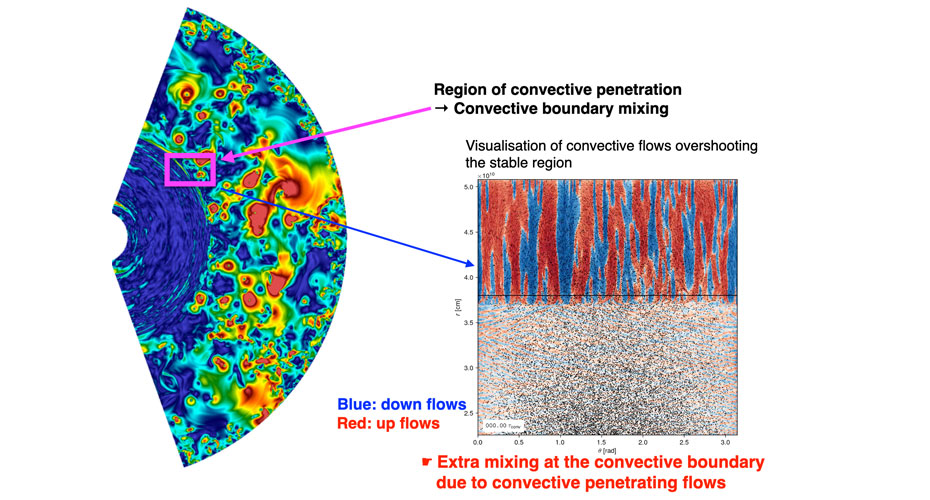
Numerical simulation performed by our team for a solar like star, describing the convective motions and the process of convective