

Formation of exoKuiper belts
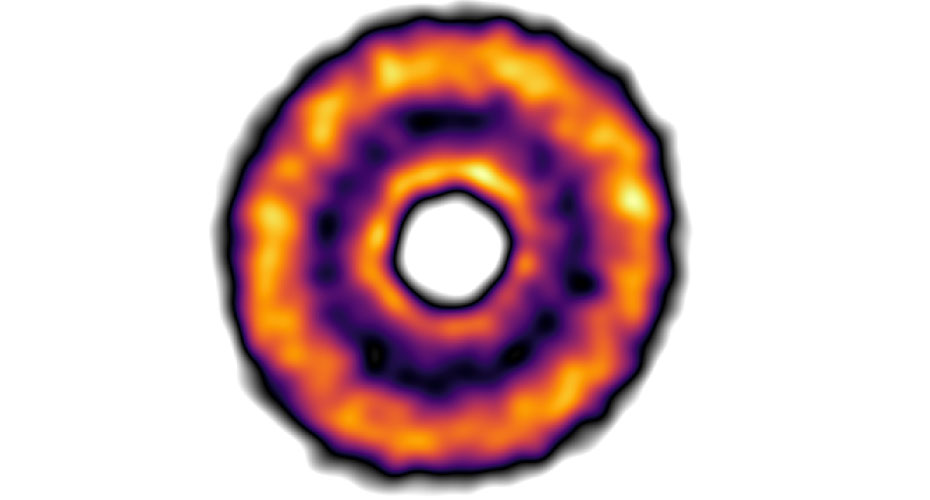
ALMA image of exoKuiper belt with gap
Supervisor: Dr Sebastian Marino, Associate Professor
In the last two decades, the study of planetary systems has been revolutionised thanks to the discovery of thousands of exoplanets and hundreds of debris discs. Whilst exoplanet discoveries have been biased towards the inner regions, cold debris discs (extrasolar analogues of the Kuiper belt) have been crucial for constraining the outer regions of exoplanetary systems. These exoKuiper belts are made of minor bodies similar to comets that collide and generate high levels of dust that are readily detectable at multiple wavelengths. As part of the ERC-funded project FEED (Formation and Evolution of Exocometary Discs) I am offering a PhD position to study how exoKuiper belts form.
How do exoKuiper belts form in protoplanetary discs?
The comets that give rise to exoKuiper belts must grow from the dust in protoplanetary discs. While the formation of comets/planetesimals has been studied in detail recently, the formation of exoKuiper belts and their comparison with observations have yet to receive much attention. The student will first use and extend existing software (dustpy) to simulate the dust evolution in a protoplanetary disc with a planet to study how exoKuiper belts form and how their structure will depend on their formation conditions. The next step will be to simulate the interaction between the planet and comets as the protoplanetary disc disperses. See Miller et al. 2021 for more details on the methods.
If you have any questions, get in touch via email. These two reviews may be useful:
- Introductory review of debris discs aimed at students
- More advanced review of debris discs aimed at young researchers
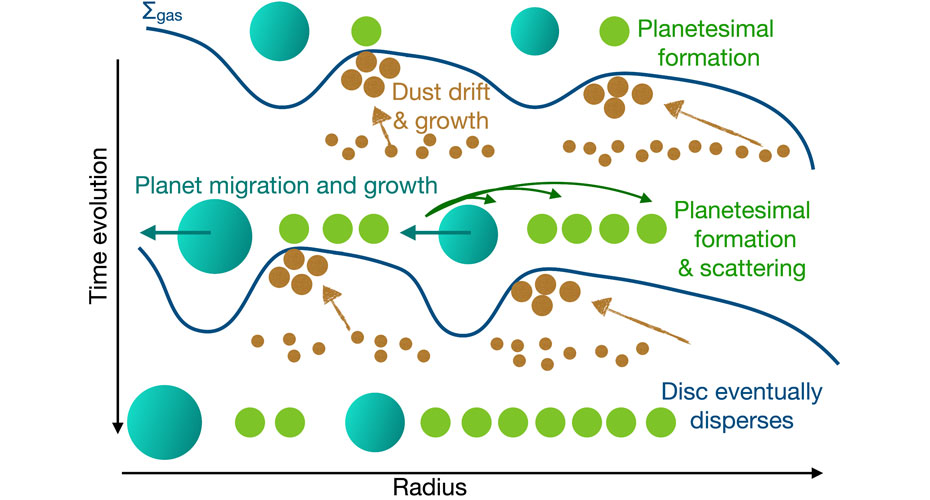
Figure 1. Diagram showing the different processes occurring in a protoplanetary disc that lead to the formation of planetesimals: Planets carve gaps that trap dust, dust accumulates and grows to form planetesimals, planets migrate and planetesimals form at different radii, and planets can scatter planetesimals.