

Machine learning, young stars, and the birth of planets
Supervisor: Professor Tim Naylor
Planets form in accretion discs around young stars. The conventional assumption when modelling planet formation in these discs is that material flows smoothly through the discs, but we know this is far from true. At least some young stars show huge brightenings (known as FU Ori outbursts) as a wave of material passes through the disc, releasing gravitational energy. It’s possible that these events have a profound effect on the planets forming on the disc. Work in Exeter has shown that the outbursts occur on average every 100000 years in what is thought to be the planet forming phase. But this is only an average, we do not know if this behaviour is limited to a subset of young stars. To make further progress we need a large sample of events, but if an event takes place every 100000 years, we to have data from 10 000 stars for 10 years to see just one event. There are now a broad range of archive data which cover temporal baselines longer than this, the challenge is to select the large sample of young stars required. Given the millions of stars that will have to examined, this is a job for machine learning. Then we will need examine the resulting samples carefully to understand what biases the machine learning introduces, before finally studying the astrophysics of star and planet formation. This is a project for a student interested in star and planet formation, as well as developing skills in machine learning.
For more information contact Professor Tim Naylor
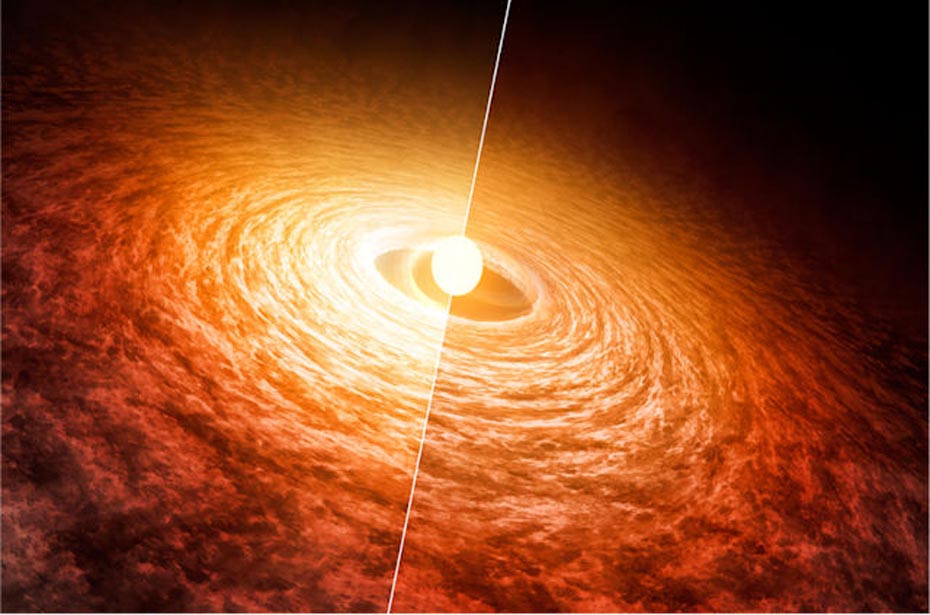
An artists impression of how the disc around a young star may change when it goes into outburst. (Credit: courtesy of NASA/JPL-Caltech)