

Signs of life in Deep Time and Deep Space
Supervisors: Professor Nathan Mayne and Dr Eric Hébrard
Summary: In this PhD project, we will explore the origins of life on Earth, and combine this with the study of life on other planets, both within and outside our solar system. Focusing on the climatic and chemical conditions of prebiotic and inhabited planets, using a suite of numerical tools, we will work to guide the search for life beyond Earth and deepen our understanding of our own origins. This multidisciplinary project will cross areas such as chemistry, climate/weather modelling, biology/ecology and astrophysics.
Context: The study of planets beyond the solar system, or exoplanets, has rapidly accelerated since the first discoveries around three decades ago with over 5000 detected exoplanets to date, including planets potentially similar in composition to the terrestrial planets of our solar system. One key goal of exoplanet research is to discover signs of life on one of the many thousands of planets accessible to observations over the coming decade. At the same time the search for direct evidence of life, from in-situ observations of Mars is a key aim of missions such as NASA’s Perseverance Rover, and future missions are planned to search for signs of life on Venus.
As we search for biosignatures on distant planets, rock cores drilled from the Earth’s surface are also being used to search for signatures of the earliest life on Earth. The early conditions on Earth and evolution of microbial life is not constrained and new studies push the emergence of life earlier and earlier with the last universal common ancestor of cellular life probably appearing before 3.9 Ga, alongside evidence for liquid water. In the search for signs of life in Earth’s past, and that of its neighbouring planets, as well as on exoplanets, without building an underlying framework for simple life and its interaction with its host planet, how will we know what to look for and why? Our best chance of a `ground truth’ for life beyond Earth is that inferred from studies of Earth’s deep past.
We will combine treatments of prebiotic chemistry, with climate modelling, to explore the implications for early life on Earth and the potential for life beyond Earth.
Training & Development: during this project you will work as part of the wider Exoclimatology Theory Group (ETG) at Exeter, with projects spanning the study of Earth, Mars, and a wide range of exoplanets (planets beyond the solar system), ranging from detailed modelling of atmospheric dynamics, to idealised exploration of life-climate interactions. Additionally, you will interact with observational collaborators across UK and international institutes, and work closely with Met Office collaborators developing numerical models.
Applications are welcomed from people from a wide range of backgrounds, but Science or Mathematical backgrounds/degrees would be most suitable.
For more information please contact Nathan Mayne (n.j.mayne@exeter.ac.uk) or Eric Hébrard (e.hebrard@exeter.ac.uk).
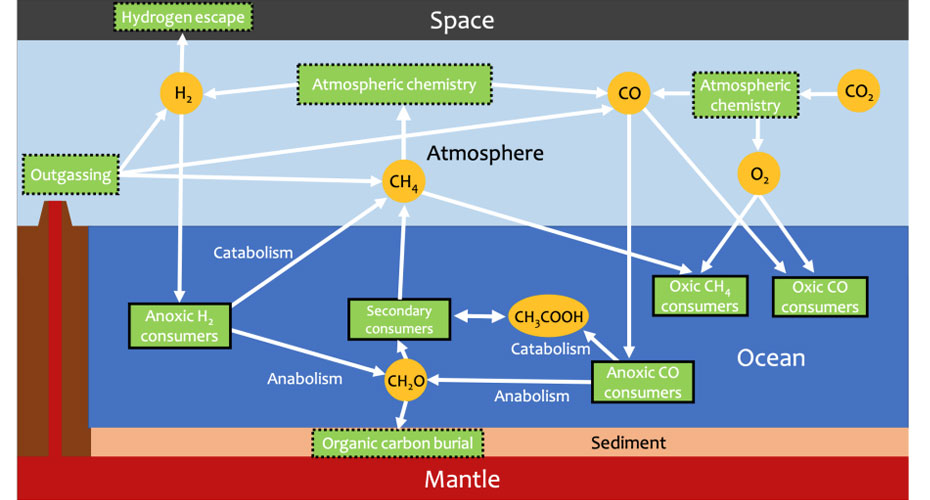
Figure showing a simple schematic of an idealised model of life-climate interaction
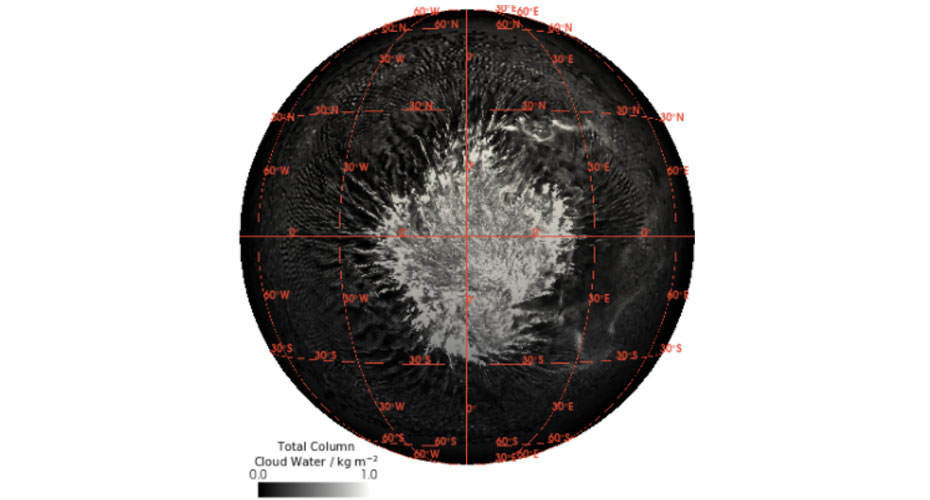
Output from a simulation of potentially habitable exoplanets using a sophisticated three-dimensional coupled-climate model