

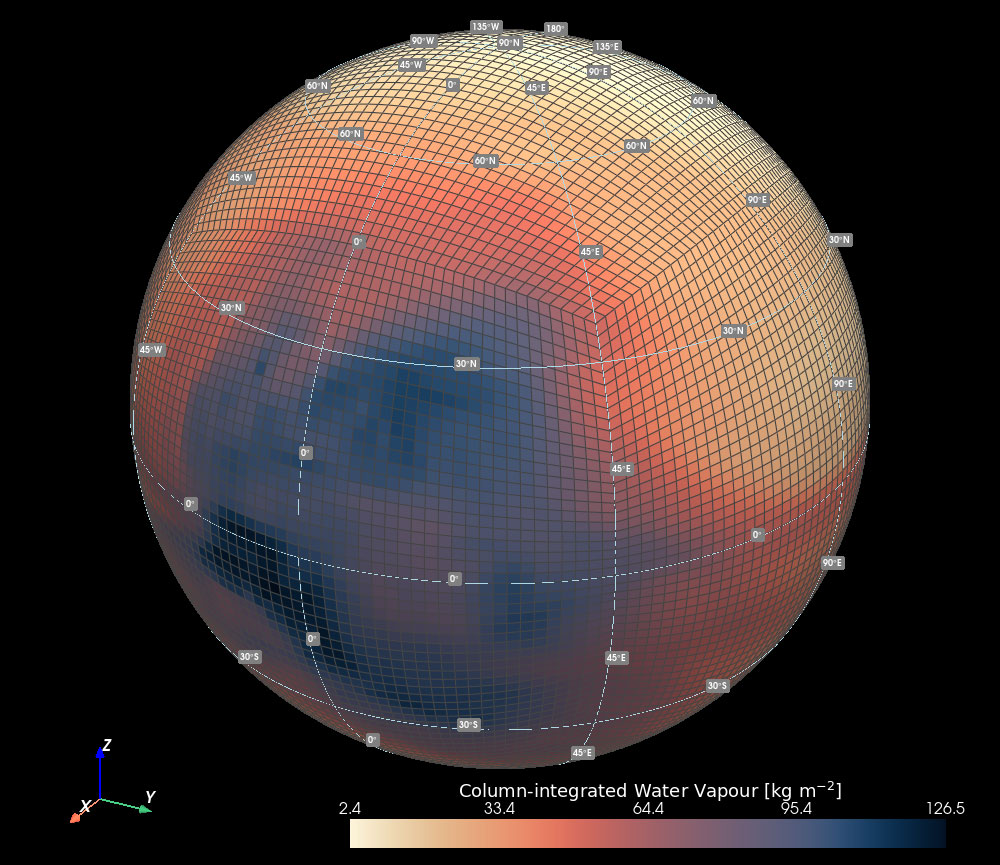
The total water vapour within an "Earth-like" exoplanet atmosphere as simulated using a 3D climate model at the University of Exeter.
Super Earths or Mini Neptunes?
Supervisors: Prof. Nathan Mayne, Dr Denis Sergeev and Dr Eric Hébrard
There are no planets, in our Solar system, intermediate in size between Earth and Neptune, yet, these planets appear to be the most common in our nearby galaxy. They straddle the transition between a terrestrial planet with a surface and extended atmosphere (Super Earth) and gas giants (mini Neptunes). Changes in the formation mechanism, evaporation and evolution of their atmospheres and interaction with the surface/interior and the outer atmosphere all switch regime across this boundary but it is unclear where the boundary actually is!
With the possibility of an abundance of water it is possible that some Super Earths may even host life, perhaps similar to that on Earth now, or as it was in the past.
Observations from the JWST are providing unprecedented insight into the atmospheres of these objects and, when combined with theoretical models, could be used to unlock the potential of Super Earths and Mini Neptunes to teach us more about how planets form and evolve.
At the Exeter Exoplanet Theory Group (EETG, exoclimatology.com) we have adapted the Met Office 3D model of Earth’s weather and climate to the study of a range of planets. Additionally, we also use long-timescale models of the interaction between life and its environment to explore the potential for life beyond Earth.
In this PhD you will work with an interdisciplinary (as well as supportive and friendly!) team to explore Super Earths and Mini Neptunes.
At EETG, and through connection to the Met Office, we provide regular training and development opportunities, interaction with observation and modelling experts and connection to an international community. Come join us in a beautiful part of the world to study distant planets!
For more information, please contact Nathan Mayne.