

How do I find my way through change?
The transition curve is a popular model used to describe a person’s journey or transition through change. It helps you to predict how you (and others around you) might react to change, so you can can navigate your way through transition. When change is first introduced at work, the people affected will typically go through four stages. These can be visualised on the change curve.
The stages are shock, anger, acceptance and commitment (however, it is worth reflecting on this as not everyone has these reactions).
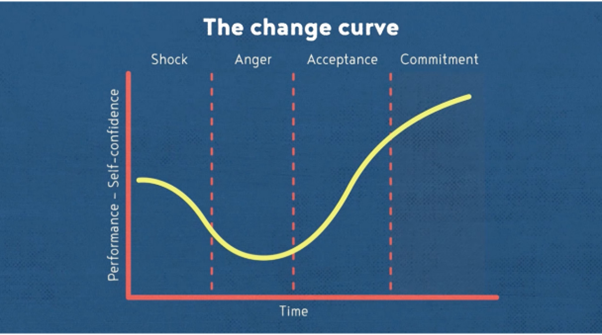
People’s initial reaction to the change will likely be shock or denial as they refuse to accept that change is happening. This might be something that is happening to you. If so, it is completely normal.
Once you begin to accept the change is happening, you may find yourself reacting negatively. You may feel angry or fearful and wish to actively resist or protest against the changes. This is perfectly understandable. If, for instance, you have been an expert in the way things used to be done, the coming change could undermine this position.
However, if you remain at stage 2, you may never find your way through this stressful and unpleasant stage, into the more positive, acceptance stage. Ask your line manager if you feel you need help to move yourself forward. They will be able to expand more on what the change means for you and how you can incorporate it into your role.
When you get to stage 3, you will stop focusing on what you’ve lost and start to let go and accept the change. With your line manager, you can begin to test and explore what the changes mean for you.
Reaching the last stage, commitment, means not only accepting the changes, but embracing them. You can now start to restructure your way of working in a productive and positive way.
- A good first step is to explore the situation with your line manager in more depth using the Workplace Pressures Risk Assessment (WPRA) tool (see here for a step-by-step guide). This should be completed sensitively and privately, allowing you to share your perception of work-related concerns.
- ACAS Tips to approach having sensitive conversations 2018 is a helpful guide to refer before you begin.
- The Dealing with Change and Uncertainty web page links to People Development training courses and resources, internal services and NHS advice.
- Our Employee Assistance Programme, Spectrum Life offers 24/7 confidential, in-the-moment support, advice, and counselling for mild-moderate mental health issues (if clinically appropriate), as well as a life-coaching service.
Contact
| occupationalhealth@exeter.ac.uk |
colleaguewellbeing@exeter.ac.uk |
| hradvisors@exeter.ac.uk |
peopledevelopment@exeter.ac.uk |