Assessments and employability
Undertaking your academic assessments will also develop your employability skills, this page covers the main types of assessments, why they are important for your employability and includes links to resources to help you develop your skills.
Communication is one of the most important skills you will need in almost every job and all methods of assessment involve you communicating complex information. How you choose, structure and present information and arguments will be crucial for gaining marks in academic work and in working effectively in a job.
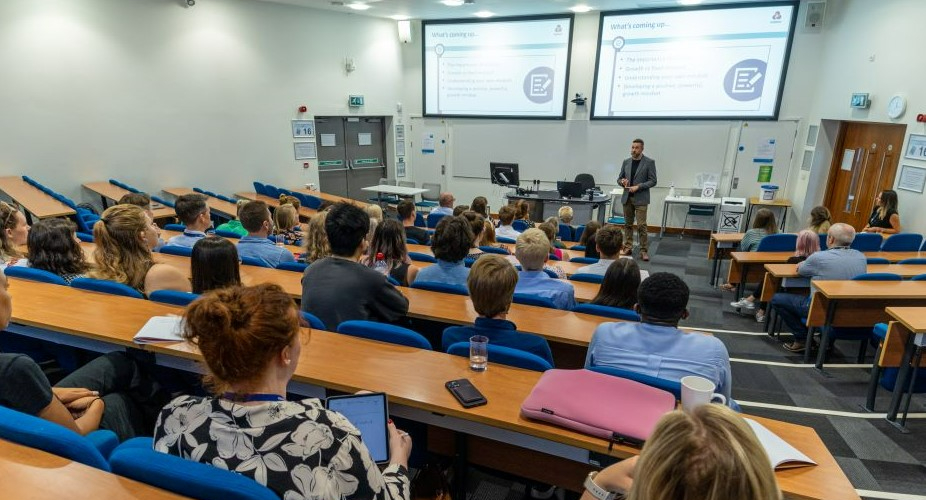
Many jobs will require you to present complex information to a range of different people. They will often be important for presenting new ideas that you want others to take forward or persuading new clients to work with your organisation. Presentations will develop a number of key skills such as
- Organising and presenting information in a structured way
- Influencing and persuading people
- Ability to work under pressure
- Help develop confidence
Posters will require you to convey complex information succinctly and in a visually attractive way. You want to get people’s attention and you want to get your point across. You’ll need to decide what to include on the poster and how it looks to ensure that you use the space as effectively as possible. Every word and every part of the poster needs to count. In a busy workplace people don’t have much time, especially senior managers, and you need to convey information quickly, clearly and persuasively.
A portfolio will usually involve collecting and organising tasks completed and reflecting on them. This will show how you have learned and developed over a period of time. This is obviously important both for academic and professional development. From a personal perspective you will want to develop your skills and learning to ensure you have the best chance of following the career you want. A portfolio will help you collate what you have achieved and to identify further learning and development. This approach will also be useful in work as you will usually be subject to appraisal or development meetings with your line manager and you may need to evidence your achievements to get a pay increase or progress in your role.
Reflection is a key skill in relation to your personal development. This is true when you are learning at university or at work. Reflecting on your experiences is important for building self awareness. Self awareness is the starting point for thinking about what you want to do in your career – what are your strengths, what are your values, what do you enjoy doing? These are all crucial questions and self awareness and reflection can help you to answer them and find the work that best suits you.
My Career Zone Digital Reflection Resources
Your ability to write effectively is essential to get good grades and in the world of work where you need to communicate information quickly and clearly. Ensuring that you structure information in the best possible way and argue your points persuasively is crucial. The ability to write clearly, correctly and succinctly is important whether you are writing an essay, an email, a report or a business plan.
My Career Zone Digital Business Writing Resources
Online profiles can be important in helping you connect with employers. Platforms such as LinkedIn and Handshake allow employers to view your profile and assess your suitability for working with them and the quality of your profile may be the difference between them contacting you, or not. Ensuring that you present information about your skills and experience in the best possible way is crucial. The content that you choose and the language you use need to be relevant for the sector that you want to work in.
This is similar to the reflective work listed above. Producing a reflective personal statement is something you may need to do if you are applying for postgraduate study, jobs or to join a programme or scheme. The ability to write about your experiences, learning, skills, strengths and ambitions in a clear, compelling and relevant way is something that can help you to be successfully when applying for opportunities.
My Career Zone Digital Reflection Resources
Study Zone Reflective Writing Resources
A video interview may involve you being asked questions by technology and this is now part of the recruitment process for some organisations. Answering questions about yourself on the spot when you have limited time to answer can be tricky at the best of times and when being interviewed by technology it can be more difficult. You have access to Interview 360 at the link below. This allows you to practice video interviews and there are a number of different options including being interviewed based on your uploaded CV. You get instant feedback and there are lots of tips about how to answer interview questions.
There are many different types of self-assessment questionnaire and they are usually used to help you to understand yourself better. In almost all cases you’ll get feedback on your answers and this can help you learn more about yourself and may inform you about further steps to take. Assessments can be undertaken in the recruitment process and in the workplace as part of staff development. Understanding how assessments work and learning to make the most of the opportunity to learn from them are good skills for your personal development.
My Career Zone Digital - Getting to grips with personality tests
My Career Zone Digital Career Assessments
Profiling for Success – access a range of commonly used assessments
These take various forms according to the discipline concerned, but they have in common the testing of subject knowledge and the ability to apply that knowledge to various kinds of problems. In contrast with various types of Course Work, their more limited duration means that they help develop the ability to think quickly and to a short-term deadline.
These may include the testing of linguistic proficiency, fluency, accuracy, range, comprehension, interaction, sociolinguistic and meta-linguistic awareness: receptive skills (listening and reading), productive skills (speaking and writing) and mediation skills (translating and interpreting). The forms of assessment may be in traditional and/or on-line format, and may include: presentations, interviews, structured oral discussions, summarising, report-writing, and translation from and into the target language.
Useful links
If you’re interested in the key employability skills here are some useful links:
- Prospects – what skills do employers want
- Target Jobs top 10 skills
- Target Jobs highlights the importance of communication and how you can develop your skills
- My Career Zone Digital - careers resources and work related skills