Using AI
.webp)
Artificial Intelligence (AI) is beginning to change the world of work, influencing the skills employers look for, how different roles are evolving, how candidates apply, and how organisations recruit.
This page explores what these changes mean for your career planning and decision making, how you can develop your AI literacy, and how to use AI effectively and responsibly in your applications. It also explains where you may encounter AI in the selection process and how to prepare for it with confidence.
AI and Your Career
As AI becomes more embedded into our daily lives and work, it’s natural to have questions and concerns about what this means for your future career. With constant headlines and speculation about AI, you may feel worried about how rapid advancements could disrupt industries or jobs you are interested in, or feel overwhelmed with the pressure to ‘AI-proof’ your career. Developing a clear awareness of the changes AI is bringing will help you move forward with curiosity, clarity and confidence, and make informed choices about your next steps.
Watch the short webinar below to learn more!
Developing your AI Literacy
The ability to use AI tools critically and effectively is becoming an essential skill in the modern workplace. AI, data and technological literacy, are the fastest growing skills between 2025-2030 (World Economic Forum, Future of Jobs Report). Research from Microsoft and LinkedIn (Work Trend Index Annual Report) also found that 66% of business leaders would not hire someone without AI skills.
"AI skills" can look very different depending on the sector or context in which they are used; from analysing data in science, to drafting communications in business, to supporting design in the creative industries.
AI literacy is about more than just knowing how to prompt a tool and get quick outputs. While understanding AI and effective prompting is part of the picture, AI literacy also means:
- Having a clear purpose and a strong understanding for what you are trying to achieve and why you are using AI to help in the first place.
- Being able to exercise strong judgement in the quality and appropriateness of the output in the context it's being applied.
Subject knowledge and contextual judgement are essential for using AI effectively, and are vital at both the input and output stages. They enable you to recognise what you are trying to achieve and what ‘good’ looks like, feed your knowledge into effective prompts, and critically evaluate the results. Strong subject knowledge and domain expertise help you decide when AI is useful and when it isn’t, and prevent you from misusing or over-relying on it.
Human-centred skills are just as important. They drive the responsible and effective application of AI and enable us to work collaboratively with it. This includes ethical judgement, creativity, problem-solving, and, crucially, self-awareness of your own subject knowledge and blind spots. Ultimately, AI is only as effective as the humans using it, and the decisions we make about how to apply it.
As shown in the diagram below, demonstrating strong AI literacy in practice means combining these three areas: AI Knowledge, Subject Knowledge, and Human-centred Skills. It’s about using AI with purpose, applying strong subject knowledge, and exercising human judgement to evaluate when and how AI adds value. Together, they provide the balanced approach that employers are increasingly looking for.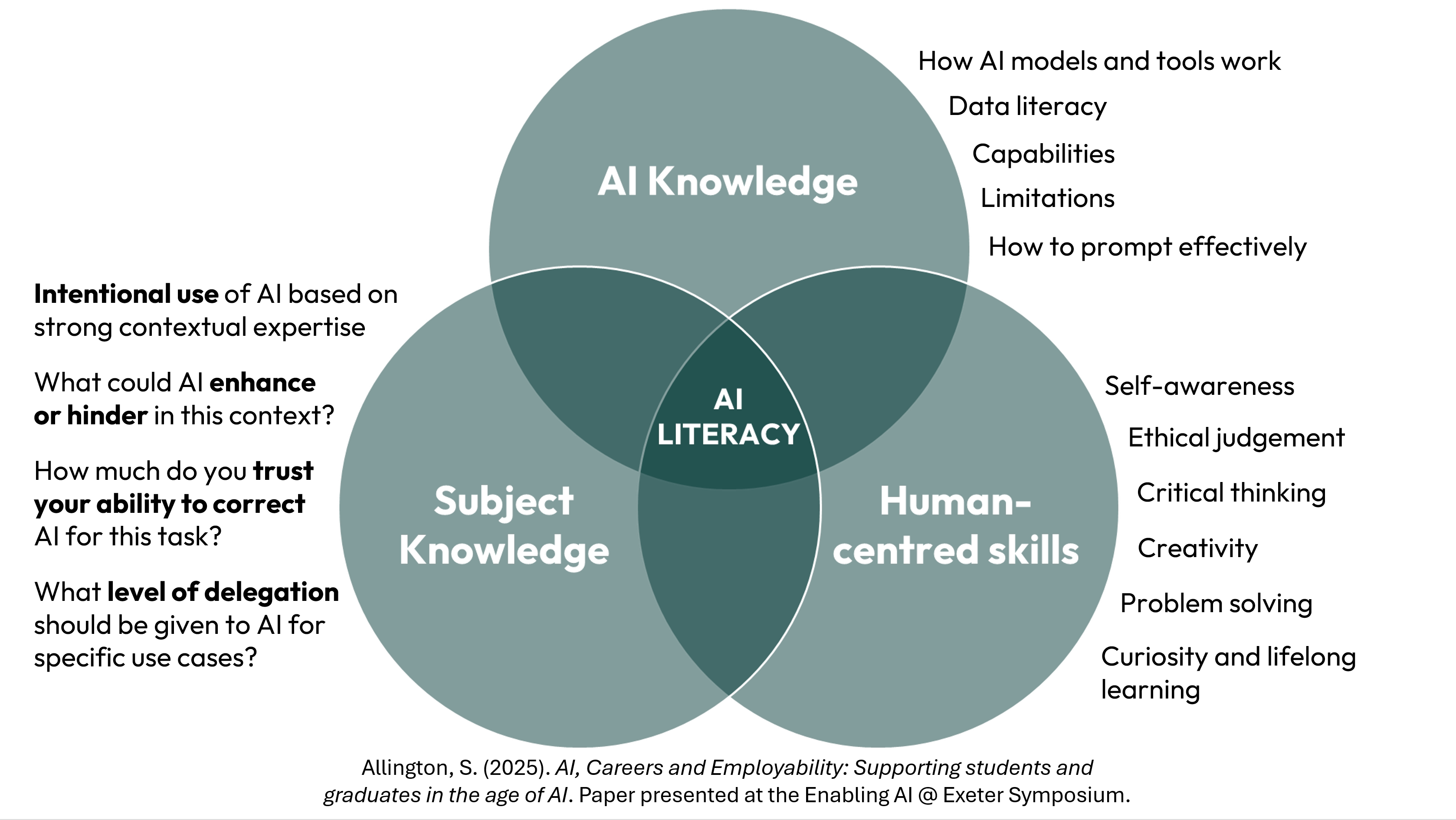
Using Generative AI in your Applications
‘Generative’ AI is a type of artificial intelligence that produces statistically probable outputs (such as text, code, images, audio or video) when prompted. It works by drawing on patterns and structures learned from the data it was trained on, and then generating new content that fits those patterns.
Large Language Models (LLMs) are one form of generative AI, trained on vast amounts of text to generate human-like responses. They work by predicting the most likely next word in a sequence, based on language patterns in their training data.
Many LLMs are now integrated into broader “multimodal” systems, where they work alongside other models that can generate or interpret images, video, or audio. This allows a single platform to handle different types of prompts and media. For example, tools such as ChatGPT, Google Gemini, Microsoft Copilot, and Claude combine LLMs with additional models to extend what they can produce or analyse.
Some generative AI tools are free to access, but some require you to pay or subscribe to access additional tools and functionality.
Learn more: AI: Understanding it
Develop strong application skills and knowledge
Before using generative AI to help you when writing CVs, cover letters and application forms, make sure you first have a strong understanding about how to write them effectively.
Remember what recruiters want to see in a job application:
✓ Specific examples of your unique personal experiences and achievements that demonstrate the skills required for the job
✓ Evidence of your passion and motivation to work for the organisation
✓ Your unique and authentic voice and personality
✓ Accurate grammar and spelling with compelling use of language
Learn more about CVs, Cover Letter, and Applications
Check each recruiter's guidelines for applicants
Some employers seek to detect content that has been copied from an AI tool and they may disqualify your application as a result. Always check and follow an employer’s guidelines.
Understand privacy risks
Always check the privacy policy of each AI tool you use so that you understand what you are agreeing to about how the information you provide will be used, stored and deleted.
Review your privacy and security settings in the AI tool and set them accordingly.
Avoid sharing any personal, confidential or sensitive information and anonymise any data when prompting a generative AI tool.
Generative AI can help you come up with ideas and structure your thoughts. However, AI doesn’t know you and is unable to reflect and tailor your unique personal experiences and achievements precisely to the role and organisation you are applying to.
Ensure that you:
- Research what skills and qualities the recruiter is looking for and reflect on your examples for them. Use the STAR framework to help structure your examples. Generative AI can highlight skills and themes in a job description, but it’s your job to interpret what the recruiter values and explain how your own experiences demonstrate those qualities.
- Research the role and organisation and reflect on what excites you and connects with you. Generative AI tools can help with your research, but you must still verify the information, and reflect on and demonstrate your enthusiasm and alignment with the organisation.
Remember, if your application is successful, you will be required to talk about your experiences, skills and motivations at interview.
The utility of AI-generated content largely depends on the quality of the prompt it is given. Tips on how to prompt generative AI effectively include:
- Be clear and specific about what you want the AI to generate: Vague prompts lead to generic, irrelevant, and inaccurate outputs.
- Provide context: Provide relevant background information and explain the purpose of your request to help the AI generate more relevant content.
- Give detailed information about relevant points you want the AI to include: For example, specify any relevant experiences, quantifiable achievements and motivations that should be highlighted to demonstrate your suitability for the role and organisation
- Give instructions on the desired tone, format and length.
- Iterate and refine: Continuously review and refine your prompt based on initial AI responses, incorporating additional details or adjustments to enhance accuracy and relevance.
Whilst effective prompting can get you closer to outputs that meet your requirements, it is unlikely to deliver the final product and any content will still require further review, adaptation and personalisation to ensure it is accurate to you, your experiences and the role.
AI-generated text is helpful as a starting point or for inspiration which should then be reviewed, adapted and personalised as part of your writing process. AI-generated content isn't the finished product, so avoid copying text directly from an AI tool to use in an application.
Recruiters want to see applications that reflect your authentic self
Generative AI often produces generic and formulaic text which lacks authenticity and doesn't reflect your personal experiences or tone. While coherent, the text often contains common phrases and identical wording to many other AI-generated applications, which is obvious to recruiters and does not make a good first impression.
Ensure that you review and adapt any AI-generated content so that the language, tone and content of your applications is tailored to the role and accurately reflects your personal voice, unique qualities and previous experiences.
Is the information correct?
AI-generated information may be out of date or from an inaccurate source. It is crucial to verify the accuracy of any AI-generated information and cross-reference against other sources.
- Learn more about how to use generative AI critically
AI in Recruitment and Selection
An increasing number of employers are using AI to support their hiring processes. Recent research from the Institute of Student Employers shows that 21% of large graduate recruiters use AI in the recruitment and selection process (ISE Student Recruitment Survey 2024), and nearly half (46%) expect to adopt it in the future.
This shift is being driven by the rise of Generative AI, which is challenging the reliability of traditional text-based selection methods such as CVs, cover letters, application forms and question-based psychometric tests. Recruiters are now receiving record numbers of applications, many of which look increasingly similar and lack authenticity, making it harder to distinguish between candidates.
In response, employers are placing more emphasis on methods where candidates must demonstrate their skills in real time rather than simply write about them, with 57% of employers planning to move to ‘skills-based recruitment’ (ISE 2024). An emerging trend here is the use of AI-powered interactive task-based assessments and psychometric tests, which use algorithms to observe how candidates respond to tasks and situations. As these tools are not reliant on language-based responses, they aim to provide a more authentic insight into candidates’ skills. At present, online psychometric assessments are the most common use of AI in recruitment, reported by 11% of employers (ISE 2024).
When applying to a large multinational company, your CV will likely be processed through an Applicant Tracking System (ATS), which is a tool recruiters use to organise and manage high volumes of applications.
While ATS tools may incorporate AI elements and can rank applications based on keyword relevance and other criteria, the belief that these systems automatically reject CVs before human review is largely exaggerated. Automatic rejection typically only occurs if candidates do not meet basic eligibility criteria asked at the beginning of the application process (e.g. right-to-work status, driving licence, etc).
The Institute of Student Employers (ISE) Student Recruitment Survey 2024 found that while 21% of employers use AI in recruitment, only 1% use AI to screen CVs, with 63% expressing concerns about AI-related bias.
It is important to tailor your CV by naturally incorporating relevant keywords and language from the job description when evidencing how your experiences align with the role. However, avoid simply repeating keywords without specific context of what you did or achieved ('keyword stuffing') in the hope that this will "beat the ATS", as this can negatively affect impact and readability. Focus instead on providing clear and meaningful evidence of your suitability, because although ATS tools help recruiters organise applications, CVs are still assessed by human reviewers.
It’s best to use a clear, professional format with simple headings and structure, while avoiding columns, text boxes, tables and graphics, as this helps both ATS tools and human recruiters quickly find relevant information.
The most frequent use of AI by recruiters is within online assessments, with 11% of recruiters using AI for this purpose (ISE Student Recruitment Survey 2024)
Employers frequently utilise AI-powered online task-based assessments and psychometric tests to evaluate candidate responses, skills, and behaviour. You can strengthen your performance and become more familiar with these assessments through practice via dedicated resources found here:
Online pre-recorded video interviews require candidates to record responses to pre-set interview questions within a specified timeframe. Some video interview platforms include AI functions that can analyse and score answers based on verbal communication (e.g. key words and phrases, speech patterns, tone of voice) and non-verbal communication (e.g. body language and facial expressions). However, only 4% of employers currently use AI to analyse video interviews (ISE Student Recruitment Survey 2024), and many employers disable these AI functions due to concerns about fairness, accuracy and bias.
- Video interview practice: Graduates First
- Learn more about Interviews
Further Support
For confidential and impartial career guidance, you can book a 1:1 appointment with a qualified and experienced Careers Consultant from the Career Zone.
You can also book an appointment with an Employability Adviser to get your CV, cover letter, application form, or LinkedIn profile checked.
To book, you can contact us via the Live Chat icon at the bottom of this page, or you can phone us on +44(0)1392 724493 (all campuses). For any other enquiries, you can email us at careers@exeter.ac.uk.
Our Study Skills Team in the library has a useful guide to help you develop AI literacy, learn how to use AI responsibly, and ensure you meet the University of Exeter’s policies.
View the guide here: AI: Understanding It
The AI Policy sets out clear principles for using AI at Exeter. It supports innovation while ensuring fairness, transparency and compliance with data protection and ethical standards. All staff, students and researchers should refer to the policy when using, developing or procuring an AI tool for University purposes, from drafting content to analysing data.
Learn more here: Enabling AI at Exeter