Course content
Successful completion of this apprenticeship programme will ensure apprentices have the skills required to successfully embark on a career as a Diagnostic Radiographer. They will gain the skills and knowledge needed to continually learn, develop and use evidence-based research to improve practice.
The modules we outline here provide examples of what apprentices can expect to learn on this course.
Employer negotiated module
In the final year, there is an employer negotiated module. This enables apprentices to gain further experience in a particular area of the department or modality, or gain additional skills such as cannulation.
Please note that the module information displayed here is subject to change.
120 credits of compulsory and non-condonable modules.
Compulsory modules
| Code | Module | Credits |
|---|---|---|
| Compulsory 1 | ||
| Applied Radiographic Knowledge 1 | 30 | |
| Professional Practice 1 | 30 | |
| Practice Foundations 1 | 30 | |
| Practice Placement 1 | 30 | |
RAD1001DA: Applied Radiographic Knowledge 1
Please note that Degree Apprenticeship programmes have variable start dates and modules are taught across the full year.
This module introduces relevant anatomy and physiology and the scientific concepts underpinning Medical Imaging.
The aim of this module is to enable you to develop knowledge of the essential multi-disciplinary sciences that underpin diagnostic radiography practice with a focus on projection radiography.
During this module you will learn about the anatomy and physiology of the human body, including surface anatomy. You will learn about how x-rays are produced and interact with the body to form medical images. By learning about these interactions you will gain understanding of the safety implications of working with and exposing patients to ionising radiation, so that you are able to use ionising radiation safely in practice. This includes being introduced to the legislative framework for the use of ionising radiation in medical imaging. You will be introduced to digital imaging as used in medical imaging, and the principles of image (and therefore dose) optimisation.
RAD1002DA: Professional Practice 1
Please note that Degree Apprenticeship programmes have variable start dates and modules are taught across the full year.
This module introduces the principles of sociology, psychology, evidence-based practice and research methodologies that underpin contemporary patient and client care. By utilising an evidence based approach, you will gain basic problem solving and reasoning skills, laying the foundations for critical, reflective and holistic practice.
The module commences with an attendance block at the University of Exeter with an emphasis on face-to-face learning. The module then runs over a 12 month period with two further block attendances across year for further face-to-face learning. In the non-block weeks there will be protected ‘off the job’ learning supported by e-learning materials provided by the academic team. The full calendar of activities and assessment will be made available via the handbook. Annual leave may be booked in accordance with the requirements laid out in the handbook. As this module is part of an apprenticeship programme, a large proportion of learning takes place within the workplace, both as on the job and off the job time. This forms part of the apprentice contract and so these hours are not reflected within individual module descriptors unless required by PSRBs.
RAD1003DA: Practice Foundations 1
Please note that Degree Apprenticeship programmes have variable start dates and modules are taught across the full year.
This module provides a practical learning environment in which you will apply theory in practice. This module will enable you to recognise and understand radiographic images and introduce you to the equipment and technical aspects involved in general radiography . You will gain insight into the important associated clinical and radiation safety measures that are required in the practice setting.
The aim of this work-based module is to enable you to develop knowledge of the essential applied science and technology that underpins diagnostic radiography in the practice setting.
This work-based module will provide practical experiences that will directly support the further development of your underpinning knowledge base. You will apply the theoretical knowledge you are gaining in RAD1001 and RAD1002 within the practice setting.
RAD1004DA: Practice Placement 1
Please note that Degree Apprenticeship programmes have variable start dates, and modules are taught throughout the year.
This module provides practical experience in safe and effective radiography, including an introduction to cross-sectional imaging modalities.
You will develop clinical and patient care skills focused on common medical imaging examinations in compliant, non-disabled patients, enabling you to deliver compassionate, holistic patient care. Also, you will be able to identify professional and leadership issues and understand how they are interrelated.
On successful completion of this module, you will understand the technical, legal, ethical and professional aspects of medical imaging practice.
Please note that the module information displayed here is subject to change.
120 credits of compulsory and non-condonable modules.
Compulsory modules
| Code | Module | Credits |
|---|---|---|
| Compulsory 1 | ||
| Applied Radiographic Knowledge 2 | 30 | |
| Professional Practice 2 | 30 | |
| Practice Foundations 2 | 30 | |
| Practice Placement 2 | 30 | |
RAD2001DA: Applied Radiographic Knowledge 2
Please note that Degree Apprenticeship programmes have variable start dates and modules are taught across the full year.
This module builds on Applied Radiographic Knowledge (ARK) 1 and aims to further develop your knowledge of the science and technology underpinning medical imaging. During this module, the scientific and technological knowledge is extended to include the other medical imaging modalities and associated contrast media and medicines used in imaging. In addition to these scientific concepts, this module encompasses pathology as encountered in medical imaging, and describes the relative role of the various modalities in the demonstration of these pathologies.
The aim of this module is to enable you to extend your knowledge of the essential multi-disciplinary sciences that underpin diagnostic radiography practice to encompass the full spectrum of routinely used medical imaging modalities.
RAD2002DA: Professional Practice 2
Please note that Degree Apprenticeship programmes have variable start dates and modules are taught across the full year. This module will deepen your understanding of sociological and psychological aspects of healthcare. As well as providing an understanding of current policies such as safeguarding and Duty of Candour, you will gain insight into the historical context and the human factors relating to the events and situations that gave rise to such policies. You will deepen your communication skills and learn about the skills needed to support training, supervision and mentoring. You will also further develop your skills in evidence-based practice by developing a sound understanding of research terminology, methods and principles and further develop your ability to both critically evaluate published research and to apply it to practice.
This module is delivered as part of an apprenticeship programme, so a large proportion of learning takes place within the workplace, both as on the job and off the job time. This forms part of the apprentice contract and so these hours are not reflected within individual module
RAD2003DA: Practice Foundations 2
*Please note that Degree Apprenticeship programmes have variable start dates and modules are taught across the full year.
This module provides a practical learning environment in which you will apply theory in practice. In this module you will experience clinical and technical aspects involved in a range of modalities including both ionising and non-ionising radiation. You will learn about safe practice and the use of contrast media in these areas. You will also learn about common pathologies encountered in the clinical environment and the relative roles of the various modalities for demonstrating these conditions.
The aim of this work-based module is to enable you to develop knowledge of the essential applied science and technology that underpins medical imaging modalities in the practice setting.
This work-based module provides practical experiences that will directly support the further development of your underpinning knowledge base. You will apply the theoretical knowledge you are gaining in RAD2001DA and RAD2002DA within the practice setting. You will apply the physics knowledge so as to understand the wide range of modalities used in medical imaging, including equipment and room design and safe practice. You will learn how quality assurance processes are used to ensure safe practice. You will apply your knowledge of pathology to identify common abnormalities on medical images and will gain understanding of comparative imaging.
RAD2004DA: Practice Placement 2
Please note that Degree Apprenticeship programmes have variable start dates and modules are taught across the full year.
This module provides further practical experience of the safe and effective practice of general and fluoroscopic imaging. It introduces you to interventional radiography and other imaging modalities. You will develop your patient-care skills and learn to handle more complex situations. You will develop your role within the imaging department and learn to identify 'professional' and 'leadership' issues and understand how these are inter-related within the inter-professional context. You will gain experience of adapting practice to care for patients, including having the ability to recognise and support a deteriorating patient.
The module commences with an attendance block at the University of Exeter with an emphasis on face-to-face learning. The module then runs over a 12 month period with two further block attendances across the year for further face-to-face learning. In the non-block weeks there will be protected 'off the job' learning (one day (7.5 hours) per week) supported by e-learning materials provided by the academic team. The full calendar of activities and assessment will be made available via the handbook. Annual leave may be booked in accordance with the requirements laid out in the handbook.
Please note that the module information displayed here is subject to change.
120 credits of compulsory and non-condonable modules.
Compulsory modules
| Code | Module | Credits |
|---|---|---|
| Compulsory 1 | ||
| Applied Radiographic Knowledge 3 | 30 | |
| Professional Practice 3 | 30 | |
| Practice Foundations 3 | 30 | |
| Practice Placement 3 | 30 | |
RAD3001DA: Applied Radiographic Knowledge 3
Please note that Degree Apprenticeship programmes have variable start dates and modules are taught across the full year.
The aim of this module is to consolidate your prior learning and to prepare you for practice. You will deepen your understanding of the digital image processes that underpin all medical imaging modalities. You will apply your knowledge base, relating this to clinical practice, to describe safe practice , including legislative frameworks, for the administration of contrast agents and medicines used in imaging. You will build upon your prior knowledge of pathologies as shown on medical imaging to develop the fundamental skills that underpin image comment writing as required for registration with the Health and Care Professions Council (HCPC).
The module builds on your prior scientific understanding and aims to prepare you for practice.
RAD3002DA: Professional Practice 3
Please note that Degree Apprenticeship programmes have variable start dates and modules are taught across the full year .
The aim of this module is to consolidate your prior learning and to prepare you for practice so that you enter the profession of diagnostic radiography fully equipped to be an informed, evidence based, compassionate practitioner. This module will deepen your understanding of the legislative and professional framework that governs radiographers together with associated managerial, professional and interprofessional issues encountered in clinical practice. The resulting framework of knowledge and skills supports safe and equitable practice. This module enables understanding of mental health and further develops communication skills. You will get the opportunity to apply what you have learned about evidence-based practice by undertaking an audit, service evaluation or research project.
RAD3003ADA: Practice Foundations 3
*Please note that Degree Apprenticeship programmes have variable start dates and modules are taught across the full year.
The aim of this module is to, in negotiation with your employer, prepare you for practice. You will build on your prior knowledge and clinical experience to deepen your understanding of a particular aspect of radiographic practice. You will work under supervision, in this negotiated area, becoming an integral member of the multi-professional healthcare team.
This module aims to develop your knowledge base and skills in an employer negotiated area of clinical practice.
During this module you will gain in-depth knowledge and skills in the specified area / modality. You will have responsibility for organising your working day and liaising with staff in the area to ensure you gain the requisite range of clinical competence with a focus on holistic, compassionate care.
RAD3004ADA: Practice Placement 3
Please note that Degree Apprenticeship programmes have variable start dates and modules are taught across the full year.
During this final placement you will become an integral member of the multi-professional healthcare team: skilled to deal with a full range of patients using a wide range of modalities. You will have responsibility for organising your working day and liaising with staff in other departments and will gain experience of managing an inter-professional team.
This third and final general placement enables you to bring together all the skills and knowledge required of a proficient compassionate radiographer. You will work in a range of areas gaining experience of more complex examinations and also of how to organise resources to effectively meet the needs of the department. This final placement will enable you to prepare for your end point assessment and subsequent practice as an autonomous radiographer.
Accreditations

The BSc (Hons) Diagnostic Radiography and Imaging is approved by the Health and Care Professions Council.
The BSc (Hons) Diagnostic Radiography and Imaging is approved by the College of Radiographers for a period of five years, from 09/2024 to 08/2029 inclusive.
Employer information
The UK faces a significant skills gap for Diagnostic Radiographers within our healthcare workforce with rising employer demand for highly skilled, qualified professionals. The University has offered an undergraduate degree course since 2004 which is consistently rated as one of the best in the UK.
To meet the needs of specific departments, pathways relating to specific imaging modalities are available. A distinctive employer negotiated third year placement, agreed between the employer and the apprentice, enables departments to plan their workforce for the future, in the knowledge that they will have new graduates with the skills required for particular aspects of their imaging service.
Diagnostic Radiographer Degree Apprenticeship Employer Booklet BSc

Top 3 in the UK for Health Professions

Earn whilst you learn

Consistently rated one of the best institutions for Diagnostic Radiography in the UK

Apply for registration with the HCPC upon successful completion of the programme
Entry requirements
| Qualification | Typical offer | Required subjects |
|---|---|---|
| GCSE | C or 4 | English and Maths |
| A Level | BBC |
GCE A-level science grade B Acceptable science subjects include Biology/Human Biology*; Chemistry; Computing; Design and Technology; Electronics; Environmental Studies; Geography; Geology; Life and Health Sciences, Maths/Pure Maths/Further Maths*; Physical Education; Physics; Psychology; Science (applied); Statistics. *If more than one of these is taken, they would only count as one 'science' but could count as two A levels towards our general requirements. |
| IB | 28/554 | Higher Level 5 in a Science Subject |
| BTEC | DMM |
Applicants studying a BTEC Level 3 Extended Diploma in Health and Social Care (Health Studies) will be accepted without the need for an additional A’ Level science subject. |
| ACCESS | 24 L3 credits at Distinction Grade and 21 L3 credits at Merit Grade |
12 Level 3 credits at Merit Grade in a relevant science subject area. The Access to Radiography, Health Science or Science will be accepted without the need for an additional A’ Level science subject. All other applicants will be required to have grade B in an acceptable A’ Level Science subject. |
| T-level | Merit | T-Level in Health Care Sciences or T-Level in Science, where laboratory science is taken as the specialism. |
| Contextual offers | BCC | Find out more about contextual offers |
| Foundation Degree | 60 credits at 60% | 60 credits at 60% in a relevant subject |
| Level 3 Apprenticeship | Pass | Senior Healthcare Support Worker - Diagnostic Imaging Support Pathway only. |
| Equivalences | View other grade equivalences | |
NB General Studies is not included in any offer.
Applicants must also have a valid and eligible residency status to gain entry onto the apprenticeship – please see the ESFA guidance for further information.
There is an additional requirement of the Health and Care Professions Council that apprentices whose first language is not English need to meet IELTS requirements of at least 7.0 overall and no less than 6.5 in any other section.
How to apply
The Diagnostic Radiographer Degree Apprenticeship does not follow the standard UCAS application process. Applicants can apply to this programme in addition to making applications to any institution through UCAS. To gain a place on an apprenticeship applicants must either:
- Be employed within a radiography department - employers must have arrangements in place with the University of Exeter to support an apprenticeship education. Employers are responsible for ensuring applicants meet the Fitness to Practice requirements of the programme. Pre-employment checks will include occupational health screening and DBS checks; fulfilment of these to the satisfaction of the employer is a prerequisite for entry onto this programme.
- Apply directly to a department offering diagnostic radiographer apprenticeship vacancies. Once applicants hold the offer of a post, employers will notify the University. Applicants will then be required to undertake an application for the University. If an applicant has been successful they will be offered a position. A place will be confirmed by us, and we will send further information about how to enrol as an apprentice.
Funding
Full programme cost: £24,000
The employer fully covers the cost of the apprenticeship; apprentices do not pay for any of the eligible training costs. The apprentice will be an employee of the organisation, gaining a University of Exeter award alongside working and earning a salary.
Employers who pay the Apprenticeship Levy will pay for the apprenticeship fees directly through that contribution. See further information about the Apprenticeship Levy funding.
Employers must pay their apprentices a salary at least consistent with national legislation.
Funding eligibility criteria
- To be eligible for funding apprentices must meet the criteria listed in the ESFA guidance.
- They must also have a valid and eligible residency status to gain entry onto the apprenticeship – please see the ESFA guidance for further information
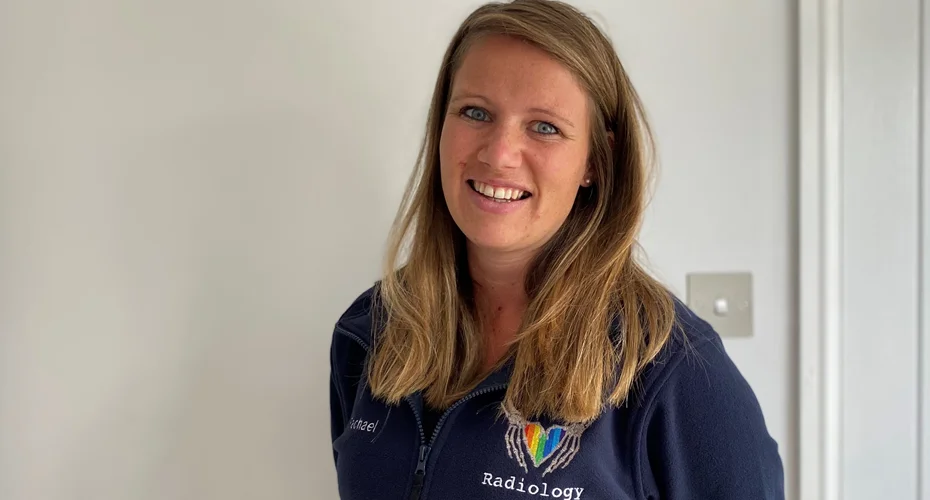
“Studying a degree apprenticeship at Exeter has been an exciting, challenging but hugely rewarding experience. The team behind my apprenticeship are always on hand if there are any issues and will quickly resolve them. There is regular communication and a real drive to gain both positive and negative feedback to make the course the best it can be.”
Rachael
Diagnostic Radiographer Degree Apprentice
Learning
Programme delivery
The Diagnostic Radiographer Degree Apprenticeship is delivered through a combination of work-based practice and blended learning provided by the University.
E-learning elements of the course, including lectures, seminars and online collaborative work, are undertaken through the University’s electronic learning environment. This will supplement and further the apprentice's learning, as well as providing academic support.
Degree apprenticeship roles are developed with a strong emphasis upon the close relationship between employer and University. The academic curriculum will, for a large part, follow real delivery in the workplace with the day-to-day challenges faced in a work environment.
Time spent studying on campus
The on-campus teaching is a mandatory block attendance at the University of Exeter, consisting of 3 blocks of 4-5 days per year. Apprentices will also have protected study time during the working week.
Support available
Our dedicated partnerships team liaise closely with employers throughout the programme; each apprentice is allocated an academic mentor to ensure their successful completion of the programme
Apprenticeship Standard
Alongside studying for their level 6 apprenticeship gained after completing the Knowledge, Skills and Behaviours of the apprenticeship standard, apprentices will study for a BSc in Diagnostic Radiography and Imaging.
20 years of Medical Imaging excellence
Medical Imaging at the University of Exeter is celebrating 20 years of teaching and research excellence, training much-needed radiographers for the NHS and beyond.
Since the programme was launched in 2004 to help address a national shortage of radiographers, Medical Imaging has trained more than 1,000 radiographers, with active student placements in ten NHS trusts across Devon, Cornwall, Dorset and Somerset.
Careers
Career opportunities:
There is a consistently great need for radiographers with strong clinical skills who enjoy working with patients. Radiography provides a very diverse range of careers such as advanced and consultant practice, including radiographer reporting and radiographer led-discharge.
Radiography is an area of practice that is constantly evolving and as such, can be a very rewarding career. In addition, career opportunities exist within research, further developing the profession, as well as within leadership and management.
A Medical Imaging degree is a passport to an interesting job and a fulfilling career. There is a grading structure that sees an individual’s salary increase as they move up in the profession.
Internationally recognised qualifications:
Radiographers trained in the UK are recognised as being among the best in the world and the health providers of many countries recruit in the UK. On graduation you will be eligible to apply for registration as a diagnostic radiographer with the Health and Care Professions Council (HCPC) and for membership of the Society and College of Radiographers.
The University’s Careers Service provides a range of support to help apprentices develop skills attractive to employers. Visit our careers service pages for more information.
Find out more about our Diagnostic Radiography degree apprenticeship

Employers
We can help you invest in upskilling your people and attract new talent via progression routes.

Aspiring apprentices
Discover why a Degree Apprenticeship is right for you.

Events
Find out more about our programmes and partnering with the University of Exeter.