MSc Physics
| UCAS code | 1234 |
|---|---|
| Duration | 1 year full time |
| Entry year | 2027 |
| Campus | Streatham Campus |
| Typical offer | 2:1 degree in Physics |
|---|---|
Why study MSc Physics at Exeter?
- A highly flexible programme designed for those wishing to pursue a career as a professional scientist
- Broaden and deepen your knowledge through studying a range of topics taught by internationally leading researchers who are actively working in your chosen field
- Our advanced research project develops your skills in research planning, execution and reporting, possibly leading to publication of your work in an international journal
- Benefit from access to advanced research facilities including clean-rooms, a helium liquefier, a water tank, amplified ultra-fast laser systems, and a suite of instruments for imaging biological materials
- Tailor your course to your career aspirations with four specialised pathways in Astrophysics, Biomedical Physics, Electromagnetic and Acoustic Materials or Quantum Systems and Nanomaterials
Fast Track (current Exeter students)
Discover MSc Physics at the University of Exeter.

Top 10 in the UK for Physics and Astronomy
7th in the Guardian University Guide 2027, and top 15 in all three major UK league tables

Study alongside our leading research groups specialising in Astrophysics, Biomedical physics, Quantum systems and Nanomaterials, and Electromagnetic and Acoustic materials

Extensive facilities in our dedicated building including clean-rooms, helium liquefier, water tanks, amplified ultra-fast laser systems, imaging suite, observatory and computer labs

Significant research project modules allow you to make a personal contribution to research while studying
Entry requirements for 2027 entry
Applicants are required to have at least a 2:1 degree in Physics. Applicants may be interviewed by video conference to assess their suitability for the course.
We may consider applications with non-standard qualifications where there is evidence of exceptional performance in modules relevant to the programme of study, significant relevant work experience, or relevant professional qualifications.
Please also see our guidance on essential documentation required for an initial decision on taught programme applications.
Entry requirements for international students
English language requirements
International students need to show they have the required level of English language to study this course.
The required IELTS test scores for this course fall under Profile B1.
Please visit our English language requirements page to view the required test scores and equivalencies from your country.
"I chose Exeter first and foremost because of the groundbreaking research into planet formation and observational astronomy. I saw this as an opportunity to get involved with world-class research, setting me on a strong path for my own research career. Alongside this was the beautiful campus in which the Physics Building sits was another huge bonus when I was visualising studying here in Exeter."
"The support and encouragement from…my project supervisor not only brought me up to speed with the current understanding of circumstellar discs and ALMA research but emboldened me to explore my own avenues of curiosity. I was given the independence to run analyses and was overwhelmed by the support for my project research and aspirations to continue towards a PhD. During my project, I had the opportunity to present my research at national conferences and to develop my MSc work into a published paper. My course has given me the skills and opportunities to pursue a career in academia.
Outside of physics, I was able to get involved with many of Exeter's multidisciplinary events, working with undergraduates and academics across campus in Grand Challenge. This saw me greatly develop my skills around communication and education. Without the skills I have learnt from my time at Exeter, I would not be taking the first steps in my academic career, starting my PhD in Astrophysics..."
Ben
MSc Physics

"Our MSc is a flexible programme that is designed for those wishing to pursue a career as a professional scientist, taught by internationally leading researchers who are actively working in your chosen field.
Students are empowered to broaden and deepen their knowledge through studying a range of topics, choosing from a wide range of taught modules to tailor a course that matches that their career aspirations with four specialised pathways in Astrophysics, Biomedical Physics, Electromagnetic and Acoustic Materials, Quantum Systems and Nanomaterials.
The advanced research project provides skills in research planning, execution and reporting, and benefit from access to our world-leading research facilities."
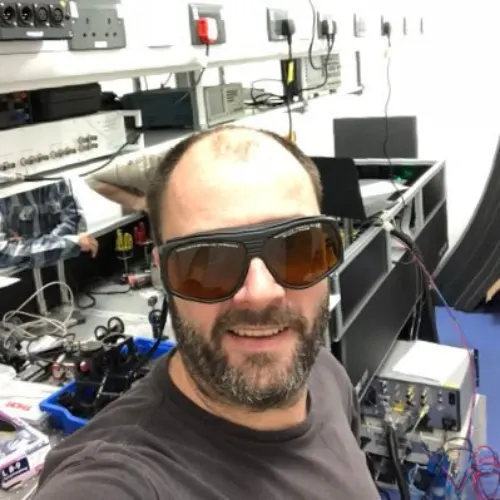
Read more from Prof Julian Moger
Prof Julian Moger
Chair in Biophotonics
Course content and modules
Our MSc physics programme is specifically targeted at those wishing to pursue a career as professional scientist. It is a highly flexible programme that gives you the opportunity to tailor your course towards your individual career aspirations. Supported by our world-leading Physics research, you’ll have the opportunity to broaden and deepen your knowledge through studying a range of topics taught by Internationally leading researchers who are actively working in your chosen field.
A major distinguishing feature of the MSc programme is an advanced research project in one of our internationally recognised research groups. This will enable you to develop the advanced skills in research planning, execution, and reporting, possibly leading to publication of your work in an international journal and prepare you to progress to PhD study.
The modules below provide examples of what you can expect to learn on this degree course based on recent academic teaching. The precise modules available to you in future years may vary depending on staff availability and research interests, new topics of study, timetabling and student demand.
Please note that the module information displayed here is subject to change.
105 credits of compulsory modules, 75 credits of optional modules
You may select 0-30 credits form Optional Module group 1
You must select 45-75 credits from Optional Module group 2
| Code | Module | Credits |
|---|---|---|
| Compulsory 1 | ||
| Frontiers in Physics Research | 15 | |
| Research Project | 90 | |
PHYM502: Frontiers in Physics Research
This module will provide you with an appreciation of the frontiers of knowledge and understanding in your chosen area of Physics. You will attend presentations given by leading international researchers as part of the regular departmental seminar programmes. You will be required to take notes during each seminar and select a topic to explore in depth using online research resources such as reviews and research articles and prepare a 5,000 report on your selected topic.
The module aims to deepen your knowledge in your chosen area of research specialism while at the same time developing skills in goal-setting and time-management. It is expected that completing this module you will be better placed to decide upon a research problem to investigate in your research project.
You will also gain knowledge in the generic research skills that will underpin your research project during the MSc programme. These include undertaking a critical literature review; the importance of communicating research; the life cycle of research; referencing; research plagiarism and ethics; and peer-review.
You will you discuss the findings in your report in a viva and apply constructive self-criticism of your final work.
PHYM503: Research Project
A major distinguishing feature of our MSc programme is its substantial project which will require you to apply the knowledge you have acquired to a real problem in a professional research environment. The aim is to foster the skills in open-ended problem solving necessary for the practising physicist. You will be given the opportunity to select a project supervisor from your chosen area of expertise and work together to design a suitable research project. The project will contribute towards 50% of the mark for your degree and will provide you with the key experience in independent research you need to advance your career.
You will work on a project linked to one of our research groups and using the knowledge gained from the modules, you will be ideally positioned to choose an exciting problem to investigate in a topic in an area that interests and motivates you. Over the period of the project, you will learn how to work as part of a research group and to develop advanced skills in research planning, execution, and reporting, possibly leading to publication of your work in an international journal.
| Code | Module | Credits |
|---|---|---|
| Optional 1 | ||
| The Physics of Living Systems | 15 | |
| Observing the Universe | 15 | |
| Analytical and Chaotic Dynamics | 15 | |
| Physics of Climate Change | 15 | |
| Electromagnetism II | 15 | |
| Nuclear and High Energy Particle Physics | 15 | |
| Electromagnetism and Quantum Mechanics | 15 | |
| The Biophysics of Cells and Tissues | 15 | |
| Methods of Theoretical Physics | 15 | |
| Nanostructures and Graphene Science | 15 | |
| Galaxies and High Energy Astrophysics | 15 | |
| Principles of Theoretical Physics | 15 | |
| Stars from Birth to Death | 15 | |
| Fluid Dynamics in Physics and Astronomy | 15 | |
| Energy, Materials and Sustainability | 15 | |
| Optional 2 | ||
| Bioimaging | 15 | |
| Mathematical Modelling in Biology and Medicine | 15 | |
| Statistical Physics | 15 | |
| Quantum Mechanics II | 15 | |
| Condensed Matter II | 15 | |
| Computational Physics and Modelling | 15 | |
| Relativity and Cosmology | 15 | |
| Physical Methods in Biology and Medicine | 15 | |
| Solar and Extra-Solar Planets and Their Atmospheres | 15 | |
| Quantum Many-Body Theory | 15 | |
| Quantum Optics and Photonics | 15 | |
| Theory and Application of Metamaterials | 15 | |
BIOM555: Bioimaging
During Part 1 (weeks 1-6), the module aims to give a comprehensive overview of the wide range of approaches used in imaging biological systems, their advantages and disadvantages, and current examples of how these techniques are being used in cutting-edge research. During Part 2 (weeks 7-12), the module will allow PGS to specialise in advanced Bioimaging applications.
The module will cover both practical and theoretical aspects of bioimaging and will involve a range of lectures, seminars, and practical workshops, during which students will use some of the most modern imaging equipment available.
You will study live-cell imaging using confocal fluorescence microscopy, molecular dynamics imaging, and electron and cryo-microscopy techniques. You will also learn how to use advanced imaging software to extract, analyse, and quantify image data.
The module aims to:
- Teach the use of bioimaging technologies to answer biological questions;
- Provide contemporary, 'front-line' examples of research case studies using the latest techniques in light and electron microscopy;
- Maximise your opportunities to be taught by leading technology specialists in each respective area;
- Give hands-on experience in optical transmission microscopy, laser scanning confocal microscopy, transmission electron microscopy, scanning electron microscopy (the exact selection of microscopes available could depend upon equipment availability and maintenance).
- Highlight the importance of image analysis and quantitative imaging.
- Allow you to lead research discussions and plan your own research programmes.
The skills you gain through this module will develop and enhance your employability. Transferable skills to other sectors include:
NSCM005: Mathematical Modelling in Biology and Medicine
This is an advanced module in mathematical modelling applied to biology and medicine that focuses on modern applications of mathematical techniques to cutting-edge research in these areas. It will introduce you to advanced topics in biochemical networks, physiology, neuroscience and biomedical data analysis. The module is run as a combination of lectures and hands-on computational modelling sessions, and may also involve laboratory visits.
This module provides you with small-group teaching across a selection of advanced topics, reflecting the research interests of the staff involved. The syllabus consists of several short courses, each taught as a self-contained set comprising 1 hour-long lectures together with 2 hours-long workshops/tutorials per week. In order to take this module, you must ensure that you have completed module MTH2003.
This is an optional module for Final Year students of MSci Natural Sciences, and is also an optional module for Final Year Mathematics, Computer Science and Physics undergraduates.
PHYM001: Statistical Physics
This module builds upon the PHY2023 Thermal Physics module taken by students at Stage 2. It emphasises four aspects of statistical physics by applying them to a number of physical systems in equilibrium. Firstly, it is shown that a knowledge of the thermodynamic state depends upon an enumeration of the accessible quantum states of a physical system; secondly, that statistical quantities such as the partition function can be found directly from these states; thirdly, that thermodynamic observables can be related to the partition function, and fourthly, that the theoretical results relate to experimental observations.
This module aims to give students an understanding of how the time-symmetric laws of quantum mechanics obeyed by all systems can be linked, through a chain of statistical and thermodynamic reasoning, to the (apparently time-asymmetric) natural processes occurring in macroscopic systems. It also furnishes the theoretical background in statistical mechanics that can be drawn on in other modules e.g. PHYM003 Condensed Matter II.
PHYM002: Quantum Mechanics II
The module covers a range of more advanced topics leading to the discussion of quantum transitions and non-relativistic scattering. Much of physics concerns manifestations of the electromagnetic interaction which is susceptible to perturbation techniques. The methods outlined in the module are applicable to many situations in condensed matter and nuclear physics enabling useful and informative solutions to be obtained to non-exactly-soluble problems without resort to numerical methods. Pre-requisite modules: PHY2022 and PHY2025 or equivalent modules.
The aim of this module is to build upon the foundations laid in PHY2022 Quantum Mechanics I and develop the students' grasp of quantum mechanics - particularly its formalism and applications - to the point where they will be able to engage with contemporary research literature.
PHYM003: Condensed Matter II
The module will apply much of the core physics covered in PHY2021, PHY2024, and PHY3051 to novel systems and engage with fundamental electric, magnetic and optical phenomena in metals and dielectrics. The module illustrates and draws on research undertaken in the Department: studies on atomically thin (2D) systems, oscillatory effects in strong magnetic fields, superconductivity, optical and magnetic phenomena.
Pre-requisite modules: PHY2024, PHY3051 and PHYM001 or equivalent modules.
The module aims to develop understanding of effects that played a key role in the development of contemporary solid state physics and to provide a general description of its current trends. The different topics covered will be linked by the idea that electrons in solids can be treated as quasi-particles interacting with other quasi-particles: electrons, phonons, photons. In addition to electrons, other excitations in solids are considered, e.g. Cooper pairs, plasmons and polaritons.
PHYM004: Computational Physics and Modelling
This continuously assessed module is delivered as two threads running in parallel. The first develops students' skills in scientific computer programming. The second explores how mathematical descriptions of physical systems can be evaluated and investigated numerically.
The lectures will use language and examples that assume a working knowledge of C (e.g. as provided by PHY2027 Scientific Programming in C) and Octave (e.g. as provided by PHY1028 IT and Electronics Skills). Pre-requisite modules: PHY2025 and PHY2027 or equivalent modules.
Computational physics is a subdiscipline lying between experimental and theoretical physics. Scientists use its techniques to investigate systems that are inaccessible to experiment and/or intractable using the standard methods of theoretical techniques. Students taking this module will develop both their programming skills and their knowledge of a range of computer algorithms of relevance to the simulation and modelling of physical systems.
Other fields have adopted the methodologies discussed in this module. Many computer games, for example, use 'physics engines' make their virtual world behave in a realistic manner. The finance industry employs computational physicists to model the financial markets and the global economy using analogous techniques.
PHYM006: Relativity and Cosmology
This module is an introduction a cornerstone of 20th century physics, the general theory of relativity, Einstein's geometric theory of gravity. The module begins with a recap of special relativity. Subsequently, the mathematical tools (tensor analysis and differential geometry) that underpin general relativity are presented, and students will require a good level of mathematical fluency and intuition in order to engage with material. Topics include Einstein's field equation, Schwarzschild's solution and black holes, gravitational waves, and the Robertson-Walker metric and cosmology.
The module aims to develop an understanding of Einstein's theory of general relativity (GR). The module starts with a recap of special relativity and then introduces the principles of equivalence, covariance and consistency that lead Einstein to the general theory. The mathematics of tensors and differential geometry are presented in the context of Einstein's field equation. This is followed by a detailed derivation of Schwarzchild's solution and its implication for time and space around a black hole. The module concludes by examining the use of GR in cosmology.
PHYM008: Physical Methods in Biology and Medicine
This module will discuss principles and current techniques used for the understanding of biology at cellular and molecular level and the particular challenges arising in their application to living systems. In addition it will highlight some of the contributions these approaches can make to medicine and the life sciences.
Pre-requisite modules: PHY2023, PHY3051, and PHY3052 or equivalent modules.
Advances both in understanding biology at the cellular and molecular level as well as clinical diagnosis are increasingly dependent on the availability of new experimental techniques that are almost always based on physics ideas and principles. This module aims to give students an understanding of the physical basis of these techniques as well as their strengths and weaknesses, potential and limitations while also providing a concise introduction into muscle biophysics.
PHYM012: Solar and Extra-Solar Planets and Their Atmospheres
This module will show how theory and observations underpin our rapidly developing knowledge of planets and their atmospheres, both inside and outside our Solar System, an area of Physics that has been developing rapidly since the first observation of an exoplanet in 1995 and is a major research theme at Exeter.
Students will learn how to apply their knowledge of core Physics (and some Chemistry!) in order to understand and interpret a wide range of phenomena associated with planets and their atmospheres, both inside and outside our Solar System.
PHYM013: Quantum Many-Body Theory
Starting with the second-quantisation formalism, the module uses sophisticated methods (Green functions, Feynman diagrams, and relativistic and non-relativistic quantum field-theories) to analyse the various phenomena that arise from the presence of interactions in many-body quantum systems of bosons and fermions, including the Hartree-Fock approximation, the microscopic Bogoliubov theory of superfluidity, spontaneous symmetry-breaking and the BCS theory of superconductivity.
The aim of the module is to introduce the foundations of many-body quantum theory, from both the technical and physical points of view. Although many of the examples are drawn from condensed matter physics, the analogies between these and the theories of high-energy physics will also be emphasised and illustrated.
PHYM015: Quantum Optics and Photonics
This module explores how light may be controlled and guided at the level of few photons. It describes how quantum physics may be harnessed in the future to offer new and exciting opportunities in manipulating light, including quantum computing and communication. This module will range over basic physics, mathematical formulation of quantum theory, and topical applications. Pre-requisite modules: PHY1023, PHY2022 and PHY3051.
This module aims to develop a detailed understanding of the physics that underpins quantum optics and photonics, and learn the underlying mathematical language. It will explores solutions to problems from topics at the forefront of current optics research, such as the production and manipulation of light in non-classical states.
PHYM017: Theory and Application of Metamaterials
This module focuses on the implementation of analytical modelling to the industrial applications of metamaterials: rationally designed composites with exotic properties not achievable in nature. You will gain deep mathematical insight into the modelling of resonant periodic systems in electromagnetism, acoustics, and elasticity, gaining proficiency in the powerful transfer matrix method. These skills will be applied in three industrial case studies of metamaterial-based businesses and products: you will delve into the physics and design space that makes these advantageous over conventional solutions, and learn about the manufacturing and commercialisation challenges that must be overcome to bring metamaterials to market and into our lives.
Please note this module has a co-requisite of ENGM016 Metamaterials.
Fees
UK fees per year:
£13,300 full-time
International fees per year:
£30,100 full-time
Scholarships
The University of Exeter offers a wide range of scholarships to support your education, with £8 million available for international students applying to study with us in the 2027/28 academic year, including our prestigious Exeter Excellence Scholarships. We also provide awards for sport, music and other achievements, as well as regional and partner scholarships with organisations such as Chevening, the Commonwealth Scholarship Commission and the British Council. For more information on scholarships and other financial support, please visit our scholarships and bursaries page.
University of Exeter Alumni Scholarship
We are pleased to offer the University of Exeter Alumni Scholarship, a scholarship for University of Exeter alumni beginning a standalone postgraduate programme in 2027/28 with us a scholarship worth 20% of the cost of your first year tuition fees.
Terms and conditions, including deadlines, apply.
Teaching and research
Teaching
- You will attend research presentations given by leading international researchers (both internal and external) that form part of our research groups regular seminar programmes. You will be able to choose which seminars to attend based on your chosen areas of interest.
- Your research project contributes towards 50% of the mark for your degree and will provide you with the key experience in independent research. You will work on a project linked to one of our research groups and using the knowledge gained from the modules, you will be ideally positioned to choose an exciting problem to investigate in an area that interests and motivates you.
Research
You will join an active research community and benefit from the world-leading research being carried out within our four research groups:
- Astrophysics: Specialisms include star formation, exoplanets, stellar physics and interstellar medium.
- Biomedical physics: activities range from studies of the cell membrane, to how cells sense and respond to physical signals.
- Electromagnetic and acoustic materials (EMAG): exploring the interaction of matter with electromagnetic radiation (from x-ray to microwave) and sound.
- Quantum systems and nanomaterials: studying the physical properties of systems at the nanoscale.
Facilities
You will have access to advanced research facilities including clean-rooms, a helium liquefier, a water tank, amplified ultra-fast laser systems, and a suite of instruments for imaging biological materials.
Find out more about our facilities on our dedicated webpage.
Careers

Our Physics MSc programme is specifically targeted at those wishing to pursue a career as professional scientist or researcher. You will develop the core research skills required to become a candidate for a PhD in Physics.
You will develop a range of skills including:
- Analytical skills
- Scientific writing
- Independent learning
- Critical evaluation
- Research technique
- Oral communication
Career support
The College's Employability Officer works with our central Career Zone team to give you access to a wealth of business contacts, support and training, as well as the opportunity to meet potential employers at our regular Careers Fairs.
Find out more about studying at Exeter








Sign-up for more information about studying with us
If you're thinking about studying MSc Physics with us, signing up to our emails is the best way to discover if we’re the right university for you.