News and events
FORTHCOMING EVENTS
29 May
The Second Nagorno-Karabakh War:
Paradoxes of International Relations
Participants: Dr. Vicken Cheterian (University of Geneva), Dr. Kevork Oskanian (University of Exeter).
Chaired by Professor Klejda Mulaj
PAST EVENTS
19 March
GUEST SPEAKER
Natalia Rulyova (University of Birmingham)
Post-Soviet Russophone Literature through the Lens of Diversity
Drawing on diversity studies, this paper which is based on the article (under review) pioneers a diversity approach to literary analysis, using representations of diversity as a lens through which to interpret authors’ literary worlds, their conceptions of identity and community, and their engagement with societal diversity policies and practices. To demonstrate the effectiveness of this approach, the article examines works by contemporary Russophone prose writers who self-identify as non-Russian in terms of ethnicity: Olga Breininger (Volga German), Alisa Ganieva (Avar/Dagestani), Hamid Ismailov (Uzbek), Dina Rubina (Jewish), and Guzel Yakhina (Tatar). First, these novels reflect on diversity themes in their socio-political contexts, engaging with the legacy of Soviet diversity policies (“territorialization,” “the friendship of peoples,” and mass migration) while portraying lived diversity in both Soviet and post-Soviet periods. Second, owing to the authors’ identity positions, diversity and difference are represented from a range of minoritized perspectives. A close comparative reading demonstrates a plurality of conceptions of diversity while also showing that the representation of diversity is integral to all these works. The article concludes that examining literary representations of diversity offers a deeper, stereoscopic understanding of diversity itself.
16 MARCH 2026
GUEST SPEAKER
Alexander Morrison (Oxford University)
Why Anglo-Russian rivalry in Asia was not a 'Great Game'
Biographical note
Alexander Morrison is Fellow and Tutor in History at New College, Oxford. He was Professor of History at Nazarbayev University, Astana, from 2013 – 2017, and before that Lecturer in Imperial History at the University of Liverpool. He is the author of Russian Rule in Samarkand 1868-1910. A Comparison with British India (2008) and The Russian Conquest of Central Asia. A Study in Imperial Expansion, 1814 – 1914 (2020)
4 December 2025
Book launch
John Heathershaw, Tena Prelec, Tom Mayne, Indulging Kleptocracy
(Oxford University Press, 2025)
4 December 2025, 2.30 pm
12th November
Emotional Governance and Manipulation: Governmental Strategies in Wartime Russia
Olga Vlasova (Visiting Researcher at King's College London)
Wednesday, November 12th, Time: 15:30-17.00
Location: Queens 1B
Dr Olga Vlasova is a political scientist specialising in authoritarian politics, propaganda, and political communication in contemporary Russia. She is currently a Visiting Researcher at the King’s Russia Institute, King’s College London, and holds a PhD in Political Science from Lomonosov Moscow State University. Her research focuses on emotional governance and manipulation, propaganda, and wartime narratives in Russia. In this talk, she discusses how emotions are increasingly recognised as central to political life, yet the ways in which governments shape collective emotions remain under-theorised. This study develops a conceptual distinction between emotional governance and emotional manipulation across regime types. Emotional governance refers to a deliberate and sophisticated attention to the emotional dynamics of the public, as part of the work of government, as well as corporations and non-governmental social authorities (Richards, 2007). Emotional governance can be realised through both civic-oriented engagement in democracies and regime-oriented stabilisation in autocracies. By contrast, emotional manipulation entails the exploitative use of emotions for individual, group, or regime advantage, often through fear appeals, scapegoating, or disinformation (Harbi, 2024; Dowding & Oprea, 2024; Riker, 1986; Whitfield, 2022; Kenzhekanova, Zhanabekova, & Konyrbekova, 2015). The analytical value of this framework is demonstrated through a case study of Russia’s emotional governance and manipulation strategies during the war in Ukraine. Drawing on critical discourse analysis of state narratives and media strategies, the study demonstrates how the Russian regime, in different time periods, combines governance strategies of pacification and demobilisation (2022-2024) with manipulative appeals to fear (2022-2025) and hope (2025). The study highlights the boundaries between governance and manipulation, underlining their implications for regime stability and authoritarian resilience.
16th October
Women’s Anti-War Resistance in Russia
Dr Ina Friesen (Aberystwyth University)
Joint session co-organised by the ECEEES jointly with the Centre for Advanced International Studies:
Dr Ina Friesen is a Marie Curie Postdoctoral Fellow at the Department of International Politics at Aberystwyth University. Before this, she obtained her PhD in International Conflict Analysis at the University of Kent, and worked at Birkbeck, University of London and the German Institute of Development and Sustainability.
Her project examines Anti-War Resistance in Russia, and her current work focuses on women's resistance, specifically on women's use of single pickets - where an individual stands alone in a public place and holds up an anti-war sign - as a form of protest.
15th October
Central Asia in Focus
Memory Landscape and Infrastructure in Kazakhstan
Kulshat Medeuova and Leyla Batykova (Eurasian National University)
ECEEES hosted the discussion on "Memory Landscape and Infrastructure in Kazakhstan” and a roundtable discussion on the memories and narratives of the Baikonur Cosmodrome and industrial heritage in Kazakhstan. The meeting featured presentation of the book “Baikonur/Baikonyr” (Almaty: Tselinnyi Publisher, 2025), and discussion with the contribution of Prof. Kulshat Medeuova (Eurasian National University, Astana) and Leila Batykova (Post graduate researcher at Eurasian National University, and comments from Nelly Bekus (History, Exeter).
This fascinating book reveals how the decades-long history of the presence of cosmodrome Baikonur on the Kazakhstani land is reflected in memory narratives and practices, how the perceptions and attitudes among local and regional communities are informed by a variety of factors, associated with experiences of land appropriation, environmental damages caused by operation of Baikonur, the questions of human rights and in(ex)clusion of Kazakhstani people in (from) the space program during the Soviet time.
Round table participants:
Kulshat Medeuova, Professor at the Department of Philosophy, L. N. Gumilev Eurasian National University in Astana. Her research interests include transformations of utopian consciousness, epistemology of national cultural concepts, postmodernism in architecture and philosophy, and philosophical, urban, and visual anthropology.
Leyla Batykova, Postgraduate Researcher at the Eurasian National University, Astana. She works on the project on the Industrial heritage in the memorial landscape of Kazakhstan.
Nelly Bekus, Senior Lecturer in the Department of Archaeology and History, University of Exeter. Her work centres on Soviet and post-Soviet studies of nationalism, memory, and identity and on the history of technoscience, architecture, and infrastructure and their role in shaping communist and post-communist development.
The Global Area Studies PGR Networking Event
1st of October 2025
ECEEES jointly with other Area Studies centre organised an informal networking event where postgraduate researchers working on projects in Area Studies could meet their fellow. The event brought together staff and research students connected to the Faculty's four Global Area Studies Centres.
We started with a round table discussion featuring HASS staff from a variety of disciplinary backgrounds and regional expertise, who shared their experiences in navigating the early stages of their career and their reflections on what Area Studies means to them and their work. The list of participants included Dr Adelaide McGinity-Peebles (Communications, Drama and Film), Dr Szinan Radi (Archaeology and History), Dr Akriti Rastogi (Communications, Drama and Film), Dr Pedro Perfeito Da Silva (Social and Political Sciences and Anthropology), and the event was chaired by Dr Kevork Oskanian (Social and Political Sciences and Anthropology).
In the second part of the event, "research speed networking" was organised, which gave participants a chance to talk to other PGR researchers about their projects, and widen their networks at the university.
It was a great way to start the new academic year and meet new people!
Book launch
David Lewis. Occupation. Russian Rule in South-Eastern Ukraine
(Hurst Publisher, 2025)
26 September 2025
ECEEES members at the XI World Congress of the International Council for Central and East European Studies (ICCEESS),
London 21 - 25 July, 2025
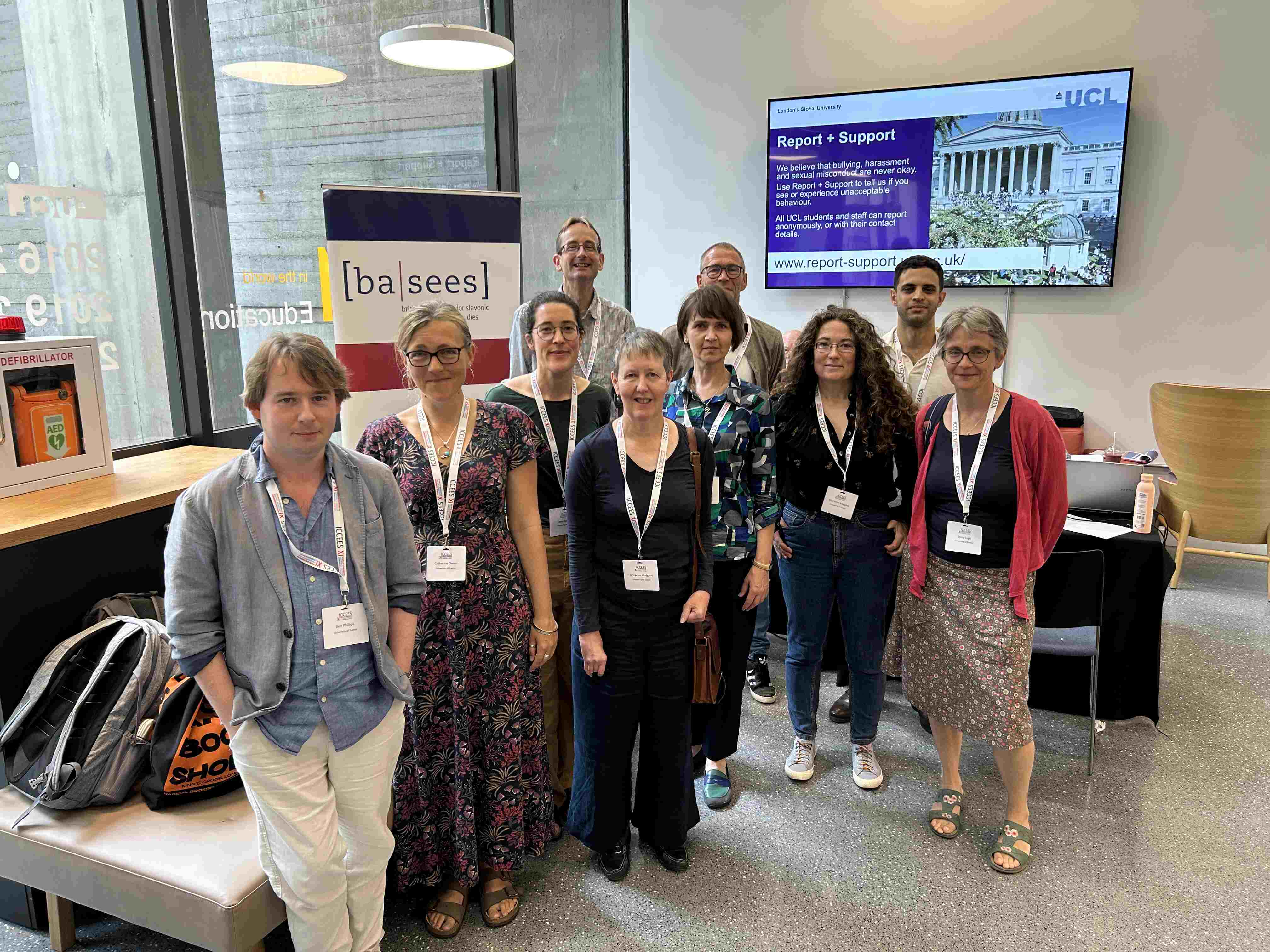
The Exeter Centre for Eastern European and Eurasian Studies was well represented at the XI World Congress of the International Council for Central and East European Studies (ICCEESS), held in London from 21 to 25 July, 2025. Scholars affiliated with the Centre contributed to a wide range of panels and discussions, spanning various disciplines, including literature, history, law, and politics.
Exeter colleagues on literary studies gave wide-ranging contributions. Professor Katherine Hodgson examined Russian literature in relation to the challenge of cultural discontinuity. Professor Muireann Maguire presented on the global impact of Russian literature from the perspective of translation studies; Dr Emily Lygo explored literature as an instrument of cultural diplomacy, drawing on the historical role of Anglo-Russian envoys within the Soviet cultural sphere; and PhD candidate Dave Weller contributed to a panel on early Soviet literature.
Exeter historians were also present in significant numbers. Professor Matt Rendle took part in discussions on the longue durée of Soviet legal history, while Dr Benn Phillips presented on the theme of political suicides and the symbolic resonance of the Old Believers within Russia’s “necronarratives.” Dr Nelly Bekus contributed to the book panel Time and Material Culture: Rethinking Soviet Temporalities, where she discussed her chapter on the temporal imaginaries of socialist cities, foregrounding their historicity and futurist visions. Recent Exeter PhD graduate, Iona Ramsay, presented an analysis of Romanian anticommunism during the Cold War,
Further contributions included legal scholar Dr Vadim Atnashev’s paper on the Tatar diaspora in the Baltic states and, and International Relations specialist, Professor Catherine Owen’s contribution on a roundtable addressing the politics of knowledge production about Eurasia in East Asia, further expanding the geographical and thematic scope of Exeter’s presence at the Congress.
Reimagining Area Studies for the 21st Century: Perspectives from Eastern Europe and Eurasia
Welcome to the launch event for ECEEES, the new University of Exeter Centre for Eurasian and Eastern European Studies. Directed by leading scholars in History, International Relations and Cultural Studies, ECEEES exists to observe, analyse, share knowledge and guide policies relating to the complex geopolitics of Eastern Europe and the nations and ethnicities across the regions of the former Soviet Union, including Russia, Ukraine, and Central Asia. All are welcome to attend our launch event at Lecture Theatre B, Streatham Court, University of Exeter on May 22nd (9.am-6.00pm).
Please register here. You can email muireann.maguire@exeter.ac.uk with any queries.
9.15am: Keynote 1: Prof. Jeremy Morris (Aarhus University) “The four challenges to area studies after the invasion of Ukraine” (chaired by Prof. Catherine Owen)
10.00-10.30: Coffee Break
10.30-11.45: Panel 1: Illiberalism Case Study (chaired by Prof. Gregorio Bettiza)
- Prof. Andrea Peto (Central European University) “Gendering Illiberalism”
- Dr Bryan Brown (University of Exeter) “Illiberalism and Culture”
- Prof. John Heathershaw (University of Exeter) “Globalisation and Illiberalism”
11.45-12.45: Lunch
13.00 -13.45: Keynote 2: Prof. Stephen Hutchings (University of Manchester) “Disinformation and its Discontents” (chaired by Prof. Muireann Maguire)
13.45 -15.00: Panel 2: Spotlight on Post-Soviet States (chaired by Prof. Catherine Owen)
- Dr Mark Youngman (Threatologist): “The past, present, and future of the North Caucasus insurgency”
- Dr Nelly Bekus (University of Exeter) “Challenging Moral Remembrance: Illiberal Mobilisation of Memory in Belarus and Russia”
15.30 – 16.15: Panel 3: Research round table by Exeter PGRs (chaired by Dr. Kevork Oskanian)
16.30 – 17.00: Panel 4: Scholars at Risk programme at the University of Exeter (chaired by Prof. Emma Loosley Leeming)
17.00 – 18.00: Closing round table chaired by Prof Muireann Maguire:
- Prof. Katharine Hodgson (University of Exeter), “BASEES: the association’s response to Russia’s full-scale war on Ukraine, 2022-present”
- Prof. Muireann Maguire (University of Exeter), “The Fifth Wave in Russian Literature”
- Prof. James Mark (University of Exeter), “Race, Whiteness and Eastern Europe”
- Prof. Brandon Gallaher (University of Exeter), “Eastern Orthodox Christianity in a time of Global Transition: War, Schism and ‘the West’”
- Prof. Matt Rendle (University of Exeter), “Rethinking the ‘Archival Revolution’: Conducting Historical Research on the Region”
Please email muireann.maguire@exeter.ac.uk with any queries.