Student support

You are charged tuition fees on an annual basis. It is important to understand how these fees are calculated, when they are due, and what to do if your situation changes.
Payment schedule
Your tuition fees are payable in two instalments:
- 50% at the start of Term 1.
- 50% at the start of Term 2.
The exact amount you are expected to pay will be shown on your tuition fee notice.
If you are unable to pay your fees in full by the scheduled dates, you must contact the Student Fees team immediately. You can do this by logging a call through SID. Discussing your situation with the team is essential, as they may be able to help you set up an alternative payment plan.
Students studying at a non-standard FTE (Full-Time Equivalent)
If you are studying at an intensity other than 100% (full-time) or 50% (part-time), your fees require a manual adjustment.
- Example: You are a Home fees student studying at 60% FTE. The full-time (100%) fee is £4,712 per year. The part-time (50%) fee is £2,356. When you register, your account may initially show the 50% fee (£2,356). Later in the academic year, a manual adjustment will be applied to add the extra 10% (£471.20), bringing your total fee to £2,827.20.
Important: The system will not notify you by email when this manual adjustment is made. You should be prepared for this additional charge. You will only receive an email if the payment deadline for the adjusted amount passes.
Funded students
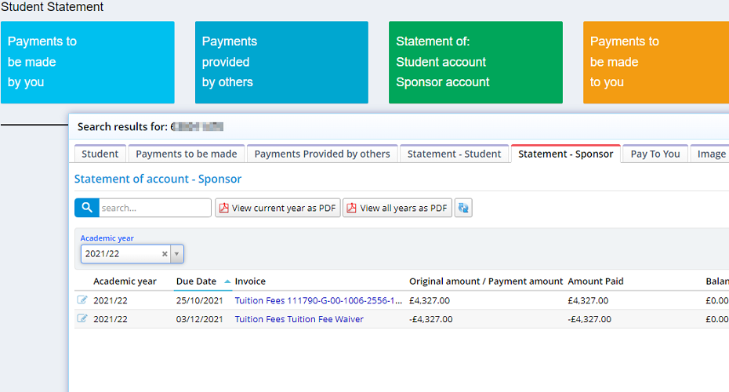
If your studentship is administered by the University, you can view your tuition fee statement on MyExeter.
- Your statement should show that your fees are covered by your funding source for the current academic year.
- If you are charged fees you are not expecting to pay, you should query this with your PGR Manager immediately.
When your funding ends part-way through the academic year
If your funding finishes before the end of the academic year (e.g. on 31 March), you will see a balance for the remaining portion of the year's fees on your account.
- Even if you plan to submit your thesis or transfer to continuation status1 by your funding end date, the fees system will still show the outstanding balance and may generate payment reminders for Term 1 and Term 2.
- Your PGR Manager can request that the Fees team does not chase you for these fees if you are expected to submit or transfer. However, the fees will still appear on your account.
- If you do not submit your thesis or transfer to continuation status by your funding end date, you will be expected to pay these outstanding fees.
[1] Continuation status is a period of writing up where a reduced fee applies.
When will I get paid?
This section provides important information about your stipend, including payment dates, how to view payments, and when payments may stop.
Payment schedule
If you hold a studentship administered by the University, your stipend is paid monthly in advance directly into your bank account.
- Stipends are due on the 1st of each month. Please budget accordingly.
- The University processes payments on Thursdays and Fridays. If the 1st falls on a day other than Thursday, payment is made on the preceding Thursday. An exception applies to Medical and Maternity pay, which is paid on Fridays.
- A remittance advice (payment notification) is emailed to you prior to payment. If you have not received this by the Wednesday of the payment week, please inform your PGR Manager.
- Please note that these dates may be subject to change due to Bank Holidays, Financial Year end, or University closure days.
Viewing your payments
You can view scheduled stipend payments via MyExeter:
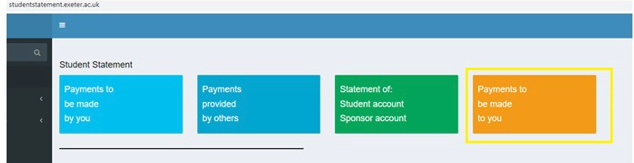
- Log in and select the 'Student Record and Registration (SRS)' tab.
- Click on the 'Finance' tab.
- Select 'Online Statement', which will redirect you to the Student Statement Management System (SSMS).
- After logging in with your University credentials, you will see a dashboard. Select 'Payments to be made to you' and filter by the current academic year to view your scholarship or bursary award (see screenshot below).
If an expected payment is not visible, please contact your PGR Manager.

When stipend payments stop
Your funding duration and end date will have been given in your financial offer letter. Please remember that we pay stipends monthly at the start of the month. If you have had interruptions or changes to your FTE or any funding extensions and are unsure of your new funding end date, this is available on request from your PGR Manager.
Your stipend payments will be suspended during any period of interruption to your studies, except for:
- Limited periods of sickness absence.
- Limited periods of maternity, shared parental, or adoption leave, in accordance with the Maternity Funding Policy.
If a stipend is paid to you for a period when you were not registered on your programme, the University will seek reimbursement of any overpayment. Similarly, if you discontinue or terminate your studies, you are not entitled to support from that date, and any overpayment will be reclaimed.
Early submission before your funding end date
Your stipend payments will automatically cease upon submission of your thesis. However, if your stipend is administered through the University of Exeter, you may be eligible to receive stipend payments until the end of the current quarter, provided you remain engaged in your studies.
The quarters are: January-March, April-June, July-September, October-December.
Example: If your funding end date is 30 September and you submit your thesis on 10 July, you can continue to receive your stipend until 30 September if you remain engaged in study.
To request continued payment, you must email your supervisor detailing your post-submission plans and request payment until the quarter's end. If your supervisor approves, they should forward their authorisation to your PGR Manager, who will arrange payment with the scholarships office..
For specific details please select your department or programme of study from the links below.
The University, in partnership with its alumni community, offers the Success for All Fund to support students facing unexpected financial difficulties that may impact their studies.
What the fund can help with
You may be eligible to apply if you are experiencing financial hardship due to situations such as:
- Struggling to pay for essential IT equipment.
- Needing support to cover the cost of a learning disability assessment.
- Having urgent bills to pay while waiting for your first grant or stipend payment.
Eligibility
All registered undergraduate and postgraduate students at the University of Exeter are eligible to apply, regardless of fee status.
Please note:
- Priority is given to students undertaking their first degree who are from low-income households or without family support.
- Most awards are means-tested, and you will need to provide evidence to support your application.
- The fund cannot be used to pay tuition fees.
How to apply
For further details and application instructions, please visit the Success for All Fund webpage.
The Faculty of Humanities, Arts and Social Sciences has a PGR Student Hardship Scheme for eligible students undertaking an MA by Research, MPhil, PhD, or EdD programme.
Your health and wellbeing are essential for successful study and a rewarding student experience. We recognise that maintaining your wellbeing can sometimes be challenging during your time at university.
Support for all students
Wellbeing Services offer a range of support to help you manage both personal and academic challenges. We understand that practical or emotional difficulties can make it harder to focus on your studies and enjoy university life.
Additional support for specific needs
For students with disabilities or long-term health conditions, we provide tailored support to help you manage your health alongside your studies.
Further information
- Comprehensive details of support services for postgraduate researchers are available on the Wellbeing Services webpages.
- The University's commitment to inclusive education is outlined in the Accessible Teaching and Learning Policy (PDF).
We encourage you to reach out for support whenever you need it. Looking after your wellbeing is an important part of your academic journey.
There are several funding options in place to help support your research while at the University of Exeter.
Study space and IT equipment
Details on specific support and facilities relevant to your programme can be accessed from the links below, including information on study space and IT equipment: