Equipment and capabilities
Equipment
Orbitrap Ascend MultiOmics Tribrid MS
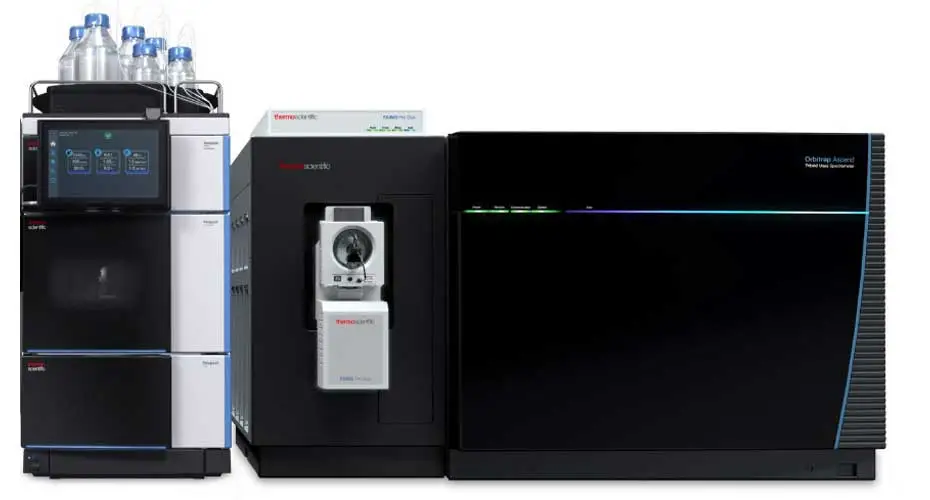
The Thermo Orbitrap Multiomics Ascend includes quadrupole, ion trap and orbitrap mass analysers. As a tribrid instrument, it can combine the advantages of the ion trap’s high speed and sensitivity with the orbitrap’s high mass accuracy. This edition offers a new hardware design featuring two ion routing multipoles and multiple orthogonal fragmentation options, including HCD (higher-energy collisional dissociation), CID (collision-induced dissociation) and ETD (Electron Transfer Dissociation) allowing for high sensitivity proteomics, metabolomics and lipidomics workflows, analysis of post-translational modifications and hydrogen-deuterium exchange mass spectrometry.
Our Thermo Orbitrap Multiomics Ascend interfaces with:
- A Vanquish Neo UHPLC for proteomics workflows and analysis of post-translational modifications
- A Vanquish Flex binary pump for metabolomics/small molecule workflows
- A Trajan LEAP HDX Advance automation platform for bottom up and intact HDX analysis. The platform can initiate labelling, quenching, separation and analysis of deuterated samples. The Ascend’s ETD fragmentation capabilities offer improved localisation and reduced scrambling.
Agilent 6410 triple quadrupole (QQQ) mass spectrometer
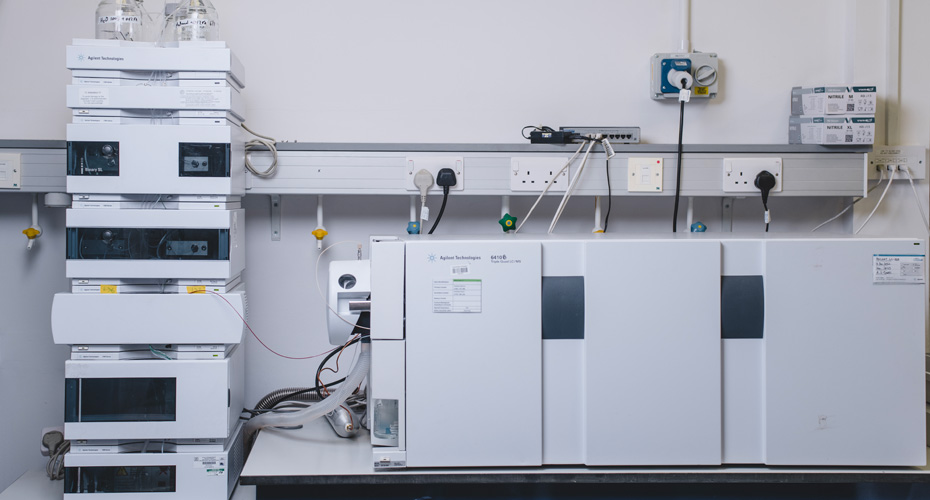
Agilent 6410 triple quadrupole (QQQ) mass spectrometer
-
Interfaced to an Agilent 1200, delivering rapid high-resolution chromatographic separation of analytes.
-
We offer in-house expertise in using a variety of LC column types to separate analytes of various classes and sizes (including sugars, amino acids, peptides, lipids, and various pharmaceutical compounds).
- An LC-QqQ analysis offers high sensitivity and selectivity for targeted quantification of your molecules of interest.
GC-QToF mass spectrometer
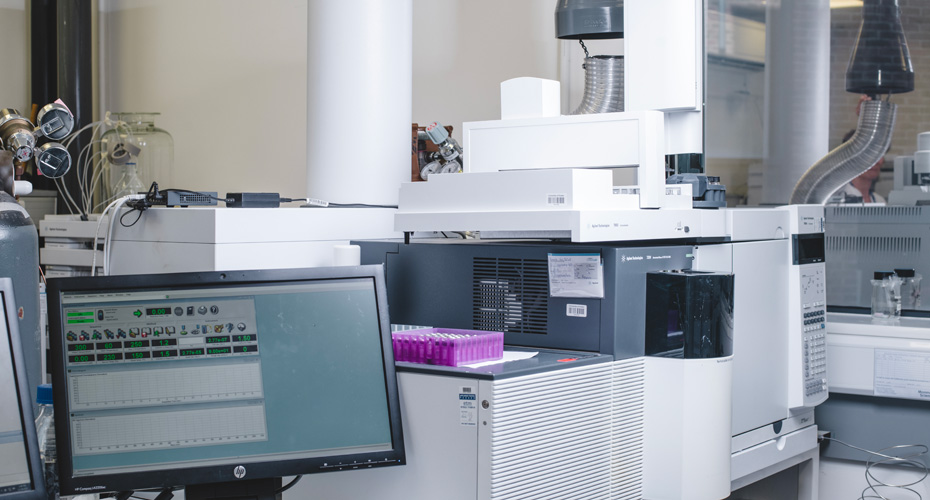
GC-QToF MS/MS with EI and CI sources
- Accurate mass (2-5 ppm) measurement of volatile compounds
- Many non-volatile compounds can be derivatised prior to analysis to make them volatile.
HPLC system
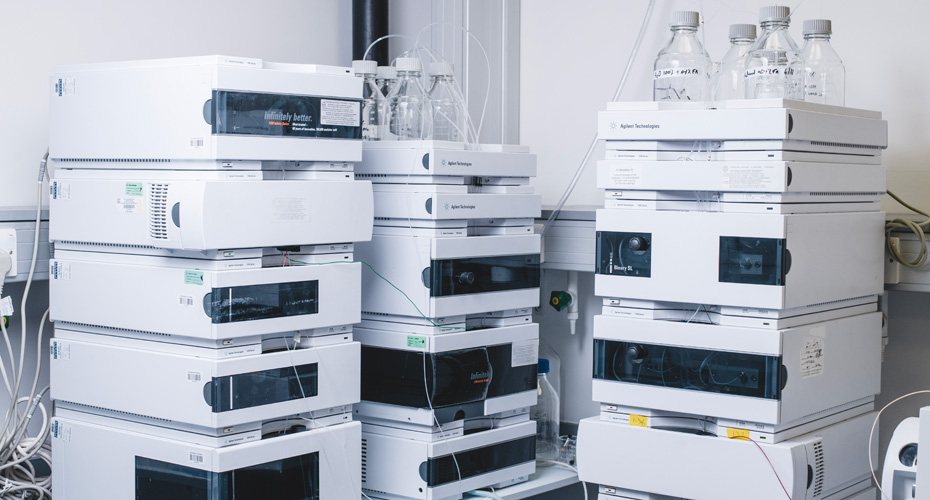
High-performance liquid chromatography (HPLC) system
Our standalone HPLC system can be used for preparative or analytical chromatography, including compound purification, fractionation, and HPLC quantitative analysis of known targets. The system includes:
- Quaternary LC pump (Agilent 1260 Quat Pump VL)
- Photodiode array (DAD)
- Refractive index detector (RID)
- Fluorescence detectors (FLD)
- Fraction collector for preparatory liquid chromatography and purification of compounds of interest.
Capabilities
Examples of types of research supported are:
Targeted small molecule and peptide quantitative analysis
We can support targeted analysis of a variety of analytes, including sugars, amino acids, metabolites, hormones, pharmaceuticals, lipids, fatty acids using the most suitable HPLC, LC-MS/MS or GC-MS workflow.
In this type of application, experimental samples are analysed alongside reference standards containing the analyte(s) of interest, providing a semi- or absolute quantification of the analyte concentrations.
Untargeted small molecule profiling and metabolomics
This type of analysis provides an untargeted profiling of a broad class of small molecules (e.g. sugars, lipids, polar compounds), based on the sample preparation and chromatography selected. It allows for comparisons and investigation of changes between conditions (such as different treatments or groups).
Untargeted proteomics and post-translational modification analysis
This type of analysis provides an untargeted profiling of cellular proteins, and can provide information on cellular responses to treatments or stimuli at the level of protein abundance. Proteomics data capture the top level of cellular regulation mechanisms (reflecting the end-result of genomic, transcriptional and post-translational regulation). Analysis of post-translational modifications such as protein phosphorylation allows for detailed profiling of cellular signalling responses.
Hydrogen-deuterium exchange mass spectrometry (HDX-MS)
HDX-MS is a powerful non-covalent labelling tool that can be used to investigate protein folding, protein dynamics, epitope mapping and protein interactions in solution. HDX utilises time-dependent, differential exchange of backbone amide hydrogens with deuterium in solution. Labelling resolution can range from the intact protein level to peptide and, in some cases, single amino acid resolution. The Trajan LEAP HDX Advance automation platform allows for fully automated HDX workflows.
Data analysis facilities
MassHunter Qualitative Analysis
Data inspection and general analysis:
- Deconvolve raw data to extract potential compounds
- Extract MS and MS/MS data for compounds
- Predict molecular formula
- Database searches
- Export reports.
MassHunter Quantitative Analysis
- Extract peak areas from samples/standards for quantitative analysis of known and unknown compounds.
- Export spreadsheets.
MassHunter Profinder
- Automated extraction of compounds and correction for retention time drift across multiple raw data files from metabolite profiling experiments.
- Export to spreadsheet or Mass Profiler Professional (MPP) to compare compound abundance across samples.
Mass Profiler Professional (MPP)
- Import compound information from Mass Hunter Profinder for statistical analysis (ANOVA, clustering, PCA etc).
- Database (IDBrowser + PCDL) searching for preliminary compound ID (detailed ID for specific compounds in MassHunter Qualitative Analysis).
- Integration of metabolomic and transcriptomic datasets.
- Accessed via MS facility data analysis computer.
Personal Compound Database and Library Manager (PCDL) for LC-MS
- Bespoke compound lists (plus MS/MS spectra imported from MassHunter Quantitative analysis).
- Searchable from MassHunter Quantitative analysis and MPP for compound identification.
Mass Spectral Librarian for GC-MS
- Very large library of MS/MS spectra searchable via MassHunter Qualitative Analysis.
- Includes the NIST mass spectral library.
- Bespoke libraries can be prepared from our GC-MS data.
Open-source software
- The metabolomics community has developed many online and downloadable data analysis pipelines.
- The MS Facility can advise on the use of a number of these.