PhD project opportunities
We currently have three pathways to PhD projects within our Centre:
You will find further details and links in the relevant sections below.
Please ensure to read through the following information paragraphs about our research and doctoral training centre before deciding whether to apply for a certain project or project idea.
Innovative, novel and relevant research
The University of Exeter's Centre for Metamaterial Research and Innovation (CMRI) is one of the largest hubs of metamaterial research in the UK. We lead the UK's Metamaterials Network (funded by EPSRC and Dstl) and are partners in large funded research programmes, including MetaHUB (EPSRC) and Meta4D. Our centre is uniquely positioned to solve multi-faceted research questions, address national and global priorities (e.g. healthy living; efficient computing; communication and security) and industry challenges. Our academic expertise spans electromagnetism (from visible and infra-red through to THz and microwave), acoustics and fluidics. The materials we work with have wide application, e.g. imaging; sensing and spectroscopy; acoustic and RF signature reduction; energy storage and harvesting.
A cohort doctoral experience
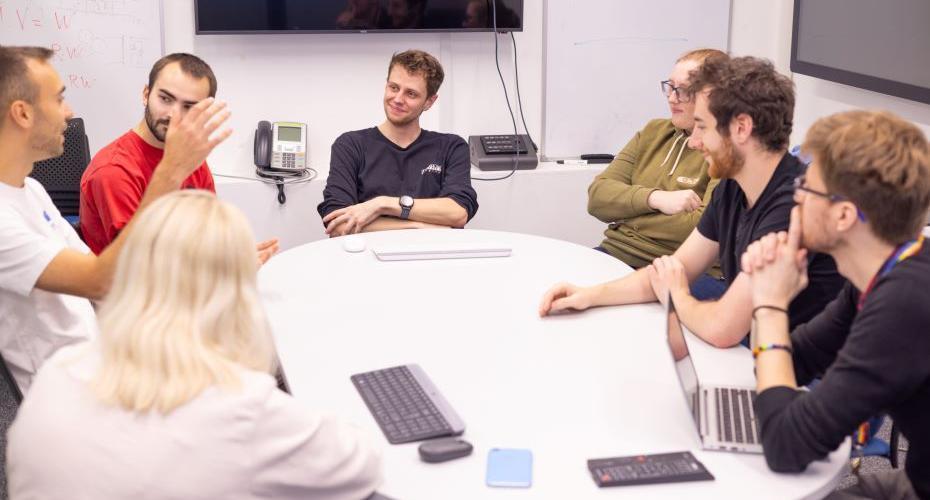
You will join the Doctoral Programme for the CMRI and benefit from an interdisciplinary, creative and supportive environment. You can be confident that your research is both at the cutting edge of the discipline, and relevant to the world today. Since its inception in 2014, our programme has been home to more than 100 PhD students. You will work within a cohort of peers developing current knowledge across metamaterial research, undertake state-of-the art research embedded in strong, focussed academic groups, and have opportunities for exposure to scientific background knowledge beyond your areas of study. Our graduates have gone on to take up leadership roles in a wide range of sectors.
Projects and funding
At Exeter, the PhD is normally 3.5 or 4 years of full-time study. Our “funded” positions (typically funded by EPSRC, Government or industry) include a living stipend (at least at standard UKRI/EPSRC rates) direct payment of your tuition fees, and a budget to support costs associated with your specific project and your training (technical and professional development).
International students are encouraged to apply but may not be eligible for all potential sources of funding. Note, Exeter offers up to 50 PhD scholarships each year in collaboration with the China Scholarship Council.
Directly funded PhD studentship projects
Please see below for current projects that have have been allocated funding, and are advertised individually. Please apply through the link or via adverts when available.
All our PhD projects are now filled, but please keep an eye out for future opportunities.
Indirectly funded PhD studentship projects
Our academics have suggested a number of exciting projects that we hope to run next year.
You are encouraged to look through this list, and if you have a strong interest in a particular project or projects, then please make an application - we will endeavour to source funding for excellent candidates. Funding for studentships can become available at any point during the year, therefore please apply early and we will contact you with opportunities as they arise.
Externally or self-funded PhD studentship projects
If you have external (international or employer) funding or intend to self-fund your PhD, then you are welcome to make an application and identify one or more projects. Please make your funding source clear in your application.
Use the University of Exeter summary on the different ways to fund a PhD.
Application process
- Please read the application criteria as outlined in the projects and below carefully before applying.
- Applications are made to the Metamaterials programme for a PhD in Physics/Engineering. We invite candidates to specify their project(s) of interest at the time of application.
- Following discussions at interview, projects will be allocated to successful candidates when the studentship offer is made.
Applications are made to the Metamaterials programme for a PhD in Physics/Engineering through the University application system. Please select the project you are most interested in. You can list any other projects of interest offered by the Centre for Metamaterial Research and Innovation in priority order as part of your cover letter.
Please prepare the documents below before starting the application process. Please ensure to upload ALL items listed below through the application system. Incomplete applications cannot be processed.
- Degree transcript(s) giving information about the qualification awarded, the modules taken during the study period, and the marks for each module taken.
- CV;
- A letter of Application, including a Personal Statement consisting of two parts*:
- Describe a) why you would like to study for a PhD, b) why you would like to focus on this particular topic, c) any relevant expertise and d) your future career ambitions;
- Describe the qualities that you believe will make you a great researcher (in particular as part of a team).
- Two references from referees familiar with your academic work. If your referees prefer, they can email the reference direct to metamaterials@exeter.ac.uk quoting the studentship reference number.
- If you are not a national of a majority English-speaking country you will need to submit evidence of your proficiency in English. Please see the entry requirements information above.
* We foster creativity and utilisation of individual strengths. Applicants are encouraged to provide evidence to support their statements. This might include conventional written documents (e.g. examples of work), but we also encourage alternatives such as audio or video recordings, websites, programming etc. Please ensure to include accessible links to such files in an appropriately named document as part of the upload process.
Eligibility (UK, EU, international) is stated in the individual project advertisement and is subject to funding requirements.
Applications will normally be reviewed within two weeks of receipt.
Candidates will be short-listed against a set of agreed criteria to ensure quality while maintaining diversity. Failure to include all the elements listed above may result in rejection.
The essential criteria:
- Undergraduate degree in a relevant discipline (minimum 2:1);
- Vision and motivation (for research & professional development);
- Evidence of the ability to work collaboratively and to engage in a diverse community;
- Evidence of excellent written and oral skills in English.
The highest quality candidates will also be able to demonstrate one of more of the following:
- Specialist knowledge in one or more of the CMRI’s areas of expertise: scientific domains, materials classes;
- Training in research methodology (e.g. undergraduate research projects);
- Research outputs (e.g. papers) and/or other indicators of academic excellence (e.g. awards).
You will be interviewed by a panel consisting of the project supervisor(s) and a CMRI Director of Postgraduate Research to assess fit to the Centre for Metamaterial Research and Innovation concept and academic ability.
If applicable, you will be invited for an interview within two weeks upon application receipt and we are always interested in hearing from interested, enthusiastic and able candidates.
Please email metamaterials@exeter.ac.uk if you have any queries about this process.