Exploring the benefits of auxetic materials
Exeter Advanced Technologies (X-AT) research group led by Professor Ken Evans
University of Exeter
The challenge
To explore the benefits of auxetic materials over conventional materials. An auxetic material is one which exhibits a negative Poisson’s ratio: this is a counter-intuitive physical property whereby the material becomes thicker when stretched.
The benefits of auxetics are:
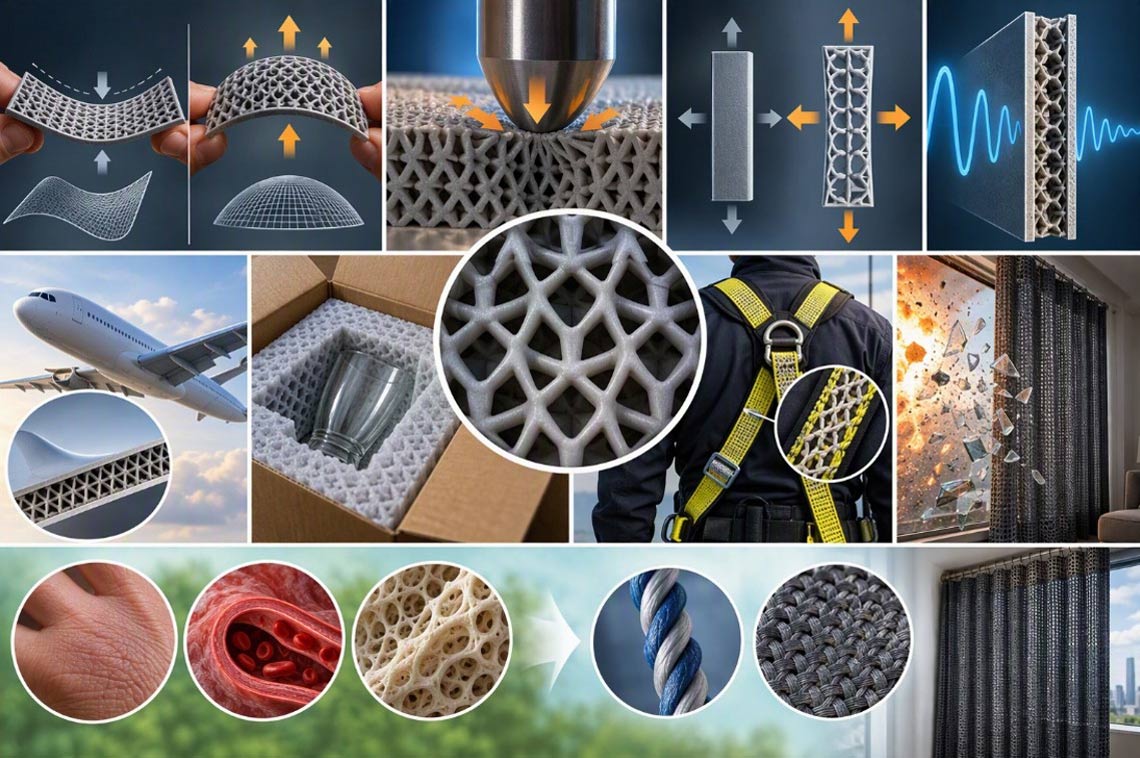
- When put into flexure they form a dome shape rather than the conventional saddle shape, which is ideal for the production of doubly curved components such as aircraft and automobile components.
- When indented, the material under the indenter densifies acting to make the material harder, ideal for indentation-resistant foam packaging.
- Poisson’s ratio balancing, allowing the use of dissimilar materials where auxetic content is used to match the lateral expansions of components to prevent internal stresses under loading.
- Auxetic materials have been successfully used to enhance the vibration damping of cellular structures used in sandwich panel cores for use in aerospace structures.
The majority of negative Poisson’s ratio materials are cellular solids such as honeycombs and foams. However, work into fibres and recently composites (including carbon fibre composites) has allowed the production of auxetic fibre composites which may be used in conjunction with auxetic honeycombs or foams to create entirely auxetic sandwich structures and to make auxetic fabrics used to develop next generation blast curtains.
Some solutions
Our world-leading research into auxetic materials and structures examines this surprising property, which is widely occurring in the natural world and has even been measured in the human body: skin, artery walls and trabecular bone all possess a negative Poisson’s ratio.
The auxetics research team that sits within the Exeter Advanced Technologies (X-AT) research group, led by Professor Ken Evans, are investigating three areas.
Auxetic textiles for blast mitigation
Using an industrial prototyping weaving loom, this research project was seeking to create a ‘smart’ material that could minimise the injuries inflicted by a terrorist attack. The team aimed to create auxetic blast curtains that would catch glass fragments and debris blown through windows by an explosion.
The curtains were put into a test chamber behind glass panels and subjected to an explosive blast to test their ability to minimise the penetration of glass into the chamber and to absorb the shock wave.
Partners: Auxetix Ltd, Home Office Scientific Development Branch, Monofil Trading Company Ltd, Centre for the Protection of National Infrastructure
Auxtrusion: A novel manufacturing process for the extrusion of helical auxetic yarns
The AUXTRUSION project proposes the development of a new extrusion manufacturing technique to produce helical auxetic yarns (HAY). This is a yarn composed of two conventional fibres, one helically wrapped around the other. By appropriate choice of materials and geometry this yarn can be made such that it effectively gets wider when stretched (exhibiting a large negative Poisson’s ratio).
Funded by: Auxetix Limited, Wisla Narrow Fabrics Ltd, Fothergill Engineered Fabrics Ltd
An improved safety, climbing, parachute harness incorporating auxetic yarns to enhance narrow fabric technology
Sling webbings are in everyday use in the construction industry and in areas where a lifting mechanism is required. Currently, there is no indication when a webbing has been overextended and is therefore no longer fit for purpose.
This project evaluated helical auxetic yarns as failure or end-of-life indicators in sling webbings. It was conceived that the ability to cause an auxetic yarn to ‘pop out’ of a fabric when under tension would provide an ideal indicator that the fabric had been deployed beyond its safe working limit. A similar mechanism could also be used to indicate when an ‘optimum’ load had been applied in alternative uses of fabric.
The trials were conducted by the University of Exeter in collaboration with Wisla Narrow Fabrics Ltd. Working prototypes were produced for both permanent and temporary overload conditions, and a patent is pending on the technology.
Funded by: Smart.mat (Materials KTN)
Why use metamaterials?
These projects open up a panorama of interesting possibilities for high-performance or ‘smart’ textiles. Uses include pore-opening fabrics in healthcare or security and defence sectors, filtration, colour change fabrics for healthcare, safety harness or fashion, and disaster mitigation – tornado, hurricane or earthquake protection.
References:
Duncan, O. et al. (2026) "Roadmap on mechanical metamaterials", Smart Materials and Structures (2026). https://doi.org/10.1088/1361-665X/ae9c0d
Preston S, Londono-Monsalve J, Evans KE, “The Viscoelastic Behaviour of Auxetic Materials”, Phys. Stat. Sol. B, 263, 2026, 70282 (13pp). https://doi.org/10.1002/pssb.70282
Yan H, Zhang Y, Jian WZ, Ji X, Zhu R, Sun JB, Xie YM, Evans KE, Ren X, “Recent Advances in Electromechanical Coupling Functional Metamaterials”, Eng. Struct., 362, 2026, 122900 (20pp). https://doi.org/10.1016/j.engstruct.2026.122900
Xu J, Lin R, Huo D, Li J, Ghita OR, Evans KE, Hua X, “Mechanically Adaptive Materials with Tunable Stiffness for Biomedical Devices: Mechanisms, Applications and Perspectives”, Mat. Today Bio, 38, 2026, 103143 (31pp). https://doi.org/10.1016/j.mtbio.2026.103143
Wang LQ, Tong JZ, Evans KE, Shen J, “Exploiting Graded Auxeticity for Tunable Tension-Induced Out-of-Plane Buckling in Elastic Plates for Shape Morphing”, Int. J. Sol. Struct., 336, 2026, 113976 (19pp). https://doi.org/10.1016/j.ijsolstr.2026.113976
Wang LQ, Tong JZ, Pan ZS, Evans KE, Shen J, “Poisson’s Ratio Control in Auxetic Metamaterials Under Large Tensile Strains”, Int. J. Mech. Sci., 304, 2025,110637 (14pp). https://doi.org/10.1016/j.ijmecsci.2025.110637
Preston S, Londono-Monsalve J, Evans KE, “Relation of Bulk-to-Shear Loss Factors in Viscoelastic Auxetic Metamaterials” Phys. Stat. Sol. B, 263, 2025, 2400512 (9pp). https://onlinelibrary.wiley.com/doi/full/10.1002/pssb.202400512
Zhang Y, Jiang WZ, Jiang W, Zhang XY, Dong J, Xie YM, Evans KE, Ren X, “Recent Advances of Auxetic Metamaterials in Smart Materials and Structural Systems”, Adv. Func. Mat., 2025, 2421746 (31pp). https://advanced.onlinelibrary.wiley.com/doi/full/10.1002/adfm.202421746
Jiang W, Zhang Y, Zhang XG, Han D, Chen WQ, Xie YM, Evans KE, Ren X, “Synclastic Behaviour of Auxetic Metamaterials”, Eng. Struct., 2025, 326, 2025, 119607 (9 pp). https://doi.org/10.1016/j.engstruct.2024.119607