Metamaterials as a substitute for critical minerals
A case study by Tim Starkey and Alastair Hibbins
University of Exeter
The challenge
Critical minerals underpin much of modern technology. They are essential to national defence, to the energy transition, to digital technologies, and to advanced manufacturing - and so they sit beneath several pillars of the UK's Industrial Strategy and its wider ambitions for economic growth. Yet the government's Vision 2035: Critical Minerals Strategy makes clear that securing a reliable supply of these materials is a genuine challenge.
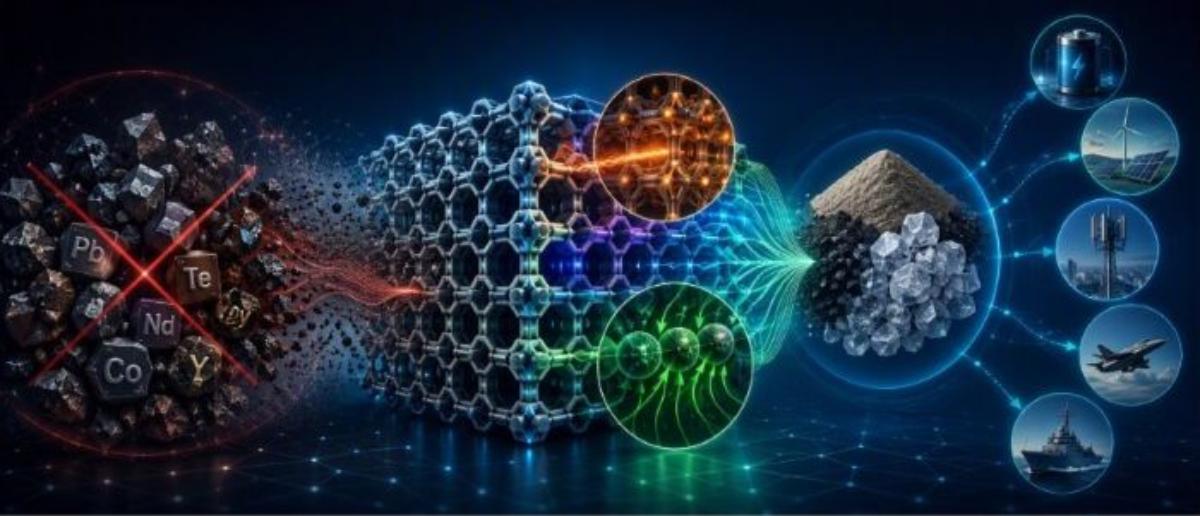
Part of the difficulty is that many of the materials we depend on are problematic in one way or another. Some are toxic, such as the lead and tellurium used in thermoelectric devices. Some are scarce or geopolitically concentrated, such as the rare earths, tellurium and cobalt that appear throughout energy and communications hardware. In each case we tend to accept the environmental cost and the supply risk because we assume there is no alternative - that the function we need is fixed by the chemistry of a particular element.
But what if that assumption is wrong? What if the materials crisis is, at least in part, not a materials problem but a design problem?
Our solution
Metamaterials let us move beyond the convention that function is fixed by chemistry. Their properties emerge from carefully designed structure - geometry across many length scales - rather than from composition alone. That opens up a different way of thinking: instead of asking "what material do we need?", we can ask "what function do we need, and how do we design it?" If we can reproduce the useful behaviour of a problematic material using structure imposed on an abundant, benign one, we can replicate the function without the toxicity, scarcity or supply risk.
This is speculative territory - there is, as yet, very little research applying metamaterials specifically to critical-mineral substitution - but two strands of our work at Exeter illustrate the potential.
Thermoelectrics without lead or tellurium.
Three-dimensional nanoscale metamaterial structures have recently been shown to give dramatic control over thermal conductivity, and that control can translate directly into game-changing efficiency gains in thermal devices such as thermoelectrics. It also offers a route to eliminate our reliance on toxic constituents such as lead and tellurium. We are exploring 3D nanostructured meta-lattices - combinations of metal oxides and polymers - to deliver controlled thermal transport and non-equilibrium thermodynamics, focusing on doped zinc oxide (ZnO) because it is abundant, non-toxic and cheap, offering a genuine step-change in sustainability. The target is a sustainable, high-efficiency, oxide-based thermoelectric device.
Magnetic materials without the rare earths
Rare-earth ferrites such as yttrium iron garnet (YIG) have excellent dynamic magnetic properties, but they are expensive, complex to manufacture, dependent on rare-earth processing, and difficult to scale sustainably. Magnetic metamaterials offer an alternative built from abundant ferromagnetic materials such as iron. To design such structures efficiently, we are developing a framework that couples machine learning with electromagnetic-micromagnetic FDTD solvers, letting us search high-dimensional parameter spaces and predict geometries with a targeted response despite the strongly coupled, nonlinear dynamics involved.
Why use a metamaterial?
The common thread is that a designed structure, not a special element, delivers the function. That reframing is powerful because it turns a procurement problem into an engineering one: where a material is scarce or toxic, we ask whether its role can be recreated by geometry imposed on something freely available.
Not every use of a critical mineral can be replaced this way - some functions really do depend on the specific chemistry, but by identifying the uses that can be substituted, and by designing structure for those critical functionalities, our aggregate demand for critical minerals can be reduced. Even partial substitution eases supply risk and environmental burden across the many sectors that depend on these materials.
This is low technology-readiness research, and the concepts described here are early and speculative. But the underlying idea - that we can design our way out of some of our dependence on problematic materials - is, we believe, worth taking seriously, and only a fraction of its potential has yet been explored.
References:
Dramatic control of thermal conductivity in 3D nanoscale metamaterials, 2024, Nature Communications. https://doi.org/10.1038/s41467-024-46182-2
Modelling of interfaces and thermal systems, 2024, Physical Review Letters, 132, 066201. https://doi.org/10.1103/PhysRevLett.132.066201
Microwave magnetization dynamics in ferromagnetic spherical nanoshells, 2019, Physical Review B, 100, 054425. https://doi.org/10.1103/PhysRevB.100.054425
Complex permittivity and permeability of composite materials based on carbonyl iron powder over an ultrawide frequency band, 2021, Physical Review Applied, 16, 014062. https://doi.org/10.1103/PhysRevApplied.16.014062
Gallagher - Microwave characteristics of particulate magnetic composites (PhD thesis, University of Exeter). https://hdl.handle.net/10871/38456