Pioneering Energy-Efficient Computing using Metamaterials
Joe Shields, Nick Farmakidis, & C. David Wright
University of Exeter
The Challenge
Global digital infrastructure now accounts for a rapidly growing share of worldwide energy consumption. As computational demands continue to scale, the environmental and economic costs of traditional computing architectures are becoming unsustainable.
Current systems rely on the von Neumann architecture, which physically separates processing units from memory and storage. This separation creates the well-known von Neumann bottleneck: continuous data transfer between computation and memory consumes excessive energy, generates heat, and limits processing speed. To build the next generation of IT infrastructure, we must eliminate this inefficiency by co-locating memory and computation, creating processors that operate more like the highly integrated human brain.
Our Solution
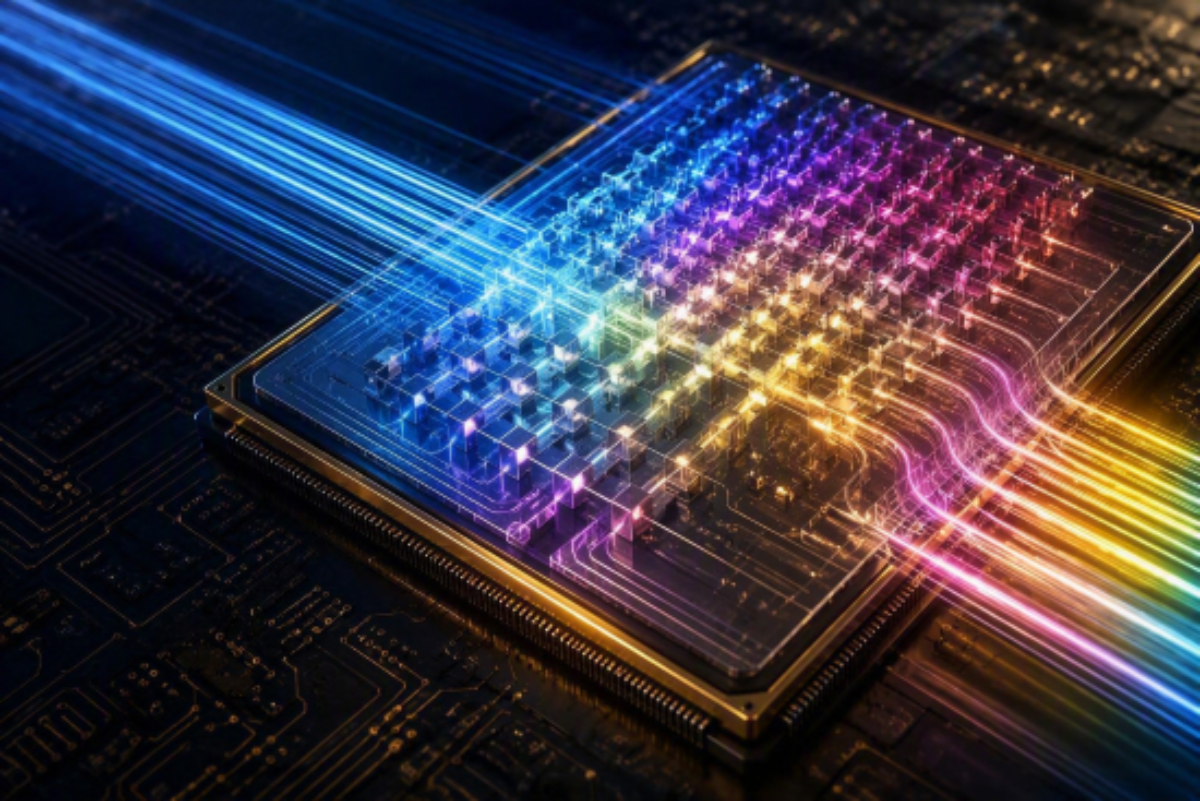
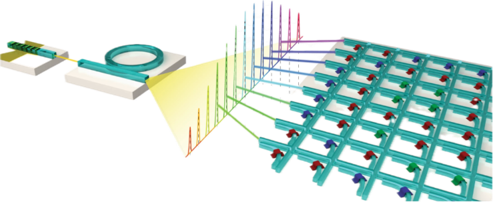
We are developing compute-in-memory architectures that perform calculations directly where data is stored. A flagship example is our optical matrix-vector multiplier chip, which executes complex linear algebra operations at the speed of light. By removing the need to shuttle data back and forth between separate memory and processing units, these chips can operate up to 100 times faster than conventional electronic processors while consuming a fraction of the energy. A core innovation is the replacement of electron-based logic with photonic computation. Light offers vastly higher bandwidth, near-zero resistive heating, and inherent parallelism, making it an ideal medium for high-speed, low-power arithmetic.
https://www.nature.com/articles/s41586-020-03070-1
Why use a Metamaterial?
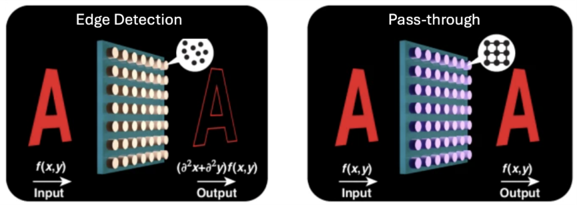
Metamaterials are the enabling technology that makes compact, high-performance optical processors feasible. By structuring materials at subwavelength scales, we can manipulate light in ways natural materials cannot. Our team designs ultra-thin metasurfaces and compact meta-devices that provide precise control over phase, amplitude, and polarization of light. These engineered structures allow us to:
· Miniaturise optical circuits to fit on standard semiconductor footprints
· Implement complex transformations and computations in a single light pass
· Reduce system complexity and power consumption by eliminating bulky conventional optics
Together, these advances are paving the way for a new class of light-based, brain-inspired computing hardware that is faster, more energy-efficient, and scalable for real-world applications.
https://www.nature.com/articles/s41377-025-01841-x