A new software to identify metamaterials that could accelerate the future of 5G communication
MaxLLG solver to help exploring and designing magnetic metamaterials
A case study by Feodor Ogrin
University of Exeter

The challenge
Magnetic materials offer important opportunities for next-generation RF, microwave and millimetre-wave technologies. Their resonant response can provide functionality that is difficult to achieve using conventional dielectric materials, including enhanced permeability, impedance matching, tunability and non-reciprocity. These properties could enable more compact antennas and new classes of reconfigurable RF and microwave components.
However, designing magnetic metamaterials remains challenging. Their electromagnetic properties depend not only on the constituent materials, but also on the dimensions, geometry and arrangement of microscopic magnetic elements. At high frequencies, the electromagnetic fields interact dynamically with the magnetisation, producing behaviour that cannot be described reliably using simple bulk permeability models.
Conventional electromagnetic solvers generally represent magnetic materials through prescribed or approximate constitutive properties. Micromagnetic solvers, conversely, can describe magnetisation dynamics accurately but do not normally calculate the complete electromagnetic response, particularly the interaction with electric fields and conducting structures.
This creates a significant modelling gap: predicting the behaviour of a practical magnetic metamaterial requires electromagnetic wave propagation and magnetisation dynamics to be calculated together.
Our solution
MaxLLG, originally developed at the University of Exeter and now developed further by MaxLLG Ltd, provides a computational approach designed specifically to bridge this gap.
The solver combines Maxwell's equations with the Landau–Lifshitz–Gilbert (LLG) equation, calculating electromagnetic fields and magnetisation dynamics simultaneously within a three-dimensional FDTD framework. The LLG equation is solved without linearisation, allowing nonlinear and field-dependent magnetic dynamics to emerge directly from the material parameters and geometry.
This makes it possible to model structures containing magnetic, dielectric and conducting components within the same full-wave simulation. Phenomena occurring at the scale of individual magnetic elements can therefore be connected directly with measurable device-scale quantities such as reflection, transmission and electromagnetic field distributions.
MaxLLG has also been developed as a cloud-based computational platform, allowing large simulations and parameter sweeps to be distributed across multiple processing nodes. This capability is particularly important for metamaterial design, where many combinations of geometry, material properties and applied magnetic field may need to be explored.
Our recent research extends this approach towards AI-enabled inverse design of magnetic metamaterials. Instead of repeatedly varying a design and calculating its response, MaxLLG simulations can generate datasets linking structural and material parameters to electromagnetic spectra. Machine-learning models can then learn these relationships and identify candidate structures that produce a specified target response.
The resulting inverse-designed candidates can subsequently be returned to MaxLLG for full-physics verification. This creates a closed computational workflow:
physical parameters and geometry → MaxLLG simulation → electromagnetic spectra → machine learning/inverse design → candidate metamaterial → MaxLLG verification.
The aim is to transform metamaterial modelling from predominantly trial-and-error exploration into predictive design.
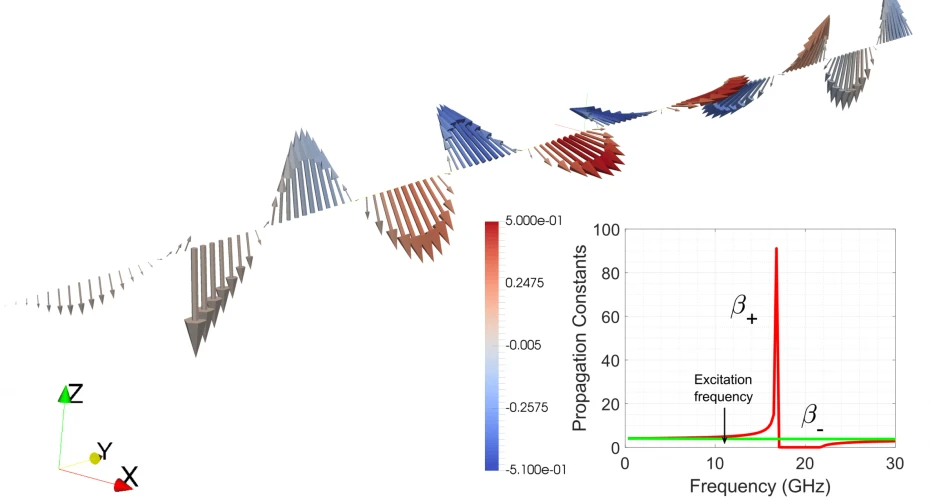
Figure: MaxLLG for enabling high frequency technologies using magnetic metamaterials.
Why use a metamaterial?
Magnetic metamaterials provide a route to electromagnetic properties that are difficult or impossible to obtain from naturally occurring bulk materials alone. By controlling the material, dimensions, shape and arrangement of ferromagnetic elements, their collective dynamic response can be engineered for a particular frequency range or application.
One important opportunity is the development of alternatives to conventional ferrites such as Yttrium Iron Garnet (YIG). YIG possesses excellent microwave properties but can be expensive and difficult to manufacture and integrate at scale. Metamaterials constructed from patterned, abundant ferromagnetic materials could provide selected magnetic functionality while offering greater flexibility in design and fabrication.
The challenge is identifying the right structure. Even a relatively simple magnetic metamaterial can have a large design space involving element dimensions, geometry, separation, magnetic properties, dielectric environment and applied field. Exploring this space through conventional parameter sweeps rapidly becomes computationally expensive.
Combining MaxLLG with AI-based inverse design offers a new approach. Rather than asking “What electromagnetic response will this structure produce?”, we can begin to ask the inverse question: “What magnetic metamaterial should we build to produce the electromagnetic response we need?”
This capability could accelerate the development of magnetic metamaterials for compact and tunable antennas, filters, circulators, isolators and other RF and microwave technologies, while supporting the transition from fundamental metamaterial concepts towards practical devices.