Wearable electronics - from internet of things (IoT) to human-machine interfacing
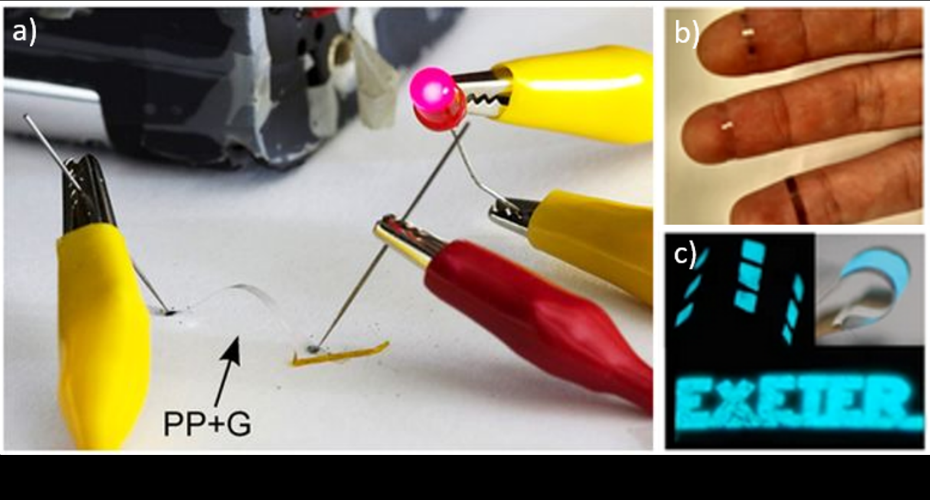
Figure a) a conductive fibre made by coating polypropylene (PP) with graphene (G)[1]
Figure b) a touch sensor
Figure c) light emitting devices fabricated using these conductive fibres[2]
A case study by Kavya Sadanandana and Ana Nevesa
aUniversity of Exeter
The problem
Textile-based wearable electronics is an emerging technology with potential to enable the imperceptible integration of electronics with the human body. Electronics incorporated into clothing will play a strategic role in various areas ranging from the internet of things (IoT) to remote health monitoring, medical therapies and human-machine interfacing. However, to enable such advances, there are many engineering challenges that still need to be overcome. Future technologies will need to take more important roles in people’s lives and this requires imperceptibility (for longer term use), capability of bending (to conform to body topography) and of stretching (to accommodate natural body motion). Therefore, advances in large-area integration and conformal lamination onto the irregular, non-flat, and coarse structures of the textile fabrics are necessary.
Our solution
Why use a metamaterial?
This type of graphene layer stacking, patterns printed on the surface etc. helps to manipulate its properties to match the desired range of application. Fabricating these new structural designs is the metamaterial aspect, and the base of this project towards the realization of wearable electronic devices.
References
[1] Neves AIS, Bointon TH, Melo LV, Russo S, de Schrijver I, Craciun MF, Alves H. (2015) Transparent conductive graphene textile fibres, Scientific Reports, volume 5, pages 9866-9866