Metamaterials for energy and sustainable systems
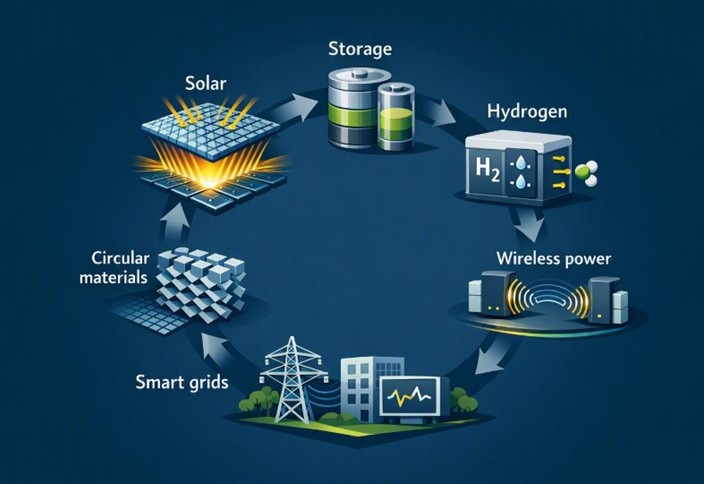
The energy transition places new demands on generation, storage, distribution and efficiency. Metamaterials can contribute by controlling light, heat, vibration, electrical response and electromagnetic fields with high precision, helping energy technologies operate more effectively while using fewer resources.
In renewable generation, photonic and nanostructured materials can improve light capture, spectral control and conversion efficiency in solar technologies. Related approaches may support radiative cooling, thermal management and advanced surfaces that regulate heat without continuous power input.
Energy storage and hydrogen technologies can also benefit from engineered interfaces, porous architectures and catalytic structures that improve ion transport, charge storage, reaction rates and durability. These advances are relevant to batteries, capacitors, electrolysers, fuel cells and grid-scale storage systems.
At the system level, metamaterial-enabled wireless power transfer, energy harvesting and smart sensing could support electrified transport, industrial automation, autonomous monitoring and smart grids. By harvesting vibration, heat, motion, sound or ambient electromagnetic energy, distributed sensors could operate with less maintenance in remote or inaccessible environments.
Sustainability must also shape the development of the materials themselves. As metamaterials move towards deployment, attention needs to be given to scalable manufacture, embodied carbon, recyclability, reuse, critical-material dependence and end-of-life recovery. The most compelling technologies will be those that improve system performance while also fitting within a circular, low-carbon economy.
Relevant studies
From harvesting to storage, our Centre brings together expertise from physics and engineering to explore, for example,
- the role of electronic and thermal transport in materials and their optical properties and characterisation;
- how to synthesize and characterise novel functional nanoporous materials for practical applications in for example solar and hydrogen energy creation, storage, and conversion, nanodevice construction, greenhouse capture and conversion, photocatalysis and environmental catalysis for renewable energy to lightweight wearable engineering devices;
- the exploitation of metamaterials in energy harvesting to enhance conversion efficiency of unused or wasted energy into electrical energy to power small electronic devices such as wireless sensors.
People
| Prof Janet Anders: Quantum thermodynamics: nano- machines, data storage, computation and communication, and diagnostic healthcare |
| Prof Bill Barnes: Nanophotonics; plasmonics; light-molecule interactions; photosynthetic materials |
| Prof Monica Craciun: Optoelectronic materials and devices; quantum phenomena; nanoelectronics |
| Dr Charles Downing: Nanophotonics and plasmonics |
| Prof Alastair Hibbins: Metasurfaces to modify fluid flow |
| Dr David Horsell: Thermoacoustics; electrical conduction in nanostructures |
| Dr Steve Hepplestone: Quantum mechanics and its applications to materials |
| Dr Simon Horsley: Theory of electromagnetic and acoustic materials |
| Prof Geoff Nash: Infrared sources; detectors and spectroscopy;surface acoustic wave devices |
| Dr Ana Neves: Wearable technology; graphene; 2D materials |
| Prof David Wright: Active/Reconfigurable metasurfaces; phase-change materials |
| Dr Yongde Xia: Nanomaterials for energy |
| Dr Dibin Zhu: Energy harvesting and wireless power transfer |
Case studies