Infrastructure and transport
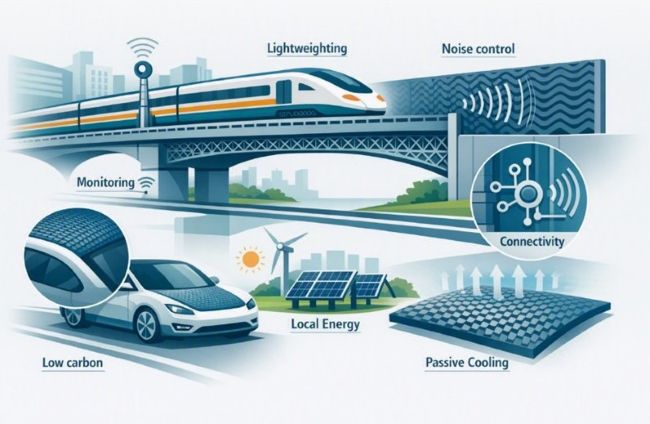
Infrastructure and transport systems must become safer, quieter, more connected, more resilient and less carbon intensive. Metamaterials can help by embedding useful physical functions into materials and structures: sensing damage, controlling noise and vibration, reducing weight, managing heat, improving wireless connectivity and harvesting local energy.
For infrastructure owners, structural health monitoring is a major opportunity. Metamaterial-enabled sensors and wave-control systems could detect changes in strain, vibration, corrosion, cracking, moisture, ground movement or fatigue before failures become critical. This could support more targeted maintenance across bridges, tunnels, railways, roads, buildings, pipelines and utilities.
Noise, vibration and flow control are equally important. Acoustic and mechanical metamaterials can reduce unwanted sound and vibration in rail, road, buildings and industrial settings. Surfaces designed to influence flow may reduce drag, turbulence and wake noise in air and water transport, improving efficiency while reducing environmental impact.
Transport applications include lighter crash structures, impact-absorbing barriers, vibration-damping components, acoustic insulation, advanced antennas, radar, LiDAR and communication systems for connected and autonomous mobility. Electric vehicles, aircraft, rail systems, ships and autonomous platforms all stand to benefit from materials that combine structural performance with sensing, acoustic, thermal or electromagnetic function.
In the built environment, thermal and photonic surfaces could contribute to passive cooling, local energy generation and reduced dependence on active heating and cooling. Lightweight, durable and multifunctional materials could also reduce embodied carbon and extend asset life, provided they are designed for practical manufacture, inspection, repair and eventual reuse.