Metamaterials for defence, security and resilience
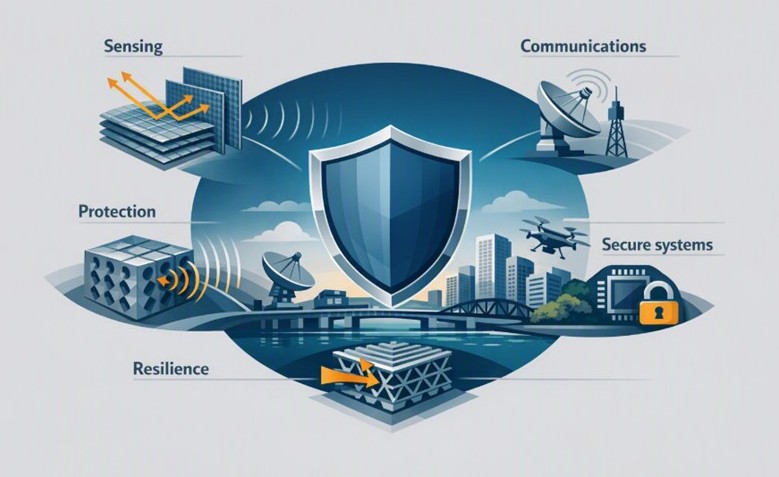
Security and resilience challenges are becoming more complex as systems become more connected, autonomous and dependent on digital and physical infrastructure. Metamaterials provide tools for shaping electromagnetic, acoustic, mechanical and thermal behaviour, making them relevant to sensing, communications, protection, platform performance and the safeguarding of essential services.
In sensing and communications, compact antennas, reconfigurable surfaces, radar components, acoustic devices and advanced optical systems can improve detection, tracking, imaging and signal management. These technologies are especially valuable where size, weight, power consumption and operation in contested or cluttered environments matter.
For protection and survivability, architected mechanical materials can absorb impacts, mitigate shock, reduce vibration and provide lightweight structural performance. Electromagnetic and acoustic metamaterials can also reduce signatures, shield sensitive electronics and improve the resilience of platforms and infrastructure exposed to interference, blast, vibration or environmental stress.
The same capabilities are relevant beyond defence platforms. Water, energy, communications and transport networks could use distributed sensing and advanced monitoring to identify faults earlier, detect leaks, assess structural condition and prioritise maintenance. Metamaterial-enabled tags, signatures and secure hardware features may also support authentication, anti-counterfeiting and asset protection across critical supply chains.
Future development will depend on combining material performance with manufacturability, qualification, integration and trusted supply. The greatest impact is likely where metamaterial functions are built directly into deployable systems rather than added as isolated components.
Relevant studies
- advance sensor systems to improve sensitivity for detecting physical, chemical, and biological entities at the micro/nanoscale;
- study the fundamental physics of acoustic, thermal and electrical transport within materials and across interfaces to investigate potential for active sensing.
- use chalcogenide phase-change ('active') metamaterials to deliver active optical metasurfaces that can work from the UV right out to the THz, and with applications ranging from LiDAR (Light Detection And Ranging) to chemical sensing;
- develop and study structured electromagnetic metasurfaces and 3D metamaterials and composites (including magnetic composites) that exhibit novel and valuable phenomena such as
- control of energy and data propagation;
- enhancement of the performance of detectors and antennas (reducing size and weight, increasing efficiency)
- control of field distribution (signature control) and beam steering;
- radiation filtering and absorption;
- for imaging and sensing
- use metamaterial concepts ('meta-atoms') to produce novel Electronic Article Surveillance (EAS) tags to protect retail merchandise with metal packaging from theft;
- study acoustic metamaterials and metasurfaces to control the propagation of sound in air and underwater through absorption, filtering or channelling;
- use structured surfaces to reduce or filter the noise associated with hydrodynamic noise.
CMRI researchers are passionate about applying their knowledge to practical challenges and welcome opportunities to form new partnerships with sector stakeholders. As a result of our solutions-focussed approach and reputation for research, metamaterials form one of the key pillars of the 'Technology Advantage' theme in the Exeter Defence, Security and Resilience Network.
People
| Prof Euan Hendry: THz materials, imaging and spectroscopy; nonlinear optics |
| Prof Robert Hicken: Development of security tags for retail |
| Prof Alastair Hibbins: RF and microwave metamaterials and composites; antenna ground planes; acoustic metamaterials |
| Dr Ian Hooper: RF and microwave metamaterials |
| Dr David Horsell: Acoustic and thermal devices |
| Dr Simon Horsley: Theory of electromagnetic and acoustic materials |
| Prof Feodor Ogrin: Magnetic materials for microwave devices and antennas; magnetic material simulation |
| Dr Alex Powell: Metamaterials for sensing and security; RF and microwave metamaterials |
| Dr Tim Starkey: Acoustic and elastic metamaterials: |
| Dr Nikita Toropov: Optical sensors |
| Prof David Wright: Active/Reconfigurable metasurfaces; phase-change materials |
Case studies