Key projects
The Centre for Metamaterial Research and Innovation (CMRI) works at the forefront of international research, partnering with leading universities, industry, and national networks to push the boundaries of metamaterials science. Through major EPSRC-funded programmes, global collaborations, and strategic industry engagement, CMRI is advancing next-generation metamaterials—from programmable and time-varying systems to large-scale translation and national coordination.
The projects below highlight the Centre’s role in shaping the future of metamaterials research and its impact across technology, industry, and society.
MetaHUB
The University of Exeter is spearheading a transformative new hub in 3D nanoscale metamaterials. MetaHUB, funded by the EPSRC, will unite world-class academic and industrial partners to advance one of the most exciting frontiers in materials science.
Supported by £19.6 million in combined public and private investment, MetaHUB will explore how metamaterials can drive breakthroughs across sectors ranging from healthcare to clean energy.
Backed by UKRI’s EPSRC and more than 40 partners - including STMicroelectronics, PepsiCo, QinetiQ, and the Henry Royce Institute - the initiative underscores Exeter’s decade-long leadership in this rapidly evolving field.

Visit the MetaHUB LinkedIn page.
UKMMN
Making the UK a science and innovation leader in metamaterials
The UK Metamaterials Network (UKMMN) is the home of the UK metamaterials community, providing leadership to drive the national metamaterials agenda. A thriving and active community, the UKMMN consists of over 1000 members from institutions across the UK and abroad, bringing metamaterials stakeholders together from all domains and sectors. It connects academia, industry, and Government benefiting UK security and prosperity.

The UKMMN was awarded NetworkPlus status in 2024 with a £2.5 million investment (c.£3,5 million over the lifetime of the Network and NetworkPlus) until September 2028. This significant investment supports the metamaterials community’s activities, bringing together experts from multiple domains and perspectives to collaborate and build a self-sustaining community.
The leadership team
| Name | Institution | Title |
|---|---|---|
| Andrew Alderson | Sheffield Hallam University | Mechanical SIG Lead |
| Tom Allen | Manchester Metropolitan University | Health Challenge Lead (Executive Board) |
| Milo Baraclough | Dstl | Microwave & THz SIG Lead |
| Gregory Chaplain | University of Exeter | Acoustics SIG Lead |
| Claire Dancer | University of Birmingham | Joint Network Lead (Executive Board) |
| Bryn Davies | University of Warwick | Theory, Modelling & AI SIG Lead |
| Oliver Duncan | Manchester Metropolitan University | Mechanical SIG Lead |
| Andrea di Falco | University of St Andrews | Fundamental Science Lead (Executive Board) |
| Nicholas Grant | University of Warwick | Manufacturing Challenge co-Lead |
| Stephen Henthorn | University of Sheffield | Microwave & THZ SIG lead |
| Alastair Hibbins | University of Exeter | Joint Network Lead (Executive Board) |
| Jisun Im | University of Warwick | Manufacturing Challenge co-Lead |
| Mitchell Kenny | University of Nottingham | Photonics SIG Lead |
| Felix Langfeldt | University of Southampton | Acoustics SIG Lead |
| Owen Lozman | M Ventures/Merck | End User Group Member |
| Miguel Navarro-Cia | University of Birmingham | Microwave & THz SIG Lead |
| Rupert Oulton | Imperial College London | Photonics SIG Lead |
| Simon Pope | University of Sheffield | Space and Aviation Challenge Area Lead (Executive Board) |
| Alex Powell | University of Exeter | |
| Diane Roth | QinetiQ | Active SIG Lead |
| Katie Shanks | University of Exeter | Sustainability Challenge Lead (Executive Board) |
| Anton Souslov | University of Cambridge |
Fundamental Science Lead (Executive Board) |
| Stefan Szyniszewski | Durham University | Theory, Modelling & AI SIG Lead |
| Jamie Williams | National Physical Laboratory (NPL) | |
| Ian Youngs | Dstl | Advisory Board Member |
| Sophie Pain | University of Warwick | Manufacturing Challenge co-Lead |
| Aakash Bansal | Loughborough University | Active SIG Lead |
| Calum Williams | University of Exeter | Health Challenge co-Lead |
| Feiran Wang | University of Nottingham | Manufacturing Challenge co-Lead |
| Helen Rance | University of Exeter | UKMMN Strategy & Science Manager (Executive Board) |
| Rob Hewson | Imperial College London | Health Challenge co-Lead |
| Rox Middleton | University of Bristol | Challenge Area co-Lead Sustainability |
| Steven Hepplestone | University of Exeter | Challenge Area co-Lead Sustainability |
| Marcelo Dias | University of Edinburgh | SIG co-Lead Mechanical Metamaterials |
| Andrew Henning | University of Huddersfield | Photonics SIG Lead |
| Naemi Leo | Loughborough University | Photonics SIG Lead |
| Ryan Bower | Imperial College London | Photonics SIG lead |
| Henry Marsh | UK Metamaterials Network | Network Operations Manager |
| Aaron Vance | University of Wolverhampton | Health Challenge co-Lead |
| Ajit Panesar | Imperial College London | Theory, Modelling & AI SIG Lead |
| Eytan Canzini | University of Sheffield | Space and Aviation Challenge co-Lead |
| Jasim Uddin | Cardiff Metropolitan University | Space and Aviation Challenge co-Lead |
| Ioannis Papakonstantinou | University College London | Sustainability Challenge Lead |
| Greg Smith | BAE Systems | Space and Aviation Challenge co-Lead |
The UK Metamaterials Network is a collaboration spread across academia, industry, government agencies and other bodies throughout the UK and the rest of the world. Below is a list of the home institutions, alongside the University of Exeter, of the Executive Board, External Advisory Board and Leadership Team as the supporters of the initial grant proposal.
The home institutions of the Executive Board
- University of Exeter
- Durham University
- The University of Manchester
- University of St Andrews
- Imperial College, London
- Loughborough University
- Manchester Metropolitan University
- Sheffield Hallam University
- University of Birmingham
- University College London
- University of Bristol
- University of Cambridge
- University of Edinburgh
- University of Huddersfield
- University of Leeds
- University of Nottingham
- University of Sheffield
- University of Southampton
- University of Warwick
- University of Wolverhampton
- Cardiff Metropolitan University
Academia (International)
Industry
- Airbus
- BAE Systems
- Business West
- Cobham
- Leonardo
- M Ventures
- MBDA
- Metaonixx
- Oxford Instruments
- Pepsico
- PragmatIC
- QinetiQ
- Rolls Royce
- Technical Composite Systems
- Thales
- WaveOptics
Other
- AWE
- CPI
- dstl
- Henry Royce Institute
- Catapult
- UKRI
- NPL
Special Interest Groups (SIGs)
Challenge areas
The latest news can be found on the UKMMN website and social media on X and LinkedIn.
Meta4D
Next generation metamaterials: Exploiting four dimensions
Researchers in the Centre for Metamaterial Research and Innovation (CMRI) are part of Meta4D an exciting £7.7m EPSRC project looking into manipulating metamaterials in the fourth dimension: time.
Spatial reflections occur when a wave hits a boundary in space, which is why you hear echoes as sound bounces off walls or see your own reflection as light bounces of a mirror. By considering time as the fourth dimension, we can think about what happens when a material in which a wave is travelling in abruptly (i.e. in time) changes it properties: a phenomenon known as a time reflection can occur.

Such energy that ‘reflects in time’ does not change its direction, but instead changes its frequency and energy. Ultimately by fabricating a metamaterial with structure in time and space, its possible to gain complete control of waves, such as direction, energy, reflection, speed, and colour.
For this project, the CMRI's cutting-edge facilities and extensive research expertise are being utilised to perform novel experiments across the acoustic, microwave and THz regimes.
In addition, CMRI researchers are applying their theoretical understanding of wave scattering to design space-time modulated surfaces. These designs could be instrumental in the development of analogue computation architectures.
The Meta4D project sees CMRI academics collaborating with researchers from King's College London and lead institution Imperial College London to study the manipulation of waves, such as light waves or acoustic waves, using tailored metamaterials that vary in time instead of space.
CMRI researchers contributing to the Meta4D project include:
Co-investigator


They form part of the Meta4D project alongside academics from partner institutions:
The Meta4D consortium sees CMRI academics collaborating with academic and industry partners:
The Meta4D project aims can be split into 4 research themes:
- Time-modulation,
- Space-time modulation,
- Amplification in space-time,
- Topology in space-time.

Check out the initial reports from the University of Exeter:
Research to build next generation of metamaterials receives multi-million pound funding boost
A-Meta
A UK-US Collaboration for Active Metamaterials
The University of Exeter has received a £1.8 million research grant for a collaboration with University of North Carolina at Charlotte, Clarkson University, and the City University of New York in the United States.
The project will develop advanced, reconfigurable metamaterials with the potential to revolutionise technologies including wireless communication networks, remote imaging, and artificial intelligence–based computing.
The research will be led by experts from Exeter’s Centre for Metamaterial Research and Innovation (CMRI) and is one of just 12 projects nationwide supported through a £17 million investment by the EPSRC under its International Centre-to-Centre Research Collaboration programme.

The project, called “A-Meta”, aims to develop a new family of metamaterials, a term used to describe artificially structured materials with properties that go beyond those found in nature.
The functionality of traditional metamaterials is however fixed at the time of fabrication in, making it hard to adapt them to the multifunctionality and reconfigurability essential to many of today’s applications.
A-Meta breaks from tradition by developing tunable, reconfigurable and programmable metamaterials, and will include input from a wide range of prestigious international partners, including:
UK
Prof Alastair Hibbins – Principle Investigator
Prof C. David Wright – Co-investigator (RC1 lead)
Prof Euan Hendry – Co-investigator (RC2 lead)
Prof Geoff Nash – Co-investigator (RC3 lead)
Prof Jacopo Bertolotti – Co-investigator (RC1)
Prof Oana Ghita – Co-Investigator (RC3)
Dr Ian Hooper – Research-Co-Investigator (RC2)
Dr Cameron Gallagher – Researcher (RC2)
Joe Shields – Researcher (RC1)
Dr Caroline Pouya – Researcher (RC3)
Stuart Kendall – PhD Researcher (RC1)
USA
Prof Andrea Alu (RC 1 & 2)
Dr David Crouse (RC 1 & 2)
Dr Cetin Cetinkaya (RC3)
Dr Glenn Boreman (RC1)
Dr Tino Hofmann (RC 2)
Dr Mario J Mencagli (RC 1 & 2)
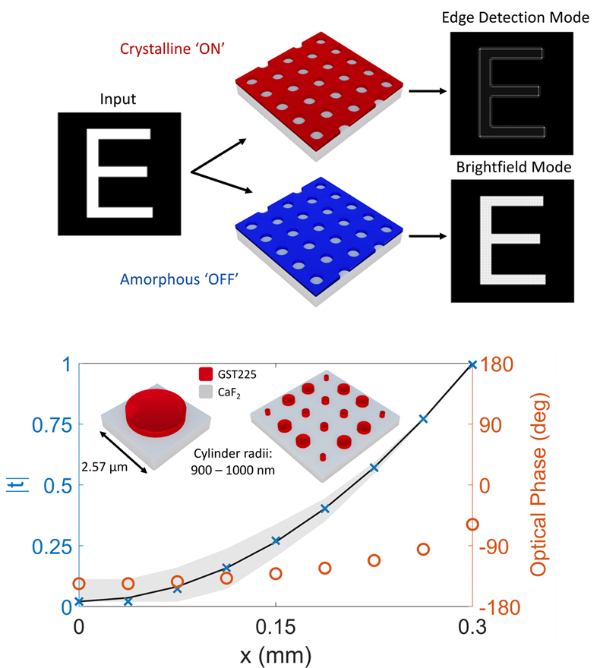
The objective here is to combine all-dielectric and plasmonic metasurface concepts with chalcogenide phase-changematerials to provide fast, dynamic, and tunable control of the amplitude and phase of light. Such active control leads to a wide range of important technical applications, such as dynamic beam steering, holographic displays, reconfigurable and dynamic lensing, optical modulation and the focus of this work- optical analogue computing and multi/hyper-spectral sensing.
Analog optical computing has seen an increase in attention in recent years due to potential advantages it holds over its digital counterpart, including intrinsic parallelism, low-loss transmission and ultra-high bandwidth. Fast and energy efficient optical computing systems have been demonstrated, for example implementing neural networks and matrix-vector multiplication. In A-Meta we are developing metamaterial-based optical computing systems for a range of computational tasks, including image processing, matrix-vector multiplication, optical mode conversion and more. Specifically - along with A-Meta collaborators at the City University of New York, the University of North Carolina at Charlotte and the University of Oxford - we have developed novel convolutional optical computing approaches using active phase-change metasurfaces that enable emerging applications in artificial intelligence-assisted imaging and vision devices with switchable multitasking.
The lead for this Research Challenge is Prof C. David Wright.
Here we will address the lack of practical microwave and terahertz modulators by exploiting the change in conductivity of a semiconductor upon illumination with an optical light source by a novel approach to reduce charge carrier recombination. Fast, high-resolution, and efficient GHz-THz spatial light modulators will be transformative to a new generation of reconfigurable complex systems for imaging, communications, beam steering and more.
Having aligned the optical excitation array with a periodic metasurface, we are able to controllably excite small regions around each meta-atom, and probe its function to the metasurface response. The image shows the photoactive regions around individual meta-atoms in a dual frequency band metasurface: we see individual switching of meta-atoms in both the low (red) and high (green) frequency bands of the surface, as well as defective meta-atoms.
The lead for this Research Challenge is Prof Euan Hendry.

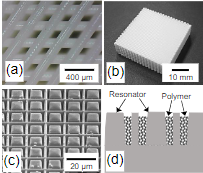
We will develop a new generation of dynamically tunable elastic-wave metamaterials from the micro- to the macroscopic to address (i) the creation of phononic test artefacts enabling in-situ monitoring of additive manufacturing (AM) processes, and (ii) the incorporation of advanced materials, using AM, to create tunable phononic materials and devices for applications such as signal processing.
The lead for this Research Challenge is Prof Geoff Nash.