Course content
Engineering remains at the heart of the UK economy and the demand for skilled and qualified engineers has never been higher.
The modules in this programme aim to enable you to:
- Become a flexible engineering graduate, equipped to work effectively within electrical and electronic engineering methodologies, design and management.
- Practice specialist skills to demonstrate an awareness of the context within which you work and take responsibility for your own personal and professional development.
- Gain awareness of the environmental, economic, social and sustainability issues that are an integral part of the professional engineer’s role. This includes topics related to electrical and electronic systems, with a focus on electrical machines, digital signals and microprocessor technologies.
- Work well in multi-disciplinary groups, with experience of communication, organisation, planning and logistics.
Years one and two provide core fundamental knowledge of engineering principles, as well as applying mathematics to engineering problems. Your three and four are spent applying your knowledge to engineering problems.
You will complete a Technical Report and Presentation in the final year: an opportunity to apply your knowledge and skills to devise an engineering solution at a professional level in an area of engineering study that interests you.
Accreditations
.png)
This programme launches in 2026 and has been developed in close partnership with industry and in consultation with our accrediting bodies. We have already successfully gained accreditation from industry professional bodies for established programmes across the Engineering department. Due to accreditation requirements for new programmes, we cannot seek accreditation until the first cohort is in their final year of the programme. Therefore, we intend to seek backdated accreditation from professional bodies when this requirement has been met, but it may not be guaranteed. If you require any further information, please contact the University directly.
Employer information
The Electrical & Electronic Engineering Apprenticeship has been developed in response to the growing industry demand for engineers with expertise in electrical and electronic systems. The Engineering Department has significant expertise in electronical engineering, particularly in digital electronics, digital signal processing, electric machines, telecommunication systems, electrical and power systems, and microprocessor and microcontroller technologies, making it well-placed to deliver this apprenticeship. This programme also fits within the strategic vision of Engineering 2030, which aims to develop cutting-edge programmes aligned with emerging technological advancements.

Top 15 in the UK for General Engineering
13th in the Complete University Guide 2026

£6.5million investment in our teaching labs, workshop spaces and equipment

Apprentices earn a salary and pay zero tuition fees, meaning they’ll graduate debt-free and enhance their career

Top 2 in the UK for Electrical & Electronic Engineering
2nd in The Guardian University Guide 2026
Entry requirements
The Programme would be able to accept the common UK Qualifications and international equivalent.
| Qualification | Typical offer | Required subjects |
|---|---|---|
| GCSE | 4 or C | Grade 4/C in GCSE English language and Mathematics |
| A-Level | ABB | GCE AL Maths grade B and another science* subject at grade B. Candidates may offer GCE AL Maths, Pure Maths or Further Maths. |
| IB | 32/655 | HL5 in Mathematics (Analysis and Approaches) and HL5 in another Science subject. Applicants achieving IB Maths SL7 plus IB HL5 in Physics will also be considered |
| BTEC Extended Diploma | DDM | Applicants studying one of the following BTEC Extended Diplomas will be considered: Applied Science; Aeronautical Engineering; Building Services; Engineering Construction and the Built Environment; Civil Engineering; Operations and Maintenance Engineering; Computer Engineering; Electrical/Electronic Engineering; Engineering; Manufacturing Engineering; Mechanical Engineering; Environmental Sustainability. |
| T-Level | Distinction | Required Subjects: Design and Development for Engineering and Manufacturing; Engineering; Manufacturing; Processing and Control; Maintenance, Installation and Repair for Engineering: Manufacturing only, Surveying and Planning for Construction. |
NB General Studies is not included in any offer.
*GCE AL/AS science includes: Biology/Human Biology**; Chemistry; Computing; Design and Technology; Economics; Electronics; Environmental Studies; Geography; Geology; Life and Health Sciences; Physical Education; Physics; Psychology; Science (applied); Statistics.
**If more than one of these is taken they would only count as one ‘ science’ but could count as two A-levels towards our general requirements.
Additional entry requirements
In certain cases, recognising applicants’ prior skills and qualifications allows us to accelerate entry to our programme. Please contact us for further information.
Application through Accreditation of Prior Certificated Learning (APCL): Where an applicant can evidence a Level 3 or 4 qualifications (completed within the past five years) which can be accredited to demonstrate there is already an understanding of Electrical and Electronic Engineering principles.
Applications through Accreditation of Prior Experiential Learning (APEL): Applicants must have a minimum of two years engineering industry experience. They must also be in a role that supports the gathering of evidence required for the Electric and Electronic Engineering apprenticeship standard.
As an apprenticeship funding requirement, all apprentices aged 16-18 studying for a level 3 apprenticeship or higher are required to evidence achievement at level 2 in Mathematics and English before their gateway to endpoint assessment.
If the apprentice is aged 19+ when they begin their apprenticeship training, and they do not already hold a suitable equivalent qualification, English and / or maths is an optional part of the programme under the funding rules. However, L2 English remains a standard entry requirement for University of Exeter programmes.
Find out more about how we support Functional Skills.
Applicants must also have a valid and eligible residency status to gain entry onto the apprenticeship – please see the Department for Education website for further information.
How to apply
- Vacancies are advertised by employers and are often promoted through our current vacancies page when they become available.
- Please be aware that each company will have their own recruitment process, the stages and timelines may vary. If applicants are successful, they will be offered a position as an apprentice with the company.
- An apprenticeship place on the programme will be confirmed by University of Exeter, and we will send further information about how to enrol as a student.
Funding
Full programme cost: £27,000
This apprenticeship is entirely funded through an Employers’ Apprenticeship Levy. Your employer fully covers the cost of the apprenticeship, apprentices do not pay for any of the eligible training costs. As an apprentice you will be an employee of your organisation, gaining a University of Exeter award alongside working and earning a salary.
Employers who pay the Apprenticeship Levy will pay for the apprenticeship fees directly through that contribution. See further information about the Apprenticeship Levy funding.
Employers who do not pay the Levy will be able to claim 95 per cent of the cost of the apprenticeship from the Government. Up to 100 per cent Government contribution may be available if the employer has fewer than 50 employees and:
- Recruits an apprentice aged 16-18
- OR an apprentice aged 19-24 who has previously been in care or who has a local authority education, health and care plan
Employers must pay their apprentices a salary at least consistent with national legislation.
Funding eligibility criteria
To be eligible for funding the apprentice must meet the criteria listed in the Department for Education guidance.
The apprentice must have a valid and eligible residency status to gain entry onto the apprenticeship.
Learning
We will foster a strong early talent community across all engineering apprentices through combining cohorts across our engineering degree apprenticeship programmes in the first two years of teaching. This approach will build a South West Hub for engineering skills and give employers opportunities to engage across sectors and industries. Our strong relationships with regional FE providers will also strengthen engineering pathways for apprentices to build their careers within the businesses.
How you’ll learn
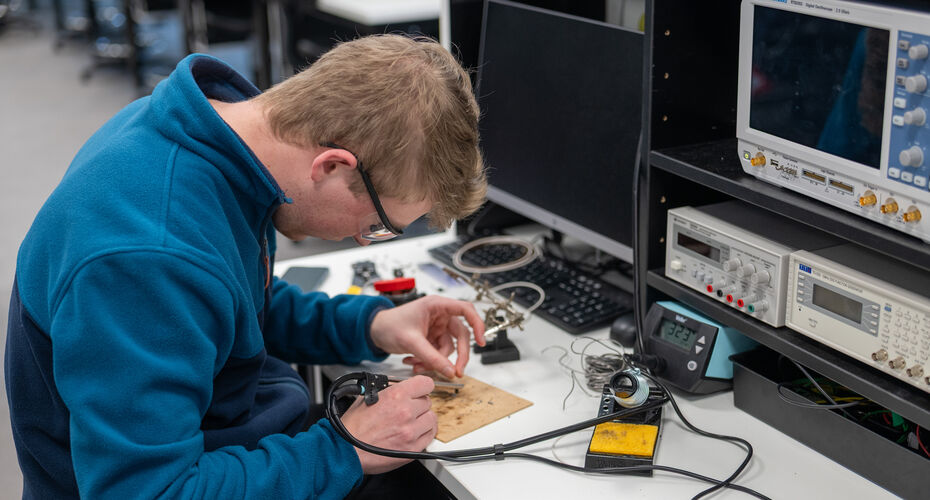
This apprenticeship adopts a balanced approach to supporting student learning through a combination of in-person lectures, hands on practical workshops, research/ industry led masterclasses and digital learning resources. Core topics include specialist subject knowledge supported by a strong foundation across engineering disciplines.
All students will all have access to the world class facilities at the University of Exeter, including benefitting from our recent £6.5 million investment in engineering teaching labs, workshop spaces and equipment. Additionally, students will benefit from established facilities across our Streatham Campus, including student study, wellbeing and careers support.
Assessment
Your performance at Exeter will be assessed in a variety of different ways, to equip you with the necessary skills for the workplace or further study. This includes coursework, lab & workshop-based tasks, exams, presentations and extended project-based activities.
Each module has a set of 'Intended Learning Outcomes' which specify what you should know and be able to do by the end of the module, and assessments are designed to demonstrate these.
Contact hours
Lectures and workshops are delivered through a series of 2-week blocks spaced throughout your degree apprenticeship. Structuring contact hours within these blocks provides a regular dedicated period of study for you to fully focus on your learning.
Outside of contact hours, you will have access to a wide range of the Universities digital resources, including our library, databases, lecture recordings and learning materials. You will also be in contact with a wide range of subject matter expert academics to guide and support your apprenticeship.
Careers
About the apprenticeship
As an apprentice, you will be a full salaried member of an organisation, typically earning between £13,000 and £19,000. Much of your learning will take place at work, either through projects linked to academic content or time set aside for distance learning.
Apprentices will be working in a relevant job from day one of your studies, meaning when you graduate, you'll have both the professional and academic experience sought after by employers.
Employer valued skills
The apprenticeship standard defines an apprentice's capabilities as an Electrical and Electronic Engineer. You will have gained experience in areas including project management, machine learning and AI, managing engineering practices in a safe and sustainable way and communicating with clients and workers of all levels.
Find out more about our Electronic Engineering degree apprenticeship

Employers
We can help you invest in upskilling your people and attract new talent via progression routes.

Aspiring apprentices
Discover why a Degree Apprenticeship is right for you.

Events
Find out more about our programmes and partnering with the University of Exeter.