Request information
Top 100 in the world for Psychology
100% of our Education research has internationally excellent impact*
Top 10 in the UK for Psychology
11th in the UK for internationally excellent research in Psychology
Accreditations
Accredited by the BPS - British Psychological Society
This course is accredited by the British Psychological Society. BPS accreditation confers eligibility for the Graduate Basis for Chartered Membership. This is the first step towards becoming a Chartered Psychologist.
Entry requirements
We usually require a minimum 2:1 Honours degree. No specific subjects are required.
Please note, that in some circumstances, research projects as part of the final dissertation module, students will be required to complete a Disclosure and Barring Service (DBS) check.
Entry requirements for international students
International students need to show they have the required level of English language to study this course.
The required test scores for this course fall under Profile B2.
Find out more about our English language requirements.
The MSc Psychology (Conversion) programme is really fascinating. I’m diving into topics that I’ve been interested in before, but now I’m getting a chance to discover more about them in greater detail.
I’ve also loved the friendships I’ve made. We’ve started a WhatsApp group and are sharing the highs and lows of studying online. It’s replaced the time you’d usually spend in the coffee shop after a lecture if you were on campus.
Read more from Carys
Carys
MSc Psychology (Conversion) Online student
Course content
Please note that programme structures may be subject to change. The modules listed here are indicative. The precise modules available to you in future years may vary depending on your point of entry, staff availability and research interests, new topics of study and student demand.
This course is specifically designed for graduates with non-psychology degrees to obtain a British Psychological Society - accredited postgraduate degree.
Completion of this course enables you to gain Graduate Basis for Chartered Membership of the BPS, allowing you to work as a psychologist in a variety of different fields, including education, clinical, forensic and organisational.
The course offers general training in psychology, making it of value to people with a broad range of aspirations, but also provides the option of specialising in clinical or educational psychology.
Fully online, it enables students to study in their own time, and without needing to attend campus.
Modules
The order in which modules are taken will vary slightly, depending on the entry point during the year. However, the module order in the course has been carefully thought out to maximise your potential for success.
In general, both Research Methods and Conceptual Issues in Psychology and Introduction to Statistics modules are taken in the first two terms, while the Research Project module is taken towards the end.
If you wish to complete the programme in two years, the course is structured so that pairs of modules are taken every term. Whereas, if you decide to take the programme in three years, for the most part, only one module is taken per term.
However, please note to complete the programme in a 3 year timeframe, there will be one term where you will need to take two modules. We will work with you to select which term is most feasible for this. As you will be taking two modules, it will double the estimated study time per week for that term.
Please note that the module information displayed here is from a previous year and is subject to change.
165 credits of compulsory modules, 15 credits of optional modules
Compulsory modules
| Code | Module |
Credits |
|---|
| PSYM220Z |
Research Project | 60 |
| PSYM221Z |
Introduction to Statistics | 15 |
| PSYM222Z |
Research Methods and Conceptual Issues in Psychology | 15 |
| PSYM223Z |
Social Psychology | 15 |
| ERPM006Z |
Cognitive and Developmental Psychology | 15 |
| PSYM225Z |
Biological Psychology | 15 |
| ERPM007Z |
Personality and Individual Differences | 15 |
| ERPM008Z |
Children and Young People's Mental Health | 15 |
Optional modules
| Code | Module |
Credits |
|---|
| PSYM227Z |
Clinical Psychology | 15 |
| ERPM010Z |
Educational Psychology | 15 |
Pay as you study
Fees:
£15,000 in total
How fees work
The MSc Psychology (Conversion) consists of 180 master’s-level credits and has a total tuition fee of £15,000, based on completion over the minimum study period of two years.
Fees are charged per 15-credit module, with each module costing £1,250. You can pay in full at the beginning of the course or as you go by paying for the module or modules you are registered to study in each term.
You can choose from three study duration options. The total cost is the same across all routes, but the number of modules taken per term determines how tuition fees are spread over time.
Study duration options
All study routes are part-time. The difference between them is the number of modules taken per term.
- 2 years: two 15-credit modules per term throughout
- 3 years: one 15-credit module per term, with two modules taken in the second term of the first year and research project (see below)
- 3 years and 1 term: one 15-credit module per term until research project (see below)
UK postgraduate student finance may be available for the 2-year and 3-year study options. The 3 years and 1 term option is not eligible for student finance.
Research Project
The programme includes a 60-credit independent research project, completed over two consecutive terms across all study durations. The research project is charged at the same per-module rate and forms part of the total programme fee.
Other costs to consider
As well as your fees, there are some potential additional costs to be aware of to ensure that you give yourself the best chance of success. These include a suitable computer or device to study and work from, an adequate internet connection to access your learning materials and connect with others, and a comfortable place to study.
While our online programmes do not require any attendance on campus, as a student of the University of Exeter you are always welcome to visit. You may also be offered the chance to attend a graduation ceremony in person, for which travel costs and gown hire will apply.
Help with paying for your studies
If you are struggling to afford your chosen programme of study, some help may be available from either the government or the university. This includes:
-
Postgraduate student loans.
If you live in the UK, you may be able to access a loan to help pay for your online degree fees and living costs while you study. To be eligible, you must not already have a Masters degree (or above). For information on how to apply and your student finance entitlement, please visit the following links depending on whether you live in England, Wales, Scotland or Northern Ireland.
If you are awaiting the approval of a postgraduate loan to pay for the course and evidence is provided through the Admissions application gateway, access to learning material will be provided prior to receipt of payment.
-
Disabled Student Allowance (DSA).
Most UK students with a physical disability or mental health difficulty, long term health condition or specific learning difficulty will be able to apply for Disabled Students’ Allowance which can help towards the cost of specialist equipment, one-to-one support and other costs associated with your condition. If you feel this applies to you, you are encouraged to apply as early as possible as the whole process can take up to 12 weeks. If you complete an application and are not eligible for DSA, please make an appointment with the Access Ability Team to discuss alternative funding and support.
-
Success for All fund.
Some financial support may be possible through our Success for All fund as assessed on a case-by-case basis providing eligibility criteria are met. Fully online students are not automatically eligible for an IT bursary, but exceptions may be made in some circumstances. However, please note the University would expect students to have made reasonable provision to support themselves during their studies prior to enrolling on a module.
-
Employer sponsorship.
Your employer or another organisation you are associated with may be happy to pay all or part of your fee. If you are getting financial support in this way, we can invoice them directly for the value that they have agreed to support before you start your studies. You will have to pay any balance so that the module you are studying is paid in full before you start.
-
Student discounts.
Our online students are fully registered students of the university, and therefore can ask for an Exeter Unicard, which can be used to access a wide range of student discounts on everyday items including food and clothing. You can also apply for student discounts on products and services through the UniDays card.
If you would like help understanding how fees, funding and study duration work together, you can arrange a conversation with one of our advisers, who can talk you through your options in more detail.
Read more
What opportunities does an online Psychology Conversion Masters lead to?
Employer-valued skills this course develops
This programme is specifically designed to enable students with a non-psychology background to pursue a career in psychology, many of which require a BPS-accredited degree for further training. This degree will help prepare graduates for a subsequent career in, for example, clinical psychology, educational psychology, organisational and occupational psychology, and forensic psychology.
Careers services
Studying with us not only offers outstanding opportunities for career development, but also the chance to tap into a worldwide peer and research network. Additionally, learning in a virtual environment both enhances and demonstrates vital skills that employers are seeking in the modern workplace, such as communication and time-management skills, the ability to self-motivate and direct, and an ease with digital technologies.
Teaching and learning
How will I learn?
The MSc Psychology (Conversion) is delivered entirely online through a structured, term-based model. Teaching materials are accessed via the University of Exeter’s online learning environment.
You will be assigned an academic personal tutor who is familiar with the programme and can support your academic and professional development, including guidance on studying psychology online and signposting to relevant university resources.
All learning takes place in the Exeter Learning Environment (ELE), which provides access to:
- Written, recorded and interactive teaching materials
- Quizzes to check learning and understanding
- Videos, podcasts and academic reading
- Electronic books and library resources
- Assessment guidance and submission deadlines
Each module has an academic lead, often supported by a team of tutors, who direct learning and provide feedback throughout the term.
Time commitment
Students should expect to spend around 10–15 hours per week per 15-credit module. This includes engagement with teaching materials, independent study and preparation for assessments. Study time varies depending on prior experience and where you are in the programme.
How you organise this time is flexible. You may choose to study regularly across the week or concentrate learning into longer sessions around work and personal commitments. If you study two modules in a single term, your expected study time for that term will be higher.
Research project
All students complete a 60-credit independent research project, completed over two consecutive terms across all study durations. This extended timeframe supports project planning, data collection, analysis and academic writing, with academic supervision throughout.

Lirong
Studied MSc Psychology (Conversion) Online
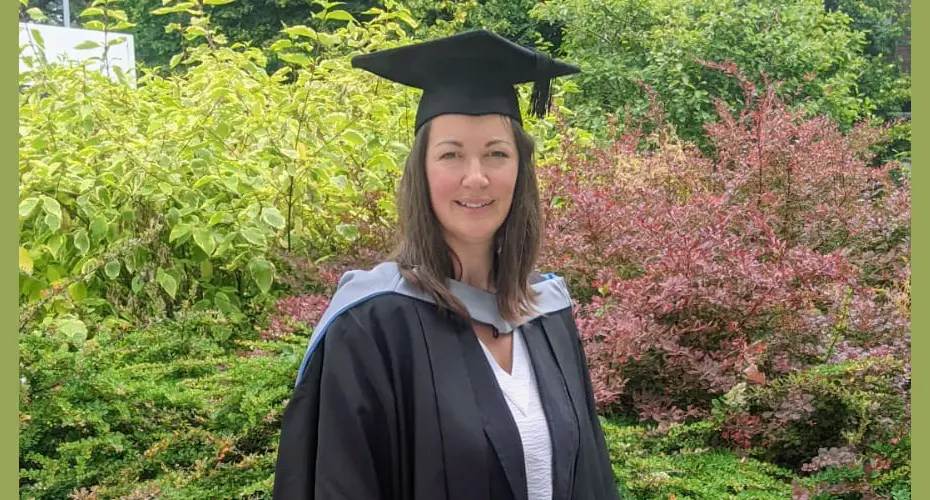
Helen
Studied MSc Psychology (Conversion) Online
Lirong
Studied MSc Psychology (Conversion) Online
"I greatly value the opportunity to take my first step toward a career transition through the MSc Psychology (Conversion) programme. Through this experience, I developed a strong theoretical foundation and the confidence to conduct an independent research project under close supervision."
Helen
Studied MSc Psychology (Conversion) Online
“The course strikes a balance in flexibility and challenge. I now view research with greater criticality, can apply mixed methodologies to practice, and appreciate both classical and contemporary theory. The research supervision and student WhatsApp support group were especially valuable.”