Britain and Slavery: Sources
| Module title | Britain and Slavery: Sources |
|---|---|
| Module code | HIH3324 |
| Academic year | 2020/1 |
| Credits | 30 |
| Module staff | Dr Ryan Hanley (Convenor) |
| Duration: Term | 1 | 2 | 3 |
|---|---|---|---|
| Duration: Weeks | 11 | 11 |
| Number students taking module (anticipated) | 16 |
|---|
Module description
Britain led the world in pursuing both slavery and its abolition. For some, this global system of theft and murder generated vast wealth and enabled access to influence and prestige at the highest levels of British society. For others, it represented a mortal evil that had to be stopped at any cost. This module introduces you to the sources that document Britain’s historical and contemporary relationships to slavery, emphasising the experiences and testimonies of the enslaved themselves. Bringing together black autobiography, propaganda, manuscript correspondence, art, and ‘big data’ sources, this module explores how slavery came home to Britain.
Module aims - intentions of the module
This module, along with its Context co-requisite, examines the evolving relationship between colonial slavery and metropolitan life in Britain from the early eighteenth century to the present day. By examining black autobiography, court records, quantitative databases, visual and material culture, published polemic, architecture, and manuscript materials from Exeter’s special collections, it aims to give youa grounding in the multifarious ways in which slavery and its cultures insinuated themselves into everyday life in Britain. It complicates familiar narratives of slavery and abolition by exploring the ways in which both sides of the discussion were linked to imperial expansion, racial thought, social hierarchies, and international diplomacy. In terms of its source selection, this module has a special emphasis on the experiences of the enslaved themselves, in particular making extensive use of first-hand enslaved testimony, encouraging you to consider the human implications of a vast, global system. It also considers the memory, representation and legacies of this history in the contemporary world, using modern art, campaigning materials, film and the built environment to explore the afterlives of slavery in Britain.
Through dialogue with the Context co-requisite, you will be encouraged to engage with these diverse sources interdisciplinarily, for instance by paying attention to how composition and the use of colour, as well as historical context, affects the meaning of visual representations of slavery. This module therefore aims to introduce you to interdisciplinary approaches to complex historical questions; no formal prior training in these methodologies is expected.
Intended Learning Outcomes (ILOs)
ILO: Module-specific skills
On successfully completing the module you will be able to...
- 1. A detailed knowledge of the different sources available for the study of colonial slavery and its lasting impact on metropolitan Britain, together with a very close specialist knowledge of those sources which you will focus upon in their seminar presentations and written work.
- 2. Ability to analyse the complex diversity of the sources studied.
ILO: Discipline-specific skills
On successfully completing the module you will be able to...
- 3. Ability to analyse closely original sources and to assess their reliability as historical evidence. Ability to focus on and comprehend complex texts
- 4. Ability to understand and deploy relevant historical terminology in a comprehensible manner.
- 5. Ability to follow the changing representations and effects of slavery in Britain
ILO: Personal and key skills
On successfully completing the module you will be able to...
- 6. Independent and autonomous study and group work, including presentation of material for group discussion, developed through the mode of learning
- 7. Ability to digest, select and organise material to produce, to a deadline, a coherent and cogent argument, developed through the mode of assessment
- 8. Ability to present complex arguments orally
Syllabus plan
This module focuses on a range of different source-types, documenting the relationship between Britain and slavery from the early eighteenth century to the present day. Organised broadly chronologically, it examines the following themes: slavery and the development of the British economy; the effects of slavery on migration to Britain and its demography; conceptions of human difference, especially the emergence of whiteness; slavery and British responses to the American, French and Haitian revolutions; the resistance of the enslaved, including violent uprisings, absconding, tool-breaking, infanticide, and publishing testimony; slave-produced commodities and consumer culture, including boycotts; the abolitionist movements; the role of antislavery in the expansion of the British Empire; the lasting legacies of British slavery; and the commemoration and forgetting of slavery in contemporary culture.
You will be introduced to the broad chronology and key developments in the history of transatlantic slavery at the beginning of the course, along with some of the major collections of primary sources available for their consultation. The seminars themselves will focus on specific sources drawn from online databases, published transcripts, or material held locally in Exeter’s special collections. Working closely with these materials alongside the historiography and contextual material in the Context co-requisite, you will be encouraged to approach them from a range of disciplinary perspectives to shed light on each week’s key themes and questions, as highlighted above. You will be expected to prepare for seminars by reading and evaluating the relevant sources in advance, and will discuss the issues raised by them in the seminars. In addition, you will be asked to work in groups to examine and present sources drawn from the major collections they have been introduced to during the course.
Learning activities and teaching methods (given in hours of study time)
| Scheduled Learning and Teaching Activities | Guided independent study | Placement / study abroad |
|---|---|---|
| 44 | 256 | 0 |
Details of learning activities and teaching methods
| Category | Hours of study time | Description |
|---|---|---|
| Scheduled learning and teaching activities | 44 | 22 x 2 hour seminars. |
| Guided independent study | 256 | Reading and preparation for seminars, coursework and presentations. |
Formative assessment
| Form of assessment | Size of the assessment (eg length / duration) | ILOs assessed | Feedback method |
|---|---|---|---|
| Seminar discussion | Ongoing through course. | 1-6, 8 | Oral from tutor and fellow students. |
Summative assessment (% of credit)
| Coursework | Written exams | Practical exams |
|---|---|---|
| 70 | 0 | 30 |
Details of summative assessment
| Form of assessment | % of credit | Size of the assessment (eg length / duration) | ILOs assessed | Feedback method |
|---|---|---|---|---|
| Portfolio | 70 | 2 assignments totalling 4000 words | 1-7 | Oral and written. |
| Individual Presentation | 30 | 25 minutes | 1-8 | Oral and written. |
Details of re-assessment (where required by referral or deferral)
| Original form of assessment | Form of re-assessment | ILOs re-assessed | Timescale for re-assessment |
|---|---|---|---|
| Portfolio assignment | Portfolio assignment | 1-7 | Referral/deferral period. |
| Presentation | Written transcript (2500 words) | 1-8 | Referral/deferral period. |
Re-assessment notes
Deferral – if you miss an assessment for certificated reasons judged acceptable by the Mitigation Committee, you will normally be either deferred in the assessment or an extension may be granted. The mark given for a re-assessment taken as a result of deferral will not be capped and will be treated as it would be if it were your first attempt at the assessment.
Referral – if you have failed the module overall (i.e. a final overall module mark of less than 40%) you will be required to submit a further assessment as necessary. If you are successful on referral, your overall module mark will be capped at 40%.
Indicative learning resources - Basic reading
Perspectives of the enslaved:
- Selections from Phillis Wheatley, Complete Writings, ed. Vincent Carretta (London: Penguin, 2001; 2012).
- Ukawsaw Gronniosaw, A Narrative of the Most Remarkable Particulars in the Life of James Albert Ukawsaw Gronniosaw, an African Prince, as Related by Himself (Bath: W. Gye and T. Mills, [1772]).
- Ignatius Sancho, Letters of the Late Ignatius Sancho, An African (London: J. Nichols et al, 1782).
- Ottobah Cugoano, Thoughts and Sentiments on the Evil and Wicked Traffic of the Slavery and Commerce of the Human Species (London: [n.p.], 1787).
- Olaudah Equiano, The Interesting Narrativeof the Life of Olaudah Equiano or Gustavus Vassa, the African, written by himself (London, 1789).
- Boston King, ‘Memoirs of the Life of Boston King’ in: Anon. (ed.), The Methodist Magazine, for the Year 1798; Being a Continuation of The Arminian Magazine (London: G. Whitfield, [1799]), pp. 105-110, 157-161, 209-213. 261-265.
- John Jea, The Life, History and Unparalleled Sufferings of John Jea, The African Preacher (Portsea: John Williams, [1817]).
- Mary Prince, The History of Mary Prince, a West Indian Slave, Related by Herself, 3rd ed. (London: F. Westley and A. H. David, 1831).
- Robert Wedderburn, The Horrors of Slavery (London: R. Wedderburn, 1824).
Other published material:
- Clarkson, Thomas, The History of the Rise, Progress and Accomplishment of the Abolition of the African Slave Trade (London: Longman et. al., 1808), 2 vols.
- Fox, William, An Address to the People of Great Britain, on the Propriety of Abstaining from West India Sugar and Rum (London: M. Gurney, 1791).
- Anon., Slave Trade: The Negro and the Free-born Briton compared; or, a Vindication of the African Slave Trade (London: J. Stockdale, 1788)
- Anon, Address to the Females of Great Britain on the Propriety of their Petitioning Parliament for the Abolition of Negro Slavery (London: J. G. & F. Rivington, 1833).
- Long, Edward, The History of Jamaica, 2 vols. (London: T. Lowndes, 1774).
- Sharp, Granville, A Representation of the Injustice and Dangerous Tendency of Tolerating Slavery (London: Benjamin White, 1769).
- Wilberforce, William, The Speech of William Wilberforce Esq. […] on the Question of the Abolition of the Slave Trade (London: Logographic Press, 1791).
Indicative learning resources - Web based and electronic resources
ELE: https://vle.exeter.ac.uk/course/view.php?id=11354
Online Databases:
- Legacies of British Slave-ownership Database: http://www.ucl.ac.uk/lbs
- The Trans-Atlantic Slave Trade Database: https://www.slavevoyages.org/
- Runaway Slaves in Britain: https://www.runaways.gla.ac.uk/
- The Antislavery Usable Past: http://antislavery.ac.uk/
Visual and Material Culture:
- George Cruikshank, The New Union Club(1819)
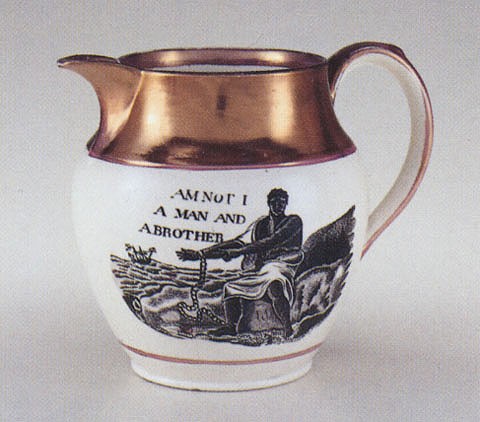
- Anon., anti-slavery milk jug, c.1820
- Josiah Wedgwood, Anti-slavery cameo (1787)
- Gabriel Matthias, ‘William Ansah Sessarakoo’ (c.1749)
- Robert Cruikshank, John Bull Taking a CLEAR VIEW of the NEGRO SLAVERY QUESTION!!!(1826)
- Lubaina Himid, Swallow Hard: The Lancaster Dinner Service(2007)
- Graham Fagen, Plans and Records(2007)
Indicative learning resources - Other resources
- Exeter Electronic Library resources include:
- Eighteenth-Century Collections Online (ECCO); Making of the Modern World; British Library Newspapers
- Online; Nineteenth Century Periodicals Online; Selections from The National Archives
| Credit value | 30 |
|---|---|
| Module ECTS | 15 |
| Module pre-requisites | At least 90 credits of History at Level 1 and/or Level 2. |
| Module co-requisites | HIH3325 |
| NQF level (module) | 6 |
| Available as distance learning? | No |
| Origin date | 13/01/2020 |
| Last revision date | 20/08/2020 |