Entry requirements for our Secondary PGCE in Modern Foreign Languages
Alongside our general entry requirements for all Secondary PGCE applicants, there are subject-specific entry requirements for Modern Foreign Languages specialism applicants.
Typically, successful applicants have a 2:2 Honours degree or above in their chosen language (French or Spanish). Other qualifications of degree level equivalence will be considered, e.g. Final Diploma of Institute or Linguists. Native speakers should hold a qualification (in any subject area) equivalent to a UK degree at a minimum of a 2.2.
Trainees should have a second language in French or Spanish (even if only at beginners' level) as this will help with employability. However, applicants with only one language are encouraged to still apply for a place on the course.
If successful, and as a condition of their offer, applicants without a second language will be directed to complete a Subject Knowledge Enhancement (SKE) course in a second language (French or Spanish) prior to the PGCE course starting.
If you are an applicant without an existing second language, you are still welcome to apply but you will need to commit to developing a basic competence in a second language (French or Spanish) before the course starts by completing some recommended self-study and a longer SKE.
Course content and leaders
You will explore teaching methods that bring your chosen languages and culture to life within the four walls of the classroom. Using the most up-to-date research you will develop a solid grounding in the approaches to language learning which puts an emphasis on communication and language as structure as recommended in the National Curriculum.
You’ll also develop the fundamentals of teaching such as behaviour management, assessment, lesson planning, inclusive teaching, and working with the school community and parents. We’ll support you to become a reflective and confident teacher who is able to assess your own achievements and professional development requirements.
Having a second language will help with employability and as such, provision is made for you to develop competence in French or Spanish as a second language.
Secondary Subject Subject Knowledge, Pedagogy, Research, and Practice
Our unique course structure based on the Exeter Model of Initial Teacher Education is praised by Ofsted and used across our subject areas. You will study a specialist Secondary Subject Knowledge, Pedagogy, Research, and Practice module alongside this. The principal aim of this module is to equip you with a comprehensive understanding of the background issues and practice of the current teaching of French or Spanish in secondary schools. In addition, the module seeks to nurture you as a reflective and autonomous professional practitioner, able to identify strengths and areas for development in your subject knowledge and pedagogy, through evaluating current professional practice in relationship to developments in research and curriculum theory.
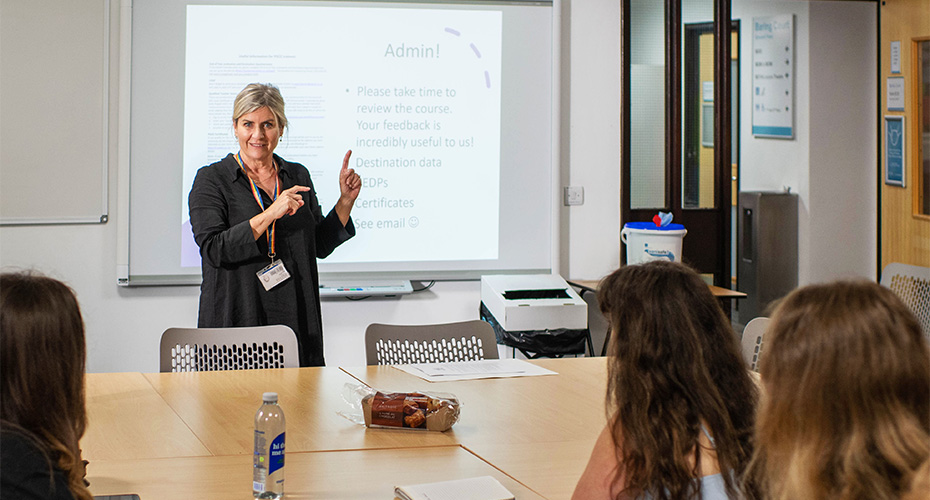
Dinah Warren
Senior Lecturer in Languages Education
Dinah Warren
Senior Lecturer in Languages Education
Dinah started her teaching career in a comprehensive school in central London, before moving on to a Head of Department role in new school in North Finchley. After moving to Devon in 2000, Dinah began teaching in a local comprehensive school, where she worked until 2012, combining this with some work on the Primary and Secondary PGCE course. She now works on the PGCE full time.
Profile page