Advice on writing a successful personal statement
The personal statement is your opportunity to explain why you want to study a particular course, as well as what will make you a good student. You’ll need to demonstrate your enthusiasm, subject knowledge and any relevant skills.

Things to consider when writing your personal statement
- It’s one statement for up to five UCAS choices, so make sure you don’t mention a specific university or college by name.
- You’re limited to 4,000 characters, so keep your statement concise and to the point.
- The statement is made up of 3 sections, each section has a minimum character count of 350 characters.
- Try to use recent examples of achievements and accomplishments and tell us what you gained/learned from doing them.
- Some higher education providers may use your personal statement as the basis for an interview, so be prepared to answer questions on it.
- We are looking for evidence of a willingness and desire to learn at a higher level, for students who have the potential and the drive to succeed.
Statement sections
The personal statement is made up of three sections. These questions are designed to be a roadmap to help you organise your ideas for – UCAS have asked these questions to help you breakdown your statement into manageable parts. They should be considered as a conversation; how would you answer the question if you were asked.
Why do you want to study this course or subject?
Show your passion and knowledge for your chosen subject. It lets universities and colleges know why you’re a good fit.
How have your qualifications and studies helped you to prepare?
Talk about the skills you’ve developed in your education, and how they’ll help you succeed.
What else have you done to prepare outside of education, and why are these experiences useful?
Reflect on any other activities or personal experiences outside the classroom that make you suited to the course.
There is no right or wrong place to include your specific examples, it might be that information about a subject you have studied might be suitable in either of the first two questions. Where you choose to include information will depend on the experiences you have to share.
Thinking about your motivation
We’ve said that when writing your personal statement you need to focus on the subjects you’re applying to. This means you should consider your reasons for applying. Your chosen universities will want to know why you’ve selected the subject you wish to study with them. Perhaps you’re motivated by your passion for the subject, or perhaps the subject relates to your future career ambitions.
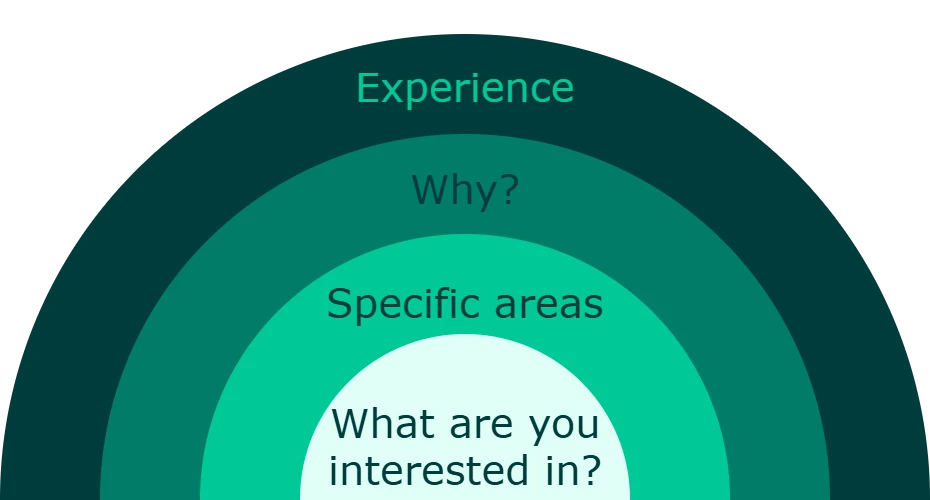
The rainbow diagram offers a structure for drafting your personal statement. Your chosen subject is the core and the first layer is about the specific areas of that subject that interest you. For the second layer, consider the reasons for your choice. The third and final layer is about all the experience you have that you can relate to the subject.
You can create your own rainbow diagram or simply write notes for each heading. This will help you pin down your knowledge and interests related to the subject. It can help you convey that you’ve undertaken your research and really thought through your decision.
Thinking about your skills
Transferable skills are skills you’ve gained in one area of life that can be transferred to another. Everyone has them, but they can be hard to identify. Your personal statement should include transferable skills that will be useful at university. The table below can help you identify different activities you’ve undertaken, skills you’ve gained and how these might be useful for university. Alongside previous/ current studies, you can include hobbies, volunteering, work experience and more. List all the activities you can think of, even if they don’t seem relevant at first. We’ve included an example.
Examples of transferable skills include:
budgeting, verbal/written communication, problem solving, creativity, critical thinking, listening, empathy, organisation, time management, leadership, numeracy, teamwork, confidence, independence.
| Activity | Skills attained | Links with your subject |
|---|---|---|
| Looking after siblings | Communication, problem solving, independence, listening and organisation. | Communication – needed to speak with students Organisation – managing independent study effectively. |
Personal statement dos and donʼts
Do
- Research your subject(s) and chosen providers
- Write what comes naturally
- Ensure it flows and has a logical structure
- Check that it’s free from grammar and spelling mistakes
- Get it proofread
Don't
- Include misleading information
- Take risks with what you include
- Plagiarise
- Use bullet points or lists
- Leave it to the last minute
- Submit it without checking
How to share personal information
There might be some information that you do not want to share in your personal statement, but you want us to be aware of. Depending on what you want us to know there are two ways to include these details so that you can use your personal statement to highlight your interest and enthusiasm for your chosen course.
Individual needs
This might include a physical and/or mental health condition, long-term illness, or learning difference, this does not have to be included in your personal statement, you can share your individual needs in the 'More about you' section of your UCAS application.
Extenuating circumstances
We understand that your studies can at times be disrupted due to a number of extenuating circumstances, which may include serious health or personal problems. If you have experienced or are currently experiencing issues which you believe have impacted on your studies or exams, we ask that you complete our online Extenuating Circumstances form in addition to completing your UCAS application.
This advice is not exhaustive. There are lots of other useful resources online. The UCAS website is a good place to start and also includes bespoke advice for carers, estranged students, refugees and asylum seekers.