Secondary PGCE courses and specialisms
We offer exceptional, internationally recognised teacher training. You will have tutors who are experienced teachers and specialists in your chosen subject who are also involved in the cutting edge of national educational research, giving you the best of both worlds. Applications are made through the DfE's Apply service. You can find out more about applying for a PGCE on our 'how to apply' webpages.
| Specialism | Course Leader | DfE Apply Code |
|---|---|---|
| Secondary PGCE English | Dr Ruth Newman and Dr Sharon Morgan | 2BT6 |
| Secondary PGCE Geography | Bryan Smith | N794 |
| Secondary PGCE History | Bryan Smith | V1X1 |
| Secondary PGCE Maths | Dr Thomas Ralph | G1X1 |
| Secondary PGCE Modern Foreign Languages (French and Spanish) | Dinah Warren | R1X1 (French) R4XC (Spanish) |
| Secondary PGCE Physical Education (PE) | Will Katene | X9C6 |
| Secondary PGCE Science (Biology) | Dr Luke Graham | C1X1 |
| Secondary PGCE Science (Chemistry) | Dr Luke Graham | F1X1 |
| Secondary PGCE Science (Physics) | Dr Luke Graham | F3X1 |
| Secondary PGCE Science (Biology with Physical Education) | Dr Luke Graham | B346 |

Top 150 in the world for Education Studies
The Times Higher Education World University Rankings by Subject 2026

82% of our Education research has internationally excellent impact
Based on research impact rated 4* + 3* in REF 2021

Accredited by the DfE to deliver Secondary ITE courses

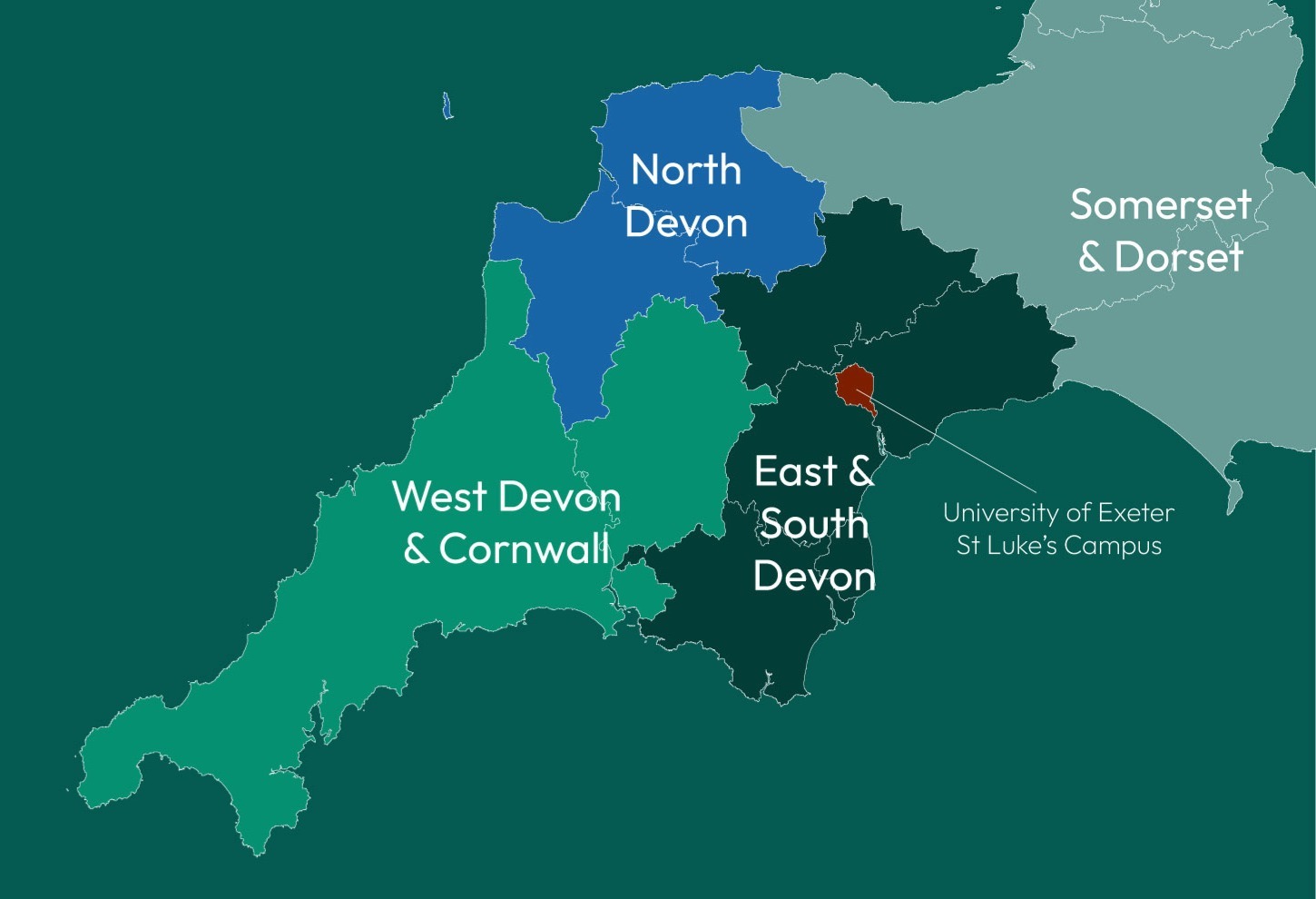
Diverse placement opportunities across the region
Course content
We provide you with a carefully scaffolded programme, so you are ready to teach from your first lesson. The course is designed to provide engaging and varied opportunities for you to develop the necessary knowledge, understanding and skills. The course provides you with a master’s level academic qualification (PGCE) and Qualified Teacher Status (QTS) at secondary (11-16) level. We also offer additional experience of post-16 teaching.
A practical and interactive course, you will focus on a range of teaching styles and educational methods distinct to teaching and learn how to motivate and engage your students in the classroom. You’ll also develop the fundamentals of teaching such as behaviour management, assessment, lesson planning, inclusive teaching, and working with the school community and parents. We’ll support you to become a reflective and confident teacher who is able to assess your own achievements and professional development requirements.
Secondary trainees need to attend in Exeter for 2 or 3 days a week during the Autumn term. You will have placements within commutable distance of Exeter or nearer to your home location if you prefer in the Spring and Summer terms.
20 days of the course are dedicated to Intensive Training & Practice, focusing on four themes of teaching and learning which enable you to delve deeply into particular key areas. You will learn about principles underpinning each theme, work with expert practitioners in university and school settings, and use the Exeter Model Framework to reflect on and synthesise your learning.
During the year you will have both an in-school subject specialist mentor and a university subject specialist mentor. Both mentors will work with you as you develop your practice, challenge your thinking about teaching to enhance your performance, and be available to support you through the year. You will also have a personal tutor to provide pastoral support.
(The structure and modules we outline here provide examples of what you can expect to learn on this course based on recent teaching. The precise modules available to you in future years may vary depending on staff availability and research interests, new topics of study, timetabling and student demand.)
Please note that the module information displayed here is from a previous year and is subject to change.
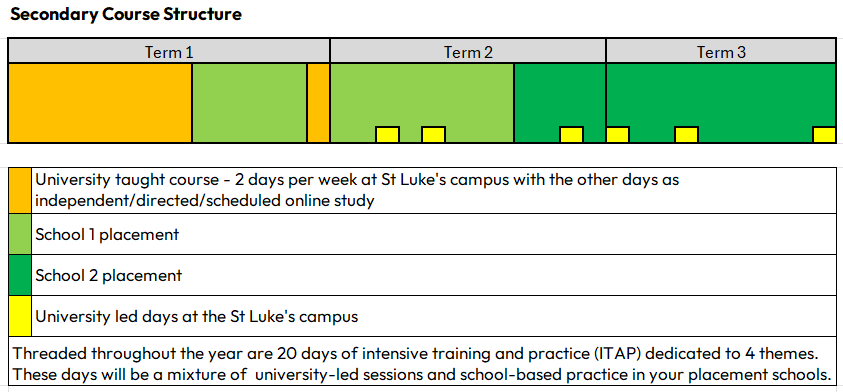
The course is part campus-based and part school-based with most of the campus-based provision in term 1.
During term 1 the campus-based delivery uses in-person and blended approaches which means you attend the St Luke’s campus for two* days each week with independent, directed and scheduled online study for the rest of the week. During this term you will also have a 5-week school placement, where you will be in school 5 days per week.
* Biology with PE trainees will attend the St Luke's campus for three days each week due to the extra PE input they receive.
Term 2 is predominantly school-based where you return to the same placement school. You will also return to the St Luke’s campus for 3 individual days of university input. Towards the end of this term you will change schools to your second placement school.
Term 3 is predominantly school-based in your second placement school with a further 3 days of university input back on campus.
Please note that the module information displayed here is from a previous year and is subject to change.
This component introduces you to key educational ideas and principles within a range of educational contexts. The module is followed throughout the year with both University and school-based elements and is concerned with classroom issues, whole school issues and the role of education in the wider society.
Please note that the module information displayed here is from a previous year and is subject to change.
Central to the course is the development of your ability to meet the standards of professional competence which trainees must demonstrate in order to meet national standards for the award of QTS. This module enables you to reflect on your professional development and demonstrate via an Individual Development Portfolio (IDP), evidence of your ongoing progression towards Qualified Teacher Status.
Please note that the module information displayed here is from a previous year and is subject to change.
The principal aim of the module is to equip you with a comprehensive understanding of the background issues and practice of the current teaching of your chosen subject in secondary schools. In addition, the module seeks to nurture you as a reflective and autonomous professional practitioner, able to identify strengths and areas for development in your subject knowledge and pedagogy, through evaluating current professional practice in relationship to developments in research and curriculum theory.
Entry requirements
Secondary PGCE students must have an honours degree and GCSE English & Mathematics at Grade C/4 or equivalent. A satisfactory medical assessment and DBS enhanced check along with satisfactory references are also requirements for entry. Selection is based on the information provided on the DfE Apply application and on performance at interview.
There are subject-specific entry requirements for each specialism. Typically, we are looking for applicants who have a 2:2 Honours degree or above in a degree in their chosen subject specialism or a related subject. Some subjects also require an A-Level or equivalent in their chosen subject. Full entry requirements for each specialism are available on the relevant subject webpage.
For applicants without the required GCSE pass at grade C/grade 4, we accept a Grade 4 pass in the English and Mathematics equivalency tests offered by A Star Equivalency and equivalencytesting.com (please do contact the PGCE Admissions team for further guidance before signing up for an equivalency test). See full list of accepted English/Maths equivalent qualifications.
We want all potentially excellent teachers to have the opportunity to train. If your qualification profile does not fit that described above, please do contact us.
Please also see our guidance on essential documentation required for an initial decision on taught programme applications.
Entry requirements for international students
Please visit our entry requirements section for equivalencies from your country and further information on English language requirements.
Fees
2026/27 entry
- UK: £9,790 full-time
- International: £24,950 full-time
A variety of attractive financial support packages including bursaries and scholarships are available.
Scholarships
The University of Exeter offers a wide range of scholarships to support your education, with £7 million available for international students applying to study with us in the 2026/27 academic year, including our prestigious Exeter Excellence Scholarships*. We also provide scholarships for sport, music and other achievements, alongside regional and partner awards such as Chevening, The Beacon Trust and the British Council. Financial support is available for students from disadvantaged backgrounds, lower income households and other under-represented groups to help them access, succeed and progress through higher education.
* Terms and conditions, including deadlines, apply. See our website for details.
Teaching and research
Our unique approach to Initial Teacher Education is praised by Ofsted and provides fantastic opportunities for trainees to achieve through our highly original Exeter Model of Initial Teacher Education. The programme runs over three terms and provides a carefully phased development of trainees’ independence as teachers.
The taught element is made up of timetabled seminars, lectures and self-directed study. You will be asked to work individually and as part of small and larger groups. You will be supported in developing the full range of teaching skills and effective reflection that you will need in your first teaching post as an Early Career Teacher (ECT).
Learning is primarily face to face during the campus-based teaching, and wholly face to face during school experience placements. The campus-based elements of the course are taught mainly through seminars and workshops with a significant element of directed collaborative group work and self-study. All modules are assessed through course work and there are no final examinations.
Vibrant community
By learning on campus for most of the first term you have access to the tools needed to rapidly build professional knowledge and confidence ready for your work in school placements. You also benefit from the opportunity to build friendships and become part of a community of trainees and teachers who are passionate about education and will support you during your course and beyond.
Facilities and support
You’ll have access to a range of support, including a personal tutor, materials available through our online learning environment including lecture notes, presentations, film clips and reading materials, and access to the University’s wellbeing and support services. We carry out a detailed skills audit with every trainee so we understand your development needs and can personalise elements of training to strengthen the skills you need to excel as a teacher.
Campus-based modules are taught at the School of Education at the St Luke’s Campus in Exeter, which offers an excellent range of specialist facilities and the UK’s largest Education library.
Research-led teaching
You will join a vibrant postgraduate community at the School of Education, studying with some of the leading scholars in their disciplines.
You will benefit from our active research culture, which promotes the sharing of ideas and knowledge to encourage innovation. Our research centres provide a focus for research and discussion for academic staff, researchers and practitioners and organise seminar series, outside speakers, conferences and other events.
Careers

The PGCE provides excellent grounding for a long career within education, whether you aspire to become an outstanding classroom practitioner, school leader, or specialist in a specific area of education, the opportunities are broad.
The University of Exeter has a strong reputation for excellence and our PGCE trainees are highly sought-after – a distinct advantage in finding employment. Many trainees gain posts in partnership schools thanks to the excellent reputation of our trainees with local headteachers.
We also work hard to support you in navigating the process of seeking employment as a teacher; and draw on links with local and national schools and recruitment agencies to support you in finding the right school for you.
Career support
Careers support including skills training, internships, jobs vacancies, employment fairs and other events is available through the Career Zone.
.webp)