Hear from one of the first recipients of the SSIS PTA Studentship
Critical thinking helps you progress through your studies and also makes you question many things that happen around you.
The foundations of my PhD topic go back to high school. To be specific, a particularly demanding European History class on the Protest Reformation and the ‘Religious Wars’ (my tutor would call the course “madness” - of a good kind, of course). She would say that it would change the way one viewed the world. It certainly did.
I found myself drawn to modules during my undergraduate and Master’s studies that shed light on interweaved themes of religion, society and politics. Having grown up in Pakistan, I was more than familiar with all three. As a dreamer with ambitions that were often at odds with certain socio-cultural norms (I am not ashamed to say it), I found my resolve in the knowledge and critical thinking gained through my education.
It was this very resolve that pivoted my professional direction towards doctoral studies early on. Given the life experiences and social observations that had brought me to this point, my research was inevitably going to have something (a lot, as it turned out) to do with religion, society and politics. In the summer of 2021, when the PTA Studentship interview panel asked about the reason behind my choice to study radicalization in Pakistan for my PhD, my answer began with, “because I can see what is happening around me”.
As a social scientist, it is your job to really see the subject of research for what it is and not what people would want it to be. The socio-cultural environment in Pakistan is heavily censored and not always kind towards those who truly endeavour to ‘see’ the inner workings of society for what they are and why they are that way.
As an international applicant, I placed immense hope on attaining the studentship. With the guidance of my meticulous supervisors Dr Stephane Baele and Dr Weeda Mehran who put in their earnest effort to prepare me for the interview, I ended up qualifying through the final selection round.
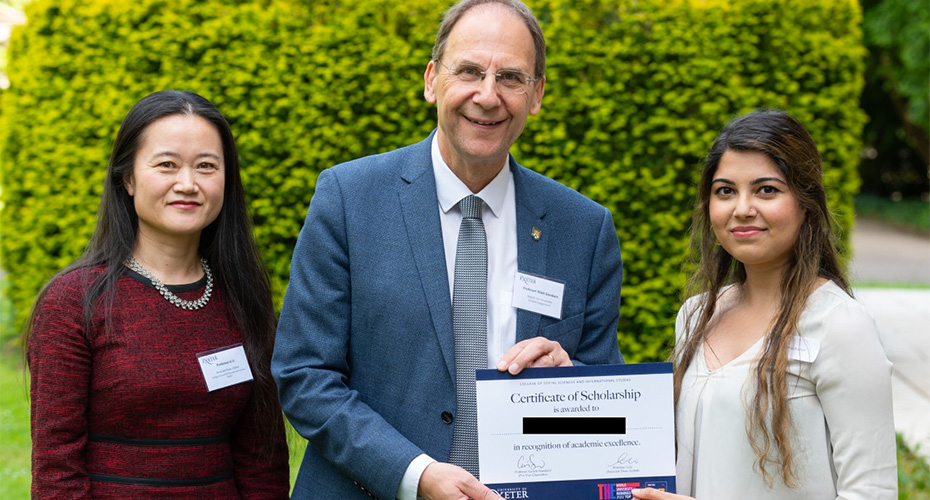
I still remember feeling incredibly happy and slightly emotional at finding out that I had been awarded the PTA Studentship. Like any Pakistani woman who is born in a traditional and patriarchal society (even/especially in urban Lahore) and dreams big in life, my journey has not been devoid of personally low moments and professional struggles. But looking back today, I can already say with conviction that my education - and the independence of thought, belief, lifestyle and choice that came with - was worth it.
Not only has my ambition to pursue a PhD come true, but because of the studentship I am also financially independent. Those - especially women from a similar background - who understand what I mean by this will agree that there is nothing more empowering.
All in all, I am very proud to be one of the first recipients of the SSIS PTA Studentship. I hope the University of Exeter will continue awarding it to deserving candidates for a long time to come.