MA Film and Screen Studies
| UCAS code | 1234 |
|---|---|
| Duration | 1 year full time 2 years part time |
| Entry year | 2027 |
| Campus | Streatham Campus |
| Typical offer | We will consider applicants with a 2:2 Honours degree or above in a social science* or humanities subject. |
|---|---|
Why study MA Film and Screen Studies at Exeter?
For scholars and practitioners seeking to critically engage with global screen cultures, this MA offers interdisciplinary training in film theory, cutting-edge screen research and archival practice – enhanced by exclusive access to the Bill Douglas Cinema Museum and research-led teaching by world class academics and through the Exeter Screen Studies Centre.
- Delve into cutting-edge methodologies, latest critical concepts and research trends in international film and screen studies.
- Benefit from the opportunity to acquire research skills and curatorial expertise with exclusive access to the Bill Douglas Cinema Museum – the only university film museum in the UK with a world-class collection of film and screen materials.
- Benefit from innovative, research-led teaching, varied modules, and an interdisciplinary approach and introduction to the latest research and scholarship through membership of the Exeter Screen Studies Centre.
- Opportunities to network with industry professionals through our successful Creative Dialogues lecture series.
- Varied career opportunities such as cultural heritage, journalism, communications, film festival management, screenwriting, film and media industry, lecturing and teaching and Doctoral research.

Top 10 in the UK for Communication and Media Studies

Home to the Bill Douglas Cinema Museum
The biggest film-related archive in the UK outside the British Film Institute

Top 100 in the world for Arts and Humanities
Ranked 95th in the Times Higher Education World University Rankings by Subject 2026

World-leading research and teaching team
Entry requirements for 2027 entry
We will consider applicants with a 2:2 Honours degree or above in a social science* or humanities subject. While we normally only consider applicants who meet this criteria, if you are coming from a different academic background which is equivalent to degree level, or have relevant work experience, we would welcome your application.
*Accepted social science subjects include:
- Anthropology
- Archaeology
- Area and Development Studies
- Criminology
- Demography
- Development Studies
- Economics
- Economic and Social History
- Education
- Environmental Planning
- Human Geography
- International Relations
- Law
- Linguistics
- Management and Business Studies
- Media and Communication Studies
- Philosophy
- Politics and International Studies
- Psychology
- Science and Technology Studies
- Social Policy
- Social Statistics, Methods, and Computing
- Social Work
- Socio Legal Studies
- Sociology
Please also see our guidance on essential documentation required for an initial decision on taught programme applications.
Entry requirements for international students
Please visit our entry requirements section for equivalencies from your country and further information on English language requirements.
Please also see our guidance on essential documentation required for an initial decision on taught programme applications.
Entry requirements for international students
English language requirements
International students need to show they have the required level of English language to study this course.
The required IELTS test scores for this course fall under Profile B1.
Please visit our English language requirements page to view the required test scores and equivalencies from your country.
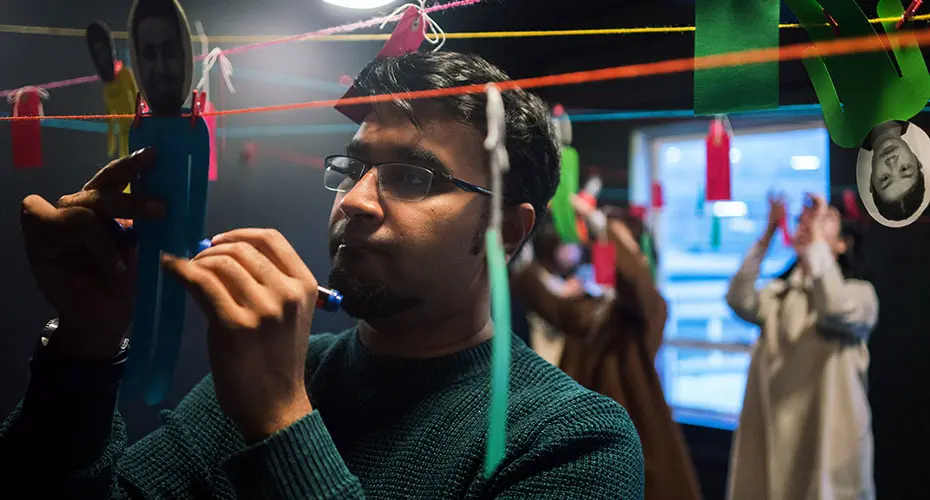
MA Creativity is a course that lets you learn from doing activities. The nature of engaging students with real-life challenges and coming up with innovative solutions through creative processes makes students market-ready in the creative world.
Moreover, the university has excellent facilities like an Innovation Centre for students, one-to-one mentoring sessions and in-course placement opportunities. You face real-life business challenges with expected creative solutions as part of the assessments.
Studying at the University of Exeter is a journey of innovation, engagement, and impact, which will be the base of career development for the rest of your life.
Shuvashish
MA Creativity: Innovation and Business Strategy
Course content and modules
You will be engaging with a broad range of topics, drawing on our strengths in teaching and research across film theory, film history and archival studies, transnational and world cinemas, feminist, queer and gender studies, star studies and transmedia adaptations. A wide choice of optional modules will enable you to tailor your studies to your research or career interests.
The Bill Douglas Cinema Museum provides a unique opportunity to gain research skills and curatorial expertise. Our research-led taught modules will prepare you to develop an MA dissertation project catering to your unique research interests. You will also have the opportunity to design a project embedded in the material cultures of film and screen studies linked to the distinctive collections of The Bill Douglas Cinema Museum. You will be supported by a dissertation supervisor, workshop lectures and a dissertation conference.
You will be joining a vibrant research community through The Exeter Screen Studies Centre.
The modules below provide examples of what you can expect to learn on this degree course based on recent academic teaching. The precise modules available to you in future years may vary depending on staff availability and research interests, new topics of study, timetabling and student demand.
Please note that the module information displayed here is subject to change.
90 credits of compulsory modules, 90 credits of optional modules
| Code | Module | Credits |
|---|---|---|
| Compulsory 1 | ||
| Dissertation - Written | 60 | |
| Critical Debates in Screen Studies | 30 | |
CDFM001: Dissertation - Written
The dissertation project is the culmination of your postgraduate course and represents an opportunity to explore a research question in detail over an extended period of time. Across the module you will conceive, plan, research and write a study of 15,000 words. Initially you will be supported by a supervisor, but during the writing period you will be expected to work independently.
The dissertation will enable you to consolidate and develop your subject knowledge and methodological skills in your discipline by exploring in detail a topic of your own devising.
You will be supported through the early stages of planning your dissertation in the second term of your studies through a series of workshops. This will enable you to develop and submit a dissertation proposal by the end of term 2 (for part time students the proposal will be submitted by the second term of the second year of study).
You will then be assigned a supervisor who will support you during term 3 as you conduct initial research, prepare draft work and establish your project sufficiently to enable you to work independently after the end of term 3. Your supervisor will support you as your research, planning and writing progress through one-to-one supervision sessions. These combined activities will offer you the necessary guidance and support to refine your initial plans and bring your research project to completion.
EAFM007: Critical Debates in Screen Studies
This module introduces you to contemporary aesthetic, critical, political and philosophical debates in screen studies and a range of advanced methodological approaches that is central to the study of contemporary and historical film, television, digital screens and visual culture. This module will enable you to engage in current key debates on film and wider screen visual cultures. You will think through philosophical and aesthetic developments in recent screen studies, analysing the ways in which the language of film produces meaning and explore film within a more expansive media ecology, considering the intersections of film and other screen media. From documentary film, through animated fables, experimental and independent films, to blockbusters and emerging minor cinemas, you will hone your ability to research and write about national and global film and screen cultures in new depth. You will examine how screen media responds to political and cultural events across the world, and to technological shifts, questioning the various potentialities for the future of film in a climate of media exhaustion, cultural amnesia, and the proliferation of the image in the digital age. The module cuts across historical and contemporary developments in screen media - and screen theory - and ultimately considers, what is film in the 21st century?
| Code | Module | Credits |
|---|---|---|
| Optional 1 | ||
| Digital Media Cultures | 30 | |
| Transmedia Adaptations | 30 | |
| Screen Skills: Festivals, Archives, Audiences | 30 | |
| World Cinema / World Literature | 30 | |
| Expanding Queerness: Critical Debates in Theory, Literature, Film and Television | 30 | |
CMMM015: Digital Media Cultures
This module on digital media culture examines a wide variety of perspectives and discourses on digital media from dimensions like (but not limited to) access, capabilities, economy, gender, power, class, and social hierarchies. This module will weave in a range of global trends and perspectives of digital media allowing you as a student of media studies to think of digital media services, software, and platforms as both individually designed experiences and also globally navigated systems. The module will offer you new ways to think about the cultural significance of digital media and the online lives we lead.
This module aims to:
1. Explore the cultural value and significance of digital media and online services and to think of online lives as sites of cultural production.
2. Encourage you to consider the potentials and limitations of different digital media theories and forms in their socio-historical contexts.
3. Motivate you to critically analyse digital media technologies, services, and processes and understand them in relation to production, consumption, dissemination, and engagement practices.
4. Provide you with an expert understanding of communications as a discipline and the various research-based approaches the discipline can offer.
EAFM009: Transmedia Adaptations
Adapting stories across media is one of the most established practices across creative industries. This module will introduce you to advanced study of these practices across several disciplines. You will consider the creative, cultural, and commercial decisions of media creators, considering how stories move across forms such as stage, screen, games, print, comics and webtoons as well as franchises incorporating these. It will also develop case studies derived from different disciplines, aiming to foster interdisciplinary expertise in areas that may include, but are not limited to: media and communications, film studies, games studies, comic studies, TV studies, English, and drama. The module will draw on interdisciplinary expertise from tutors and is suitable for individuals wishing to gain interdisciplinary understanding of the ways that transmedia adaption operates as a creative, commercial, or political practice. There are no pre-requisite modules; however, it will be useful if you have relevant educational experience in any part of the humanities, social sciences or creative industries.
EAFM010: Screen Skills: Festivals, Archives, Audiences
What does it actually take to programme a film festival, curate a digital archive, or understand what audiences want from the cinema? This module puts you at the centre of those questions — not in the abstract, but in practice, working on a real brief with real professional stakes.
You will develop advanced working knowledge across three interconnected areas of screen industry practice: film festival curation, archival exhibition, and audience research. You will engage with the methods, ethics and critical frameworks that shape these fields, building the professional literacy to move fluently between them. After this initial phase, you will choose the specialism that best fits your interests and ambitions, and will develop an original project that contributes directly to a live industry partnership.
That partnership is with LOCO, the London Comedy Film Festival — the world's largest, most distinctive and beloved celebration of comedy on screen. Your cohort's collective work will shape a curated programme of screenings, an associated digital archival exhibition of related materials, and an audience research report informing the festival's programming choices. This is not a simulation but a live brief and your decisions will matter.
EASM167: World Cinema / World Literature
This team taught module, considers the relationship between the production of cinema and literature and debates around the critical and theoretical concepts of 'world' cinemas and literatures and their articulation around world revolutionary moments and cultures of protest and dissent. Interdisciplinary in approach, this module is suited to students with an interest in world, global and postcolonial film and literary studies.
EASM171: Expanding Queerness: Critical Debates in Theory, Literature, Film and Television
Over the last 30 years, queer scholars have offered some of the most exciting, innovative and disorientating ways of conceptualising sexuality and gender. This module explores recent theoretical and political developments in queer studies. We will examine how approaches drawn from queer studies resonate with cultural constructions of homo-, hetero- and bisexualities as well as cis, trans and non-binary forms of gender expression. The overall goal of the module is to challenge and expand our understanding of queerness by responding to and participating in theoretical, conceptual and political debates in queer studies through an engagement with works of literature, film and television.
This interdisciplinary module is suitable for all students. You will have the chance to engage closely with theoretical texts.
This module engages with different debates in queer studies and explores a range of filmic, televisual and literary depictions of various sexualities and gender expressions to examine three intersecting themes.
- Queerness and Normativity
We will begin by reconsidering how queer studies has tended to define queerness against the norm. What is at stake in designating some sexualities and gender expressions as queer and others as normal or normative? We will question whether we need to rethink the assumed link between homosexuality and queerness at a time in which gay marriage and 'normative' models of the family have become an option for at least some lesbian, gay and bisexual subjects. We will also investigate what it means to expand definitions of queerness, considering what is at stake to try and think about heterosexual or homosexual marriage or reproduction as queer. Which other sexual practices or (cis, trans or non-binary) gender expressions need to be considered within a queer framework? What role do categories like gender, class, race or disability play in shaping understandings of queerness and normativity? What is at stake in seeking to represent queer identities or experiences in literature, film or television? What aesthetic strategies have artists and writers employed to do so? Is the diegetic representation of queer identities or experiences required for a text to be identified as queer?
Fees
UK fees per year:
£13,050 full-time; £6,525 part-time
International fees per year:
£26,300 full-time; £13,150 part-time
Scholarships
The University of Exeter offers a wide range of scholarships to support your education, with £8 million available for international students applying to study with us in the 2027/28 academic year, including our prestigious Exeter Excellence Scholarships. We also provide awards for sport, music and other achievements, as well as regional and partner scholarships with organisations such as Chevening, the Commonwealth Scholarship Commission and the British Council. For more information on scholarships and other financial support, please visit our scholarships and bursaries page.
University of Exeter Alumni Scholarship
We are pleased to offer the University of Exeter Alumni Scholarship, a scholarship for University of Exeter alumni beginning a standalone postgraduate programme in 2027/28 with us a scholarship worth 20% of the cost of your first year tuition fees.
Terms and conditions, including deadlines, apply.
Teaching and research
Research
Research-led teaching ensures module content includes the latest trends in Film and Screen Studies. Our research areas include: film and television history, film theory, world cinema, transmedia adaptation, gender studies, queer studies, world cinema, and star studies. The MA team curates a bespoke series of visiting speakers relating to the content of individual modules and the programme as a whole to enable you to engage with a wide range of world-leading experts and the most up-to-date research trends and debates in Film and Screen Studies.
Facilities
The Bill Douglas Cinema Museum holds a wide-ranging collection of more than 70,000 film related artefacts and is the largest research archive in any British University. The collection is available for all students to use as a research and study resource, giving students a highly distinctive and valuable experience of studying and researching film and screen media using primary materials, documents and artefacts. State-of-the-art equipment in our Digital Humanities Lab enables the examination and analysis of these materials.
Careers
Employer-valued skills
You will gain valuable transferable skills in advanced research, critical thinking, written and verbal communication, and project management. Unique opportunities to go behind the scenes in the Bill Douglas Cinema Museum and Digital Humanities Lab will develop your practical skills in screen media archiving, cataloguing, and curation. The international focus of taught materials will enable you to enhance your intercultural competencies, skills that are invaluable in shaping future global citizens and which are becoming more and more attractive to employers. You will also gain valuable networking skills through participation in the Exeter Screen Studies Centre and the Creative Dialogues series.
Career paths
The programme set students up to pursue either doctoral research in film, media, screen and television studies or routes into employment by offering sought-after transferable skills and knowledge well suited to working in a range of professional destinations. An MA in Film and Screen Studies is academically relevant to careers in the arts and media, leading to employment in arts administration, screen and media industries, communications, archiving, film and media research, cultural heritage, journalism, film festival management, lecturing, and teaching.
Career Zone
As part of the wider Faculty of Humanities, Arts and Social Sciences at Exeter you will have the chance to use our Career Zone which can help you gain the skills, experience and expertise employers are looking for.
There are a wide range of opportunities to enhance your employability, along with the support you need to make important career decisions. You will be encouraged to speak to your personal tutor and academic staff about your future career, as they may be able to offer advice and guidance to assist your decision making to help you achieve your goals.
I couldn’t recommend the course more. I have been able to apply the modules in my degree to real-world working environments, and vice versa.
For example, part of the module I recently completed involved writing a business plan for implementation by the company that I work for, which was commended for being “market ready”.
The course has also provided us with so many great networking opportunities, and as a result I have been working freelance since December, designing and executing multi-channel exhibition and event marketing campaigns. The course itself has opened my eyes in so many ways to how integral creativity is to business, and business acumen to the success of creative practice.
Amy
MA Creativity: Innovation and Business Strategy

Find out more about studying at Exeter








Sign-up for more information about studying with us
If you're thinking about studying MA Film and Screen Studies with us, signing up to our emails is the best way to discover if we’re the right university for you.