The science of boiling an egg
Originally compiled and written by Charles D. H. Williams, Department of Physics and Astronomy.
This document is an introduction to of some of the science relevant to preparing boiled eggs. It has evolved from a letter published in the Last Word section of New Scientist magazine (04-April-98) which answered a question by Chris Finn, who asked 'Does anybody have a formula to calculate the boiling time for a soft-boiled egg, given its weight and initial temperature?'.
Much of the information presented here is well-known and compiled from secondary sources (e.g. nutritional information printed on egg boxes!).
A Formula for Soft-Boiling Eggs
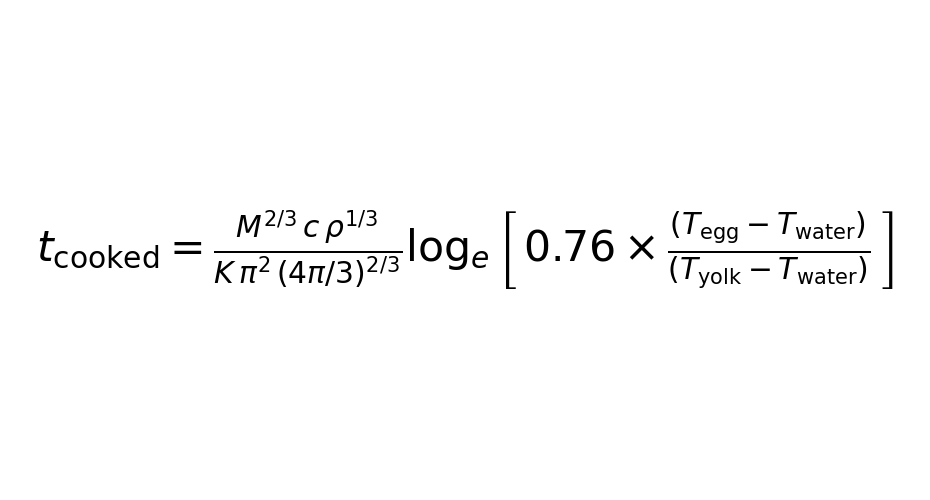
To obtain a simple formula the problem must be idealised somewhat, so the egg will be treated as a spherical homogeneous object of mass M and initial temperature Tegg. If the egg is placed straight into a pan of boiling water at Twater, it will be ready when the temperature at the boundary of the yolk has risen to Tyolk~63°C. With these assumptions, the cooking time t can be deduced by solving a heat diffusion equation.
The result
The final result is relatively simple. ρ is density, c the specific heat capacity, and K thermal conductivity of 'egg'. According to this formula, a medium egg (M~57 g) straight from the fridge (Tegg=4°C) takes four and a half minutes to cook, but the same egg would take three and a half minutes if it had been stored at room temperature (Tegg=21°C). If all the eggs are stored in the fridge, then a small (size 6, 47 g) egg will require four minutes to cook, and a large egg (size 2, 67 g) will take five minutes.
Accuracy
The model of an egg used to derive the above formula involves several approximations. For a more accurate treatment one would need to note that the thermal properties of the white, yolk and shell are all different, and treat the egg as three concentric ellipsoids with Dirichlet boundary-conditions at the water-shell interface and Neuman boundary-conditions for the shell-white and white-yolk parts. Changes in its thermal properties when the white changes state from sol to gel, and the latent heat associated with this change would also need to be accounted for.
Boiling Eggs on a Mountain
It takes noticeably longer to boil an egg on a mountain than at sea-level. This must be because the boiling point of water falls with decreasing atmospheric pressure Patm.
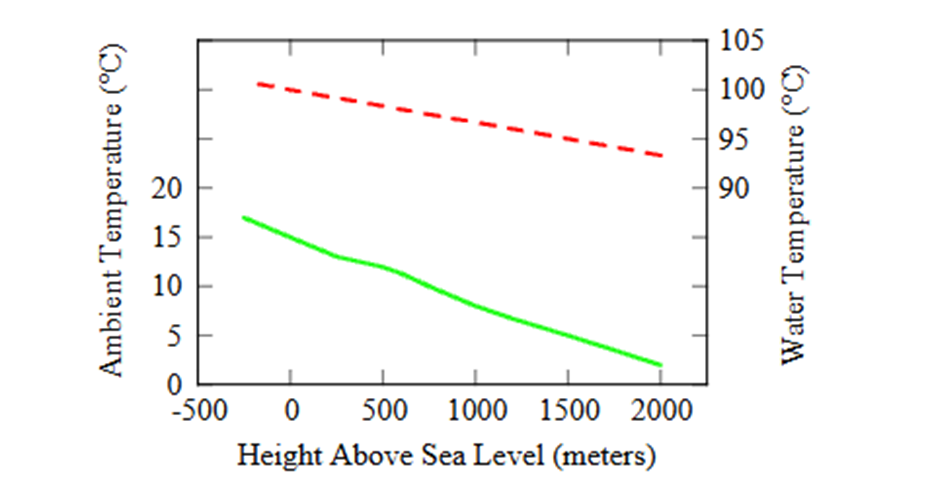
How ambient temperature and Twater decrease with height in a temperate climate. Derived from the Manual of ICAO Standard Atmosphere (1964).
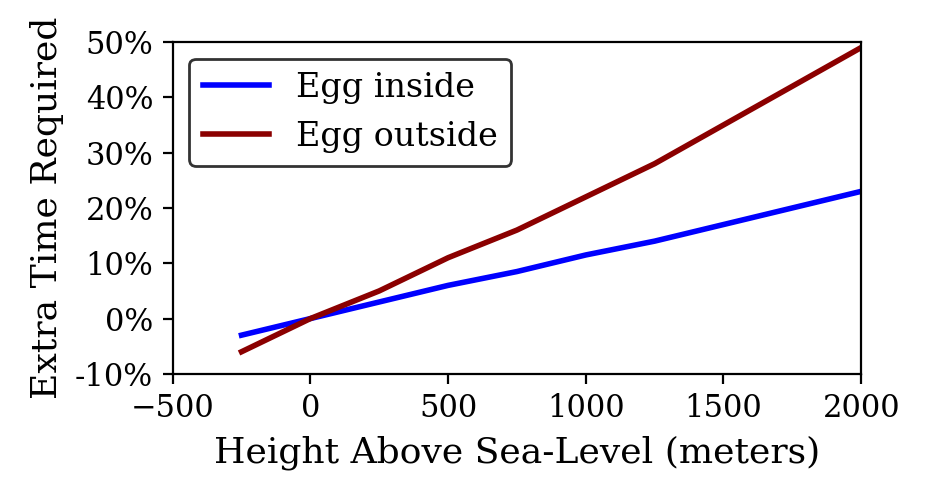
How the reduction in water temperature increases the time needed to boil an egg with increasing altitude.
Two cases are shown. The 'egg inside' curve is for an egg taken from a refrigerator at 4°C. The 'egg outside' curve is for an egg that is initially at the ambient temperature (plotted above), e.g. during a camping trip. Of course, if circumstances were such that the egg has become frozen, then the cooking time would increase dramatically due to the latent heat required to melt it again.
Dr Edward Brooks is reported to have said "It took me five minutes to cook a 'three minute egg" at Mount Washington Observatory (1917m). It seems that the additional cooking time predicted by this application of the formula is too small.
Assuming that room temperature at the observatory was similar to that sea level, the discrepancy probably arises because the single 'coagulation temperature' Tyolk used to derive the formula is an approximation. Coagulation is a complicated process and does not occur instantaneously at a single temperature, but via chemical reactions that get increasingly rapid with increasing temperature. The result is that a higher 'coagulation temperature' is needed to model the lower temperature cooking that occurs at high altitude.
Structure and Composition of Eggs
There is a considerable amount of detailed structure to a hen's egg, but the gross features and properties are as follows:
Shell
The shell accounts for about 9 to 12% of its total weight depending on egg size. It comprises about 94% calcium carbonate with small amounts of magnesium carbonate, calcium phosphate and other organic matter including protein.
Shell strength is influenced by two factors. Firstly, the hen's diet, particularly its calcium, phosphorus, manganese and vitamin D intake. Secondly, egg size, which increases as the hen ages while the mass of shell material that covers cover it stays fixed. Hence the shell is thinner on larger eggs.
Between seven- and seventeen-thousand tiny pores are distributed over the shell surface. As the egg ages, moisture and carbon dioxide diffuses out, and air diffuses in through these causing the air cell to grow and the net mass to decrease. The shell is covered with a protective coating called the cuticle. By blocking the pores, the cuticle helps to preserve freshness and prevent microbial contamination of the contents. This is why good quality eggs (e.g. EC class A) should not be washed, which removes the cuticle, until immediately before they are to be used.
The colour of the shell is determined by the breed of hen. Brown-shelled eggs tend to be more expensive because they come from larger birds, and these are more costly to feed.
White (Albumen)
Albumen accounts for most of an egg's liquid weight, about 67%. It consists of four opalescent layers of alternately thick and thin consistencies. The white of a freshly laid egg has a pH between 7.6 and 7.9 and an opalescent (cloudy) appearance due to the presence of carbon dioxide. As the egg ages the CO2 escapes which increases the pH. Egg white also becomes thinner as an egg ages because its protein changes in character. That's why fresh eggs broken onto a plate sit up tall and firm while older ones tend to spread out. The albumen of older eggs is more transparent than that of fresher eggs. Fresh egg whites coagulate in the range 62° to 65°C, the temperatures decrease with increasing pH and hence age. This is why very fresh eggs require more time to cook than older eggs.
Yolk
The yolk (yellow portion) makes up about 33% of the liquid weight of the egg. It contains all of the fat in the egg and slightly less than half of the protein. With the exception of riboflavin and niacin, the yolk contains a higher proportion of the egg's vitamins than the white. All of the egg's vitamins A, D and E are in the yolk. Egg yolks are one of the few foods naturally containing vitamin D. The yolk also contains more phosphorus, manganese, iron, iodine, copper, and calcium than the white, and it contains all of the zinc. The yolk of a large egg yields about 250 kJ of energy. Egg yolks have a pH of about 6.0 which stays relatively constant as the egg ages as there is no CO2 loss. Coagulation occurs in the range 65° to 70°C.