Services for the community
Exeter Zebrafish Hub
Advancing disease research with zebrafish models
The Hub provides a central place for zebrafish news, events, training opportunities, workshops and shared resources. It includes links to upcoming conferences and meetings, job adverts, protocols and other useful resources for the zebrafish community.
Researchers can share meetings, vacancies, protocols, resources and success stories with the wider network. This helps keep the community informed, visible and connected.
For the public and community groups, the Hub offers an accessible introduction to zebrafish research and its importance for understanding development, health and disease. It also highlights opportunities to engage with researchers, attend public events and learn more about ongoing studies.
By bringing together information, opportunities and community resources, the Zebrafish Hub strengthens collaboration, supports training and makes zebrafish research more visible and accessible.
12th Strategic Conference of Zebrafish Investigators
January 10-13, 2027
Hyatt Regency Merida, Merida, Mexico
2nd UK Zebrafish Meeting
June 02-04, 2027
John McIntyre Conference Centre, Edinburgh, UK
20th International Zebrafish Conference
June 26-30, 2027
Daejeon Convention Center, Daejeon, Korea
Our past events:
1st UK Zebrafish Meeting - 10-12 September 2025
We welcomed participants for the 1st ever UK Zebrafish Meeting in September. Event details and photos from the conference can be found on the meeting web page.
The European Zebrafish Meeting 2026 - Viena July 7 - 11 2026
LSI Researchers Make a Splash at the European Zebrafish Meeting in Vienna.
LSI in Vienna
LSI Researchers Make a Splash at the European Zebrafish Meeting in Vienna
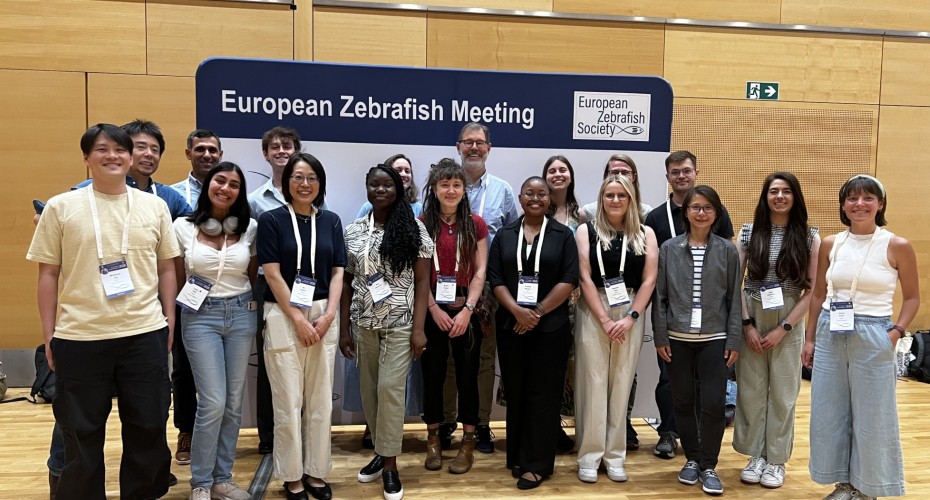
From the 7th-11th July 2026, members of the Exeter zebrafish research community travelled to Vienna for the European Zebrafish Meeting, one of the largest gatherings in the field, bringing together researchers from across Europe and beyond to share the latest developments in zebrafish research.
This year's conference saw an especially strong turnout from the University of Exeter, with 18 researchers attending from the LSI (with representatives from the Scholpp, Nikolaou, Ryu and Yang groups) and Department of Biosciences (with the Tyler, Winter and Kudoh groups represented). The whole group gathered together for a photo to mark the occasion.
Talks and posters covered a wide range of topics, reflecting the breadth of zebrafish research happening in Exeter. Yosuke Ono presented in the opening session on Emerging Technologies on "Genome editing with programmed short DNA integration using Prime Editors to establish a zebrafish model for Robinow syndrome". Gemma Sutton shared findings from "Rab8a-positive vesicles transport Wnt8a along cytonemes in zebrafish embryogenesis" in the Tissue Formation session. Carol Yang presented her lab's work on "Connexin 43propagates the synchronicity of pancreatic beta cells initiated by neural signalling" in the Metabolism session. Posters were also presented by Steph Jones (Neurobiology), Jess Bamsey (Tissue Formation), James Ellams (Neurobiology), Sarah Woodsford (Neurobiology), Tumisang Moswete (Toxicology), Min-Kyeung Choi (Neurobiology) and Ekaterina Dvorianinova (Disease Models). Together, these contributions highlighted the depth and diversity of research being carried out across Exeter's zebrafish community. Beyond the science, the conference was a great opportunity to reconnect with collaborators, meet new researchers in the field, and enjoy everything Vienna had to offer. It was fantastic to see such a strong Exeter presence at an international meeting of this scale, and a real testament to the vibrancy of zebrafish research here.
Job Adverts Panel