Metamaterials for health, wellbeing and human performance
Healthcare is under pressure to detect disease earlier, treat patients more precisely and support people to live healthier lives for longer. Metamaterials offer a distinctive contribution because they can make medical technologies smaller, more sensitive, more adaptive and better matched to the body’s physical environment.
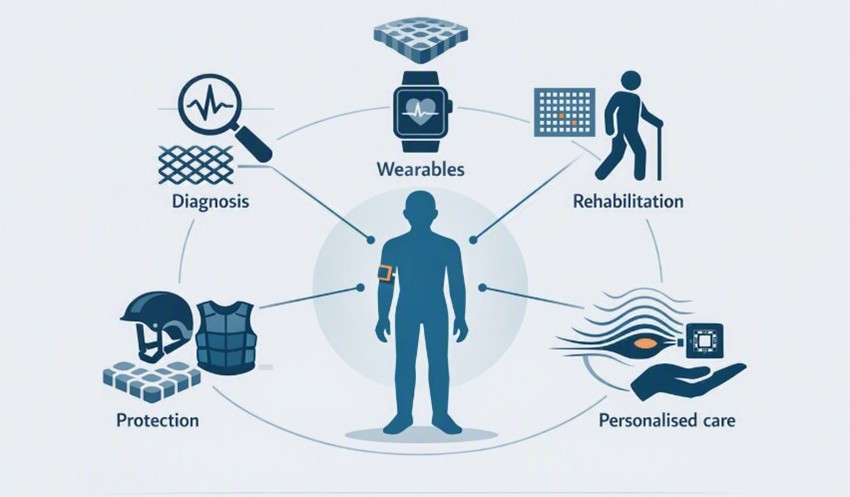
In diagnostics, engineered electromagnetic, acoustic and optical responses can improve imaging, biosensing and point-of-care testing. More sensitive sensors could detect biomarkers at lower concentrations, while advanced imaging systems may help clinicians see tissue structure, margins or physiological changes with greater clarity. These capabilities are relevant to cancer detection, surgical guidance, wearable monitoring and portable diagnostic devices.
Metamaterials also have strong potential in rehabilitation, mobility and assistive technologies. Mechanical architectures can be designed to cushion, stiffen, flex or distribute load in carefully controlled ways. This creates opportunities for improved prosthetics, orthotics, implants, protective equipment and rehabilitation devices that are lighter, more comfortable and more personalised to individual users.
Sport and exercise provide an important early route to real-world use. Products such as footwear, helmets, body protection, saddles and rackets can exploit auxetic and architected materials to improve comfort, vibration control and impact protection. Lessons learned in these less regulated markets can then inform more demanding healthcare and rehabilitation applications.
Future opportunities include adaptive medical devices, targeted therapeutic platforms, implantable communication systems, smart textiles, connected care technologies, tissue-mimicking materials and biomedical surfaces designed to reduce infection or improve patient outcomes.
Relevant studies
- how the fundamental diversity in the capability to take up molecules in bacteria can help us develop guidelines for the optimisation of antibiotic therapy in killing infecting bacteria;
- how magnetic metamaterials can help us create microscopic machines that would be able to mimic micro-organisms which could revolutionise a range of practices used in medicine and biotechnology (e.g. targeted drug delivery);
- how we can advance the development and applications of Brillouin microscopy as a novel optical technique within biophotonics and the clinical environment;
- how to use THz imaging to quickly take accurate high resolution images of breast tissue in the operating theatre, showing the exact boundaries where healthy and cancerous tissue meet, should greatly enhance the accuracy of breast cancer surgery and reduce the need for repeat procedures;
- how to develop sensor systems that enable detection and analysis of molecules on miniature devices ('lab on a chip');
- the fundamental physics of acoustic, thermal and electrical transport both within materials and across interfaces between materials to investigate the ways in which these properties are used in biological systems, including biomimetics, thermoregulation in insects and electrical signalling in plants and animals;
- the development of textile-based wearable electronics as an emerging technology with potential to enable the imperceptible integration of electronics with the human body.
If you have any questions or ideas to explore, don't hesitate to get in touch: metamaterials@exeter.ac.uk.
People
| Prof Monica Craciun: Optoelectronic materials and devices; quantum phenomena; nanoelectronics |
| Dr Alex Corbett: Fluorescence microscopy; medical imaging |
| Prof Euan Hendry: THz materials, imaging and spectroscopy; nonlinear optics |
| Prof Robert Hicken: Novel microscopy technique for studying magnetic hyperthermia as a cancer treatment |
| Prof Geoff Nash: Infrared sources; detectors and spectroscopy; surface acoustic wave devices |
| Prof Feodor Ogrin: Bio-inspired magnetic systems |
| Dr Stefano Pagliara: Membrane transport in antibiotic resistance |
| Prof Francesca Palombo: Biophotonics and biomechanics; mechanical properties of metamaterials |
| Prof Nick Stone: Biomedical spectroscopy; light-based diagnostics and therapeutics |
Case studies