How do I recruit a placement student?
Advertising a placement opportunity
All vacancies can be advertised for free through our career’s portal My Career Zone (powered by TargetConnect.) These will be visible to all current students.
Please note: we do not currently advertise unpaid positions via the jobs portal unless they are four weeks or less in duration and undertaken as part of a credit-bearing placement module/programme.
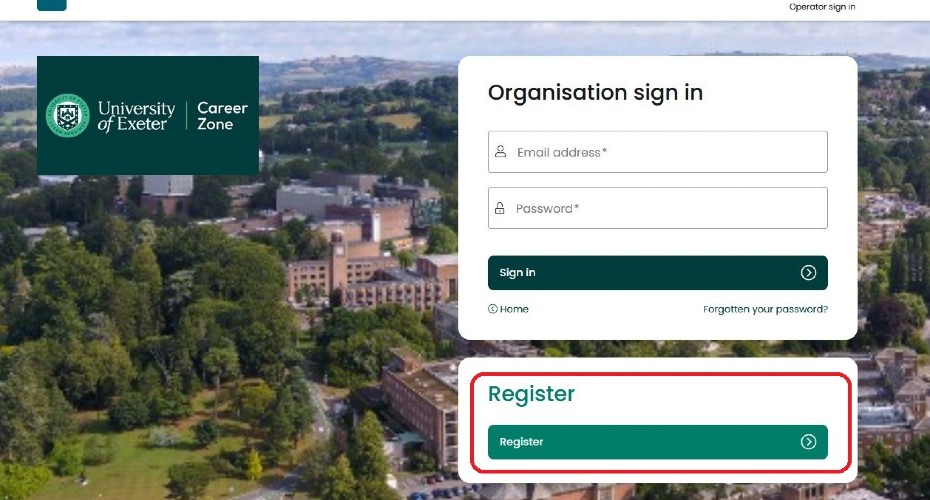
To advertise your placement vacancy, you will need to provide the following information:
- Company description and web link.
- Job description.
- Person Specification.
- Location and salary detail.
- How to apply details. (e.g. email address or link to external page.)
More information about advertising your vacancy
Frequently asked questions
Access to Internships (A2I) is a fund to help employers offset the salary cost for a University of Exeter student or graduate on a UK paid internship or graduate role. It is only applicable to select students.
Students must be employed by the organisation and paid through the organisations own payroll system. Students can be employed part-time during term-time, or full-time during the vacation periods. Organisations can receive more than one subsidy, to a maximum of two subsidies per year, across all A2I funding sources.
The University of Exeter is committed to ensuring that students with a disability or long-term health condition face no additional barriers when pursuing or undertaking work placement opportunities as part of their degree programme.
It is important to ensure that everyone has fair access and opportunity to apply for placement or internship roles, and this involves making reasonable adjustments at each stage of the application process to accommodate everyone's needs.
The Chartered Institute of Personnel and Development (CIPD) has produced extensive guidance on disability equality at work, including a practical guide for line managers that advises on recruiting, managing and developing people with a health condition or disability. This can be accessed on the CIPD website . You can also read the guide for managers on the GOV.uk website
A CIPD resource on discrimination in the workplace and during the recruitment process, includes suggestions for how this can be mitigated.
Making the offer
Once you’ve identified a successful candidate and want to move forward with an offer, you may wish to consider one or more of the following:
- Right to work check.
- Medical questionnaires and making reasonable adjustments.
- Making a written offer of employment (though do note that in the UK a verbal offer can be considered by the candidate as legally binding – Read further information on the gov.uk website ) Preparations for induction (see below section).
Placement paperwork process
All placements undertaken by students need to be approved in advance of them starting. This is to ensure that we know the details of the placement, can undertake any relevant risk assessment review process and identify the correct agreement to be forwarded to the placement host.
The process for the approval is as follows:
1. Once an offer has been made, we ask the student to fill out a form via our careers platform to outline the details of their placement. In this form, we ask for information such as:
- the full legal name of the organisation,
- address details of the organisation and place of work,
- a brief description of the student’s roles and responsibilities,
- details of employment e.g. dates and salary,
- health & safety considerations.
Crucially, the university requires the student to identify a main point of contact at the organisation via which we can confirm placement details and forward the relevant agreement or email.
2. Once the placement details have been approved, we will send out a relevant agreement or email to the placement host and student. There are three main agreements that our team issue:
- A Letter of Expectation is issued via email for UK-based placements where an employment contract exists between the organisation and the student. This letter requires acknowledgement of receipt from a contact at the organisation to confirm of the presence of a contract and that the student’s activities on placement are covered by employers’ accident insurances.
- A UK Work Placement Agreement is a tripartite (three-party) agreement issued for UK-based placements where an employment contract has not been put in place between the organisation and the student. This document outlines the responsibilities of all parties and asks placement hosts to provide details of employers’ accident insurance. This document is issued digitally via DocuSign and requires signature from the placement host and the student in advance of the placement start date.
- A Global Work Placement Agreement is a tripartite (three-party) agreement for any placement undertaken outside of the United Kingdom, whether paid or unpaid. This document is issued digitally via DocuSign and requires signature from the organisation contact and the student in advance of the placement start date.
Non-disclosure agreements (NDAs)
As part of the assessment process, students may need to reflect on their experiences and/or demonstrate their understanding of a particular sector or organisation. This may therefore require them to refer to confidential information from their host organisation. In these cases, students are advised to contact the university’s Education Contracts team to set up a Non-Disclosure Agreements (NDAs) and ensure that any confidential information is not shared through these assessment tasks. If the organisation requires an NDA to be signed by the student, the student is likewise advised to contact the Education Contracts team at the address above.
As you may be aware, organisations have legal duties in relation to health and safety. You can find further information on health and safety obligations for organisations, including advice on training provision and liability insurance on the Health and Safety Executive website.
Specifically, it is crucial to ensure that the placement opportunity can proceed safely and without any undue risk to the student. This needs to be considered and addressed as part of the placement development process and before the student starts work.
Likewise, students will need to acknowledge and comply with health and safety requirements as part of their placement. As detailed above, the student will complete a risk assessment with guidance from the university and formally agree to adhere to health and safety regulations at their place of work.
You will be asked to confirm that you have the appropriate insurances in place to cover the students as part of the placement paperwork process. If you do not have insurance to cover the student and their activities on the placement, please discuss this with us to agree next steps by emailing: placements@exeter.ac.uk.
Get in touch
If you have any queries, please don’t hesitate to get in touch with the Placements Team at the following email addresses:
- Recruit Exeter students: placements@exeter.ac.uk
- Recruit Cornwall students: placements-penryn@exeter.ac.uk