BEng Robotics and Artificial Intelligence
| UCAS code | H110 |
|---|---|
| Duration | 3 years |
| Entry year | 2027 |
| Campus | Streatham Campus |
| Typical offer | A-Level: AAB-ABB |
|---|---|
|
A-Level: BBB-BBC |
| UCAS code | H123 |
|---|---|
| Duration | 4 years |
| Entry year | 2027 |
| Campus | Streatham Campus |
| Typical offer | A-Level: AAB-ABB |
|---|---|
|
A-Level: BBB-BBC |
Why study Robotics and AI at Exeter?
- Help shape our future by studying BEng Robotics and Artificial Intelligence. Prepare to lead and innovate in this rapidly evolving field which is set to revolutionise how we live and work.
- Gain hands-on experience in autonomous systems, machine learning and intelligent robotics.
- Engage with projects ranging from developing self-driving vehicles to creating advanced robotic manipulators.
- Benefit from state-of-the-art teaching lab spaces equipped with the latest robotics equipment and get involved in real-world challenges and projects.
- Prepare for exciting roles in diverse industries such as manufacturing, product development and software engineering, where expertise in robotics and AI is in high demand.
- You may also be interested in our four-year integrated Masters MEng Robotics and Artificial Intelligence, or BEng Robotics and Artificial Intelligence with Foundation Year.

Top 10 in the UK for General Engineering

Hands-on course with an emphasis on practical project work

92% of our Engineering research is internationally excellent
Based on research rated 4* + 3* in REF 2021

£6.5million investment in our teaching labs, workshop spaces and equipment
Accreditation information
This course launches in 2025 and has been developed in close partnership with industry and in consultation with our accrediting bodies. We have already successfully gained accreditation from industry professional bodies for established programmes across the Engineering Department.
As this is a new programme, we aim to seek accreditation from the relevant professional bodies; however, this cannot be guaranteed at this stage.
Accreditation status will be updated when new information is available. If you require any further information, please contact the University directly.
Entry requirements for 2027 entry (typical offer)
| Qualification | Typical offer | Required subjects |
|---|---|---|
| A-Level | AAB - ABB | GCE A-Level Maths grade B and another science* subject at grade B. Candidates may offer GCE A-Level Maths, Pure Maths or Further Maths. |
| IB | 34/665-32/655 | HL5 in Mathematics (Analysis and approaches or Applications and interpretations) and HL5 in another Science subject. Applicants achieving IB Maths SL7 plus IB HL5 in Physics will also be considered. |
| BTEC | DDD - DDM | See below under 'read more' for further information |
| GCSE | 4 or C | Grade 4/C in GCSE English language |
| Access to HE | 24 L3 credits at Distinction Grade and 21 L3 credits at Merit Grade | 12 L3 Credits at Merit Grade in Mathematics and 12 L3 Credits at Merit Grade in an acceptable Science subject area. |
| T-Level | Distinction | T-Level in Design and Development for Engineering and Manufacturing, or T-Level in Design, Surveying and Planning for Construction. GCE A-Level Maths is still required. |
| Contextual Offer | A-Level: BBB-BBC |
Specific subject requirements must still be achieved where stated above. Find out more about contextual offers. |
| Other accepted qualifications | ||
| English language requirements |
International students need to show they have the required level of English language to study this course. The required test scores for this course fall under Profile B1. Please visit our English language requirements page to view the required test scores and equivalencies from your country. |
|
NB General Studies is not included in any offer.
Grades advertised on each programme webpage are the typical level at which our offers are made and provide information on any specific subjects an applicant will need to have studied in order to be considered for a place on the programme. However, if we receive a large number of applications for the programme we may not be able to make an offer to all those who are predicted to achieve/have achieved grades which are in line with our typical offer. For more information on how applications are assessed and when decisions are released, please see: After you apply
*Accepted GCE A-Level/AS science subjects include: Biology/Human Biology**; Chemistry; Computing; Design and Technology; Economics; Electronics; Environmental Science; Environmental Studies; Geography; Geology; Life and Health Sciences; Physical Education; Physics; Psychology; Science (applied); Statistics.
**If more than one of these is taken they would only count as one 'science' but could count as two A-Levels towards our general requirements.
BTEC Extended Diploma
Applicants studying one of the following BTEC Extended Diplomas will be considered without a GCE A-Level science subject (GCE A-Level Maths is still required): Applied Science, Aeronautical Engineering, Building Services Engineering, Construction and the Built Environment, Civil Engineering, Operations and Maintenance Engineering, Computer Engineering, Electrical/Electronic Engineering, Engineering, Manufacturing Engineering, Mechanical Engineering, Environmental Sustainability.
BTEC Diploma or BTEC Extended Certificate
Applicants studying Applied Science or Engineering in the BTEC Diploma or BTEC Extended Certificate will be considered without a GCE A-Level science subject. GCE A-Level Maths is still required.
For any questions relating to entry requirements please contact the team via our online form or 01392 727272.
Course content and modules
Robotics and artificial intelligence are pivotal to modern society, with increasing demand for skilled professionals. In your first year on the course, you'll build a solid foundation in mechanical, electronic and materials engineering.
As you advance, you'll specialise in robotics and artificial intelligence, delving into autonomous systems, machine learning and intelligent robotics. Key topics include robot sensing, path planning and AI-driven decision-making.
The course features extensive hands-on projects, allowing you to apply theory and develop practical skills. You'll work on exciting projects such as developing self-driving vehicles and creating advanced robotic manipulators.
If you are interested in Formula Student, you have the option to join the student team to build and program a fully autonomous car. If your team passes the selection process and demonstrates strong project development, you will have the opportunity to participate in the Formula Student AI competition at Silverstone circuit.
You may notice changes to some of our modules over the coming months. This is because we are making space for the following:
- Minors: Future Skills Pathways - Alongside your main degree you may be eligible (depending on your course) to choose modules from another subject to broaden your skills and interests.
- Skills to Thrive built into every degree - Essential skills for your future, including communication, problem-solving, teamwork and digital confidence.
- Increased innovation and wellbeing - More room for creative learning, real-world projects and a healthier study rhythm.
The modules below provide examples of what you can expect to learn on this degree course based on recent academic teaching. The precise modules available to you in future years may vary depending on staff availability and research interests, new topics of study, timetabling and student demand.
Please note that the module information displayed here is subject to change.
120 credits of compulsory modules.
| Code | Module | Credits |
|---|---|---|
| Compulsory 1 | ||
| Engineering Mathematics and Scientific Computing | 30 | |
| Multi-Disciplinary Group Challenge Project | 30 | |
| Fundamentals of Mechanics | 15 | |
| Fundamentals of Materials | 15 | |
| Fundamentals of Electronics | 15 | |
| Fundamentals of Engineering | 15 | |
ENG1002: Engineering Mathematics and Scientific Computing
This module introduces modern Engineering Mathematics by teaching maths alongside programming.
What you learn in this module will support mathematical content in core modules throughout your programme. You will be introduced to core mathematical tools for modelling Engineering systems which will be developed further in Year 2. You will learn about statistical methods of analysis that are vital tools for Engineers in the 21st century.
An elementary introduction to programming in Python will be provided which will equip you with valuable data processing and modelling skills. The teaching of Python will mirror mathematical content, building on knowledge of specialist packages for matrices, differential equations and statistics.
This module aims to provide you with all mathematical tools to tackle modern Engineering problems. It will allow you to develop strong quantitative skills, such that mathematical tools become second nature so you can focus directly on Engineering challenges and concepts. An important aspect of this is to provide a solid foundation in programming so that it will help you develop new ways of Engineering thinking and cutting-edge solutions to ever-changing societal challenges.
ENG1005: Multi-Disciplinary Group Challenge Project
The University declared an environment and climate emergency in May 2019. The future of our planet and community is at stake. We know though that simply declaring an environment and climate emergency is not enough so you will be part of a team involved in this real-world Project Based Learning (PBL) module to show our commitment to leading the change required. Your career as a professional engineer will require you to work effectively with multi-disciplinary teams on complex and challenging projects. In preparation for this working environment your first task as a new engineering student will be to work on energy harvesting during this multidisciplinary challenge project.
The PBL driving question is ‘How can we harness ocean energy and convert it into reliable, sustainable and cost-competitive electricity that can be used to power homes, transport, and industries’.
The purpose of this module is to:
- Address the climate emergency through a team project focused on energy harvesting. The PBL project will facilitate the application of the core engineering knowledge gained in Fundamentals of Mechanics, Materials and Electronics.
- Develop 21st century skills in creativity, collaboration, communication, critical thinking, problem solving, leadership and technology literacy.
- Gain valuable experience in research/study skills, sketching, technical communication, 3D modelling and prototyping.
- Steering projects through the design process and creating prototypes for a final PBL ‘Public Product’.
ENG1007: Fundamentals of Mechanics
In this module we focus on classical mechanics. At the heart of any engineering analysis is the need to understand an object’s response to its environment, whether it’s the forces imparted by traffic as it traverses a bridge or the forces of lift that allow an aircraft to fly. None of this analysis is possible without first understanding classical mechanics. In this module you will cover foundational mechanics theory.
This module aims to equip you with fundamental knowledge and skills in Mechanics. It also consolidates a common knowledge base and begins the development of a learning methodology appropriate to a professional engineer. Through both continuous assessment and the end of year exams, the module encourages you to actively manage your own learning and seeks to develop your ability to communicate your understanding of engineering theory and concepts in a professional manner.
ENG1008: Fundamentals of Materials
In this module, we focus on two sub-disciplines, fracture mechanics and additive manufacturing. At the heart of any engineering analysis is the need to understand an object’s response to the applied conditions, whether it is the allowed stress level to avoid catastrophic failure of pressurised vessels, or altering material micro- and nanostructures to provide improved ductility, strength, or resistance to fracture. None of this analysis is possible without first understanding basic materials.
You will work through new topics each week with the aid of extensive learning materials, lectures, tutorials, and experimental activities. You will undertake several online continuous assessments throughout the module, which will allow you to evaluate your understanding of the material and diagnose areas that require further attention. Continuous assessments provide ongoing feedback and support you to actively manage your learning.
The module is taught using a flipped learning methodology. Each week, you will review background materials. A flipped learning methodology allows you to extract more benefit from guided tutorials but also requires more upfront work by you in preparation.
ENG1009: Fundamentals of Electronics
This module introduces the key building blocks of modern electronic systems, focusing on both analogue and digital electronics. You will learn how components like diodes and transistors help control and amplify signals, and how operational amplifiers are used in everyday devices. On the digital side, you’ll explore how computers and digital systems make decisions using logic, learning about the basic rules (Boolean algebra) and building blocks (logic gates, flip-flops, and counters) that underpin digital technology. The module blends theory with hands-on activities to help you understand how electronic circuits work and how they are used in real-world applications.
You will also take part in assessed practical electronic laboratories that introduces and develops your practical electronic skills in soldering and wiring. These practical laboratories will also develop the familiarity with using test and measurement equipment and applies your knowledge in both analogue and digital fields and demonstrate applications of their circuits.
ENS1000: Fundamentals of Engineering
This module exemplifies the unique approach taken here at Exeter to nurturing the next generation of multidisciplinary engineers. It will introduce engineering concepts and theory across the areas of Mechanics, Materials and Electronics and will provide you with a solid grounding on which to build in later modules.
In this module we focus on two sub-disciplines of materials, material science and material engineering, with topics spamming from material properties, material structures, material failure and material applications. At the heart of any engineering analysis is the need to understand an object's response to the applied conditions, whether it is the allowed stress level to avoid catastrophic failure of pressurised vessels, or altering material micro- and nanostructures to provide improved ductility, strength, or resistance to fracture. None of this analysis is possible without first understanding basic materials.
We also focus on classical mechanics. At the heart of any engineering analysis is the need to understand an object's response to its environment, whether it's the forces imparted by traffic as it traverses a bridge or the forces of lift that allow an aircraft to fly. None of this analysis is possible without first understanding classical mechanics. In this module you will cover foundational mechanics theory.
Please note that the module information displayed here is subject to change.
120 credits of compulsory modules.
| Code | Module | Credits |
|---|---|---|
| Compulsory 1 | ||
| Microcontroller Engineering | 15 | |
| Modelling of Engineering Systems | 15 | |
| Communication and Networking Technologies | 15 | |
| Analogue and Digital Electronics Design | 15 | |
| Python and ROS for Robotics | 15 | |
| Robotics and AI Challenge Project | 30 | |
| Control Engineering | 15 | |
ENG2008: Microcontroller Engineering
A microcontroller is a small computer on a single integrated circuit. It is widely used in automatically controlled systems and devices such as appliances, automobiles, robots and mobile phones. In this module, you will be introduced to the fundamental principles of the design, operation and application of microcontrollers. This includes the architecture of microcontrollers and peripherals, such as various types of memories, analogue and digital input/output interfaces, serial communication modules, timers and interrupts. You will also learn how to program a microcontroller and gain extensive practical experience of designing an embedded system using a microcontroller.
Prerequisite module: ENG1009 or equivalent
This module aims to develop your understanding of the fundamental principles of the design, architecture and applications of a microcontroller. The laboratory sessions concentrate on the microcontroller development system, and you will get the chance to use programming languages to develop a range of microcontroller based applications.
ENG2009: Modelling of Engineering Systems
This module is designed to introduce second year undergraduates to mathematical modelling techniques for engineering systems, and their implementation using scientific computing (e.g. python).
1. To strengthen mathematical and computational skills for solving mathematical challenges arising in the modelling of engineering systems.
2. To acquire a large variety of analytical, numerical and mathematical techniques to be used for those engineering problems.
3. To build practical skills in translating engineering problem statements into mathematical models / questions, and then analysing, simulating and solving the problem by writing a software programme.
4. Understand the concept of analytical and numerical approximation, and learn methods to validate and test your mathematical formulation and programme.
ENG2017: Communication and Networking Technologies
Communications and networking technologies are rapidly evolving, and have revolutionised the ways in which we socialise, and network in business. This module gives you the chance to gain in-depth knowledge of these technologies, and the ways in which they are used. You will learn all about protocols - the set of rules and instructions that computers and other devices follow when they communicate with each other across a network. Furthermore, you will gain invaluable practical experience, using the Internet as a tool to assist on your own project, in which you will conduct a risk analysis, and gain a deeper understanding of the impact that viruses can have on computer networks. You will also get the chance to see computer applications and protocols in action, when lecturers give demonstrations, using real life examples.
The aim of this module is to equip you with the underlying theory and knowledge that underpins the fields of communications engineering and computer networking. You will learn about the nature and purpose of key telecommunication and networking principles, and apply these principles to addressing typical telecommunications and networking problems. You will demonstrate what you have learnt by critically evaluating a specified communication system, and providing an appropriate technical solution to a problem associated with that system.
ENG2118: Analogue and Digital Electronics Design
Analogue and digital signals are found in all modern-day technology, from mobile phones to aircraft. This practical, hands-on module teaches you how to design, simulate, build and test real electronic systems.
You will get the chance to design electronic circuits using basic analogue and digital circuit building blocks, including transistor amplifiers, integrated circuit operational-amplifiers, filters, oscillators, counters, decoders, adders, latches and multiplexers. Furthermore, you will devise complex digital systems using programmable logic, such as Field Programmable Gate Arrays (FPGAs). Finally, you will design a range of practical circuits, simulating their performance in modern electronics simulators (Multisim and HDL) and explore their hardware implementation taking into account practical considerations such as component tolerances for circuit analysis and improvement.
Throughout the module, lecturers will use a variety of case studies to aid your learning, including the design of amplifiers, filters and synchronous counters.
Prerequisite module: ENG1009 or equivalent
ENS2000: Python and ROS for Robotics
This module introduces you to Python programming designed specifically for robot applications. It focuses on using Python to control and interact with robotic systems, covering key concepts such as data manipulation, sensor integration and real-time monitoring. You will learn to use Python libraries such as ROS (Robot Operating System), NumPy and OpenCV for robot programming and simulation. Through practical exercises, you will develop skills to write effective code for tasks such as motion planning, sensor data processing and automation.
The aim of this module is to equip students with the knowledge and skills necessary for programming robots using Python. The curriculum emphasises practical application, teaching students how to employ Python in controlling robotic systems and interfacing with sensors for data handling and live monitoring. Students will become proficient in utilising specialised Python libraries like ROS, NumPy, and OpenCV to code for robotics and simulations. The hands-on approach of the module ensures that students gain experience in writing efficient programs for robot motion planning, sensor data interpretation, and task automation.
ENS2001: Robotics and AI Challenge Project
This module, through a project-based learning approach, develops the robotic design and practical skills in a project-based learning framework. Through this project, you will design and validate robotics, automation and AI systems to solve an engineering problem. You will be working as part of a group to bring the project to a successful conclusion. Through the project-based approach, you will use your existing knowledge, learn new theory and skills or adopt a heuristic approach to tackle some aspects of the work. In this way, you will gain practical understanding of the robotics design process and practices which cannot be developed through lectures alone.
This module aims to develop essential robotic design and practical skills through a project-based learning approach. The primary objectives are to enable students to design, implement, and validate via numerical simulations or experiments a robotics system to solve an engineering problem. By working individually and in groups, students will bring their projects to successful conclusions, applying existing knowledge while learning new theories and skills. The module emphasises an empirical approach to problem-solving, fostering a practical understanding of the robotics design process and practices that cannot be developed through lectures alone.
ENS2005: Control Engineering
The advancement of technology during the 20th century put control engineering on the map - and it still plays a critical role in everything from simple household washing machines to high performance fighter aircraft. This module will give you a fundamental understanding of control engineering for single input single output systems. In particular, you will analyse the fundamental concept of feedback and its impact on system dynamics. You will study the performance of closed loop systems from a time domain and frequency domain perspective. Classical approaches to studying closed loop systems will be introduced including root-locus, Nyquist and Bode diagram methods. The module will also describe a method for parameterizing all stabilizing controllers for a given plant model, and how this result can be used from a design perspective. The module will also introduce the fundamentals of proportional-integral-derivative (PID) control, which you will use to analyse and design control systems. The module will describe the concepts of gain and phase margins for assessing the robustness of closed loop systems to modelling uncertainty.
Please note that the module information displayed here is subject to change.
Find out more about the year in industry option below.
120 credits of compulsory modules.
| Code | Module | Credits |
|---|---|---|
| Compulsory 1 | ||
| Year in Industry | 120 | |
ECM3174: Year in Industry
The Year in Industry module will provide you with an opportunity to undertake practical work experience in a business, commercial or public sector engineering environment that is of direct relevance to your development as an experienced professional. You will apply the knowledge and skills from taught modules in the workplace, which will give you important insights into your potential job role once you graduate from university. You will be responsible for finding your own placement (with support from the Student Experience and Employability Team and the Career Zone). All paperwork to support the approval of the placement must be submitted by you, and approved by the module leader at least 4 weeks in advance of the start date for your placement. You can undertake your work placement in the UK, any part of the European Union countries that participate in the Erasmus+ programme, or other approved international setting.
The aim of this module is to provide practical work experience in a business, commercial or public sector setting that is of direct relevance to the subject-specific aims of your degree programme. Crucially, the module will also develop and enhance critical soft skills which are in demand within the engineering sector, e.g. communication, team working, time management, planning, resilience, commercial awareness.
Please note that the module information displayed here is subject to change.
105 credits of compulsory modules, 15 credits of optional modules.
| Code | Module | Credits |
|---|---|---|
| Compulsory 1 | ||
| Communications Engineering | 15 | |
| Individual Project | 30 | |
| Mechatronics | 15 | |
| Distributed Algorithms for Robotics | 15 | |
| Machine Learning and AI | 15 | |
| Optimisation Methods | 15 | |
ECM3166: Communications Engineering
Communications lie at the heart of our modern-day society so our communication systems need to deal with ever-increasing amounts of information, to operate at ever-increasing speeds, use lower and lower powers and protect personal data. In this module you will learn how to modern communication systems, such as wired and wireless technologies and optical fibre systems, meet such demands and, importantly, how to design modern communication links from a systems level perspective.
Prerequisite module: ENG2017 or equivalent.
The purpose of this module is to develop the subject-specific knowledge, understanding and skills, required to design and analyse modern-day communication systems. It develops the signal and system theory framework necessary to further your understanding of the operating and performance-limits of analog and digital communication systems. Furthermore, it applies such theory to real-world communications examples, including analog and digital radio, fibre-optic communications and wireless systems.
Finally, the module describes in detail the design and implementation of a range of modern-day digital communication systems, such as digital mobile communications links, computer communications, radio and TV broadcasting systems, optical fibre communications.
ECM3175: Individual Project
The Individual Project module will enable you to put into practice your research, project management and engineering skills, engaging you in the development of your own real world solution to an engineering problem or challenge. From clearly articulating the rationale for your project, to scoping and refining the design and finished product, you will work individually to apply the knowledge gained from other modules in your degree programme. You will be expected to innovate, create and present your engineering solution, honing your entrepreneurial as well as academic and practical skills. In this way, the module will enable you to develop valuable transferable skills for future employment in industry.
In this module, you will apply the knowledge and skills obtained from taught modules to devise a real engineering solution at a professional level. You will be encouraged to use initiative, imagination and creativity during the management of your project, devoting around 300 hours of independent study towards its completion. You will study with greater levels of autonomy than in previous taught modules.
ENG3012: Mechatronics
This module takes you into an interdisciplinary field of engineering dealing with the integration of mechanical, electric and electronic components coordinated by a controller. You will have the chance to learn a broad range of mechatronic systems and components, including analogue and digital circuits, sensors, actuators, energy harvesting and system integration to gradually build your capability to design mechatronic systems. You will also have practical hands-on session to learn how to build real-world mechatronic systems, ranging from simple LED light flashing and DC motor control circuits, to complex robot arm control and ultrasonic range detection.
Aimed at both electronic and mechanical engineers, this module combines major components of mechanical, electric and electronic engineering to explore how mechatronic systems are designed and built, right from learning the fundamental knowledge and concepts of major components in the systems, through to building mechatronic systems for real-world applications.
ENS3000: Distributed Algorithms for Robotics
This module explores the design and analysis of algorithms that enable coordinated actions in robotic networks. You will learn essential topics such as leader election, where robots dynamically choose a leader; averaging algorithms, which allow robots to reach consensus through local interactions; and more complex tasks like deployment and aggregation algorithms that manage robot movements to achieve specific formations or cover areas efficiently. The module emphasises the integration of sensing, communication, and control capabilities in robots, addressing both theoretical aspects and practical implementations. It is critical for applications in disaster recovery, environmental monitoring, and security.
ENS3001: Machine Learning and AI
The module provides an overview of the principles that drive modern artificial intelligence technologies. You will explore key concepts of machine learning, such as supervised and unsupervised learning, neural networks and deep learning architectures. The module focusses on practical applications and problem-solving using tools such as PyTorch or TensorFlow. Through a balance of theoretical lectures and practical tutorials, you will gain an overview of model training, evaluation, and deployment. You will be provided with the basic skills needed to understand and contribute to the advancement of artificial intelligence and machine learning and prepares them for a career in a rapidly evolving technological landscape.
This module aims to equip students with a comprehensive understanding of the foundational principles and cutting-edge technologies in artificial intelligence. By delving into key machine learning concepts, including supervised and unsupervised learning, neural networks, and deep learning architectures, students will develop both theoretical knowledge and practical skills. The module emphasizes hands-on problem-solving using industry-standard tools such as PyTorch and TensorFlow. Through a blend of lectures and practical tutorials, students will learn to train, evaluate, and deploy AI models, preparing them to contribute effectively to the field of artificial intelligence and pursue careers in this dynamic and rapidly evolving sector.
ENS3024: Optimisation Methods
This module provides advanced techniques for solving optimization problems, focusing on their applications in robotics and clean energy systems. Topics include linear and nonlinear programming, multi-objective optimization, and dynamic programming. Students will explore algorithmic strategies such as gradient-based methods, evolutionary algorithms, and convex optimization. Emphasis is placed on problem formulation, solution interpretation, and computational tools. Applications include robotic path planning, energy management in renewable systems, and optimization of fuel cell and battery systems. Practical case studies and project-based learning will enhance skills in applying optimization methods to real-world engineering challenges, fostering critical thinking and technical problem-solving abilities.
| Code | Module | Credits |
|---|---|---|
| Optional 1 | ||
| Digital Signal Processing | 15 | |
| Zero Emission Vehicles | 15 | |
| Energy, Materials and Sustainability | 15 | |
ECM3165: Digital Signal Processing
In our technologically oriented world we need to process, interrogate and manipulate ever-increasing amounts of data from a wide variety of sources - such as video, audio and text, information databases, sensors and measurement systems, manufacturing equipment and robotic systems etc. Today, such signal processing is invariably carried out using digital techniques, and so digital signal processing (DSP) has become an invaluable and integral part of a wide variety of fields ranging from consumer electronics to medicine to space exploration. In this module you learn about the theory that lies behind the enormous popularity and power of DSP, as well as learning how to design and implement real-world DSP systems.
This module introduces you to the fundamental principles of digital signal processing, from both theoretical and practical viewpoints. You will get the chance to design digital signal processing systems for a range of important application areas, and to develop experimental digital signal processing applications using the XiLinx FPGA devices.
ENG3023: Zero Emission Vehicles
Today, it is of paramount importance to stimulate the creativity of students to solve the challenges in the decarbonisation of the transportation sector.
This module aims to provide you with a solid foundation in modelling and control techniques for zero-emission powertrains. Throughout the module, you will gain a comprehensive understanding of the core components of a fully electric vehicle, including batteries, power converters, electric motors, and drives, as well as mechanical elements. Furthermore, the module will introduce you to the fundamentals of energy balance and management principles specific to electric vehicles, along with an introduction to optimization approaches applied in this domain.
The module provides a comprehensive exploration of the concepts of modelling, energy-power management, control, and optimisation as they relate to zero-emission vehicles. It will enable you to develop a range of interdisciplinary skills at the intersection between mechanical, electrical, and control systems engineering. A central theme of the module is to demonstrate the significance of mathematical modelling and equations in critically evaluating power requirements, efficiency, and energy balance in the context of electric vehicles.
The module will encourage the creation of an inclusive team-work environment where you will contribute as a group to achieve common goals.
PHY3222: Energy, Materials and Sustainability
This module will allow you to develop a critical, scientific, and pragmatic understanding of the role energy and materials can play in building a sustainable future. The module will emphasise the relationship human activity has with our only finite resource, the Earth . The environmental and societal impacts of acquiring energy and primary resources required to survive as a species will be explored. We will discuss the costs and limitations of manufacturing using more sustainable materials on a planet with finite resources. You will gain a strong background in renewable energy generation and new materials to help build a sustainable future.
This module will provide you with:
- A global perspective of our total energy and resource needs now and in the future.
- An overview of established energy sources.
- An overview of renewable energy sources including photovoltaics, wind, and wave power
- An overview of how these more sustainable technologies can help reduce our dependence on fossil fuels, and the environmental implications of the move to renewable energy sources.
In addition, the module will enable you to:
Course variants
BEng Robotics and Artificial Intelligence with Year in Industry
UCAS code: H123
Our four-year ‘with Year in Industry’ programme includes a paid placement in business or industry for the duration of your third year. Work experience is a real advantage when entering the graduate job market. It’s also a great way to try out different jobs and to make contacts within companies you’re interested in working for.
Does it count towards my degree?
Yes, it’s worth 120 credits.
How does it affect my tuition fee?
During this year you will pay a reduced tuition fee. Visit the Tuition Fees page for more information.
How do I apply?
You can apply for this programme through UCAS using the code above, or transfer onto this option at the end of your first year in an Exeter-based Engineering degree.
Preparation and support
We will help you to prepare for your work placement from early in your studies. A special module 'Employability and Placement Preparation for Engineers' takes place in your second year. This is an opportunity to start thinking about your placement well in advance. You’ll also be invited to attend workshops offering guidance and support.
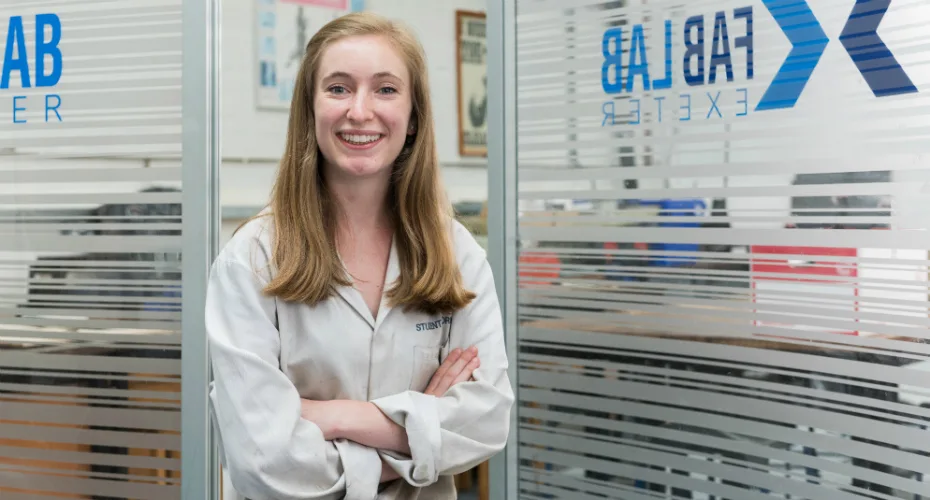
Studying at Exeter is really enjoyable. There are so many different ways you can ask for support from academics who are always there to help you.
The best part about my subject is all of the hands-on opportunities. Almost all of the labs you see are ones you could have opportunities to use.
Emily
An Engineering student
Fees
Tuition fees for 2027 entry
UK students: £10,050 per year
International students: £31,500 per year
Scholarships
The University of Exeter offers a wide range of scholarships to support your education, with £8 million available for international students applying to study with us in the 2027/28 academic year, including our prestigious Exeter Excellence Scholarships*. We also provide scholarships for sport, music and other achievements, alongside regional and partner awards such as The Beacon Trust. Financial support is available for students from disadvantaged backgrounds, lower income households and other under-represented groups to help them access, succeed and progress through higher education.
For more information on scholarships and other financial support, please visit our scholarships and bursaries page.
* Terms and conditions, including deadlines, apply. See our website for details.
Learning and teaching
You’ll typically have between 15 and 32 hours of direct contact time per week with academics and you will be expected to supplement your lectures with independent study. You should expect your total workload to average about 40 hours per week during term time.
In addition to lectures, you’ll also have access to our workshops and laboratories where you’ll be trained to use specialist equipment, supporting and developing what you’ve learnt in the classroom and putting it into practice.
Facilities
You will benefit from state-of-the-art teaching lab spaces equipped with the latest robotics equipment. These facilities provide hands-on experience, allowing you to experiment, innovate and apply theoretical knowledge to practical scenarios.
A research and practice led culture
All our academic staff are internationally-recognised scientists working across a wide range of topics. Your course will draw on the very latest ideas, research discoveries and new technologies in the field. You’ll be able to participate directly in current research at various stages throughout your degree.
Student projects are often linked to our research activities and may involve working with industrial partners.
Assessment
Modules are assessed by a combination of continuous assessment through small practical exercises, project work, essay writing, presentations and exams. You must pass your first year assessment in order to progress to the second year, but the results do not count towards your degree classification.
Project work is a core element of this degree, providing invaluable experience of problem-solving, engineering design and team working.
Your future with a degree in Robotics and AI
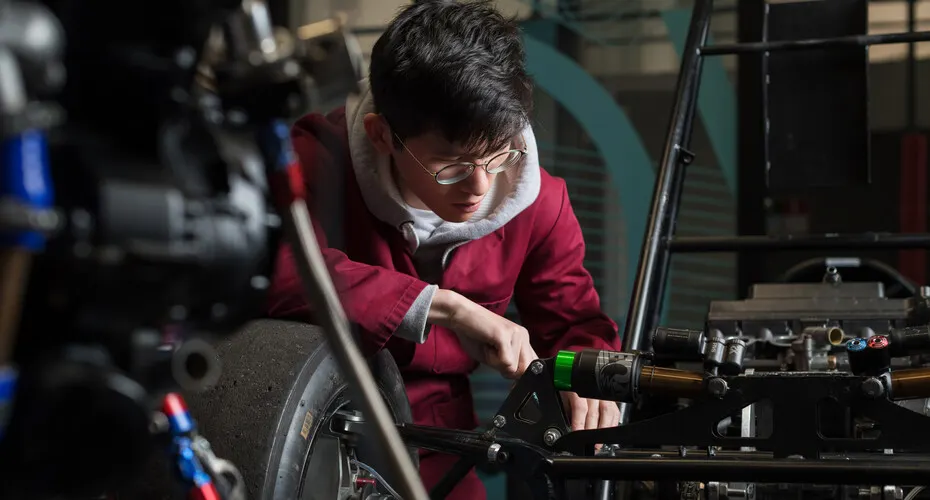
Robotics and artificial intelligence are among the fastest-growing fields, creating a high demand for skilled professionals to drive innovation.
As a BEng Robotics and Artificial Intelligence graduate, you'll be highly sought after for your expertise in autonomous systems, machine learning and intelligent robotics. You'll bring strong technical skills, including proficiency in programming languages and software, along with essential abilities in analytics, problem-solving and project management.
The practical experience gained at Exeter will set you apart from other graduates, as you will have applied theoretical knowledge to real-world industry challenges. Your specialised skills will position you as a valuable asset in diverse sectors, including manufacturing, product development and software engineering.
With a robust foundation in engineering, mathematics, computer science, robotics and AI, you will be well-equipped to shape the future of technology.
Find out more about studying at Exeter








Sign-up for more information about studying with us
If you're thinking about studying BEng Robotics and Artificial Intelligence with us, signing up to our emails is the best way to discover if we’re the right university for you.