SDG 17 - Partnerships for the Goals
We're working to strengthen the means of implementation and revitalize the Global Partnership for Sustainable Development. Explore our impact.
Our recent work and impact on SDG 17: Partnerships for the Goals
SDG 17 (Partnerships for the Goals) aims to strengthen global collaboration to achieve sustainable development.
Strong global and regional partnerships are central to our approach through programmes such as Future17, alongside collaborations with governments, NGOs, industry and global research networks to address shared challenges.
COP 30
We played an important role at COP30, in Belém, Brazil. With global warming set to exceed 1.5°C – breaching a goal of the Paris Agreement set at COP21, Our experts helped to provide the latest research, policy insight and solutions to the escalating climate crisis.
We now have more than 1,500 people working on the environment and climate emergency.
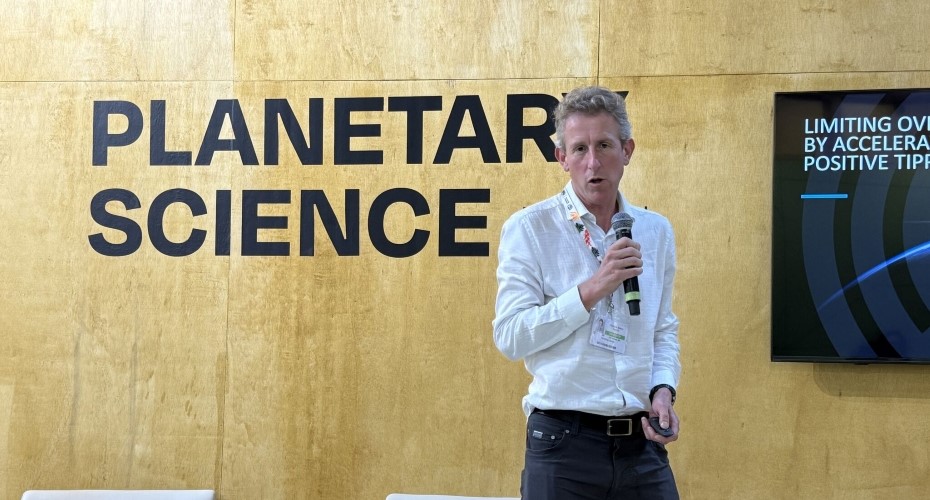
Read our comprehensive SDG 17 report for 2024/25
The University of Exeter signed the Sustainable Development Goals Accord in 2019. The Accord is a commitment made by learning institutions to one another, to do more to deliver the SDGs, annually report on individual progress as a Signatory, and do so in ways which share the learning with each other both nationally and internationally.
Benefits of SDG Accord reporting allows a more relatable and clear dialogue on sustainability internally within the organisation and externally, allowing us to build new external partnerships based on the SDGs, such as around research, policy and projects.
EAUC publish the SDG Accord annual progress report, highlighting the collective progress towards the SDGs in the college and university sector.
The University is renowned for its environmental research and education, and is home to many of the world’s leading climate scientists. We now have more than 1,500 people working on the environment and climate emergency, and recently launched a new business support initiative called Green Futures Solutions.
International Collaboration on Gathering and Measuring Data for the SDGs
The University of Exeter’s research and education makes a difference across the world. In order to deliver our Strategy 2030 we recognise that Global Partnerships are vital. Our mission is to make the world greener, healthier and fairer place by collaborating with partners on priorities which address the UN Sustainable Development Goals (SDGs) by gathering, sharing and measuring data in order to develop international best practice. Some of our key partnerships and research collaboration in 2024/2025 are listed below.
UQ-Exeter Institute
The UQ-Exeter Institute is a strategic partnership between The University of Queensland and the University of Exeter—two research-intensive universities committed to solving the world’s most urgent challenges. Born from a shared belief in the power of collaboration, the Institute connect researchers, students, and partners across hemispheres to review comparative approaches in order to co-create impactful solutions in health (SDG 3), technology (SDG 9), sustainability (SDG 13), and resource security (SDG 12). The Institute aims to deliver impactful research that addresses major global challenges, unified by the central issue of ‘Global Sustainability and Wellbeing’.
Earth League
The University of Exeter is a member of the Earth League - a voluntary alliance of leading scientists and institutions working on planetary processes and sustainability issues, established to address current challenges and opportunities related to the future of our planet.
The Earth League is dedicated to releasing timely statements and publications on critical topics related to global change, such as actionable insights derived from the latest climate science and research presented at the United Nations Framework Convention on Climate Change Conferences of the Parties. These publications aim to inform policymakers and decision makers about the current status of research and perspectives in the fields of climate, socio-economics and the environment.
World Universities Network (WUN)
Exeter joined the World Universities Network (WUN) in 2023, a partnership bringing an unparalleled richness of talent and resources to bear on major research problems. As well as fostering distinctive international research collaborations directed at problems of global significance, the WUN also helps nurture research talent, shape institutional policy and practice through analysis and information exchange, and build partnerships with national and international bodies.
Its research addresses the overarching themes of the UN SDGs, including social justice (SDG 16), human rights and inequalities (SDGs 5 and 10); sustainable world: cities and urbanisation, energy transitions, water and food security (SDGs 11, 12, 14 and 15); mental health, child and maternal health, ageing (SDG 3); and responsible and ethical use of computing: artificial intelligence, information security, privacy (SDGs 9 and 12).
The University of Exeter joined research teams supporting 7 of the 20 newly-awarded research development fund projects in 2024.
Climate Action Network for International Educators (CANIE) Accord
In April 2024 the Global Opportunities Team became the first Russell Group University to sign the CANIE Accord. CANIE - Climate Action Network for International Educators - is an organisation that drives change in the international education sector to foster sustainable practices and climate action through international collaboration and research.
From 2024 and beyond, the Global Opportunities team is actively working to fulfil our CANIE commitments. Our Sustainability Working Group takes a holistic approach to embedding sustainability into mobility practices, team culture and programme design. We share best practice through the Universities UK International Outward Mobility Network, integrate sustainability into team development, and prioritise ways to sustain and grow exchange partnerships with a strong environmental focus.
We are proud of the progress so far - but we also recognise that there is more to do. Our commitment to CANIE is both a responsibility and an opportunity: to lead by example, to collaborate across the sector, and to ensure that international education can thrive in a more sustainable future.
HABITABLE
The HABITABLE project (2020-2024) brings together 22 diverse recognised institutions from 18 countries, covering a wide range of expertise. This international collaboration is the largest research project on climate change and migration to have ever been funded by the European Commission’s Horizon 2020 program for research and innovation. The fund tackles climate change, helps to achieve the UN’s Sustainable Development Goals and boosts the EU’s competitiveness and growth.
HABITABLE seeks to connect different scales of research by adopting an interdisciplinary, mixed-methods approach. Empirical data gathered through a longitudinal survey will be complemented by in-depth qualitative methods to provide a more nuanced understanding of how particular tipping points influence migration behaviour and the habitability of Socio-Ecological Systems (SES).
The overall goal of HABITABLE is to investigate how and to what extent climate change affects the habitability of socio-ecological systems and transforms current and future migration and displacement patterns. HABITABLE’s systemic approach will contribute to the design of appropriate and sustainable policy responses to the climate-migration nexus.
The four objectives:
- Formulate a predictive understanding of migration patterns and dynamics under climate change through the identification of social tipping points that lead to migration.
- Propose adaptation options and strategies for populations affected by climate change based on an assessment of how migration redefines the limits to adaptation.
- Identify, analyse and mainstream the gendered and social equity dimensions of the climate-migration nexus throughout the project.
- Support the development of effective policy responses by co-producing migration scenarios and policy recommendations with key stakeholders.
World Economic Forum partnership
Announced in 2023, our first partnership with the World Economic Forum will help develop a new project in support of the Arctic and Antarctic biospheres. Hoffmann Fellowships in 2023 and 2024 have funded posts to support Arctic and Antarctic biospheres, and to broaden the scope of positive tipping points as well as work with industry and policy leaders to help them apply the science of positive tipping points to their operations.
Global Carbon Budget
The Global Carbon Budget Office is led by Professor Pierre Friedlingstein from the University of Exeter’s Global Systems Institute with the support of more than 100 people from 70 organisations in 18 countries. Since 2006, as part of the Global Carbon Project, the Global Carbon Budget has provided a wealth of information and data on carbon emissions and the ramifications for reaching the global climate goals.
COP 29
The University of Exeter played an important role at COP29, the UN Climate Change Conference - held in Baku, Azerbaijan from 11th to 22nd November 2024. The summit brought together world leaders, negotiators and activists to coordinate global action against climate change and share examples of best practice. Exeter’s work at the conference included leading the Global Carbon Budget – a vital annual report on the sources of carbon emissions, and natural “sinks” that absorb about half of the carbon emitted by human activity.
As a world-leading university in the field of environmental sustainability and climate change, we provide the ideal learning environment for students who want to play their part in building a green future for all. Our Green Futures website provides information on a selection of sustainability courses.
Future 17 – the Sustainable Development Goals Challenge Programme.
The University of Exeter and QS are partners in delivering Future17, a transformative educational partnership between the world’s leading universities and global organisations, to empower and enable the next generation of students to answer the questions that will shape today, tomorrow and the future for us all.
In an era of global challenges, the 17 UN Sustainable Development Goals (SDGs) have become a key framework to articulate the issues that face humanity and encourage mobilisation of concerted efforts to end poverty, fight inequalities and tackle climate change. While many organisations have taken steps to embed these goals into their strategies, at the University of Exeter we are committed to going further. We believe in the power of our brightest young minds coming together to tackle these global challenges whilst developing 21st century skills to enhance their education.
Our vision, in partnership with QS, is to build a global ecosystem that connects students from multiple universities with international organisations to generate insights and develop solutions that help address SDGs. To connect the next generation to the most complex challenges of our time and generate actionable solutions.
The University of Exeter played an important role at COP29, the UN Climate Change Conference - held in Baku, Azerbaijan from 11th to 22nd November 2024. Exeter’s work at the conference included leading the Global Carbon Budget – a vital annual report on the sources of carbon emissions, and natural “sinks” that absorb about half of the carbon emitted by human activity.
Relationships with regional NGOs and government for SDG policy
We directly inform national government and regional non-government organisations through policy development for SDGs. Our 2024/2025 work identified challenges of climate change and cooperative actions to take to adapt (NAP3) together with modelling likely futures and providing reliable insights to local and regional government, through our Parliamentarians Guide to Climate Change. We work in collaboration with NGOs to coordinate regional action on climate adaptation, the Devon, Cornwall and Isles of Scilly (DCIoS) Climate Adaptation Strategy helps communities monitor early warning signs of climate change together with resources to take action for climate adaptation and prepare for climate impacts.
Climate Change Risk Assessment (CCRA3) and National Adaptation Programme (NAP3)
Analysis led by the University of Exeter informed a major UK government report on climate adaption. Academics at the University of Exeter participated in cooperative planning for climate change disasters. Professor Richard Betts MBE, led the detailed 1500-page CCRA3 Technical Report, providing the evidence at the core of the Independent Assessment, which has informed the UK government's third National Adaptation Programme (NAP3). Published in July 2023 NAP3 sets out the key actions for 2023 to 2028, that government and others will take to adapt to the challenges of climate change in the UK and plan for climate change disasters. The University of Exeter is taking a leading role by providing the scientific basis for reports such as the National Adaptation Programme, and the work of our researchers is enabling policymakers to make evidence-based decisions in our quest for a greener future.
Parliamentarians Guide to Climate Change
In October 2024 The Parliamentarians Guide to Climate Change was launched at the House of Commons. The guide, produced by the University of Exeter in partnership with NGO Peers for the Planet, brings together analysis from the world-leading climate experts to provide government and other policy makers – at national and local level – with reliable insights to inform and plan action on climate change.
Devon, Cornwall and Isles of Scilly Climate Impacts Group
On a regional level, the University, in collaboration with NGOs including the Westcountry Rivers Trust, is a member of the Devon, Cornwall and Isles of Scilly Climate Impacts Group which is coordinating regional action on climate adaptation, preparing communities and organisations for a changing climate, and improving resilience across the region. The DCIoS Climate Adaptation Strategy 2023 to 2027 will help communities and organisations across the Southwest better understand the risks their area might face in the future, as climate change increasingly affects the UK. It will also help them monitor early warning signs of climate change and adapt to these changes, thereby improving their resilience and community safety. Resources have been made available to help individuals, communities, organisations and local policy makers take action for climate adaptation and prepare for climate impacts.
Exeter Climate Forum
The Met Office and the University of Exeter hosted scientists, policy makers and business leaders for vital talks assessing growing risks from climate change – and action to address it. With the dangerous impacts of climate change increasing worldwide, the Exeter Climate Forum aimed to help shape priorities for the COP30 climate summit in Brazil. More than 1,000 people attended a wide variety of events, ranging from science talks and workshops to film screenings and music performances. Held from 30 June to 4 July 2025, the event took place at the University’s Streatham Campus in Exeter. Events included the Exeter Climate Conference, the second Global Tipping Points Conference, the annual meeting of the New Carbon Economy Consortium, and dedicated events for policymakers and business leaders.
Collaboration with NGOs for SDGs (2024/2025)
The University of Exeter and the National Trust national partnership focusses on protecting the natural world. The joint research initiative explores how both organisations can best respond and adapt to environmental and cultural change, support wildlife renewal and improve wellbeing through nature. This is only the second university collaboration of its kind from the National Trust. It builds on more than 20 joint research projects and four student placements and volunteering opportunities run collaboratively by the University of Exeter and the National Trust over the last 5 years. Collaborating on projects involving landscapes and communities, and new opportunities for cross-disciplinary research, knowledge exchange and engagement at an international level. The collaboration will focus on three main themes: rethinking: how to reverse declines in nature and adapt to climate change; regeneration: managing changing multifunctional landscapes and exploring novel approaches and management techniques; and reconnection: engaging people in conservation. Experts will develop science-based, action-orientated research to inform land use decision making and better understand ways to care for our natural and cultural landscapes. The focus will be to plan and manage the inevitable transformation of landscapes so they work best for people, place, nature and future generations.
Schools Across the Ocean (SATO) teamed up 25 schools from the UK and Brazil on a collaborative learning programme focused on improving climate literacy and developing personal resilience and creativity. The programme united 5,000 pupils and some of academia’s leading authorities on the marine environment and climate change. Each transatlantic pairing participated in online workshops, learned about one another’s cultures, and worked alongside their designated scientist, who shared the latest research on the planet and its ecosystems. The programme was led by the British Council, the University of Exeter, and the Met Office, and has reached thousands of children in often rural, coastal, or remote areas. The programme was showcased at several events at COP30 (November 2025) by the British Council, alongside a series of climate cards which include artwrk created by children who have previously been enrolled on SATO. These cards are designed to help children create and share stories about the planet, and promote curiosity and creative thinking around climate science through storytelling.
In collaboration with local, national and international NGOs, the University has developed a number of open-access educational resources, including:
- Devon, Cornwall and Isles of Scilly Climate Impacts (DCIoS) Group Resources to help individuals, communities, organisations and local policy makers take action for climate adaptation and prepare for climate impacts.
- The Convex Seascape Survey (2022-2027) facilitated by Blue Marine Foundation, with science led by the University of Exeter in collaboration with partners. Together with Encounter Edu and Blue Marine Foundation work includes the creation of a legacy of UK curriculum-aligned lesson packages while ensuring a global reach through live lessons, a free-to-access online repository of resources/activities, and an immersive digital experience.
How we are addressing the Sustainable Development Goals
Find out more about each of the UN SDGs below, or visit our Sustainable Development Goals homepage.