BA Film & Television Studies and Media & Communications
Please note: This page is for 2026 entry. Click here for 2027 entry.
| UCAS code | W608 |
|---|---|
| Duration | 3 years |
| Entry year | 2026 |
| Campus | Streatham Campus |
| Typical offer | A-Level: ABB |
|---|---|
|
A-Level: BBC |
| UCAS code | W609 |
|---|---|
| Duration | 4 years |
| Entry year | 2026 |
| Campus | Streatham Campus |
| Typical offer | A-Level: ABB |
|---|---|
|
A-Level: BBC |
| UCAS code | W610 |
|---|---|
| Duration | 4 years |
| Entry year | 2026 |
| Campus | Streatham Campus |
| Typical offer | A-Level: ABB |
|---|---|
|
A-Level: BBC |
Why study BA Film & Television Studies and Media & Communications at Exeter?
- Investigate film and television history and analyse world cinemas to understand film’s role and power in today’s mediascape.
- Gain deep knowledge of film and television as a cultural, social, industrial and global phenomenon.
- You will hone practical and professional skills, equipping you to work across the creative industries or anywhere requiring people who understand how communications work.
- Excellent facilities on campus include our Special Collections relating to world-renowned writers, The Bill Douglas Cinema Museum which is a unique film and popular culture resource and our Digital Humanities Lab. Exeter has also recently been awarded UNESCO City of Literature status.
- Participate in events involving internationally acclaimed authors, actors and filmmakers.

World-class film research resources, including The Bill Douglas Cinema Museum
The largest university library collection in the UK

Opportunities for study abroad and employment experience in the UK or abroad

4th in the UK for Drama, Dance and Cinematics
Complete University Guide 2026
The lecturers have been amazing. They’re all very approachable and willing to discuss readings and go through work in office hours.
The course has been fantastic. It has introduced me to a lot of critical theory. The film modules also rely on the materials of The Bill Douglas Cinema Museum, so you get a chance to interact with ephemera and touch some valuable film memorabilia! My essay writing skills have improved greatly (and hopefully continue to improve!).
Richard
BA Film & Television Studies

Entry requirements (typical offer)
| Qualification | Typical offer | Required subjects |
|---|---|---|
| A-Level | ABB | n/a |
| IB | 32/655 | n/a |
| BTEC | DDM | n/a |
| GCSE | C or 4 | English Language |
| Access to HE | 24 L3 Credits at Distinction Grade and 21 L3 credits at Merit Grade. | N/A |
| T-Level | Distinction | n/a |
| Contextual Offer | A-Level: BBC |
Specific subject requirements must still be achieved where stated above. Find out more about contextual offers. |
| Other accepted qualifications | ||
| English language requirements |
International students need to show they have the required level of English language to study this course. The required test scores for this course fall under Profile B1. Please visit our English language requirements page to view the required test scores and equivalencies from your country. |
|
NB General Studies is not included in any offer.
Grades advertised on each programme webpage are the typical level at which our offers are made and provide information on any specific subjects an applicant will need to have studied in order to be considered for a place on the programme. However, if we receive a large number of applications for the programme we may not be able to make an offer to all those who are predicted to achieve/have achieved grades which are in line with our typical offer. For more information on how applications are assessed and when decisions are released, please see: After you apply
Course content
You may notice changes to some of our modules over the coming months. This is because we are making space for the following:
- Minors: Future Skills Pathways - Alongside your main degree you may be eligible (depending on your course) to choose modules from another subject to broaden your skills and interests.
- Skills to Thrive built into every degree - Essential skills for your future, including communication, problem-solving, teamwork and digital confidence.
- Increased innovation and wellbeing - More room for creative learning, real-world projects and a healthier study rhythm.
The modules below provide examples of what you can expect to learn on this degree course based on recent academic teaching. The precise modules available to you in future years may vary depending on staff availability and research interests, new topics of study, timetabling and student demand.
Please note that the module information displayed here is subject to change.
60 credits of compulsory Film & Television Studies modules,
60 credits of compulsory Media & Communications modules.
Compulsory modules
| Code | Module | Credits |
|---|---|---|
| Compulsory 1 | ||
| Perspectives on Communications | 30 | |
| Communications Research Methods | 30 | |
| Major Debates in Film Theory | 30 | |
| Interrogating Screens | 30 | |
CMM1001: Perspectives on Communications
This module will develop your analytical skills as you engage with communications narratives, from propaganda to reportage and social media. By reflecting on how these narratives inform representations of power and constructions of identity, you will consider how cultural consumption and production has adapted and transformed in response to digital communications. Through the application of relevant theory, and by engaging with empirical case studies, you will develop your understanding of differing methods and models of communication and apply them to a range of contemporary contexts.
This module aims to:
- Explore the historical development of a range of communication technologies
- Encourage you to consider the potentials and limitations of different forms of communication in their particular socio-historical contexts
- Motivate you to critically analyse the potential of 'new' media technologies to challenge historical structures of power and to create 'active' audiences.
CMM1004: Communications Research Methods
This module introduces the main research techniques that are employed in researching media texts, institutions, and audiences, both in their contemporary and historical contexts. You will be introduced to research practices in different traditions of communications research, such as cultural studies, critical media studies, ethnography, content analysis, and other forms of qualitative and quantitative research. Many of these methods are used in professional industry contexts and will be vital skills when you enter the job market. On completing this module, you will be able to choose which research methods are most appropriate in developing your own research questions and be fully prepared to undertake your own research. There are no pre-requisites or co-requisites for this module, and no specialist knowledge, skills, or experience are required to take it.
This module aims to:
- Introduce you to a range of research techniques used in different traditions of communication studies, broadly conceived.
- Enable you to develop a deep understanding of methods in media research
- Support you in applying critical judgement in the selection of research techniques
- Help you identity an appropriate research method to address a particular research question, problem, or topic.
EAF1501: Major Debates in Film Theory
This module will introduce you to some of the key debates and concepts in film theory. It will investigate some questions about film that have emerged as the most pressing at different junctures in the history of film and of film studies. Together, these ideas will allow you to build a conceptual framework for understanding film's relationship to reality, individuals, cultures and societies. It will demonstrate how theories can be productively applied to film analysis, and will develop your understanding of film and of the world around you, in new and diverse ways.
- To introduce you to a series of major debates in film theory from issues of realism and film language to affect and queer theories.
- To familiarise you with these theoretical approaches, situate them in the broader development of Film Studies as an academic discipline, and demonstrate how these theories might productively be applied to analyse film texts in new and different ways.
EAF1506: Interrogating Screens
Interrogating Screens will introduce you to key skills in formal analysis for film and television. It offers you an essential technical tool kit for interrogating film and television form and style, considering properties of image, audio, editing, storytelling and non-narrative media modes. To do this, the module covers a wide range of big and small screen texts from different historical periods, cultures, genres and movements. By the end of the module, you will be proficient in the use of a range of tools and techniques for close formal analysis and will be able to relate this analysis outwards to an understanding of relevant cultural and industrial contexts and conditions.
The module aims to:
- introduce you to the essential technical vocabulary for the close reading of film and television form and style;
- teach you how to apply this vocabulary in oral and written forms in constructing original analyses and close readings of texts;
- introduce you to a wide range of cinematic and television styles and genres from global media histories;
- enable you to understand how particular movements and trends in film and television form relate to their particular cultural and historical contexts;
- develop your core study skills in academic reading, writing, research and presentation;
- develop your ability to work individually and in a team.
Please note that the module information displayed here is subject to change.
1. Subject to taking 120 credits overall, students must take 30-60 credits of optional Film and Television modules.
2. Students must take a 30-credit compulsory Media and Communications module (Communications in the Workplace).
3. Subject to taking 120 credits overall, students must take up to 30 credits of optional Media and Communications modules.
Compulsory modules
| Code | Module | Credits |
|---|---|---|
| Compulsory | ||
| Communications in the Workplace | 30 | |
CMM2002: Communications in the Workplace
In preparation for this module, you will secure and undertake one or two work placements, totalling at least 40 hours. Through a series of talks with media and communications professionals, the module will allow you to develop an understanding of how the skills and knowledge acquired as part of a Communications degree are applicable to the workplace and to extend relevant work-based skills and knowledge in a reflective way. The module provides an opportunity for you to develop an understanding of a business or work environment through practical activities and to gain experience in the use of technologies and applications commonly used in organisations.
This module aims to:
Enable you to undertake a work placement, paid internship, volunteer position or other vocationally-relevant activity.
Provide you with opportunities to engage with the University's Career Zone and familiarise yourself with the services and support they can offer.
Offer you a range of industry perspectives from guest speakers from the media and communications sector.
Equip you with a working understanding of different media and communications jobs via industry speakers.
Optional modules
| Code | Module | Credits |
|---|---|---|
| Optional | ||
| Professional Writing | 30 | |
| Internet Foundations and Frontiers | 30 | |
| Design Thinking | 15 | |
| Communications and the Climate Crisis | 15 | |
| Communications in the 21st Century | 15 | |
| Media and the Law: Regulation, Governance, Ethics | 15 | |
| Media Production | 15 | |
| Politics and the Media | 15 | |
| Combined Honour Optional | ||
| Script Craft: Writing for Screen and Stage | 15 | |
| Shots in the Dark | 30 | |
| Television: Times, Trends and Technologies | 30 | |
| Scrublands, Sanctuary, Screens: Co-creating Knowledges alongside Donkeys | 15 | |
| Adaptations: Text, Image, Culture | 15 | |
| Fanatical: Fan Culture and Identity | 15 | |
| World Cinemas: Representations, Histories, Conflicts | 15 | |
| World Cinemas: Contexts, Environments, Industries | 15 | |
CMM2010: Professional Writing
In this module, you will learn how to create compelling narratives across forms, from journalism to blogging, and then apply these techniques to contemporary communications challenges. You will learn how to adapt your tone of voice according to the audience you are writing for, and to present complex content effectively for a range of platforms, channels and publications. This module will enable you to develop your professional skillset within a reflexive, theoretically informed communications framework.
The module aims to:
- Explore recent trends in the production and consumption of different forms of journalism and other professional writing since the rise of digital outlets and social media platforms
- Encourage students to be adaptable, creative and reflexive in producing content for specific audiences across a variety of digital outlets and social media platforms
- Develop writing skills that enhance the employability of graduates wishing to enter digital publishing, journalism, social media management, and/or other such areas of the cultural industries
- Identify best practice within the field of professional writing, from journalism to brand narratives.
CMM2017: Internet Foundations and Frontiers
'Internet Foundations and Frontiers' invites you to explore the social, cultural, and political dimensions of the Internet's development and its impact on contemporary society. This module examines not only the foundational technologies and protocols but also the human choices and social forces that have shaped the evolution of digital platforms, news distribution, social media, and artificial intelligence. You will approach these topics through a mix of theory, historical case studies, and hands-on experience to gain a well-rounded understanding of the Internet's role in society and future directions. There are no pre-requisites or co-requisites for this module, and no specialist knowledge, skills, or experience are required to take it.
This module aims to:
- Provide you with a comprehensive understanding of the foundational technologies and protocols that underlie the Internet, from its inception through to present-day applications and future directions
- Enable you to investigate the transformative impacts of digital platforms on media, communications, and public discourse, highlighting the roles of search algorithms, social media, and AI.
- Equip you with the critical tools to analyse the cultural, social, and political forces that have shaped the Internet and the Web as we know them today.
- Help you in applying interdisciplinary perspectives to assess the ongoing transformations of the web, positioning them within broader contexts of media, communications, and societal change.
CMM2025: Design Thinking
Design thinking is an approach to developing innovative solutions to problems. It is widely used across a range of commercial, public, and charitable sectors. This module will introduce you to the principles of design thinking and explore how they can be used to address issues in media and communication. Through a range of activities this module aims to introduce you to key skills in design thinking: framing problems; understanding stakeholders and users; envisaging users and determining key emotional drives for users; problem solving; prototyping and testing; using feedback and dissemination strategies. There are no pre-requisites or co-requisites for this module, and no specialist knowledge, skills, or experience are required to take it.
CMM2026: Communications and the Climate Crisis
The climate crisis is one of the defining issues of our era, threatening the future viability of human life on planet Earth. This module critically examines the media’s role in framing the parameters of climate change debates and how it represents visions of the natural world. It also interrogates some of the ways that the communications technologies and the media industries contribute to the climate crisis themselves, in terms of carbon footprints and digital (un)sustainability. Topics may include mapping the history of environmental awareness, the impact of digital technologies on the natural world, fictional and non-fictional stories about environmentalism, celebrity activism, and exploring a range of critical approaches to thinking about the climate crisis. No specialist knowledge, skills, or experience are required to take this module. It is suitable for all students in Humanities and on interdisciplinary pathways.
CMM2027: Communications in the 21st Century
This module explores some of the most pertinent issues of communications in the contemporary digital landscape, including the uses and abuses of new media, debates about politics and citizenship, new media and identity, digital exhaustion, and security, surveillance, and safety. One of the key threads of this module will be to encourage self-reflection about how individuals engage with new media and digital communication technologies and the implications of this practice on everyday life, including new media’s overdetermined construction of our social realities.
CMM2028: Media and the Law: Regulation, Governance, Ethics
This module explores the concept of media governance and regulation, focusing on the legal, ethical, and political frameworks that shape the production, distribution, and consumption of media content. We will critically examine the roles of governments, regulatory bodies, and industry stakeholders in ensuring that media systems operate in ways that serve public interests while balancing freedom of expression, commercial interests, and societal values. Through case studies and contemporary examples, you will gain insights into the challenges and complexities of regulating emerging media technologies, including social media, streaming platforms, and artificial intelligence. There are no pre-requisites or co-requisites for this module, and no specialist knowledge, skills, or experience are required to take it.
This module aims to:
- Introduce you to contemporary debates around media regulation, with a key focus on social media and big tech.
- Provide you with a comprehensive understanding of the principles and practices of media regulation and governance.
- Equip you with the critical tools to assess and engage with debates on media policy and governance in a rapidly evolving digital landscape.
- Enable you to analyse and critique the ethical and practical implications of media regulation in today's global media environment.
- Situate contemporary debates about media regulation in a wider historical context.
CMM2029: Media Production
Working on a live industry project, this module introduces you to technical media production skills and methods in a specific industry area. You will work closely with industry-facing media professionals to build your practical skills through a range of technical demonstrations and workshops, and apply these to the development of a client-focused media project. In doing so you will garner industry experience while developing soft skills in project management, client messaging, workflows, and procedures. This will help you to start building production skills for your future employment. The technical skills this module focuses on will change from year to year depending on the live industry project and client brief that is running.
CMM2030: Politics and the Media
This module will critically examine the media’s role in one of the defining political developments of the contemporary era: the global rise of populism and the crisis of democracy. Underpinning the module will be the changing nature of political and media institutions as they continue to grapple with rapid technological change. Topics may include: theories and definitions of populism; the role of legacy media in the age of digital media; debates about public service broadcasting; post-truth politics; techniques of propaganda and spin; media impartiality; the rise of partisan news outlets; surveillance and whistle-blowing; the potentialities and limitations of citizen journalism; the rise of AI; and the efficacy of political satire in the new media environment. You will have opportunities to engage with specific historical case studies, such as the Brexit referendum campaigns, the emergence of Donald Trump, and the rise of ‘Tech Bros’, while being encouraged to engage with issues pertaining to the main aims of the module that arise in the media as the module progresses. The module will encourage global perspectives and examine case studies from around the world.
CDF2001: Script Craft: Writing for Screen and Stage
This module introduces you to the basic skills needed for writing for Screen and Stage. You will learn how to write short-form and long-form texts (scripts, short dramatic scenes) tailored to specific audiences, media, and purposes. You will use concepts such as scene structure, character, conflict, dialogue, pacing or visual description to create dramatic writing for stage or screen. You will learn how to apply the conventions of film, broadcast, or stage and use them to shape tone, structure and rhetorical approach. You will have the opportunity to implement iterative revision practices using feedback, focusing on clarity, concision, tone, and dramaturgical coherence. There are no pre-requisites or co-requisites for this module, and no specialist knowledge, skills, or experience are required to take it.
EAF2502: Shots in the Dark
This module offers you the opportunity to look closely at Hollywood, one of the world's most successful exponents of screen entertainment, but also consider the important realms of independent filmmaking and art cinema, which have broadened the scope of cinematic innovation and representation, and have often offered a distinct challenge to Hollywood's own practices. It gives you the chance to study some of the most fascinating and significant films to have emerged from the American cinema, placing them in the rich cultural and institutional contexts from which they emerged.
EAF2511: Television: Times, Trends and Technologies
Mass entertainment, public service broadcasting, state apparatus, domestic screen medium, digital platform: this module examines the changing nature of global television by investigating its different histories, modes and technologies. By reflecting and informing daily life, television plays a significant role in shaping how individuals, families and communities consume sound and images. You will consider television's role from a number of perspectives drawn from a range of disciplines - visual culture, history, sociology, politics, and psychology, to name a few. As an introduction to television studies, this module is suitable for all students regardless of previous experience.
This module aims to offer a rich insight into the development of television on a global scale, considering its historical and geographical evolution, various forms and trends, and its changing technologies. The module examines the origins of television across the world, enabling an understanding of different national industries in America, Europe, Africa and Asia. You will interrogate television as a socio-cultural phenomenon, evaluating some of the most influential programming trends and ground - breaking texts, and how they have engaged societies. We will locate these discussions within specific broadcasting policies and broader institutional and political contexts.
EAF2519: Scrublands, Sanctuary, Screens: Co-creating Knowledges alongside Donkeys
You will be trained to evaluate critically the portrayals and experiences of donkeys in film and other screen media and contrast that with in-person donkey observations. You will be fully immersed into the day-to-day practicalities of donkey life including the labour of care, the exact nature of which will be individually determined at Sidmouth Donkey Sanctuary (https://www.thedonkeysanctuary.org.uk/visit-us/sidmouth). No prior experience of working with other species is required. The module includes 1 day at the donkey sanctuary. The day will consist of learning about donkeys in Knowing Donkeys sessions, donkey observations and potentially some interactions. You will explore the myriad ways in which donkeys have been represented in screen cultures and incorporated into discourse and rethink human-donkey relationships in the process of working on this module. You may be given the opportunity to present your final video assessment on the Donkey Sanctuary website and/or at their Education centre.
EAF2520: Adaptations: Text, Image, Culture
The process of adapting material between media, including literary forms, such as scripts, short stories, novels and plays and visual forms, including film, television, graphic novels, webtoons, and games is one of the oldest, most dominant and most ubiquitous strategies in the creative industries. By analysing a wide range of adaptations in different forms you will be able to understand the rich and complex relationships between textual and visual media at distinct historical moments and in specific cultural contexts. This module introduces key issues in transmedia studies and offers you the opportunity to understand adaptation as a creative process and adaptations as cultural products.
EAF2521: Fanatical: Fan Culture and Identity
Fanatical delves into the scholarly study of fandom, blending theory with real-world examples and personal reflection to examine how fandom shapes and challenges contemporary media. Through lectures, seminars, screenings, and hands-on engagement with archival materials at the Bill Douglas Cinema Museum, you will gain insight into fan studies and its discourse. Suitable for any student interested in critically reflecting on their own fan practices and examining media industry dynamics, this module is an excellent choice for interdisciplinary pathways.
EAF2522: World Cinemas: Representations, Histories, Conflicts
World Cinemas: Representations, Histories, Conflicts is the first of two modules which introduce you to some of the key debates, themes and films of ‘world cinema’. In this module, you will examine how these films interrogate some of the key issues of our time: global conflicts, power and identity (including race, gender, sexuality and class). You will explore how these themes are portrayed in films from all over the world, including South and East Asia, Africa, Europe, and North America. The films span a wide range of genres, including animation, comedy, drama, thriller and documentary. You do not need prior knowledge of film, or deep knowledge of geopolitics or identity politics to study this module. You just need a curiosity about the world around you and an interest in how cinema portrays it. There is no expectation that you will necessarily complete both World Cinema modules, although they address different material and you are welcome to if you wish to.
EAF2523: World Cinemas: Contexts, Environments, Industries
World Cinemas: Contexts, Environments, Industries is the second of two modules which introduce you to some of the key debates, themes and films of ‘world cinema’. This module specifically invites you to explore some of the key debates around contexts, histories, and media industries globally. You will examine how these films interrogate some of the key issues of our time including representations from the margins, climate change, and neoliberalism. Further, you will explore how media industries are shaped by the idea of world cinemas, and global voices shape industry contexts, particularly, film festivals. You will explore how these themes are portrayed in films from all corners of the world. In addition to films from diverse genres, you will also assess the burgeoning global screen industries around cinemas of the world. You do not need prior knowledge of Film or a theoretical grounding to participate, and therefore the module welcomes students from all contexts and expertise levels. The module studies cinema as a key framing apparatus for the world, and as such will aid you through interdisciplinary readings to name the world and frame questions about the world. There is no requirement for you to have completed the first World Cinema module before taking this one, although it will provide some useful foundational understanding.
Please note that the module information displayed here is subject to change.
Typically, any placement year will take place in Year 3. If you are not taking a placement year please see the Final Year modules for year 3.
With Study Abroad
120 credit compulsory placement module
Compulsory modules
| Code | Module | Credits |
|---|---|---|
| Compulsory 1 | ||
| Study Abroad | 120 | |
HAS3999: Study Abroad
The Study Abroad programme enables you to undertake a year-long study placement at a partner university outside of the UK, as part of your degree programme.
This module serves as the administrative mechanism for recording the Study Abroad assessment results of students within the Faculty of Humanities, Arts, and Social Sciences (HASS). Students participating in the Study Abroad programme and based in a HASS department (except for the Law School, the Institute of Arab and Islamic Studies, Modern Languages, and the School of Education) will be registered on this module during their Study Abroad placement year.
The Study Abroad programme widens the range of modules available to you during Stage 3 of your degree programme; enables you to broaden your academic horizons by studying in a different learning culture and (where relevant and appropriate) in languages other than English; and aims to promote resilience, independence, cultural awareness, and communication skills.
With Employment Experience
120 credit compulsory placement module
Compulsory modules
| Code | Module | Credits |
|---|---|---|
| Compulsory 2 | ||
| Employment Experience | 120 | |
HAS3998: Employment Experience
This module allows you to undertake and to learn from an extended work placement during the third year of a four year “with Employment Experience” programme. You will use one or more work placements to gain skills that equip you to work in the employment market and to improve your knowledge of the work environment. You are encouraged to think about the intercultural competence and the employability skills that you acquire during your year.
To progress to this module, you will have secured a suitable placement for a minimum of 26 weeks.
Having developed the skills necessary to find relevant roles and apply for roles in the graduate labour market, this is an invaluable opportunity to develop work-related skills and experience that will further enhance your success in the graduate labour market and support your future career choices.
During your placement year you will be supported by the Module Convenor and Placement Team.
The module assessment structure provides opportunity and support for you to evaluate your skills and achievements using personal development techniques. You will also write an Employer Report to showpiece the culmination of your academic and business skills.
This module aims to:
Please note that the module information displayed here is subject to change.
1. Students must take either the Dissertation (CDF3000) or the Creative Film Dissertation (EAF3516).
2. Students who take the Dissertation (CDF3000), may choose a further 90 credits from optional Film and Television modules or Media and Communications modules, with at least 30 credits in each discipline.
3. Students who take the Creative Film Dissertation (EAF3518), must choose a further 30 credits from optional Film and Television modules and 60 credits from Media and Communications modules.
Compulsory modules
| Code | Module | Credits |
|---|---|---|
| Compulsory 1 | ||
| Dissertation | 30 | |
| Creative Film Dissertation | 30 | |
CDF3000: Dissertation
This module gives you the opportunity to undertake an
in-depth research project, either in the form of a traditional written
dissertation or by bridging academic scholarship and practical application. You
will develop critical thinking and independent research skills, and will have
the opportunity to apply theoretical knowledge in real-world contexts should
you wish. You can choose between an 8,000-word scholarly dissertation or a
career-oriented portfolio, allowing you to tailor the project to your interests
and future goals. The module offers preparatory workshops, group supervision,
individual supervision and, where appropriate, reflective practice activities,
helping you explore topics of professional or academic interest. The module is
designed to enable you to enhance both your intellectual rigour and career
readiness and can be tailored to your individual skill sets and strengths.
EAF3516: Creative Film Dissertation
This module gives the opportunity to pursue a sustained piece of independent visual media film production of your choosing, in the form of EITHER a short film OR a video essay. You will have the chance to develop both your imaginative and critical abilities through the completion of this audio-visual work, alongside a critical commentary. In both cases, you must submit an individual film, with your own edit, even if you have worked on the film as part of a team. In the case of the video essay, the critical commentary should concern a topic closely related to the video essay and should include a self-reflexive discussion of the creative research process as well as evidence of appropriate research. In the case of the short film, you should submit a critical commentary including a self-reflexive discussion of the creative research process, and a justification and explanation of the creative decisions taken using appropriate critical sources.
You will have a chance to discuss ideas with your peers and in supervisions with a single member of staff allocated to your project.
Module pre-requisite:
Optional modules
| Code | Module | Credits |
|---|---|---|
| Optional | ||
| Gender, Sexuality and Media | 30 | |
| Digital Inequalities | 30 | |
| Imagining Tech Futures for the Common Good | 30 | |
| Crisis Communication: Managing Risk and Reputation | 15 | |
| Celebrity Culture | 15 | |
| Gaming in Everyday Life | 15 | |
| Media and Nostalgia | 15 | |
| Combined Honours Optional | ||
| Queering British Screens | 15 | |
| Beyond Sex and the City: Becoming a Woman in Contemporary Western Cinema | 15 | |
| American Independent Film | 15 | |
| British Screens | 15 | |
| Cinema in the Anthropocene | 15 | |
| Film, Philosophy, and the Internet | 15 | |
| Perspectives on Animation | 15 | |
| Film Audiences | 15 | |
| Something to See: War and Visual Media | 15 | |
CMM3005: Gender, Sexuality and Media
Media play a powerful role in both constructing and challenging local and global understandings of gender and sexuality. On this module you will focus on how practices and norms of gender and sexuality are represented, complicated, and resisted across different forms of media. This inter-disciplinary module draws on insights from media/communication, anthropology, and queer and feminist theory to examine historical and contemporary media production, consumption, and circulation across nations, with a special emphasis on the Global South and look at a series of case studies. There are no pre-requisites or co-requisites for this module, and no specialist knowledge is required to take it.
MODULE AIMS
This module aims to:
• Provide you with a critical understanding of the roles that media play in constructing and challenging the norms of gender and sexuality.
• Provide you with an in-depth knowledge of the roles of gender and sexuality at the intersection of race and class in shaping media designs, production, and consumption.
• Historicise the construction of gender and sexuality from de-colonial perspectives.
• Help you contextualise and understand feminist and queer theories.
• Help you diversify and de-colonise your views of gender and sexuality by learning about media practices in the Global South.
CMM3006: Digital Inequalities
This module will adopt a global perspective to enable you to explore the digital inequalities that have surfaced and gained prominence due to the rapid development of digital technologies in recent years. On this module you will examine the various forms of digital inequalities observed, encountered, and experienced in our daily interactions with digital media and technologies. There are no pre-requisites or co-requisites for this module, and no specialist knowledge, skills, or experience are required to take it.
This module aims to:
- Provide you with a comprehensive understanding and knowledge of the various types of digital inequalities prevalent in an increasingly digitalised society.
- Introduce key concepts and theories essential for the study of digital inequalities.
- Explore classic and current approaches and methods for studying topics related to digital inequalities.
- Help you develop a critical perspective for viewing, reflecting upon, and examining pressing social issues associated with digital inequalities.
- Assist you in cultivating an interdisciplinary and intersectional perspective for understanding and studying digital inequality issues.
- Foster an understanding of the connections and intersections between digital media, society, and real-world inequalities.
CMM3008: Imagining Tech Futures for the Common Good
This module analyses AI, data, algorithms and social media with a focus on imagining better tech futures for the common good. To achieve this, we ask: what does the common good mean? And how can digital technologies be used as tools for the common good? When asking these questions, we draw from perspectives on decolonial imagination, intersectionality, and critical data/AI studies. We also build upon notions of autonomy, the commons, and pluriversality, employing participatory pedagogies and applying them to future tech scenarios. Such scenarios are framed in line with the UN's Sustainable Development Goals (SDGs). At the end of the term, we will set up a Digital Media Museum of the Future, working in groups to devise creative artefacts and connecting them to these concepts. This museum can be used as a creative portfolio in which students can showcase their digital media skills as well as critical thinking. There are no pre-requisites or co-requisites for this module, and no specialist knowledge, skills, or experience are required to take it. This module is recommended for interdisciplinary pathways.
This module aims to:
CMM3015: Crisis Communication: Managing Risk and Reputation
This module examines how organisations anticipate, respond to, and recover from crises in an era of interconnected global risks, heightened scrutiny, social media amplification, and stakeholder activism. It brings theory into dialogue with real-world practice to explore why crises escalate, how backlash forms, and what effective communication strategies look like under pressure. You will analyse high-profile case studies across corporate, political, cultural, and non-profit contexts, assessing leadership decisions, media dynamics, and public response. You will develop strategic thinking, crisis response message framing, and rapid-response communication skills. The module equips you with the analytical and practical tools required to manage crises credibly, ethically, and effectively in complex and volatile communication environments.
CMM3016: Celebrity Culture
This module will assess and critique from an academic perspective contemporary celebrity culture, exploring the ways conceptions of fame have in recent years exceeded their traditional origins in Hollywood due to the expansion of the media industries and developments in technology. It will, therefore, engage with the growing historiography of celebrity by locating modern versions of fame and stardom in Classical Hollywood and chart developments through the twentieth century, before focusing particularly on the production and consumption of celebrity in the contemporary milieu of social media and convergence culture. The module will explore a range of methodologies, including textual analysis, semiotics, political economy, and post-structuralism. Key topics will include history and historiography, ethics, technology, propaganda and public relations, branding, fan cultures, and the various affective functions of celebrity in terms of class and identity issues, including nation, gender, sexualities, and ‘race’.
CMM3017: Gaming in Everyday Life
The last two decades have seen the emergence of video games as one of the world's "go to" leisure time activities. An activity that is inherently digital, acts of digital play have emerged globally as a widely prevalent and heterogenous practice that is rich in nuance and detail. Accompanied by an industry that has steadily grown through financial recessions, reports indicate that two out of three people in the world have engaged with the medium at some point in their lives. This module will allow you to engage with video games as a medium and then look at various ways in which constituents and elements from video games have reshaped aspects of our lives. The module will introduce you to ideas like gamification, building of layered narratives, decision and choice-based progression, and other ways in which games have shaped the way we understand the lives we lead. From fitness trackers to service-based algorithms, dimensions of the gaming experience are no longer limited to just acts of leisure. By adopting a global perspective, this module will allow you to grapple with the many intersections of gaming across contexts.
CMM3018: Media and Nostalgia
This module examines nostalgia as a powerful cultural force shaping how media texts are produced, circulated, and consumed. Focusing on film, television, music, digital platforms, and popular culture, we will explore how representations of the past are mobilised to construct identities, emotions, and collective memory. The module introduces key theoretical perspectives on nostalgia, including cultural memory, affect theory, and media archaeology, and situates them within contemporary debates about retro aesthetics, reboots, and remakes. Through a range of case studies and examples we will critically assess the political, economic, and ethical dimensions of nostalgic media. Attention is given to questions of authenticity, loss, longing, and power, particularly in relation to nationalism, race, gender, and class. By the end of the module, you will be equipped to analyse how nostalgia functions not simply as a backward-looking sentiment, but as an active and contested force in shaping present and future media cultures.
EAF3107: Queering British Screens
You will encounter a range of dynamic film and television texts from the post-war period to the present day, which you will analyse in the light of your wide reading in classic and contemporary queer theory. Using both the screen texts and the theories, you will consider the question of whether ‘the queer must insist on disturbing’ as Lee Edelman argues. You will debate film and television’s contributions to both reinforcing and disturbing heteronormative myths, and the radical impact that both media have had on the political positioning of LGBT+ subjects. Far from privileging British culture as a special case, the module will consider how Britishness itself is an identity open to interrogation, considering how homonationalism has linked notions of ‘the good LGBT+ subject’ with ideas of the nation. The module will provide opportunities to build on some of the theoretical and critical insights of earlier modules, as well as developing a precise critical vocabulary for writing on the moving image.
The module aims to:
EAF3520: Beyond Sex and the City: Becoming a Woman in Contemporary Western Cinema
On this module you will study contemporary films (1990s onwards) from American and European cinema that map out girls, girlhood and coming-of-age. It is designed to enable students from a wide range of backgrounds such as English, Modern Languages, History, Politics and Philosophy to engage critically with some key ideas concerning filmic representation of contemporary girlhood and its aesthetic, cultural and political meanings. Prior experience of film study is not necessary. The focus of the module is on how film articulates certain tropes, and how they may shore up or allow space for critique of what has been labeled a ‘post-feminist’ culture. Major themes include emotion and affect on film; sexualisation of mainstream culture; diversity and race; and performance.
This module aims to appeal to students from a wide range of backgrounds such as English, DML, History, Politics and Philosophy. It aims to enable you to:
- Study contemporary films from European cinema that map out the fraught process of attaining adult femininity
- Examine how a range of filmic European cultures, in both art house and popular modes, represent and refract the status of young women in contemporary society against a backdrop of anxiety concerning the sexualisation of young women and the status of feminism
- Draw upon the theories of post-feminism and place these into a comparative context, including an engagement with cinema produced in Hollywood that also impacts upon European audiences
- Debate and critique representations of femininity within a range of cinematic cultures
- Discuss and articulate a range of feminist and postfeminist positions and ideas
- Appreciate and understand a wide range of films, drawn from both ‘popular’ and ‘art-house’ traditions, and their articulation of female life stages, and the political and aesthetic consequences of this
- Apply a range of theoretical concerns to films and television programmes with which you may be familiar already
EAF3524: American Independent Film
This module gives you an in-depth look at the contemporary American independent film sector, tracing major developments, and studying some of the key films and filmmakers to have emerged over the last few decades. You will look at the rise of the Sundance film festival, study Hollywood’s investment in ‘specialty’ or ‘indiewood’ productions, examine key directors and genres, and develop an understanding of the different artistic and political approaches employed by filmmakers working in the field. You will also think about how the emergence of digital production, distribution and exhibition has changed the independent film sector, and the challenges to create new modes of storytelling in this era.
EAF3525: British Screens
Screen entertainment, from magic lanterns to film and TV, has both transformed and reflected British culture. In this module you will explore the history of cinema and television in Britain by using the holdings of The Bill Douglas Cinema Museum, the University’s internationally renowned resource of artefacts, ephemera and archives on the moving image. You will use the museum’s materials to understand how moving image culture has been experienced in the UK, how it has been produced and consumed, and consider what it might say about Britain., including within a collaborative curatorial assessment where you will curate a public or digital exhibition. The module will develop skills in analysis, research, and curation that will also aid employment opportunities in the heritage and cultural sectors. The module will appeal to both film students and non-specialists.
The module aims:
- To enable you to understand British moving image history in both its particularities and its links to other cultures and to link this to theories of reception, national identity, industrial histories and authorship
- To evaluate and interpret the role of material culture and to use archives and primary sources productively and creatively, aiming to assist future employment in the heritage and culture industries in jobs in museums, arts administration and the media.
- To aid understanding of the active role of the audience as consumers, and the questions film and television raise about what it means to be British, both in the cultural mainstream and in independent traditions, through a range of approaches including innovative assessments
EAF3526: Cinema in the Anthropocene
This module seeks to interrogate the role of cinema in the Anthropocene: the rapidly overheating, manmade, geological epoch that we all inhabit. Divided into three sections (Origins, The Myth of Progress, Navigating the Anthropocene), the module will engage with film’s relationship to the environment since the silent era, pursuing intersectional approaches that seek to understand the Anthropocene through considerations of capitalism, gender, colonialism, race and class. Films from across the globe will be analysed and consideration will be given to sustainable filmmaking practices. There are no pre-requisites or co-requisites for this module.
This module is suitable for specialist and non-specialist students.
This module is recommended for interdisciplinary pathways.
EAF3527: Film, Philosophy, and the Internet
Film is an empathy machine. It puts us into others’ shoes and behind their eyes. This window on the world enables us to learn different philosophical concepts, thereby understanding that world more fully. This module will enable you to grasp ideas about aesthetics, logic, ethics and uncertainty from a creativity-focused perspective. Art and media are increasingly constructed, consumed and distorted by digital disruptions. You will examine core notions of philosophy including identity, agency, and value, in relation to a world changed and changing through the Internet. There are no pre-requisites or co-requisites for this module, and no specialist knowledge, skills, or experience are required.
EAF3528: Perspectives on Animation
The module will explore the historical development of animation and select studios as well as relevant contexts and animation techniques. Topics might include: critical and theoretical perspectives, questions of national identity, studies of individual animators’ work, and the evolution of animation as a technology. Case studies might include animation from the early 20th-century modernist period, films and series produced by established studios, arthouse productions, European and Asian productions, and animations made and exhibited outside family-oriented contexts.
EAF3529: Film Audiences
Watching a film is about more than just the film itself. It is about the people we watch with, the tastes and smells of the snacks we prepare or purchase, the sharing of an experience in the dark, and the discussions all this provokes afterwards. On this module you will learn to understand these experiences, working with real audiences in a project-based mode. You will collect qualitative data about their activities and responses using professional-standard tools that you will learn to devise for yourself. You will then analyse and interpret this data. No prior knowledge or experience is required.
EAF3531: Something to See: War and Visual Media
This interdisciplinary module investigates the dynamic connection between visual media and industrialized warfare, making it suitable for students across a wide range of subjects. It will offer you the opportunity to interrogate how visual media shape the ways war is understood, remembered and waged. Bringing together approaches from media, history, conflict studies and visual culture, it critically examines both fictional and non‑fictional representations of warfare and investigates the blurred boundaries between the two. Starting with photography and film in early industrialized wars, and moving on to television, videogames and digital media, you will explore the evolution of visual conventions for representing conflict and analyse their relationship to political, cultural and ideological contexts. Throughout, you'll develop a critical understanding of how media technologies and texts don't just represent warfare, but actively participate in how conflicts are fought, felt, and understood. At the same time, the module supports you in building the analytical, research and communication skills that are valued across a wide range of careers, from media and cultural industries to policy, journalism and military roles. Through working with diverse sources, producing digital outputs and crafting clear, well‑evidenced arguments, you will strengthen your ability to navigate complex information environments and to communicate insightfully in professional and academic contexts.
Course variants
BA Film & Television Studies and Media & Communications with Study Abroad
UCAS code: W609
Our four-year ‘with Study Abroad’ degree offers you the possibility of spending your third year abroad, studying with one of our many partner universities.
Why study abroad?
Living and studying in a different country is an exciting experience that broadens your academic and cultural horizons, as well as giving you the opportunity to widen your circle of friends. Students who have studied abroad demonstrate initiative, independence, motivation and, depending on where they stay, may also have gained a working knowledge of another language – all key qualities that employers are looking for in today’s competitive employment environment.
Where can I study abroad?
We have partnership arrangements with many prestigious institutions across the globe. Exactly where you can apply to study will depend on the subjects you are studying at Exeter. For a full list please visit the Study Abroad website.
Are there any academic requirements to study abroad?
Yes. If you wish to study abroad as part of this degree course, you must achieve an overall grade of at least 60% (a 2:1) for your first year of study. This applies to all students, even if you are registered on the 'with Study Abroad' variant from the start of your degree.
Does it count towards my degree?
Credit for academic work during your year abroad is arranged by agreement between the University of Exeter and the host institution. These marks are then translated back into your degree at Exeter. If you are studying abroad for a semester or full year, your time abroad will count toward your final degree.
How does it affect my tuition fee and funding?
For the year that you spend studying abroad you will pay a significantly reduced tuition fee to Exeter, but nothing to your host university – for more information visit our fees pages. If you were previously eligible, you will continue to receive a maintenance loan whilst on your Study Abroad year.
BA Film & Television Studies and Media & Communications with Employment Experience
UCAS code: W610
Our four-year ‘with Employment Experience’ degree offers you the option of spending your third year carrying out a graduate-level work placement or placements, within the UK or abroad, as part of your degree.
Why choose to include Employment Experience?
Undertaking graduate-level work during your degree unlocks a world of experience that allows you to develop essential employability and interpersonal skills that relate to your degree and future career.
A work placement will dramatically boost your confidence, enhance your CV and develop graduate-level skills and competencies that employers are looking for.
Where will I do my work placement?
The sector and country you choose to work in is very much your choice, as you will be responsible for finding and organising your placement.
We will provide plenty of guidance and support during your first and second years which will prepare you to research and apply for placements. Ultimately, the university will give final approval to your placement to make sure you have a valuable experience.
How does it affect my tuition fees and funding?
For your ‘Year In Industry’ you will pay a significantly reduced tuition fee to Exeter – for more information visit our fees pages. If you were previously eligible, you will continue to receive a maintenance loan whilst on your year of work placement/s.
Is the placement paid?
You will be paid in accordance with the rules of the country you work in and there may be visa restrictions or requirements which you need to consider when applying.
Find out more
Fees
Tuition fees for 2027 entry
UK students: £10,050 per year
International students: £25,700 per year
Scholarships
The University of Exeter offers a wide range of scholarships to support your education, with £7 million available for international students applying to study with us in the 2026/27 academic year, including our prestigious Exeter Excellence Scholarships*. We also provide scholarships for sport, music and other achievements, alongside regional and partner awards such as Chevening, The Beacon Trust and the British Council. Financial support is available for students from disadvantaged backgrounds, lower income households and other under-represented groups to help them access, succeed and progress through higher education.
* Terms and conditions, including deadlines, apply. See our website for details.
Learning and teaching
How will I learn?
The nature of learning at university involves considerable self-guided study and research. You will be taught through a combination of lectures and discussion-based seminars. We also support the development of team-based learning by organising students into study groups, and we make full use of both traditional learning resources and our virtual learning environment. Lecturers and tutors are all available to provide further support in one-to-one consultations.
Most of your work will be done in group and self-directed study: reading or viewing module material, writing essays or preparing for your seminars. Active participation in seminars develops important transferable skills such as good verbal and visual communication and effective interaction with other people. You will also develop a range of professional abilities, such as time management and team working, plus valuable critical, analytical and communication skills.
We are actively engaged in introducing new methods of learning and teaching, including the increasing use of interactive computer-based approaches to learning. Through our virtual learning environment, you can access detailed information about modules, and interact through activities such as discussion forums. You will also have access to online subscription databases and websites, such as Early English Books Online (EEBO), Eighteenth Century Collections Online (ECCO), MLA FirstSearch and JSTOR.
How will I be assessed?
You will be assessed in a variety of ways but primarily through exams and coursework. Coursework includes essays, a dissertation and presentation work. The ratio of formal exam to coursework is on average 40:60. Your first year doesn’t count towards your final degree classification, but you do have to pass it in order to progress.
Other/Extra-curricular opportunities
We provide an exciting range of special lectures and seminars by visiting academics and renowned writers, actors and film directors. In addition to your academic work, the student-run English Society organises book and poetry readings, film screenings and social events, providing an opportunity to meet students who share a love of literature, culture and the arts. Students from the English department are always active on the University student newspapers, radio and TV station and in the University’s drama groups.
Optional modules outside of this course
Each year, if you have optional modules available, you can take up to 30 credits in a subject outside of your course. This can increase your employability and widen your intellectual horizons.
Minors: Future Skills Pathways
You can study a Future Skills Pathway alongside your main degree by choosing up to 30 credits of modules from a different subject area in your second and final years.
Facilities
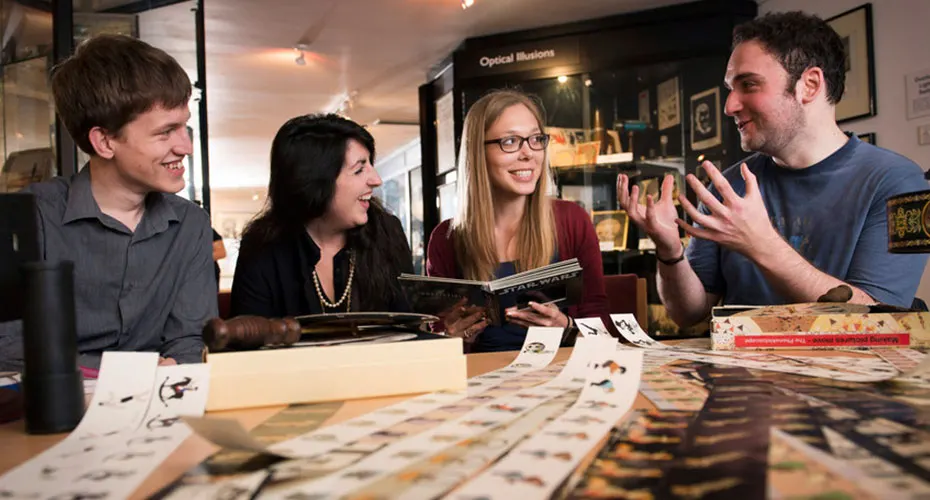
Students in the Bill Douglas Cinema Museum
We are exceptionally lucky to have some fantastic facilities and resources on the Streatham Campus.
Special Collections
We have Special Collections relating to writers such as Agatha Christie, Daphne du Maurier, and William Golding, and we integrate these into our teaching so students can share the excitement we have when discovering new insights from manuscripts, letters, and business papers.
The Bill Douglas Cinema Museum
Our unique film and popular culture resource, contains items going back hundreds of years. We regularly take students into its archives and think about the study of literature in relation to visual texts.
Digital Humanities Lab
Digital Humanities is increasingly important in all areas of humanities research, including history, archaeology, literatures and languages. This research space enables the examination, preservation and analysis of historical, literary and visual material. Facilities in the lab include:
- a flagship seminar room equipped with a 4.2-metre video wall, encouraging interactive engagement in a shared display space
- two state-of-the-art photography labs, including provision for the 2D digitisation of heritage material and primary sources
- an audio-visual lab with a recording studio and sound editing suite
- a MakerSpace equipped with 3D scanning and printing equipment
Your future
Employer-valued skills this course develops
Film graduates from the University of Exeter have an excellent reputation with graduate recruiters and compete very successfully in the employment market.
A degree in Film Studies from the University of Exeter will enable you to acquire skills which are attractive to employers and relevant for a wide range of careers. You will develop an informed, critical and creative approach. Alongside strong oral and written communication skills, you will be able to manage your time and workload effectively, work well as part of a team or independently, be flexible when faced with new situations and have strong analytical skills.
Employer visits
We have a dedicated, award-winning Careers Service, ensuring you have access to careers advisors, mentors and the tools you need to succeed in finding employment in your chosen field on graduation. We offer the Exeter Award and the Exeter Leaders Award which include employability-related workshops, skills events, volunteering and employment which will contribute to your career decision-making skills and success in the employment market. Our graduates compete very successfully in the employment market, with many employers targeting the University when recruiting new graduates. For further information please visit our Careers Service.
Career paths
You will be equipped with skills that are attractive to employers and relevant for a wide range of careers, including graduate-level roles in Events Management, TV production, the film industry, publishing, education, sales, communications and marketing.
Example careers
- Accounts Executive
- Data and Research
- Analyst
- Digital Media Assistant
- Editor/Film-maker
- Innovations Coordinator
- Marketing Executive
- Market Researcher
- Post-production Assistant
- Production Runner
- PR Consultant
- Further study
Further study
Recent graduates have progressed to postgraduate courses in:
- MA English
- MA Film and Cinema
- MA Creative Writing
- MA International Film Business
- MA History
- MA Arts and Cinema Studies
- MA Creative Writing
- MA Film Studies
- MA Theology
- MRes in Sexuality and Gender Studies
* This information has been taken from the Destinations of Leavers from Higher Education (DLHE) Surveys 14/15, 15/16, and 16/17. Please note that, due to data protection, the job titles and organisations are listed independently and do not necessarily correspond.