BEng Mining Engineering
Please note: This page is for 2026 entry. Click here for 2027 entry.
| UCAS code | J117 |
|---|---|
| Duration | 3 years |
| Entry year | 2026 |
| Campus | Penryn Campus |
| Typical offer | A-Level: AAB-ABB |
|---|---|
|
A-Level: BBB-BBC |
Why study BEng Mining Engineering at Exeter?
- Learn how to responsibly manage the extraction of natural resources that are essential for modern society to function
- Understand the mining lifecycle, mining value chain and the investment and fundraising environment
- Address the challenges of environmental sustainability, governance and social responsibility
- Undertake an industry work placement in a mining business or operational environment
- Fieldwork at local mine sites offers extensive, hands-on practical experience

Top 20 in the world for Mineral and Mining Engineering
QS University World Subject Rankings 2025

Strong employment opportunities available nationally and worldwide

The only mining engineering degree offered in the UK

Join a global network of Camborne School of Mines alumni when you graduate
Top 20 in the world for Earth Sciences
18th in the 2025 Global Ranking of Academic Subjects (GRAS) or Shanghai Rankings

The BEng (Hons) Mining Engineering is accredited by the Institute of Materials, Minerals and Mining (IoM3), who is under licence from the UK regulator, the Engineering Council as:
- Fully satisfying the educational base for an Incorporated Engineer (IEng).
- Partially satisfying the educational base for a Chartered Engineer (CEng).
A programme of accredited further learning will be required to complete the educational base for CEng. See www.iom3.org for further information.
Accreditation is a mark of assurance that the degree meets the standards set by the Engineering Council in the UK Standard for Professional Engineering Competence (UK-SPEC). Accreditation is awarded for a maximum of 5 years under each assessment exercise. The dates applicable to the current accreditation of this degree programme can be viewed on the Engineering Council’s list of accredited degrees: www.engc.org.uk.
Entry requirements (typical offer)
| Qualification | Typical offer | Required subjects |
|---|---|---|
| A-Level | AAB - ABB | GCE A-Level Maths grade B and another science* subject at grade B. Candidates may offer GCE A-Level Maths, Pure Maths or Further Maths. |
| IB | 34/665-32/655 | HL5 in Mathematics (Analysis and approaches or Applications and interpretations) and HL5 in another Science subject. |
| BTEC | DDD - DDM | See below under 'read more' for further information |
| GCSE | 4 or C | Grade 4/C in GCSE English language |
| Access to HE | 24 L3 credits at Distinction Grade and 21 L3 credits at Merit Grade | 12 L3 Credits at Merit Grade in Mathematics and 12 L3 Credits at Merit Grade in an acceptable Science subject area. |
| T-Level | Distinction | T-level in Design, Surveying and Planning for Construction; Design and Development for Engineering and Manufacturing; Engineering, Manufacturing, Processing and Control; or Maintenance, Installation & Repair for Engineering and Manufacturing only. |
| Contextual Offer | A-Level: BBB-BBC |
Specific subject requirements must still be achieved where stated above. Find out more about contextual offers. |
| Other accepted qualifications | ||
| English language requirements |
International students need to show they have the required level of English language to study this course. The required test scores for this course fall under Profile B1. Please visit our English language requirements page to view the required test scores and equivalencies from your country. |
|
NB General Studies is not included in any offer.
Grades advertised on each programme webpage are the typical level at which our offers are made and provide information on any specific subjects an applicant will need to have studied in order to be considered for a place on the programme. However, if we receive a large number of applications for the programme we may not be able to make an offer to all those who are predicted to achieve/have achieved grades which are in line with our typical offer. For more information on how applications are assessed and when decisions are released, please see: After you apply
*Accepted GCE A-Level/AS science subjects include: Biology/Human Biology**; Chemistry; Computing; Design and Technology; Economics; Electronics; Environmental Science; Environmental Studies; Geography; Geology; Life and Health Sciences; Physical Education; Physics; Psychology; Science (applied); Statistics.
**If more than one of these is taken they would only count as one 'science' but could count as two A-Levels towards our general requirements.
BTEC Extended Diploma
Applicants studying one of the following BTEC Extended Diplomas will be considered without a GCE A-Level science subject (GCE A-Level Maths is still required): Civil Engineering, Engineering, Electrical/Electronic Engineering, Mechanical Engineering, Computer Engineering, Manufacturing Engineering, Aeronautical Engineering.
For any questions relating to entry requirements please contact the team via our online form or 01392 724061.
Course content
Natural resources are required for our everyday activities: from the provision of essential commodities and construction materials, to the supply of critical minerals to drive the green energy transition. The well-managed, responsible extraction of natural resources is therefore essential for modern society to function.
The resource sector faces unprecedented global demand for sustainable, efficient operating solutions as demand for minerals increases and governments move to implement climate change directives. Skilled graduates with expertise in Mining Engineering will be at the forefront of delivering change and achieving a sustainable, net carbon future through the responsible extraction of these resources.
You will study a broad range of topics which include: the underlying maths, digital, geology and physics skills that inform engineering, then mine design, operations, processing, services, automation, safety, economics, environment and social governance.
You may notice changes to some of our modules over the coming months. This is because we are making space for the following:
- Minors: Future Skills Pathways - Alongside your main degree you may be eligible (depending on your course) to choose modules from another subject to broaden your skills and interests.
- Skills to Thrive built into every degree - Essential skills for your future, including communication, problem-solving, teamwork and digital confidence.
- Increased innovation and wellbeing - More room for creative learning, real-world projects and a healthier study rhythm.
The modules below provide examples of what you can expect to learn on this degree course based on recent academic teaching. The precise modules available to you in future years may vary depending on staff availability and research interests, new topics of study, timetabling and student demand.
Please note that the module information displayed here is subject to change.
120 credits of compulsory modules
Compulsory modules
| Code | Module | Credits |
|---|---|---|
| Compulsory 1 | ||
| Engineering Mathematics and Scientific Computing | 30 | |
| Multi-Disciplinary Group Challenge Project | 30 | |
| Fundamentals of Mechanics | 15 | |
| Fundamentals of Materials | 15 | |
| Fundamentals of Electronics | 15 | |
| Fundamentals of Engineering | 15 | |
ENE1011: Engineering Mathematics and Scientific Computing
Mathematics is at the heart of all Science and Engineering subjects, providing the logical foundations and quantitative tools for modelling and analysis. The modern engineer also leverages the power of computing to solve otherwise intractable problems. This module introduces the fundamental mathematics and scientific computing skills that will underpin engineering applications throughout your programme of study.
You will learn about matrix methods, differential equations, integral transforms and statistics - mathematical tools that are vital for 21st-century engineers. Training in scientific computing with the Python programming language will equip you with powerful modelling and data processing skills - this will mirror mathematical content, building knowledge of specialist packages to implement mathematical methods.
This module aims to provide you with the mathematical tools to tackle modern engineering problems. It will allow you to develop strong quantitative skills, such that mathematical tools become second nature so you can focus directly on engineering challenges and concepts. An important aspect of this is to provide a solid foundation in programming so that it can help you develop new ways of engineering thinking and cutting-edge solutions to ever-changing societal challenges.
ENE1012: Multi-Disciplinary Group Challenge Project
The University declared an environment and climate emergency in May 2019. The future of our planet and community is at stake. We know though that simply declaring an environment and climate emergency is not enough so you will be part of a team involved in this real-world Project Based Learning (PBL) module to show our commitment to leading the change required. Your career as a professional engineer will require you to work effectively with multi-disciplinary teams on complex and challenging projects. In preparation for this working environment your first task as a new engineering student will be to work on energy recovery systems during this multidisciplinary challenge project.
The PBL driving question is: How can we design innovative energy recovery systems for mining operations?
Your team project will be completed over two terms and PBL will be the vehicle for putting the core knowledge gained in Fundamentals of Mechanics, Materials and Electronics into practice in a collaborative group setting. To support your project work you will undertake workshops in study/research skills, sketching, technical communication, 3D modelling and prototyping. Your group project will culminate in a presentation using both multimedia, 3D modelling and basic physical prototyping such as card modelling, 3D printing, laser cutting or blue foam modelling.
ENE1014: Fundamentals of Mechanics
This module builds on foundational engineering principles, advancing your understanding of key concepts in Mechanics. Designed as part of a trio of core engineering modules, it provides essential knowledge of mechanics, materials, and electronics, offering a solid foundation for more specialized study. In this module, the focus shifts from classical mechanics to more advanced fundamentals, including hydrostatics, hydrodynamics, and an introduction to dynamics. These topics are crucial for understanding real-world engineering problems, such as the behaviour of fluids in different environments and the forces acting on moving objects. Whether assessing pressure distribution on submerged structures or analysing fluid flow in pipelines, this module equips you with the necessary tools for tackling complex engineering challenges.
The module is structured around flipped learning, where you engage with learning materials and practical questions ahead of interactive tutorial sessions. A continuous assessment approach enables you to self-evaluate throughout the term, providing feedback on your progress and helping to reinforce critical learning.
ENE1015: Fundamentals of Materials
This module is one of three engineering fundamentals modules that will introduce engineering concepts and theory across the areas of Mechanics, Materials and Electronics and will provide you with a solid grounding on which to build in later modules. In this module we focus on two sub-disciplines, material science and material engineering, with topics spamming from material properties, material structures, material failure and material applications. At the heart of any engineering analysis is the need to understand an object's response to the applied conditions, whether it is the allowed stress level to avoid catastrophic failure of pressurised vessels, or altering material micro- and nanostructures to provide improved ductility, strength, or resistance to fracture. None of this analysis is possible without first understanding basic materials.
You will work through new topics each week with the aid of extensive learning materials, lectures, tutorials, and experimental activities. You will undertake numerous elements of online continuous assessment throughout the module which will allow you to evaluate your understanding of the material and diagnose areas that require further attention. Continuous assessments provide ongoing feedback and support you to actively manage your learning.
ENE1016: Fundamentals of Electronics
This module takes you into the world of Electronic engineering - a field that covers everything from radio to space flight. In this module you will learn fundamental concepts of charge, current and potential which are the foundation of electrical signals. You will be introduced to the basic electronic components and circuital laws for developing important DC and AC circuits for applications in power supplies, wireless power transfer, signal filters and sensor circuits.
As part of modern electronics, this module also gives you a foundation of semiconductors and semiconductor devices both analogue and digital. You will learn the characteristic and operation of fundamental analogue devices such as diodes, transistors and operational amplifiers and their applications as amplifiers, in power suppliers, device drivers, and sensor circuits (such as temperature and strain). In digital electronics, you will study Boolean algebra and fundamentals of logic gates for the design of combinational and sequential logic circuits and their practical applications in decision making circuits and controllers for industrial applications, counters and timers.
ENE1017: Fundamentals of Engineering
This module exemplifies the unique approach taken here at Exeter to nurturing the next generation of multidisciplinary engineers. It will introduce engineering concepts and theory across the areas of Mechanics, Materials and Electronics and will provide you with a solid grounding on which to build in later modules.
In this module we focus on two sub-disciplines of materials, material science and material engineering, with topics spamming from material properties, material structures, material failure and material applications. At the heart of any engineering analysis is the need to understand an object's response to the applied conditions, whether it is the allowed stress level to avoid catastrophic failure of pressurised vessels, or altering material micro- and nanostructures to provide improved ductility, strength, or resistance to fracture. None of this analysis is possible without first understanding basic materials.
We also focus on classical mechanics. At the heart of any engineering analysis is the need to understand an object's response to its environment, whether it's the forces imparted by traffic as it traverses a bridge or the forces of lift that allow an aircraft to fly. None of this analysis is possible without first understanding classical mechanics. In this module you will cover foundational mechanics theory.
Please note that the module information displayed here is subject to change.
120 credits of compulsory modules
Compulsory modules
| Code | Module | Credits |
|---|---|---|
| Compulsory 1 | ||
| Geotechnics | 15 | |
| Resource Cycle and Value Chain | 30 | |
| Resource Extraction Methods | 15 | |
| Resource Development | 30 | |
| Discipline Group Challenge Project | 30 | |
CSM2185: Geotechnics
This module provides a comprehensive introduction to the geotechnical behaviour of rock and soil materials as applied to engineering design. The course begins with the fundamental principles of engineering geological characterization, progressing through core concepts in introductory soil and rock mechanics. You will combine these foundational elements with empirical design methodologies, serving as a basis for more advanced geotechnical engineering modules in the third year.
On this module, you will have a combination of lectures, collaborative group activities, and hands-on practical sessions. Assessment comprises two core components: (1) a technical report based on the analysis and interpretation of site investigation data, and (2) an exam.
Prerequisites:
Successful completion of first-year modules within the CSM programme or possible direct-entry candidates into the second year.
Relevance and Progression:
You will particularly enjoy this module if you are intending to pursue careers in civil engineering, mining and minerals engineering, geotechnical design for surface and subsurface construction, or environmental geosciences. It offers critical insight into the geological and geomechanical factors underpinning engineering design.
CSM2324: Resource Cycle and Value Chain
In this module you will explore the mining life cycle: understand how to find a mineral deposit, evaluate it, extract the ore and process it to a saleable product – as well as appreciating the impact that this may have on the environment and communities. Mines are made not found. In order to assess if a mineral deposit is potentially viable to develop into a mine both the mineralisation and the host rocks in which it sits need to be fully characterised. This involves understanding the geological context of the deposit, and a range of methods to investigate the 3d geological setting. The concepts covered will be developed in more detail in subsequent modules but this covers a range of underpinning concepts that will help contextualise these later modules.
CSM2325: Resource Extraction Methods
Correct mining method selection is vitally important as it impacts multiple aspects of an operation. As a mining engineer the selection of the correct method is a fundamental aspect of your role, being able to balance multiple parameters. You will be introduced to mining methods selection, both surface and underground, and how they are applied to different ore bodies taking into consideration economic, geological and engineering constraints.
Building on the basic knowledge given to you in CSM2324, this module focuses on the development and extraction components of the mining life cycle. This module will give you a detailed overview of the different mining methods used for extraction through both surface and underground mines, and how they are selected based on site and orebody location and geology. This will include shaft sinking and pit development.
CSM2329: Resource Development
This module will develop your understanding of the development techniques used in surface and underground mining. You will examine the methods of mine transport that may be utilised in both surface and underground operations and extend your understanding of engineering principles in relation to the handling and transport of persons and materials. To develop a mineral resource, it is necessary to understand excavation techniques in detail. This module will also introduce you to the principles of drill and blast design in surface and underground mining operations, including the application of both explosives and machine mining for rock breakage.
This module examines the how a mineral resource is developed in a mine. This includes the methods of mine transport that practitioners may well use in both surface and underground operation. It also aims to extend your understanding of engineering principles in relation to the handling and transport of materials and persons. The module also provides knowledge of the use of explosives in rock breaking, and it gives you an overview of mine development techniques.
ENE2011: Discipline Group Challenge Project
In this challenge project you will develop your understanding of fundamental surveying techniques. This includes using surveying equipment to make spatial measurements (angles, distances and elevations), as well as the theory and mathematics involved with establishing control networks and use of coordinate systems. As the module advances you will be introduced to how global navigation satellite systems are used in surveying and be introduced to setting out and engineering surveying. You will work within a group to develop your group working skills and undertake practical application of the taught content. Focus will be placed on survey control, detail surveying and the production of an accurate plan of the chosen challenge project.
Through project based learning, this module provides students with a comprehensive understanding of the principles and techniques used in engineering and mine surveying. The course covers both surface and underground surveying practices, focusing on their application in the mining industry. Through a combination of lectures covering theory and practical fieldwork, students will gain the necessary skills to undertake both surface and underground surveys, analyse data, and apply it to real-world scenarios. Students will also develop teamwork, communication, and project management skills through group-based assignments.
Please note that the module information displayed here is subject to change.
120 credits of compulsory modules
Compulsory modules
| Code | Module | Credits |
|---|---|---|
| Compulsory 1 | ||
| Surface Excavation Design | 15 | |
| Tunnelling and Excavation Design | 15 | |
| Politics, Mining and Sustainable Development | 15 | |
| Resource Infrastructure and Mine Services | 30 | |
| Mineral Processing, Recycling and Resource Recovery | 15 | |
| Individual Project | 30 | |
CSM3038: Surface Excavation Design
Effective design is critical for the stability and creation of a safe working environment for surface excavations. This module commences with a critical review of input data required for design of surface excavations (building on previous knowledge obtained in the year two module Geotechnics or equivalent).
By taking this module, you will acquire knowledge relating to both geotechnical design-related aspects and blast design of surface excavations. We will follow initial identification of potential slope failure modes with instability analyses and the identification of appropriate stabilisation methods/techniques.
The module is not recommended for interdisciplinary pathways.
This module gives you the specialist analysis and design skills associated with civil, geotechnical, environmental and related industries. It provides problem-solving skills and offers simulated industrial experience.
Where appropriate, we will use case history information to emphasise important aspects associated with data variability and its influence on design. In addition, we will use design-based assignments to emphasise and consolidate key aspects of hazard appraisal of slope faces and how discontinuity characteristics affect excavation stability and the choice of appropriate stabilisation methods.
CSM3041: Tunnelling and Excavation Design
Effective design is critical for the stability and creation of a safe working environment for underground excavations. The module commences with a critical review of input data required for design of underground excavations (building on previous knowledge obtained in the year 2 module ‘Geotechnics’ or equivalent). The model investigates factors influencing the design of underground excavations, including both discontinuity and stress-controlled instability. The module is not recommended for interdisciplinary pathways.
The module provides specialist analysis and design skills associated with the tunnelling, underground mining and related industries. The module provides problem-solving, data-handling and evaluation skills. The module also provides an opportunity for you to develop an awareness of risk assessment applied to underground excavation design.
Where appropriate, case history information is used to emphasize important aspects associated with data variability and its influence on design.
Computer-based design exercises are used to emphasize and consolidate key aspects of how stress redistribution and discontinuity characteristics affect excavation stability and choice of appropriate stabilization methods.
CSM3409: Politics, Mining and Sustainable Development
This module covers the vital industry issues of corporate social responsibility, social license to operate, stakeholder engagement, health & safety and political & environmental factors that affect mining decisions. The module explores how environmental impact is measured, monitored and controlled, and what sustainability means in the context of mining. It also explores international and local mining legislation, expectations of local people in mining regions, and the long- and short-term impacts of mining on a local and national scale with a particular focus on the social, economic and environmental impacts of mine closure. The module covers the key aspects of health and safety management that future managers, engineers and scientists will need to know and find useful in their future lives and careers.
CSM3410: Resource Infrastructure and Mine Services
This module aims to provide students with a comprehensive understanding of the energy requirements and management within mining operations. It focuses on the efficient use of energy in various mining processes, particularly in ventilation systems, which are critical for maintaining safe and productive environments in underground mines. Key objectives include exploring energy consumption patterns andimplementing energy-saving technologies. Additionally, the course will coverventilation design principles, air quality control all while emphasizing theenvironmental impact of mining activities and strategies to reduce energy waste.
CSM3411: Mineral Processing, Recycling and Resource Recovery
This module provides you with key knowledge of technologies and processes for mineral processing and hydrometallurgy for a range of important metalliferous and industrial mineral deposits. It will provide you with essential understanding of key processes downstream of ore extraction. The module complements existing knowledge about the sustainable extraction of primary resources. Techniques presented in this module may also be applied to beneficiation and management of secondary resources. You will also develop an understanding of industrial recycling systems and the importance of a sustainable circular economy.
The module aims to provide students with a comprehensive understanding of the principles, techniques, and technologies used in mineral processing, recycling, and resource recovery. It will emphasize the importance of sustainable practices in resource extraction and waste management, exploring innovative approaches for minimizing environmental impact while optimizing resource utilization. Students will develop the ability to evaluate and design processes that maximize the recovery of valuable materials from both primary and secondary sources, including mining waste and recycling streams.
CSM3414: Individual Project
This module gives you the chance to showcase the skills you have developed in previous modules by carrying out an independent research project. You will collect, analyse (using previously acquired data and/or data collected as part of the project), interpret and discuss geological, exploration, mining or related environmental data, and come up with conclusions and recommendations.
This module is designed to provide BEng students with the opportunity to undertake an independent research project in the field of mining and/or minerals engineering. The module aims to develop critical thinking, research skills, and technical expertise relevant to contemporary issues and challenges in mining and/or minerals engineering. Through this project, students will develop their ability to conduct research, analyse data, and present findings in a professional manner, while also gaining hands-on experience in the application of mining engineering principles.
Fees
Tuition fees for 2026 entry
UK students: £9,790 per year
International students: £31,200 per year
Scholarships
The University of Exeter offers a wide range of scholarships to support your education, with £7 million available for international students applying to study with us in the 2026/27 academic year, including our prestigious Exeter Excellence Scholarships*. We also provide scholarships for sport, music and other achievements, alongside regional and partner awards such as Chevening, The Beacon Trust and the British Council. Financial support is available for students from disadvantaged backgrounds, lower income households and other under-represented groups to help them access, succeed and progress through higher education.
* Terms and conditions, including deadlines, apply. See our website for details.
Learning and teaching
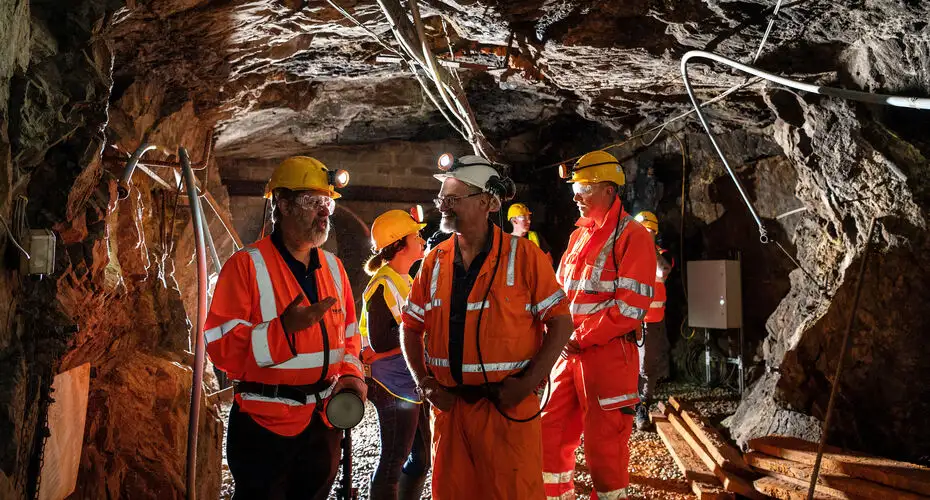
Learning and teaching will take place through lectures, seminars and practicals; these can be laboratory-based or in and around mining operations.
You will develop new knowledge, skills, behaviours and ideas that will enable you to become a more effective employee who can add real change to their organisation and lay the foundation for a prosperous and challenging career in the mining and resource extraction industry.
Placement
As part of your degree, you will complete a work placement in the summer between years 2 and 3. This will be in a mining environment, which could include a mine or in the business operations division of a mining company. You will complete a placement report which will form part of your assessment.
You will be responsible for finding your own placement, supported by the academic team within the department and industry contacts.
Fieldwork
Throughout your studies there will be many fieldwork opportunities for undertaking practical assessments, in areas such as surveying, geological and geotechnical mapping, and ventilation. There will be visits to local mine sites, both surface and underground, in both the South West and around the wider United Kingdom.
Assessment
Assessment methods vary between modules, but usually combine exams and coursework. This might include practical work, professional posters, group projects, reports, software exercises, essays or verbal presentations.
Your future
A rich curriculum enhanced by strong links with industry
Throughout your degree a strong emphasis is placed on your personal and professional development.
You will develop the essential skills valued by employers, such as:
- problem-solving
- teamwork
- decision-making
- communication
- planning and organising
- time management
- presentation
- and leadership.
You’ll benefit from the hundreds of links with industry we have established through collaborative research and consultation. Student projects are usually industrially driven and often directly involve a company. This provides an opportunity for you to undertake commercially important projects at the forefront of technology, gain invaluable experience and enhance your employability.
The Camborne School of Mines Association and the award-winning University of Exeter Careers Service have the skills and a strong network of alumni to help you find employment.
Employer Visits
There are regular employer events from local and international mining companies and mining support companies throughout the year. These allow our students to network and meet with potential employers, and learn more about possible career paths. There are also regular guest lectures from industry experts on the current state of the art.