MEng Biomedical Engineering
Please note: This page is for 2026 entry. Click here for 2027 entry.
| UCAS code | H113 |
|---|---|
| Duration | 4 years |
| Entry year | 2026 |
| Campus | Streatham Campus |
| Typical offer | A-Level: AAB-ABB |
|---|---|
|
A-Level: BBB-BBC |
| UCAS code | H138 |
|---|---|
| Duration | 5 years |
| Entry year | 2026 |
| Campus | Streatham Campus |
| Typical offer | A-Level: AAB-ABB |
|---|---|
|
A-Level: BBB-BBC |
Why study MEng Biomedical Engineering at Exeter?
- Join the forefront of innovation in healthcare technology with an MEng in Biomedical Engineering, where you'll learn to design and develop cutting-edge solutions that enhance patient care and wellbeing.
- Gain a strong foundation in mechanical and electronic engineering, biology and physics, equipping you with the essential skills to excel in the rapidly growing biomedical engineering field.
- Engage in hands-on projects where you will develop, prototype and explore the market for solutions to pressing biomedical engineering challenges.
- The MEng course allows you to specialise further into biomedical engineering through an integrated Masters. In this fourth year, you’ll explore more advanced topics and put your skills into practice with an investigative report.
- Prepare for a dynamic career in various sectors including medical device manufacturing, healthcare technology, academic research and third-sector organisations like the NHS, addressing critical medical issues such as ageing populations and non-communicable diseases.
- You may also be interested in our three-year BEng Biomedical Engineering programme.

Top 15 in the UK for General Engineering
13th in the Complete University Guide 2026

Hands-on course with an emphasis on practical project work

92% of our Engineering research is internationally excellent
Based on research rated 4* + 3* in REF 2021

£6.5million investment in our teaching labs, workshop spaces and equipment
Accreditation information
This course launches in 2025 and has been developed in close partnership with industry and in consultation with our accrediting bodies. We have already successfully gained accreditation from industry professional bodies for established programmes across the Engineering Department.
As this is a new programme, we aim to seek accreditation from the relevant professional bodies; however, this cannot be guaranteed at this stage.
Accreditation status will be updated when new information is available. If you require any further information, please .
Entry requirements (typical offer)
| Qualification | Typical offer | Required subjects |
|---|---|---|
| A-Level | AAB-ABB | GCE A-Level Maths grade B and another science* subject at grade B. Candidates may offer GCE A-Level Maths, Pure Maths or Further Maths. |
| IB | 34/665-32/655 | HL5 in Mathematics (Analysis and approaches or Applications and interpretations) and HL5 in another science subject. Applicants achieving IB Maths SL7 plus IB HL6 in Physics will also be considered. |
| BTEC | DDD-DDM | See 'read more' below |
| GCSE | 4 or C | Grade 4/C in GCSE English Language |
| Access to HE | 24 L3 credits at Distinction Grade and 21 L3 credits at Merit Grade. | 12 L3 Credits at Distinction Grade in Mathematics and 12 L3 Credits at Distinction Grade in an acceptable Science subject area. |
| T-Level | Distinction | T-Level in Design and Development for Engineering and Manufacturing, or T-Level in Design, Surveying and Planning for Construction. GCE A-Level Maths is still required. |
| Contextual Offer | A-Level: BBB-BBC |
Specific subject requirements must still be achieved where stated above. Find out more about contextual offers. |
| Other accepted qualifications | ||
| English language requirements |
International students need to show they have the required level of English language to study this course. The required test scores for this course fall under Profile B1. Please visit our English language requirements page to view the required test scores and equivalencies from your country. |
|
NB General Studies is not included in any offer.
Grades advertised on each programme webpage are the typical level at which our offers are made and provide information on any specific subjects an applicant will need to have studied in order to be considered for a place on the programme. However, if we receive a large number of applications for the programme we may not be able to make an offer to all those who are predicted to achieve/have achieved grades which are in line with our typical offer. For more information on how applications are assessed and when decisions are released, please see: After you apply
*Accepted GCE A-Level/AS science subjects include: Biology/Human Biology**; Chemistry; Computing; Design and Technology; Economics; Electronics; Environmental Science; Environmental Studies; Geography; Geology; Maths/Pure Maths/Further Maths**; Physical Education; Physics; Psychology; Science (applied); Statistics
**If more than one of these is taken they would only count as one 'science' but could count as two A-levels towards our general requirements.
For any questions relating to entry requirements please contact the team via our online form or 01392 727272.
BTEC Extended Diploma
Applicants studying one of the following BTEC Extended Diplomas will be considered without a GCE A-Level science subject (GCE A-Level Maths is still required): Applied Science, Aeronautical Engineering, Building Services Engineering, Construction and the Built Environment, Civil Engineering, Operations and Maintenance Engineering, Computer Engineering, Electrical/Electronic Engineering, Engineering, Manufacturing Engineering, Mechanical Engineering, Environmental Sustainability.
BTEC Diploma or BTEC Extended Certificate
Applicants studying Applied Science or Engineering in the BTEC Diploma or BTEC Extended Certificate will be considered without a GCE A-Level science subject. GCE A-Level Maths is still required.
Course content
In your first year, you'll gain a comprehensive foundation in core engineering disciplines, including mechanical, electronic and materials engineering. As you progress through your degree, your modules will become more specialised, with a focus on biomedical engineering. In your fourth year, you’ll put into practice your research, project management and engineering skills, in the investigation of an engineering research question.
Throughout the course, you'll have numerous opportunities for hands-on project work, allowing you to apply theoretical knowledge, develop practical skills and create innovative prototypes. This practical experience is designed to bridge the gap between classroom learning and real-world applications, preparing you for a successful career in the field.
You may notice changes to some of our modules over the coming months. This is because we are making space for the following:
- Minors: Future Skills Pathways - Alongside your main degree you may be eligible (depending on your course) to choose modules from another subject to broaden your skills and interests.
- Skills to Thrive built into every degree - Essential skills for your future, including communication, problem-solving, teamwork and digital confidence.
- Increased innovation and wellbeing - More room for creative learning, real-world projects and a healthier study rhythm.
The modules below provide examples of what you can expect to learn on this degree course based on recent academic teaching. The precise modules available to you in future years may vary depending on staff availability and research interests, new topics of study, timetabling and student demand.
Please note that the module information displayed here is subject to change.
120 credits of compulsory modules.
Compulsory modules
| Code | Module | Credits |
|---|---|---|
| Compulsory 1 | ||
| Engineering Mathematics and Scientific Computing | 30 | |
| Multi-Disciplinary Group Challenge Project | 30 | |
| Fundamentals of Mechanics | 15 | |
| Fundamentals of Materials | 15 | |
| Fundamentals of Electronics | 15 | |
| Fundamentals of Engineering | 15 | |
ENG1002: Engineering Mathematics and Scientific Computing
This module introduces modern Engineering Mathematics by teaching maths alongside programming.
What you learn in this module will support mathematical content in core modules throughout your programme. You will be introduced to core mathematical tools for modelling Engineering systems which will be developed further in Year 2. You will learn about statistical methods of analysis that are vital tools for Engineers in the 21st century.
An elementary introduction to programming in Python will be provided which will equip you with valuable data processing and modelling skills. The teaching of Python will mirror mathematical content, building on knowledge of specialist packages for matrices, differential equations and statistics.
This module aims to provide you with all mathematical tools to tackle modern Engineering problems. It will allow you to develop strong quantitative skills, such that mathematical tools become second nature so you can focus directly on Engineering challenges and concepts. An important aspect of this is to provide a solid foundation in programming so that it will help you develop new ways of Engineering thinking and cutting-edge solutions to ever-changing societal challenges.
ENG1005: Multi-Disciplinary Group Challenge Project
The University declared an environment and climate emergency in May 2019. The future of our planet and community is at stake. We know though that simply declaring an environment and climate emergency is not enough so you will be part of a team involved in this real-world Project Based Learning (PBL) module to show our commitment to leading the change required. Your career as a professional engineer will require you to work effectively with multi-disciplinary teams on complex and challenging projects. In preparation for this working environment your first task as a new engineering student will be to work on energy harvesting during this multidisciplinary challenge project.
The PBL driving question is ‘How can we harness ocean energy and convert it into reliable, sustainable and cost-competitive electricity that can be used to power homes, transport, and industries’.
The purpose of this module is to:
- Address the climate emergency through a team project focused on energy harvesting. The PBL project will facilitate the application of the core engineering knowledge gained in Fundamentals of Mechanics, Materials and Electronics.
- Develop 21st century skills in creativity, collaboration, communication, critical thinking, problem solving, leadership and technology literacy.
- Gain valuable experience in research/study skills, sketching, technical communication, 3D modelling and prototyping.
- Steering projects through the design process and creating prototypes for a final PBL ‘Public Product’.
ENG1007: Fundamentals of Mechanics
In this module we focus on classical mechanics. At the heart of any engineering analysis is the need to understand an object’s response to its environment, whether it’s the forces imparted by traffic as it traverses a bridge or the forces of lift that allow an aircraft to fly. None of this analysis is possible without first understanding classical mechanics. In this module you will cover foundational mechanics theory.
This module aims to equip you with fundamental knowledge and skills in Mechanics. It also consolidates a common knowledge base and begins the development of a learning methodology appropriate to a professional engineer. Through both continuous assessment and the end of year exams, the module encourages you to actively manage your own learning and seeks to develop your ability to communicate your understanding of engineering theory and concepts in a professional manner.
ENG1008: Fundamentals of Materials
In this module, we focus on two sub-disciplines, fracture mechanics and additive manufacturing. At the heart of any engineering analysis is the need to understand an object’s response to the applied conditions, whether it is the allowed stress level to avoid catastrophic failure of pressurised vessels, or altering material micro- and nanostructures to provide improved ductility, strength, or resistance to fracture. None of this analysis is possible without first understanding basic materials.
You will work through new topics each week with the aid of extensive learning materials, lectures, tutorials, and experimental activities. You will undertake several online continuous assessments throughout the module, which will allow you to evaluate your understanding of the material and diagnose areas that require further attention. Continuous assessments provide ongoing feedback and support you to actively manage your learning.
The module is taught using a flipped learning methodology. Each week, you will review background materials. A flipped learning methodology allows you to extract more benefit from guided tutorials but also requires more upfront work by you in preparation.
ENG1009: Fundamentals of Electronics
This module introduces the key building blocks of modern electronic systems, focusing on both analogue and digital electronics. You will learn how components like diodes and transistors help control and amplify signals, and how operational amplifiers are used in everyday devices. On the digital side, you’ll explore how computers and digital systems make decisions using logic, learning about the basic rules (Boolean algebra) and building blocks (logic gates, flip-flops, and counters) that underpin digital technology. The module blends theory with hands-on activities to help you understand how electronic circuits work and how they are used in real-world applications.
You will also take part in assessed practical electronic laboratories that introduces and develops your practical electronic skills in soldering and wiring. These practical laboratories will also develop the familiarity with using test and measurement equipment and applies your knowledge in both analogue and digital fields and demonstrate applications of their circuits.
ENS1000: Fundamentals of Engineering
This module exemplifies the unique approach taken here at Exeter to nurturing the next generation of multidisciplinary engineers. It will introduce engineering concepts and theory across the areas of Mechanics, Materials and Electronics and will provide you with a solid grounding on which to build in later modules.
In this module we focus on two sub-disciplines of materials, material science and material engineering, with topics spamming from material properties, material structures, material failure and material applications. At the heart of any engineering analysis is the need to understand an object's response to the applied conditions, whether it is the allowed stress level to avoid catastrophic failure of pressurised vessels, or altering material micro- and nanostructures to provide improved ductility, strength, or resistance to fracture. None of this analysis is possible without first understanding basic materials.
We also focus on classical mechanics. At the heart of any engineering analysis is the need to understand an object's response to its environment, whether it's the forces imparted by traffic as it traverses a bridge or the forces of lift that allow an aircraft to fly. None of this analysis is possible without first understanding classical mechanics. In this module you will cover foundational mechanics theory.
Please note that the module information displayed here is subject to change.
120 credits of compulsory modules.
Compulsory modules
| Code | Module | Credits |
|---|---|---|
| Compulsory 1 | ||
| Introduction to Fluid Dynamics | 15 | |
| Microcontroller Engineering | 15 | |
| Modelling of Engineering Systems | 15 | |
| Solid Mechanics | 15 | |
| Biomedical Engineering Challenge Projects | 30 | |
| Thermodynamics and Heat Transfer | 15 | |
| The Physics of Living Systems | 15 | |
ENG2007: Introduction to Fluid Dynamics
Almost all engineered objects are immersed either in air or water (or both) or make use of some working fluid in their operation. This is particularly true of machines for energy generation and conversion, such as engines, turbines, and renewable energy devices like wind turbines or wave-energy converters. The ability to understand and predict the behaviour of such devices is therefore of key importance for engineers. In this module, you will learn about the fundamentals of fluid systems: pressure, flow, and viscosity, and how they can be analysed experimentally and mathematically. Engineering applications covered include pumps, turbines, and internal flows in pipe networks.
By the end of this course, you will have the skills to analyse engineering systems involving internal and external flows, using experimental and mathematical techniques together with tables and charts of fluid dynamical and physical properties.
ENG2008: Microcontroller Engineering
A microcontroller is a small computer on a single integrated circuit. It is widely used in automatically controlled systems and devices such as appliances, automobiles, robots and mobile phones. In this module, you will be introduced to the fundamental principles of the design, operation and application of microcontrollers. This includes the architecture of microcontrollers and peripherals, such as various types of memories, analogue and digital input/output interfaces, serial communication modules, timers and interrupts. You will also learn how to program a microcontroller and gain extensive practical experience of designing an embedded system using a microcontroller.
Prerequisite module: ENG1009 or equivalent
This module aims to develop your understanding of the fundamental principles of the design, architecture and applications of a microcontroller. The laboratory sessions concentrate on the microcontroller development system, and you will get the chance to use programming languages to develop a range of microcontroller based applications.
ENG2009: Modelling of Engineering Systems
This module is designed to introduce second year undergraduates to mathematical modelling techniques for engineering systems, and their implementation using scientific computing (e.g. python).
1. To strengthen mathematical and computational skills for solving mathematical challenges arising in the modelling of engineering systems.
2. To acquire a large variety of analytical, numerical and mathematical techniques to be used for those engineering problems.
3. To build practical skills in translating engineering problem statements into mathematical models / questions, and then analysing, simulating and solving the problem by writing a software programme.
4. Understand the concept of analytical and numerical approximation, and learn methods to validate and test your mathematical formulation and programme.
ENG2011: Solid Mechanics
This module will provide students with extended understanding of the theories in Solids Mechanics and their applicability in stress/strain analysis, including motion/equilibrium equations, compatibility equations, Hooke's law, elasticity and plasticity, boundary conditions for complex engineering problems, and energy methods for stress and deformation analysis. Such essential engineering knowledge will equip students with commonly required capabilities in mechanics modelling, solving a mechanics model for stress and deformation on a practical problem, conducting stress concentration analysis, interpolating experimental data and associating with industrial problems, and performing basic finite element analysis on structure behaviours. Students are expected to comprehensively use the knowledge and skills attained above to solve various real-life engineering problems in their senior- year modules, individual and group projects, and future career.
This module aims to illustrate the fundamental principles of stress and deformation in a solid under complex loading associated with the elemental structures/components in civil and mechanical engineering. The understanding of solids mechanics will provide the ability to analyse problems in terms of strength and deformation in relation to the design, manufacturing and maintenance of machines, vehicles, structures, and devices in the above-mentioned engineering areas.
ENS2004: Biomedical Engineering Challenge Projects
Engineering design is a complex activity, which combines using technical knowledge, and combining it with more creative knowledge and skills. In this module, which will be completed over two terms, you will improve your knowledge of the design process by learning more about CAD, engineering drawings, electronics design and covering design case studies to improve both your development of concepts and designs, and your communication of them as part of the design and development process. You will then apply these new skills along with the core knowledge gained throughout your degree so far, to solve real-world problems relating to biomedical engineering as part of a collaborative team.
The module is designed to establish the foundation for advanced biomedical engineering design projects. The purpose of this module is to:
- Establish the principles of the design processes as part of engineering practice.
- Develop 21st century skills in creativity, collaboration, communication, critical thinking, problem solving, leadership and technology literacy.
- Build on project research/study skills, conceptual and detail design using 3D modelling and prototyping and report/technical writing.
- Develop new skills in engineering part and assembly drawings.
- Develop new skills in electronic design and prototyping.
ENS2035: Thermodynamics and Heat Transfer
This module covers engineering thermodynamics and heat transfer, including refrigeration, heat exchangers and compressors, as well as various aspects of power generation such as gas turbines, internal combustion engines and modern systems such as hybrid power trains and fuel cells. Processes of heat and energy transfer are fundamental to mechanical and chemical engineering, particularly when it comes to power and energy generation and energy management. This module introduces the theory and practice of engineering thermodynamics and heat transfer. You will be introduced to the fundamentals of thermodynamics and heat transfer and explore their application in analysing steam operated power plants and design of heat exchangers. You will develop cycle analysis for the design of refrigerators, compressors, gas turbines, compression and spark ignition engines. Furthermore, you will study the properties of fuels, their combustion, exhaust composition, atmospheric pollution, exhaust emissionsPHY2029: The Physics of Living Systems
Students are introduced to the basic physical concepts and principles required to understand and study living systems. . The module will cover topics like transport and conduction models, physics of perception, and population modelling.
This module aims give physics students a sound grasp of the interdisciplinary knowledge required to undertake biophysics projects at Stage 3/4.
Please note that the module information displayed here is subject to change.
If you choose the 'with Year in Industry' version of this course, your placement will take place in your third year, and your course will be 5 years in total.
120 credits of compulsory modules.
Compulsory modules
| Code | Module | Credits |
|---|---|---|
| Compulsory 1 | ||
| Year in Industry | 120 | |
ECM3174: Year in Industry
The Year in Industry module will provide you with an opportunity to undertake practical work experience in a business, commercial or public sector engineering environment that is of direct relevance to your development as an experienced professional. You will apply the knowledge and skills from taught modules in the workplace, which will give you important insights into your potential job role once you graduate from university. You will be responsible for finding your own placement (with support from the Student Experience and Employability Team and the Career Zone). All paperwork to support the approval of the placement must be submitted by you, and approved by the module leader at least 4 weeks in advance of the start date for your placement. You can undertake your work placement in the UK, any part of the European Union countries that participate in the Erasmus+ programme, or other approved international setting.
The aim of this module is to provide practical work experience in a business, commercial or public sector setting that is of direct relevance to the subject-specific aims of your degree programme. Crucially, the module will also develop and enhance critical soft skills which are in demand within the engineering sector, e.g. communication, team working, time management, planning, resilience, commercial awareness.
Please note that the module information displayed here is subject to change.
105 credits of compulsory modules, 15 credits of optional modules.
Compulsory modules
| Code | Module | Credits |
|---|---|---|
| Compulsory 1 | ||
| Digital Signal Processing | 15 | |
| Individual Project | 30 | |
| Mechatronics | 15 | |
| Finite Element Analysis for High Value Manufacturing | 15 | |
| Biomaterials and Tissue Engineering | 15 | |
| The Biophysics of Cells and Tissues | 15 | |
ECM3165: Digital Signal Processing
In our technologically oriented world we need to process, interrogate and manipulate ever-increasing amounts of data from a wide variety of sources - such as video, audio and text, information databases, sensors and measurement systems, manufacturing equipment and robotic systems etc. Today, such signal processing is invariably carried out using digital techniques, and so digital signal processing (DSP) has become an invaluable and integral part of a wide variety of fields ranging from consumer electronics to medicine to space exploration. In this module you learn about the theory that lies behind the enormous popularity and power of DSP, as well as learning how to design and implement real-world DSP systems.
This module introduces you to the fundamental principles of digital signal processing, from both theoretical and practical viewpoints. You will get the chance to design digital signal processing systems for a range of important application areas, and to develop experimental digital signal processing applications using the XiLinx FPGA devices.
ECM3175: Individual Project
The Individual Project module will enable you to put into practice your research, project management and engineering skills, engaging you in the development of your own real world solution to an engineering problem or challenge. From clearly articulating the rationale for your project, to scoping and refining the design and finished product, you will work individually to apply the knowledge gained from other modules in your degree programme. You will be expected to innovate, create and present your engineering solution, honing your entrepreneurial as well as academic and practical skills. In this way, the module will enable you to develop valuable transferable skills for future employment in industry.
In this module, you will apply the knowledge and skills obtained from taught modules to devise a real engineering solution at a professional level. You will be encouraged to use initiative, imagination and creativity during the management of your project, devoting around 300 hours of independent study towards its completion. You will study with greater levels of autonomy than in previous taught modules.
ENG3012: Mechatronics
This module takes you into an interdisciplinary field of engineering dealing with the integration of mechanical, electric and electronic components coordinated by a controller. You will have the chance to learn a broad range of mechatronic systems and components, including analogue and digital circuits, sensors, actuators, energy harvesting and system integration to gradually build your capability to design mechatronic systems. You will also have practical hands-on session to learn how to build real-world mechatronic systems, ranging from simple LED light flashing and DC motor control circuits, to complex robot arm control and ultrasonic range detection.
Aimed at both electronic and mechanical engineers, this module combines major components of mechanical, electric and electronic engineering to explore how mechatronic systems are designed and built, right from learning the fundamental knowledge and concepts of major components in the systems, through to building mechatronic systems for real-world applications.
ENG3022: Finite Element Analysis for High Value Manufacturing
This module will provide a hands-on introduction to Finite Element Analysis for modelling complex structures and materials. This helps to maximise the performance of our designs by analysing the suitability of materials and equipment before and during manufacturing. It will provide a elementary foundation in the mathematical foundations of finite element analysis, building on the stiffness matrix approaches introduce earlier, however it focuses on an introduce to using finite element analysis using a commercial finite element package (ANSYS) to evaluate the manufacturability of different materials to enhance the design and early evaluation of critical design parameters. The module will be 100% coursework with a series of coursework deliverables: coursework 1, which test fundamental understanding, and coursework 2, testing how FEM can be used for engineering design.
This module is suitable for all Engineering students who have taken the prerequisite ENG2011 Solid Mechanics
The aim of this module is making the students familiarised with different FEA applications required for the design and manufacturing including stress analysis, thermal analysis, vibration, and impact & crash analysis. These types of evaluations will help to achieve high value manufacturing by minimising the waste, and required design cycles, for an optimal high-quality product. Such evaluations also help to validate and certify the designs for manufacturing.
ENS3010: Biomaterials and Tissue Engineering
This module will integrate your knowledge of materials science with biomedical sciences. You will gain an understanding of natural biological tissues across the cellular, tissue, and organ scales. You will then delve into a range of materials for tissue regeneration, including metals, ceramics, polymers, and composites, exploring how they interact with biological systems to support tissue repair and replacement. Finally, you will explore advanced techniques, such as 3D-printed scaffolds, organ-on-chip technology, stem cell and vaccine-based therapies, which offer innovative solutions for the continued challenges of ageing and degenerative conditions. This will provide you with an overview of tissue engineering, and the preliminary skills with which to conduct biomaterial and tissue engineering research.
This module will introduce the fundamentals of tissue engineering. It will provide an overview of the strategies used in tissue engineering and regenerative medicine, and will highlight the multi-disciplinary approaches required to develop current therapies, and the ongoing research being completed to develop therapies of the future.
PHY3061: The Biophysics of Cells and Tissues
The physical properties of tissues and their constituent cells and biomolecules are central to their biological functions. Physical processes are also vital to normal growth and development and diseases, ranging from arthritis to cancer, may be related to failures in these processes. This module describes the fundamental physical properties of biomolecules, cells and tissues and introduces some of the biophysical and biomechanical challenges in understanding the behaviour of normal tissues and their failures in disease.
Optional modules
| Code | Module | Credits |
|---|---|---|
| Optional 1 | ||
| Materials | 15 | |
| Decision Making Systems and Decision Theory | 15 | |
| Engineering Electromagnetics | 15 | |
| Fluid Dynamics and CFD | 15 | |
| Management and Leadership | 15 | |
| Quality Control and Improvement | 15 | |
ECM3160: Materials
This module builds on the materials science content of the core course and equips you with a deeper understanding of the deformation, strengthening and failure of materials, including surface processes. You will learn about failed components and the processes and techniques of Materials analysis. The module content also emphasises the interrelationship between mathematical models of materials and their mechanical properties and provides material in support of the subsequent design modules.
By the end of this module, you will demonstrate aptitude in using phase diagrams, TTT-diagrams and micrographs to predict the composition and properties of metals and alloys. You will also be capable of applying the concept of dislocations to quantitatively describe plasticity, strengthening and creep, and utilising Weibull statistics to predict the failure of ceramics.
Furthermore, you will show competence in adopting advanced materials selection algorithms to support design, and will understand the different types of friction and wear and extract friction coefficients from typical graphs. Moreover, you will comprehend different types of surface treatments (including laser, nitriding and carburising) and have the ability to establish links between principles and applications.
ENG3002: Decision Making Systems and Decision Theory
In today’s business environment, procedural decision-making is a routine daily activity for managers. Decisions must be made in dynamic and complex environments and factor in many risks and uncertainties. It is therefore crucial for managers and policy makers to understand the nature of decision-making processes and to develop strategies for choosing best alternatives among all possible options. In this module, you will learn about the theories and motivations behind decision-making processes, individual and group decision-making, and descriptive and prescriptive approaches. Moreover, decision analysis will be conducted via modelling the uncertainty and risks on daily examples and solution approaches using machine learning techniques such as Bayesian Statistics, Decision Trees, Game Theory, Monte Carlo simulation. Further, theories and techniques for multi-criteria decision-making processes will be demonstrated. Finally, you will explore applied decision support systems through case study analyses.
ENG3004: Engineering Electromagnetics
A fundamental knowledge of electromagnetics is critical when pursuing a career in electronic engineering, providing you with understanding of how signals travel in conductors and in space for applications in communications and antenna systems and foundation for designing such systems. Beginning with the physical exploration of electromagnetics, you will study the origins of electric and magnetic fields, looking at the historical impact and application of electromagnetism. Furthermore, you will investigate electrostatics and the electric field as well as magnetic forces and magnetostatics, applying this knowledge to real world engineering problems; exploring theories, such as Maxwell's equations, you will develop essential problem-solving tools. Meanwhile, studying communication systems, you will consider elements such as the transmission of mobile phone signals and how radio works, incorporating Hertz's first measurement of radio waves. Assignments will cover practical exercises and open-ended problems to design your microwave waveguides or antenna systems with numerical models.
ENG3005: Fluid Dynamics and CFD
Fluid dynamics is a key element of mechanical engineering, with applications to automotive and aerospace engineering in particular. However the governing equations of fluid mechanics are complex and difficult to solve for realistic engineering problems. Computational Fluid Mechanics is the application of computational analysis to solve the equations of fluid mechanics. In this module you will learn about the solution of the Navier-Stokes equations which govern fluid mechanics, and the basics of their solution through CFD, together with applications in engineering including exterior aerodynamics, aerofoils, and wind turbines.
The module is developed around two pieces of project work (worth 30% each) together with a short exam (1.5hrs, 40% of marks). The first project analyses boundary layers through experiment and numerical solution using Python, whilst in the second you will look at aspects of wind turbine design, in particular the properties of an aerofoil (experiment) and CFD analysis of the turbine structure.
ENG3011: Management and Leadership
As engineering students, becoming engineering managers may not be your final objective of your career development but will be a milestone during your career life after graduation. In this sense, a sound knowledge base with good understandings of both mature and advanced management methods and tools is an important quality driver for you to effectively manage and control an engineering project or company. This module will provide you with such a knowledge base, as well as standing you in good stead should you aspire to an engineering management position in the future. In this module, we will lead you to the interior of a manufacturing/engineering company so as to provide you with a working knowledge base, by which you can easily realise and locate where you are working, what you are working for, how you can work effectively, and who you can liaise with in your work. This knowledge base includes organisational structure, business functions and processes, strategic management, and methods and practices for business operations. Furthermore, you will have the invaluable opportunity to learn about essentials of leadership and human resource management, as well as the legal framework in which business operates.
ENG3017: Quality Control and Improvement
This module focuses on the fundamentals of total quality planning and improvement for both manufacturing and service organisations. The main focus is to monitor and control quality, and the way in which quality can be continually improved within an organisation. This module covers the importance and history of quality, definition of quality and total quality, the contribution of quality gurus, total quality tools and the improvement cycle (i.e., the seven quality control tools, statistical process control, Taguchi loss function method, and process capability), and root cause analysis; ultimately to improve product and/or service quality, increase customer satisfaction, and improve profitability and competitiveness. In this module, quality management related software will be introduced to tackle bigger and more complex quality datasets.
This module aims to systematically provide you with:
Please note that the module information displayed here is subject to change.
105 credits of compulsory modules, 15 credits of optional modules.
Compulsory modules
| Code | Module | Credits |
|---|---|---|
| Compulsory 1 | ||
| Advanced Finite Element Analysis | 15 | |
| MEng Individual Investigative Project | 45 | |
| Orthopaedics, Degeneration and Ageing | 15 | |
| Biosensors and Wearables | 15 | |
| Musculoskeletal Biomechanics | 15 | |
ENGM003: Advanced Finite Element Analysis
Finite Element Analysis (FEA) is an important tool for mechanical engineers that is used in analysis, optimisation, and design of material and engineering components. This course will provide you with a deeper knowledge in numerical techniques ranging from FD to FEA at the frontiers of modern engineering research. This module will give you more insight how numerical techniques such as FD and FEM work and how to solve advanced problems numerically and to understand the underlying mathematical challenges of solving such problems. You will learn about the concept of finite difference and FEA and how it is derived from numerical methods, starting from FD to Galerkin FEA method. In Labs you will use MATLAB to solve numerical engineering problems e.g. heat equation, stress distribution etc.
This module aims to:
- Introduce advanced topics in finite difference and finite element methods and how to use this knowledge in analysis, design and optimization of complex engineering problems.
- Introduce the fundamental of continuum mechanics and how we use it in advanced nonlinear problems.
- Provide detailed understanding of geometric and materials nonlinearity such as contact analysis, hyper-elasticity, elasto-plasticity.
- Provide detailed knowledge of numerical techniques and how to use it to solve advanced problems.
ENGM015: MEng Individual Investigative Project
The MEng Individual Project module will enable you to put into practice your research, project management and engineering skills, in the investigation of an engineering research question. This is a research focused project that will give you the opportunity to develop a deep level of understanding in a research area of your choice. You will work with engineering academics in their areas of expertise and contribute towards engineering innovation.
Upon selecting of an area of research interest, you will, in collaboration with your research supervisor, develop a research question based on your review and assessment of the existing literature. You will develop a hypothesis and set about designing a programme of research that allows you to test your hypothesis. Projects may range from heavily experimental to purely theoretical or numerical.
You will disseminate your research findings by producing an academic paper and presentation. A goal throughout your project will be the production of publishable work that advances the state of knowledge. To this end, you will produce an academic paper. Should your work have made a contribution to the state of knowledge on your chosen topic and be endorsed by your supervisor, your paper will be submitted for publication in an academic journal.
ENSM008: Orthopaedics, Degeneration and Ageing
This module will introduce you to the anatomy of the musculoskeletal system, the forces and motion of joints in the body, and the basic properties of biological materials such as bone and cartilage. You will then learn about how the mechanical and biological environments of the musculoskeletal system interact, and mechanisms of degeneration and ageing. In addition to the natural materials and structures of the musculoskeletal system, you will also learn about medical devices such as joint replacements, the emerging area of regenerative therapies to treat musculoskeletal conditions, and the methods and international standards used to evaluate medical devices.
The aim of this module is to equip you with a comprehensive understanding of the function of the musculoskeletal system, the processes of its degeneration over time, and the impact of ageing on orthopaedic health. The module will also introduce emerging health technologies and innovations, focusing on their application in the prevention and treatment of orthopaedic-related injuries and diseases.
ENSM009: Biosensors and Wearables
In this module, you will explore the interdisciplinary field of biosensors, focusing on their application in implantable and wearable medical devices. Key topics include the properties and design of biomaterials, biocompatibility, and the integration of biosensors for monitoring physiological parameters. You will study the principles of implantable devices, such as pacemakers, as well as wearable technologies like smartwatches and fitness trackers. Emphasis will be placed on the engineering challenges and innovations in developing safe, effective, and user-friendly devices, combining theoretical knowledge with practical insights from current research and industry practices and trends.
In this module, you will explore the interdisciplinary field of biosensors, focusing on their application in implantable and wearable medical devices. Key topics include the properties and design of biomaterials, biocompatibility, and the integration of biosensors for monitoring physiological parameters. You will study the principles of implantable devices, such as pacemakers, as well as wearable technologies like smartwatches and fitness trackers. Emphasis will be placed on the engineering challenges and innovations in developing safe, effective, and user-friendly devices, combining theoretical knowledge with practical insights from current research and industry practices and trends.
ENSM010: Musculoskeletal Biomechanics
Musculoskeletal biomechanics is the study of how bones, muscles, tissues and joints work together to support and move the body through applying principles of physics and engineering. In this module, you will be introduced to core principles and methods used in musculoskeletal biomechanics research and applied practice. You will explore experimental and computational approaches to analysing bodily motion and determining the forces required to produce it. Through lectures and practical work, you will learn best practice, including hands-on lab-based collection of experimental data via motion capture, force plates, and electromyography, and integrating them with computer-based modelling and simulation methods.
This module aims to further develop your ability to apply mechanical principles to the analysis of human movement, using the concepts introduced in year one and year two. You will develop an understanding of the use of modelling methods combining kinetic and kinematic data to improve understanding of human movement, and to estimate the loads experienced by structures of the human body, such as bones, joints, muscles, and connective tissues, during different activities and tasks.
Optional modules
| Code | Module | Credits |
|---|---|---|
| Optional 1 | ||
| Additive Manufacturing | 15 | |
| Data-Centric Engineering | 15 | |
| Intellectual Property For Engineering Innovation | 15 | |
| AI and Data Science Methods for Life and Health Sciences | 15 | |
| Mathematical Modelling in Biology and Medicine | 15 | |
ENGM001: Additive Manufacturing
This module is dedicated to additive manufacturing, focusing on parts that are fabricated through additive processes (powder or filament – metallics, polymer or composites) versus the conventional, subtractive methods. As we approach a time where resources scarcity and clean/carbon neutral manufacturing technologies are amongst the key business drivers in many engineering sectors, this module aims to introduce you to the digital manufacturing processes, materials, design and applications.
The syllabus will provide you with in-depth knowledge of additive manufacturing processes for metallics, polymers and composites, from principles of operation to fundamentals of material processing including rheology (powder and polymer melt), sintering mechanisms and models, crystallization characteristics. Properties and green credentials of the technology will also be discussed.
AIMS - intentions of the module:
ENGM010: Data-Centric Engineering
The next decade will see a step changes in data-driven technology, impacting all aspects of engineering and industry. By exploiting data being generated presents enormous engineering opportunities to transform both system design and control.
This module focuses on the logic, algorithms, and frameworks that are essential to tackle real-world data and the grand challenges of modern data-driven engineering applicable to the domains such as materials, patient-specific medicine, virtual prototyping, and sustainability.
The module will introduce the students to mathematical foundations and state-of-the-art methods in probabilistic modelling, Bayesian analysis, and probabilistic machine learning.
The module aims at providing a course in mathematical foundations and advanced methods for data-centric engineering at the frontiers of the research of interest at the University of Exeter.
ENSM034: Intellectual Property For Engineering Innovation
Intellectual creations form the basis for designing, developing, and delivering impactful technologies and innovations. Understanding and managing what, when, where, and how to protect these creations is critical and it requires a comprehensive understanding of intellectual property (IP) rights and other protection mechanisms. This module will introduce the fundamentals of intellectual property (IP) rights, core components in managing IP and their relevance to engineering, technology development and innovation. The module will deliver key concepts, frameworks, analytical methods, and practical tools for identifying and assessing the novelty of intellectual creations, exploring different protection mechanisms and IP rights, and exploiting IP for technology transfer and commercialization. The module will include analytics workshops to search and analyse IP databases for exploring existing inventions (prior art) and for analysing technology trends and competitive landscapes for informed dMTHM015: AI and Data Science Methods for Life and Health Sciences
Analysing data and quantitatively comparing mathematical models to data are crucial when using mathematics to improve our understanding of complex biological systems. Data from biology experiments and clinical recordings are diverse and often present challenges for analysis and modelling, such as high dimensionality and non-stationarity. This module will introduce you to some common kinds of data observed in biological and clinical applications such as images, time series and high dimensional sequencing data. You will be introduced to advanced methods that deal with these data, but can also be applicable in other fields, for example in climate systems and finance.
Competence in a scientific programming language (such as Matlab or Python) is highly desirable
We will introduce data and methods that arise in the above application areas but are also applicable in other fields. The content will be centred on real-world applications: for example, the analysis of motility in single cell organisms, analysis of clinical time series in neurology and neuroendocrinology as well as analysis of next generation sequencing (NGS) data.
The study of these examples will require theory in:
NSCM005: Mathematical Modelling in Biology and Medicine
This is an advanced module in mathematical modelling applied to biology and medicine that focuses on modern applications of mathematical techniques to cutting-edge research in these areas. It will introduce you to advanced topics in biochemical networks, physiology, neuroscience and biomedical data analysis. The module is run as a combination of lectures and hands-on computational modelling sessions, and may also involve laboratory visits.
This module provides you with small-group teaching across a selection of advanced topics, reflecting the research interests of the staff involved. The syllabus consists of several short courses, each taught as a self-contained set comprising 1 hour-long lectures together with 2 hours-long workshops/tutorials per week. In order to take this module, you must ensure that you have completed module MTH2003.
This is an optional module for Final Year students of MSci Natural Sciences, and is also an optional module for Final Year Mathematics, Computer Science and Physics undergraduates.
Course variants
MEng Biomedical Engineering with Year in Industry
UCAS code: H138
Our five-year ‘with Year in Industry’ programme includes a paid placement in business or industry for the duration of your third year. Work experience is a real advantage when entering the graduate job market. It’s also a great way to try out different jobs and to make contacts within companies you’re interested in working for.
Does it count towards my degree?
Yes, it’s worth 120 credits.
How does it affect my tuition fee?
During this year you will pay a reduced tuition fee. Visit the Tuition Fees page for more information.
How do I apply?
You can apply for this programme through UCAS using the code above, or transfer onto this option at the end of your first year in an Exeter-based Engineering degree.
Preparation and support
We will help you to prepare for your work placement from early in your studies. A special module 'Employability and Placement Preparation for Engineers' takes place in your second year. This is an opportunity to start thinking about your placement well in advance. You’ll also be invited to attend workshops offering guidance and support.
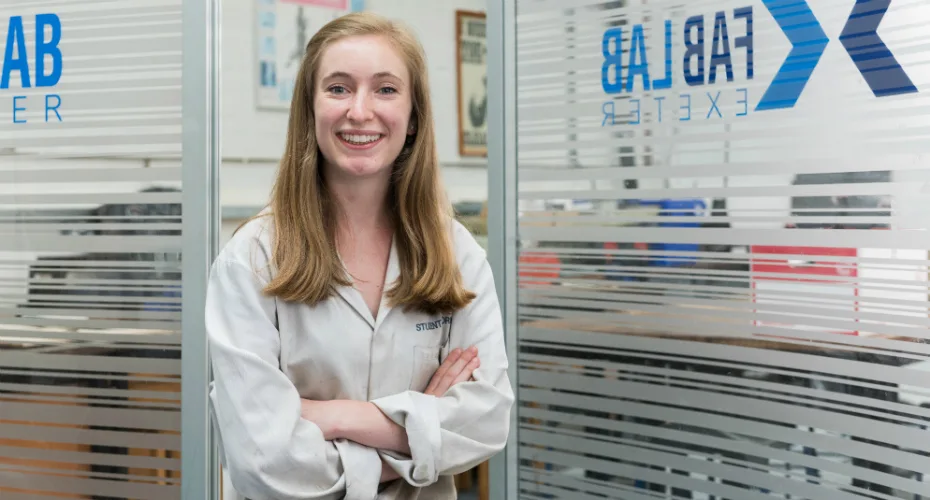
Studying at Exeter is really enjoyable. There are so many different ways you can ask for support from academics who are always there to help you.
The best part about my subject is all of the hands-on opportunities. Almost all of the labs you see are ones you could have opportunities to use.
Emily
An Engineering student
Fees
Tuition fees for 2026 entry
UK students: £9,790 per year
International students: £31,200 per year
Scholarships
The University of Exeter offers a wide range of scholarships to support your education, with £7 million available for international students applying to study with us in the 2026/27 academic year, including our prestigious Exeter Excellence Scholarships*. We also provide scholarships for sport, music and other achievements, alongside regional and partner awards such as Chevening, The Beacon Trust and the British Council. Financial support is available for students from disadvantaged backgrounds, lower income households and other under-represented groups to help them access, succeed and progress through higher education.
* Terms and conditions, including deadlines, apply. See our website for details.
Learning and teaching
You’ll typically have between 15 and 32 hours of direct contact time per week with academics and you will be expected to supplement your lectures with independent study. You should expect your total workload to average about 40 hours per week during term time.
In addition to lectures, you’ll also have access to our workshops and laboratories where you’ll be trained to use specialist equipment, supporting and developing what you’ve learnt in the classroom and putting it into practice.
A research and practice-led culture
All our academic staff are internationally recognised scientists working across a wide range of topics. Your course will draw on the very latest ideas, research discoveries and new technologies in the field. You’ll be able to participate directly in current research at various stages throughout your degree.
Assessment
Modules are assessed by a combination of continuous assessment through small practical exercises, project work, essay writing, presentations and exams. You must pass your first year assessment in order to progress to the second year, but the results do not count towards your degree classification.
Project work is a core element of this degree, providing invaluable experience of problem-solving, engineering design and team working.
Your future
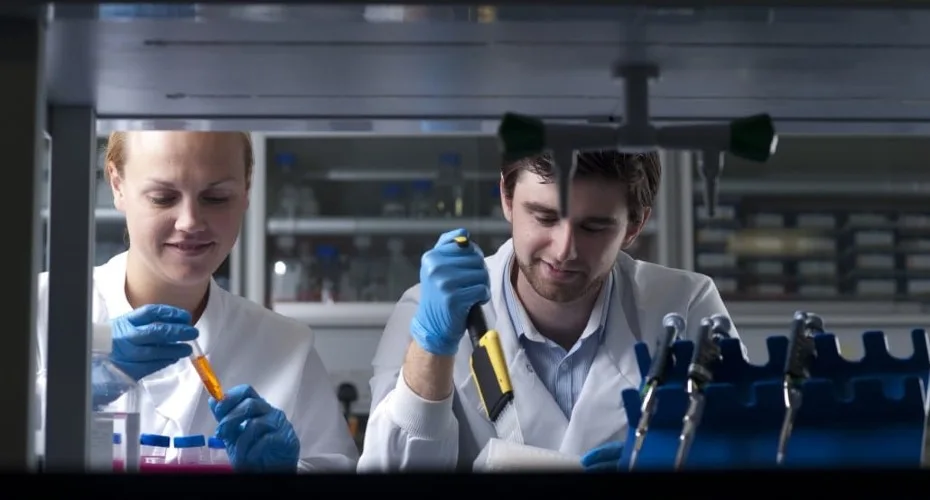
Biomedical engineering is a rapidly growing field, driven by the global ageing population and the increasing prevalence of non-communicable diseases, as well as the need to manage and treat emerging health challenges.
Upon graduation, you will be well-prepared to leverage your expertise in healthcare-related science and technology, alongside your skills in engineering processes, problem-solving and design. This expertise will open doors to careers in various sectors, including medical device design and development, healthcare technology implementation and biomedical research.
The comprehensive knowledge and skills you acquire during this course are also highly transferable, making you a valuable asset in other industries such as wider engineering disciplines, finance, professional services, management consultancy and teaching.
Career support
As a University of Exeter student, you will also have access to the Career Zone, providing invaluable support and tailored guidance to help you prepare for your career after university.