MEng Chemical Engineering
Please note: This page is for 2026 entry. Click here for 2027 entry.
| UCAS code | H115 |
|---|---|
| Duration | 4 years |
| Entry year | 2026 |
| Campus | Streatham Campus |
| Typical offer | A-Level: AAB-ABB |
|---|---|
|
A-Level: BBB-BBC |
| UCAS code | H125 |
|---|---|
| Duration | 5 years |
| Entry year | 2026 |
| Campus | Streatham Campus |
| Typical offer | A-Level: AAB-ABB |
|---|---|
|
A-Level: BBB-BBC |
Why study MEng Chemical Engineering at Exeter?
- Explore one of the most diverse fields in engineering, where you'll learn to sustainably convert raw materials into useful products, from bench-top experiments to industrial-scale processes.
- Learn from industry experts about cutting-edge topics like clean energy generation and storage, waste reduction and water treatment, and smart coatings and nanotechnology.
- Enhance your technical expertise and develop valuable transferable skills through engaging, hands-on group and individual projects with our strong focus on project-based learning.
- The MEng course allows you to specialise further into chemical engineering through an integrated Masters. In the fourth year, you’ll tackle more advanced topics and apply your skills in a comprehensive investigative project.
- Launch your career with the technical and practical knowledge needed to excel across a broad range of industries, including food and beverage, healthcare, materials and clean energy.
- You may also be interested in our three-year BEng Chemical Engineering programme.

92% of our Engineering research is internationally excellent
Based on research rated 4* + 3* in REF 2021

Top 15 in the UK for General Engineering
13th in the Complete University Guide 2026

Hands-on course with an emphasis on practical project work

£6.5million investment in our teaching labs, workshop spaces and equipment
Entry requirements (typical offer)
| Qualification | Typical offer | Required subjects |
|---|---|---|
| A-Level | AAB-ABB | GCE A-Level Maths grade B and another science* subject at grade B. Candidates may offer GCE A-Level Maths, Pure Maths or Further Maths. |
| IB | 34/665-32/655 | HL5 in Mathematics (Analysis and approaches or Applications and interpretations) and HL5 in another Science subject. Applicants achieving IB Maths SL7 plus IB HL6 in Physics will also be considered. |
| BTEC | DDD-DDM | See 'read more' below |
| GCSE | 4 or C | Grade 4/C in GCSE English Language |
| Access to HE | 24 L3 credits at Distinction Grade and 12 L3 credits at Merit Grade. | 12 L3 Credits at Distinction Grade in Mathematics and 12 L3 Credits at Distinction Grade in an acceptable Science subject area. |
| T-Level | Distinction | T-Level in Design and Development for Engineering and Manufacturing, or T-Level in Design, Surveying and Planning for Construction. GCE A-Level Maths is still required. |
| Contextual Offer | A-Level: BBB-BBC |
Specific subject requirements must still be achieved where stated above. Find out more about contextual offers. |
| Other accepted qualifications | ||
| English language requirements |
International students need to show they have the required level of English language to study this course. The required test scores for this course fall under Profile B1. Please visit our English language requirements page to view the required test scores and equivalencies from your country. |
|
NB General Studies is not included in any offer.
Grades advertised on each programme webpage are the typical level at which our offers are made and provide information on any specific subjects an applicant will need to have studied in order to be considered for a place on the programme. However, if we receive a large number of applications for the programme we may not be able to make an offer to all those who are predicted to achieve/have achieved grades which are in line with our typical offer. For more information on how applications are assessed and when decisions are released, please see: After you apply
*Accepted GCE A-Level/AS science subjects include: Biology/Human Biology**; Chemistry; Computing; Design and Technology; Economics; Electronics; Environmental Science; Environmental Studies; Geography; Geology; Maths/Pure Maths/Further Maths**; Physical Education; Physics; Psychology; Science (applied); Statistics
**If more than one of these is taken they would only count as one 'science' but could count as two A-levels towards our general requirements.
For any questions relating to entry requirements please contact the team via our online form or 01392 727272.
BTEC Extended Diploma
Applicants studying one of the following BTEC Extended Diplomas will be considered without a GCE A-Level science subject (GCE A-Level Maths is still required): Applied Science, Aeronautical Engineering, Building Services Engineering, Construction and the Built Environment, Civil Engineering, Operations and Maintenance Engineering, Computer Engineering, Electrical/Electronic Engineering, Engineering, Manufacturing Engineering, Mechanical Engineering, Environmental Sustainability.
BTEC Diploma or BTEC Extended Certificate
Applicants studying Applied Science or Engineering in the BTEC Diploma or BTEC Extended Certificate will be considered without a GCE A-Level science subject. GCE A-Level Maths is still required.
For any questions relating to entry requirements please contact the team via our online form or 01392 727272.
Course content
In your first year, you'll establish a strong foundation in core engineering disciplines, including mechanical, electronic, and materials engineering. As you progress, your focus will shift more towards chemical engineering with specialised modules that provide in-depth knowledge in the field.
In your fourth year, you’ll put into practice your research, project management and engineering skills, in the investigation of an engineering research question.
Our programme places a significant emphasis on hands-on project work, allowing you to apply theoretical concepts and enhance your practical skills. You'll gain experience with chemical engineering lab equipment, such as unit operations, heat exchangers and reactors, as well as equipment from other engineering disciplines, including mechanical workshops and electronics labs. This diverse practical experience will help you become a well-rounded graduate, prepared to excel in various engineering environments and set you up for success in your future career.
You may notice changes to some of our modules over the coming months. This is because we are making space for the following:
- Minors: Future Skills Pathways - Alongside your main degree you may be eligible (depending on your course) to choose modules from another subject to broaden your skills and interests.
- Skills to Thrive built into every degree - Essential skills for your future, including communication, problem-solving, teamwork and digital confidence.
- Increased innovation and wellbeing - More room for creative learning, real-world projects and a healthier study rhythm.
The modules below provide examples of what you can expect to learn on this degree course based on recent academic teaching. The precise modules available to you in future years may vary depending on staff availability and research interests, new topics of study, timetabling and student demand.
Please note that the module information displayed here is subject to change.
120 credits of compulsory modules.
Compulsory modules
| Code | Module | Credits |
|---|---|---|
| Compulsory 1 | ||
| Engineering Mathematics and Scientific Computing | 30 | |
| Multi-Disciplinary Group Challenge Project | 30 | |
| Fundamentals of Mechanics | 15 | |
| Fundamentals of Materials | 15 | |
| Fundamentals of Electronics | 15 | |
| Fundamentals of Engineering | 15 | |
ENG1002: Engineering Mathematics and Scientific Computing
This module introduces modern Engineering Mathematics by teaching maths alongside programming.
What you learn in this module will support mathematical content in core modules throughout your programme. You will be introduced to core mathematical tools for modelling Engineering systems which will be developed further in Year 2. You will learn about statistical methods of analysis that are vital tools for Engineers in the 21st century.
An elementary introduction to programming in Python will be provided which will equip you with valuable data processing and modelling skills. The teaching of Python will mirror mathematical content, building on knowledge of specialist packages for matrices, differential equations and statistics.
This module aims to provide you with all mathematical tools to tackle modern Engineering problems. It will allow you to develop strong quantitative skills, such that mathematical tools become second nature so you can focus directly on Engineering challenges and concepts. An important aspect of this is to provide a solid foundation in programming so that it will help you develop new ways of Engineering thinking and cutting-edge solutions to ever-changing societal challenges.
ENG1005: Multi-Disciplinary Group Challenge Project
The University declared an environment and climate emergency in May 2019. The future of our planet and community is at stake. We know though that simply declaring an environment and climate emergency is not enough so you will be part of a team involved in this real-world Project Based Learning (PBL) module to show our commitment to leading the change required. Your career as a professional engineer will require you to work effectively with multi-disciplinary teams on complex and challenging projects. In preparation for this working environment your first task as a new engineering student will be to work on energy harvesting during this multidisciplinary challenge project.
The PBL driving question is ‘How can we harness ocean energy and convert it into reliable, sustainable and cost-competitive electricity that can be used to power homes, transport, and industries’.
The purpose of this module is to:
- Address the climate emergency through a team project focused on energy harvesting. The PBL project will facilitate the application of the core engineering knowledge gained in Fundamentals of Mechanics, Materials and Electronics.
- Develop 21st century skills in creativity, collaboration, communication, critical thinking, problem solving, leadership and technology literacy.
- Gain valuable experience in research/study skills, sketching, technical communication, 3D modelling and prototyping.
- Steering projects through the design process and creating prototypes for a final PBL ‘Public Product’.
ENG1007: Fundamentals of Mechanics
In this module we focus on classical mechanics. At the heart of any engineering analysis is the need to understand an object’s response to its environment, whether it’s the forces imparted by traffic as it traverses a bridge or the forces of lift that allow an aircraft to fly. None of this analysis is possible without first understanding classical mechanics. In this module you will cover foundational mechanics theory.
This module aims to equip you with fundamental knowledge and skills in Mechanics. It also consolidates a common knowledge base and begins the development of a learning methodology appropriate to a professional engineer. Through both continuous assessment and the end of year exams, the module encourages you to actively manage your own learning and seeks to develop your ability to communicate your understanding of engineering theory and concepts in a professional manner.
ENG1008: Fundamentals of Materials
In this module, we focus on two sub-disciplines, fracture mechanics and additive manufacturing. At the heart of any engineering analysis is the need to understand an object’s response to the applied conditions, whether it is the allowed stress level to avoid catastrophic failure of pressurised vessels, or altering material micro- and nanostructures to provide improved ductility, strength, or resistance to fracture. None of this analysis is possible without first understanding basic materials.
You will work through new topics each week with the aid of extensive learning materials, lectures, tutorials, and experimental activities. You will undertake several online continuous assessments throughout the module, which will allow you to evaluate your understanding of the material and diagnose areas that require further attention. Continuous assessments provide ongoing feedback and support you to actively manage your learning.
The module is taught using a flipped learning methodology. Each week, you will review background materials. A flipped learning methodology allows you to extract more benefit from guided tutorials but also requires more upfront work by you in preparation.
ENG1009: Fundamentals of Electronics
This module introduces the key building blocks of modern electronic systems, focusing on both analogue and digital electronics. You will learn how components like diodes and transistors help control and amplify signals, and how operational amplifiers are used in everyday devices. On the digital side, you’ll explore how computers and digital systems make decisions using logic, learning about the basic rules (Boolean algebra) and building blocks (logic gates, flip-flops, and counters) that underpin digital technology. The module blends theory with hands-on activities to help you understand how electronic circuits work and how they are used in real-world applications.
You will also take part in assessed practical electronic laboratories that introduces and develops your practical electronic skills in soldering and wiring. These practical laboratories will also develop the familiarity with using test and measurement equipment and applies your knowledge in both analogue and digital fields and demonstrate applications of their circuits.
ENS1000: Fundamentals of Engineering
This module exemplifies the unique approach taken here at Exeter to nurturing the next generation of multidisciplinary engineers. It will introduce engineering concepts and theory across the areas of Mechanics, Materials and Electronics and will provide you with a solid grounding on which to build in later modules.
In this module we focus on two sub-disciplines of materials, material science and material engineering, with topics spamming from material properties, material structures, material failure and material applications. At the heart of any engineering analysis is the need to understand an object's response to the applied conditions, whether it is the allowed stress level to avoid catastrophic failure of pressurised vessels, or altering material micro- and nanostructures to provide improved ductility, strength, or resistance to fracture. None of this analysis is possible without first understanding basic materials.
We also focus on classical mechanics. At the heart of any engineering analysis is the need to understand an object's response to its environment, whether it's the forces imparted by traffic as it traverses a bridge or the forces of lift that allow an aircraft to fly. None of this analysis is possible without first understanding classical mechanics. In this module you will cover foundational mechanics theory.
Please note that the module information displayed here is subject to change.
120 credits of compulsory modules.
Compulsory modules
| Code | Module | Credits |
|---|---|---|
| Compulsory 1 | ||
| Introduction to Fluid Dynamics | 15 | |
| Modelling of Engineering Systems | 15 | |
| Principles of Chemical Engineering | 30 | |
| Chemical Engineering Challenge Project | 30 | |
| Reaction and Reactor Engineering 1 | 15 | |
| Thermodynamics and Heat Transfer | 15 | |
ENG2007: Introduction to Fluid Dynamics
Almost all engineered objects are immersed either in air or water (or both) or make use of some working fluid in their operation. This is particularly true of machines for energy generation and conversion, such as engines, turbines, and renewable energy devices like wind turbines or wave-energy converters. The ability to understand and predict the behaviour of such devices is therefore of key importance for engineers. In this module, you will learn about the fundamentals of fluid systems: pressure, flow, and viscosity, and how they can be analysed experimentally and mathematically. Engineering applications covered include pumps, turbines, and internal flows in pipe networks.
By the end of this course, you will have the skills to analyse engineering systems involving internal and external flows, using experimental and mathematical techniques together with tables and charts of fluid dynamical and physical properties.
ENG2009: Modelling of Engineering Systems
This module is designed to introduce second year undergraduates to mathematical modelling techniques for engineering systems, and their implementation using scientific computing (e.g. python).
1. To strengthen mathematical and computational skills for solving mathematical challenges arising in the modelling of engineering systems.
2. To acquire a large variety of analytical, numerical and mathematical techniques to be used for those engineering problems.
3. To build practical skills in translating engineering problem statements into mathematical models / questions, and then analysing, simulating and solving the problem by writing a software programme.
4. Understand the concept of analytical and numerical approximation, and learn methods to validate and test your mathematical formulation and programme.
ENS2003: Principles of Chemical Engineering
In this module you will be introduced to the basic principles underpinning chemical engineering, from the units and variables to the processes. You will gain an understanding of the principles of mass and energy conservation within the quantitative framework of material and energy balances that govern the development and deployment of chemical processes. This includes both batch and continuous processes, steady and unsteady states, multiphase systems, and systems with and without chemical reactions. Mass and energy flow analysis will be applied to a variety of unit operations and separation processes, such as distillation columns, from both a modelling and experimental perspective.
This module will cover fundamental aspects of chemical engineering, namely the calculation of mass and energy balances for different types of systems operating under different conditions. It will inform your ENS2008 Chemical Engineering Challenge Project, introducing you to unit operations and basic equipment. Running across both teaching terms, it also complements ENG2007 Introduction to Fluid Dynamics and ENG3016 Thermodynamics and Heat Transfer, which you will be taking alongside it. You will have a chance to undertake an experimental activity and develop your lab skills, both in terms of health and safety and in analysing and communicating your results.
ENS2008: Chemical Engineering Challenge Project
This problem-based learning module builds on the chemistry and chemical engineering knowledge from other modules with the aim of designing a process related with the chemical engineering industry. You will undertake an already established lab experiment that mimics a known chemical engineering process, and you will learn the principles of chemical engineering design and the implications of health and safety, sustainability, and ethics. The module will cover data collection and how to treat errors, along with a range of experimental and characterisation techniques to inform your design. You will have a range of topics to choose from, and you will work in groups to design a scalable multi-step process to a set of specifications in a systems approach, make decisions in a technical context, produce the necessary documentation, and select the appropriate experimental and characterisation techniques to operationalise it.
ENS2009: Reaction and Reactor Engineering 1
The design and operation of chemical reactors is at the core of Chemical Engineering. In this module you will apply the principles of chemical engineering to select appropriate reactors for specific reactions and conditions. You will be introduced to different types of reactions, such as homogeneous and heterogeneous, batch and continuous, single, parallel, and multiple reactions, and apply the concepts of conversion, selectivity and yield. You will also become familiar with different types of reactors, such as plug-flow and continuous stirred tank reactors. Catalytic reactions and reactors will also be covered, along with enzymatic or microbial reactions and their bioreactors. A practical investigation of reaction parameters and control systems will be undertaken in groups, using distillation, fluidised bed or bioreactors.
ENS2035: Thermodynamics and Heat Transfer
This module covers engineering thermodynamics and heat transfer, including refrigeration, heat exchangers and compressors, as well as various aspects of power generation such as gas turbines, internal combustion engines and modern systems such as hybrid power trains and fuel cells. Processes of heat and energy transfer are fundamental to mechanical and chemical engineering, particularly when it comes to power and energy generation and energy management. This module introduces the theory and practice of engineering thermodynamics and heat transfer. You will be introduced to the fundamentals of thermodynamics and heat transfer and explore their application in analysing steam operated power plants and design of heat exchangers. You will develop cycle analysis for the design of refrigerators, compressors, gas turbines, compression and spark ignition engines. Furthermore, you will study the properties of fuels, their combustion, exhaust composition, atmospheric pollution, exhaust emissionsPlease note that the module information displayed here is subject to change.
If you choose the 'with Year in Industry' version of this course, your placement will take place in your third year, and your course will be 5 years in total.
120 credits of compulsory modules.
Compulsory modules
| Code | Module | Credits |
|---|---|---|
| Compulsory 1 | ||
| Year in Industry | 120 | |
ECM3174: Year in Industry
The Year in Industry module will provide you with an opportunity to undertake practical work experience in a business, commercial or public sector engineering environment that is of direct relevance to your development as an experienced professional. You will apply the knowledge and skills from taught modules in the workplace, which will give you important insights into your potential job role once you graduate from university. You will be responsible for finding your own placement (with support from the Student Experience and Employability Team and the Career Zone). All paperwork to support the approval of the placement must be submitted by you, and approved by the module leader at least 4 weeks in advance of the start date for your placement. You can undertake your work placement in the UK, any part of the European Union countries that participate in the Erasmus+ programme, or other approved international setting.
The aim of this module is to provide practical work experience in a business, commercial or public sector setting that is of direct relevance to the subject-specific aims of your degree programme. Crucially, the module will also develop and enhance critical soft skills which are in demand within the engineering sector, e.g. communication, team working, time management, planning, resilience, commercial awareness.
Please note that the module information displayed here is subject to change.
120 credits of compulsory modules.
Compulsory modules
| Code | Module | Credits |
|---|---|---|
| Compulsory 1 | ||
| Fluid Dynamics and CFD | 15 | |
| Chemical Engineering Design: 1 - Research | 15 | |
| Chemical Engineering Design: 2 - Development | 15 | |
| Reaction and Reactor Engineering 2 | 15 | |
| Energy Storage | 15 | |
| Separation Processes and Particle Technology 1 | 15 | |
| Separation Processes and Particle Technology 2 | 15 | |
| Transport Phenomena | 15 | |
ENG3005: Fluid Dynamics and CFD
Fluid dynamics is a key element of mechanical engineering, with applications to automotive and aerospace engineering in particular. However the governing equations of fluid mechanics are complex and difficult to solve for realistic engineering problems. Computational Fluid Mechanics is the application of computational analysis to solve the equations of fluid mechanics. In this module you will learn about the solution of the Navier-Stokes equations which govern fluid mechanics, and the basics of their solution through CFD, together with applications in engineering including exterior aerodynamics, aerofoils, and wind turbines.
The module is developed around two pieces of project work (worth 30% each) together with a short exam (1.5hrs, 40% of marks). The first project analyses boundary layers through experiment and numerical solution using Python, whilst in the second you will look at aspects of wind turbine design, in particular the properties of an aerofoil (experiment) and CFD analysis of the turbine structure.
ENS3006: Chemical Engineering Design: 1 - Research
This is a project-based module in which you will work in teams to design processes and equipment to create a complete chemical engineering plant. This project will not only focus on the technical challenge, of equal importance is identifying a viable commercial opportunity and strategy to capitalise on it. It also aims to broaden your appreciation for the commercial realities that all engineering activities must face.
In the first part of the module, you and your team will be given a set of requirements to meet customer needs, identify the constraints and think creatively to develop a preliminary solution that not only meets the specifications, but also minimises the costs and environmental impact. You should be able to link core aspects of heat and mass transfer and key process equipment learnt last year, and bring knowledge you will learn in tandem from ECMM134 Environmental Processes and ENS3021 Separation Processes and Chemical Technology. You will further your knowledge in process simulation, as it will assist you in the choices you make related to, for example, equipment sizing or energy management.
ENS3007: Chemical Engineering Design: 2 - Development
This module continues directly from where you left off in term 1. You and your team will now develop your concept into the detailed design of a complex chemical plant that meets the brief you were given within the specifications and uncertainty associated with the open-ended nature of the design process. This will involve flowsheets, key process equipment, and operational details, such as control, start-up and shut-down, etc. Your design should be accompanied by a simulation of your plant using process simulation software. You will also be expected to and produce all the necessary documentation related with health, safety and environment legislation, showing an appreciation of the wider aspects related to a chemical plant.
You and your team will now have to develop your conceptual design into an extended front-end engineering design (FEED) study and produce all the documentation to present to your customer. This should include the final flowsheet, details about the operation of your proposed process/plant, individual equipment and control, as well as safety, health, environment and sustainability reviews and statements.
ENS3019: Reaction and Reactor Engineering 2
In this module you will build on the knowledge gained in ENS2009 Reaction and Reactor Engineering 1 by looking at advanced reactor construction, be able to specify suitable materials and control systems, along with instrumentation to monitor the reaction processes. The heating and cooling of reaction processes and the modelling of heat transfer systems will be explored in greater detail, along with the various methods of mixing during both batch and continuous reactions. Reaction simulation will be undertaken, and the actual reaction performance of a reactor measured and compared to simulated performance with various reaction parameters in a practical component. Energy inputs and outputs will be compared to calculated values, and yield assessed, providing an understanding of reactor design efficiency.
ENS3020: Energy Storage
Energy storage is a rapidly advancing field, driven by the urgent need to decarbonize energy systems through the integration of renewable energy sources. This module offers an in-depth exploration of key energy storage technologies. You will study various systems, including mechanical energy storage (such as pumped hydro and compressed air), different types of batteries (including lithium-ion, redox flow, and lead-acid), and hydrogen energy, encompassing hydrogen production, storage, fuel cells, and the broader hydrogen economy. The module emphasizes cost-effectiveness, environmental impact, and sustainability. Through case studies, you will evaluate technological advancements and perform basic design calculations, equipping you with the skills needed to contribute to this dynamic field.
ENS3021: Separation Processes and Particle Technology 1
Unit operations are central to the chemical engineering industry, and the processes therein often involve particulate solids and separation of the components of a mixture. In this module you will further your knowledge about separation processes, such as absorption, distillation, liquid-liquid extraction, leaching, evaporation, crystallisation, drying, filtration and membrane processes. Adsorption and ion-exchange processes will also be covered in the scope of chromatographic separations. You will learn about particulate solids, from their properties and characterisation, to processing and separation techniques. Process intensification and sustainability considerations will also be given in the scope of process plant design.
In this module you will delve deeper into widely used separation processes. With a focus on absorption, distillation, and extraction processes, you will further your knowledge on fluid separation processes. You will learn about performance metrics, graphical analysis, and multistage separations, and you will also become familiar with the equipment used for the different separation processes.
The module will then focus on particle technology. You will learn how bulk solids can be processed in terms of their size, mixing and fluidisation, and how these particulates can be characterised. Finally, you will learn about separation processes for particulate solids.
ENS3022: Separation Processes and Particle Technology 2
Separation technology is key to the design of chemical engineering operations, with the necessity to separate reaction products cleanly and efficiently a major consideration in any plant design. Phase of the components to be separated is a key factor and designing separation processes relies heavily on differences in phase between the extracted and bulk materials. Separation technology 2 will cover drying of solids, adsorption, crystallisation, and membrane separation techniques. This module will also further explore particulate systems and multi-phase mixtures and their properties, looking at changes in rheology of soft solids, gels, and emulsions, how they are created and what parameters affect their material characteristics.
In this module you will explore the various methods of separation of products of unit operations, and how temperature and phase are utilised in these separation processes. The module aims to provide advanced insight into how mixed phase systems are separated by various advanced methods, and introduce drying, crystallisation adsorption and membrane separation technologies. The module will also further extend your knowledge of multi-phase systems, including how they affect bulk rheology and contribute to material characteristics such as viscosity and elasticity. Students will have an appreciation of how phases in mixtures interact including surface tension and surfactant interactions of liquid/liquid and liquid/gas materials.
ENS3023: Transport Phenomena
The understanding of transport phenomena in chemical processes is fundamental to the ability to effectively design efficient chemical operations. The module will cover molecular diffusion, convection and mass transfer including how these can be calculated and controlled in chemical processes. The principle that a quantity being considered must adhere to a continuity equation and its response to stimuli can be calculated using a constitutive equation such as the Navier-Stokes equations will be introduced. The module will explore fluid flow and interactions between multi-phase systems (gas/liquid, liquid/liquid, solid/liquid). Heat transfer during unit processes and energy recovery using heat exchange systems will be considered and the way an understanding of transport phenomena is incorporated into plant design will be studied. Transport phenomena will be observed in a practical component of the module.
In this module you will understand how the key processes of diffusion, convection, evaporation and other transport phenomena effect and can be utilised in chemical engineering processes. The principles of conservation of mass/energy and momentum and how these are affected by changing external factors will be explored using various theoretical and at least one practical case studies.
Please note that the module information displayed here is subject to change.
105 credits of compulsory modules, 15 credits of optional modules.
Compulsory modules
| Code | Module | Credits |
|---|---|---|
| Compulsory 1 | ||
| Advanced CFD | 15 | |
| Additive Manufacturing | 15 | |
| MEng Individual Investigative Project | 45 | |
| Advanced Topics in Chemical Engineering | 15 | |
| Water and Wastewater Treatment | 15 | |
ECMM148: Advanced CFD
The governing equations of fluid mechanics, the Navier-Stokes equations (NSE), are complex and non-linear, and thus cannot be solved analytically for anything but the simplest possible cases. To solve more complex problems of real engineering interest, we typically use computational methods, solving the NSE, or equations derived from these, numerically using high performance computers. This is known as Computational Fluid Dynamics, or CFD, and is now a key tool in the development and design of almost any product which involves fluids, including but not limited to; cars, aircraft, ships, engines and power plants, renewable energy devices such as wind or tidal turbines, and many others beside. CFD can be extended to incorporate other physical processes; multiphase flow, chemical reactions and combustion, interaction with deforming or rigid structures; and can thus be applied to analyse problems in a range of industries in areas such as chemical engineering and biomedical problems.
ENGM001: Additive Manufacturing
This module is dedicated to additive manufacturing, focusing on parts that are fabricated through additive processes (powder or filament – metallics, polymer or composites) versus the conventional, subtractive methods. As we approach a time where resources scarcity and clean/carbon neutral manufacturing technologies are amongst the key business drivers in many engineering sectors, this module aims to introduce you to the digital manufacturing processes, materials, design and applications.
The syllabus will provide you with in-depth knowledge of additive manufacturing processes for metallics, polymers and composites, from principles of operation to fundamentals of material processing including rheology (powder and polymer melt), sintering mechanisms and models, crystallization characteristics. Properties and green credentials of the technology will also be discussed.
AIMS - intentions of the module:
ENGM015: MEng Individual Investigative Project
The MEng Individual Project module will enable you to put into practice your research, project management and engineering skills, in the investigation of an engineering research question. This is a research focused project that will give you the opportunity to develop a deep level of understanding in a research area of your choice. You will work with engineering academics in their areas of expertise and contribute towards engineering innovation.
Upon selecting of an area of research interest, you will, in collaboration with your research supervisor, develop a research question based on your review and assessment of the existing literature. You will develop a hypothesis and set about designing a programme of research that allows you to test your hypothesis. Projects may range from heavily experimental to purely theoretical or numerical.
You will disseminate your research findings by producing an academic paper and presentation. A goal throughout your project will be the production of publishable work that advances the state of knowledge. To this end, you will produce an academic paper. Should your work have made a contribution to the state of knowledge on your chosen topic and be endorsed by your supervisor, your paper will be submitted for publication in an academic journal.
ENSM005: Advanced Topics in Chemical Engineering
A number of industrially-focussed case studies across the Chemical Engineering sector will be presented in this module. Those can range from food/beverage and agriculture, polymers and textiles or detergents and cosmetics. You will analyse these complex cases in terms of their often-conflicting requirements, specialist products and processes, unit operations, equipment, systems, process safety, sustainability and ethics. You will review one of these complex cases in depth, identifying the limitations of current the technology and proposing new approaches to advance the industry, ensuring a solution that minimised environmental and societal impact.
In this module you will be able to apply knowledge from previous years in industrially-focussed case studies where a more comprehensive understanding of chemical engineering practice is required. You will also gain a better understanding of the wider commercial, economic and social context of engineering and the role of the professional chemical engineer through examples in the forefront of the industry sector and more widely. From legal requirements and industry standards to considerations around risk assessment, hazard identification, you will see these in detail through case studies involving complex and novel systems and processes, analyse the limitations and propose strategies to overcome them.
ENSM020: Water and Wastewater Treatment
This module will provide you with comprehensive knowledge of water and wastewater treatment processes, including advanced techniques for contaminant removal and efficient resource recovery. It covers the urban water cycle, addresses the water-energy nexus, and prepares you to tackle future challenges in the industry. By the end of the module, you will understand the key treatment processes related to water quality for engineering applications as well as the challenges and opportunities facing the water sector and their implications on other areas.
The module aims to provide a deep understanding of processes associated with water and wastewater treatment processes. The first part of the module covers chemical, physical and biological processes. The second part of the module covers water-energy nexus and sustainability in the water sector.
Optional modules
| Code | Module | Credits |
|---|---|---|
| Optional 1 | ||
| Sustainable Engineering | 15 | |
| Metamaterials | 15 | |
| Composite Materials | 15 | |
| Advanced Topics in Natural Sciences Chemistry I | 15 | |
| Advanced Topics in Natural Sciences Chemistry II | 15 | |
ECMM163: Sustainable Engineering
Sustainable engineering concerns the design or operation of systems with the aim of reducing energy demand, resource extraction and carbon emissions with the goal of minimising the impact on the environment. By transforming any sector to be more sustainable, it can play a major role in reducing the threat of climate change. But as a practising engineer you must also be aware of the wider role that sustainability plays for example in equality diversity and inclusion issues. This module discusses the interdependency between changes required across all activities of human life across all scales. This module will make you think across disciplines with the goal of evaluating sustainability on a whole system basis including resource supply and demand, energy supply and demand and sustainable management.
This module aims to provide you with an appreciation of the complexities which arise from considering sustainability and the need to tackle the issue from an interdisciplinary perspective. This module aims to provide some of the tools required to assess sustainability as well as the ability to critically analyse the extent to which a product, building, industry or service could be considered to be sustainable.
ENGM016: Metamaterials
This multidisciplinary module will focus on innovative materials that combine mechanical properties with unusual chemical, optical or electromagnetic properties. These materials include, but are not limited to, nanomaterials, carbon-based and organic materials, hybrid materials and metamaterials. You will investigate the application of these materials through research showcases in opto-electronics, energy harvesting and storage and wearables.
This module will cover the principles behind the behaviour of nanomaterials, as well as nanofabrication techniques and advanced applications of nanostructured and nanoengineered materials, and the issues associated with the manufacturing and commercialisation of such materials.
The aim of this module is to explore the many applications of an expanding range of materials at the nanoscale. Examples of applications of such materials in areas such as opto-electronics, energy harvesting and storage, and wearables.
ENGM017: Composite Materials
This advanced, masters level module, will provide a detail course in the mechanics, manufacturing and design of composite materials. This course will be of great importance to engineers looking to work in the aerospace, automotive industries, where composites usage is every increasing. The module is split between 40% coursework and exam (60%). The coursework will focus on a design for manufacturing and performance of a real-world example of an aircraft structure. It will require students to pool all aspects of the degree together, from understanding of materials, fundamental structures and quantitative methods for design.
This module aims to:
- develop a broad understanding of various types of constituent (reinforcement and matrix) materials
- appreciate the principles which guide their selection for composites design and engineering applications; 3) appreciate the diverse manufacturing techniques/methodologies for composite materials
- understand the relationships between manufacture, properties (in particular, mechanical properties) and performance
NSCM006: Advanced Topics in Natural Sciences Chemistry I
This module provides you with the opportunity to study two topics in Natural Sciences Chemistry at the research level, delivered as self-contained sets of ten lecture/workshop/tutorial sessions by experts in their field.
To take this module, you are required to have completed the pre-requisite module(s) specific to each short course, these being listed within the Syllabus Plan below. Alternatives will be considered on a case-by-case basis. There are no co-requisites.
Module aims - intentions of the module:
Our aim in offering this module is to provide you with the opportunity to study two current chemistry research topics. This variety will help you to develop and achieve your career goals. In two, self-contained courses, you will work with research-level material, combining your study and communication skills with your core knowledge to understand complex systems and solve challenging problems.
The skills you gain will develop and enhance your employability. Transferable skills to other sectors include:
NSCM007: Advanced Topics in Natural Sciences Chemistry II
This module provides you with the opportunity to study two topics in Natural Sciences Chemistry at the research level, delivered as self-contained sets of ten lecture/workshop/tutorial sessions by experts in their field.
To take this module, you are required to have completed the pre-requisite module(s) specific to each short course, these being listed within the Syllabus Plan below. Alternatives will be considered on a case-by-case basis. There are no co-requisites.
Module aims - intentions of the module
Our aim in offering this module is to provide you with the opportunity to study two current chemistry research topics. This variety will help you to develop and achieve your career goals. In two, self-contained courses, you will work with research-level material, combining your study and communication skills with your core knowledge to understand complex systems and solve challenging problems.
The skills you gain will develop and enhance your employability. Transferable skills to other sectors include:
Course variants
MEng Chemical Engineering with Year in Industry
UCAS code: H125
Our five-year ‘with Year in Industry’ programme includes a paid placement in business or industry for the duration of your third year. Work experience is a real advantage when entering the graduate job market. It’s also a great way to try out different jobs and to make contacts within companies you’re interested in working for.
Does it count towards my degree?
Yes, it’s worth 120 credits.
How does it affect my tuition fee?
During this year you will pay a reduced tuition fee. Visit the Tuition Fees page for more information.
How do I apply?
You can apply for this programme through UCAS using the code above, or transfer onto this option at the end of your first year in an Exeter-based Engineering degree.
Preparation and support
We will help you to prepare for your work placement from early in your studies. A special module 'Employability and Placement Preparation for Engineers' takes place in your second year. This is an opportunity to start thinking about your placement well in advance. You’ll also be invited to attend workshops offering guidance and support.
Fees
Tuition fees for 2026 entry
UK students: £9,790 per year
International students: £31,200 per year
Scholarships
The University of Exeter offers a wide range of scholarships to support your education, with £7 million available for international students applying to study with us in the 2026/27 academic year, including our prestigious Exeter Excellence Scholarships*. We also provide scholarships for sport, music and other achievements, alongside regional and partner awards such as Chevening, The Beacon Trust and the British Council. Financial support is available for students from disadvantaged backgrounds, lower income households and other under-represented groups to help them access, succeed and progress through higher education.
* Terms and conditions, including deadlines, apply. See our website for details.
Learning and teaching
You’ll typically have between 15 and 32 hours of direct contact time per week with academics and you will be expected to supplement your lectures with independent study. You should expect your total workload to average about 40 hours per week during term time.
In addition to lectures, you’ll also have access to our workshops and laboratories where you’ll be trained to use specialist equipment, supporting and developing what you’ve learnt in the classroom and putting it into practice.
A research and practice led culture
All our academic staff are internationally recognised scientists working across a wide range of topics. Your course will draw on the very latest ideas, research discoveries and new technologies in the field. You’ll be able to participate directly with current research at various stages throughout your degree.
Assessment
Modules are assessed by a combination of continuous assessment through small practical exercises, project work, essay writing, presentations and exams. You must pass your first year assessment in order to progress to the second year, but the results do not count towards your degree classification.
Project work is a core element of this degree, providing invaluable experience of problem-solving, engineering design and team working.
Your future
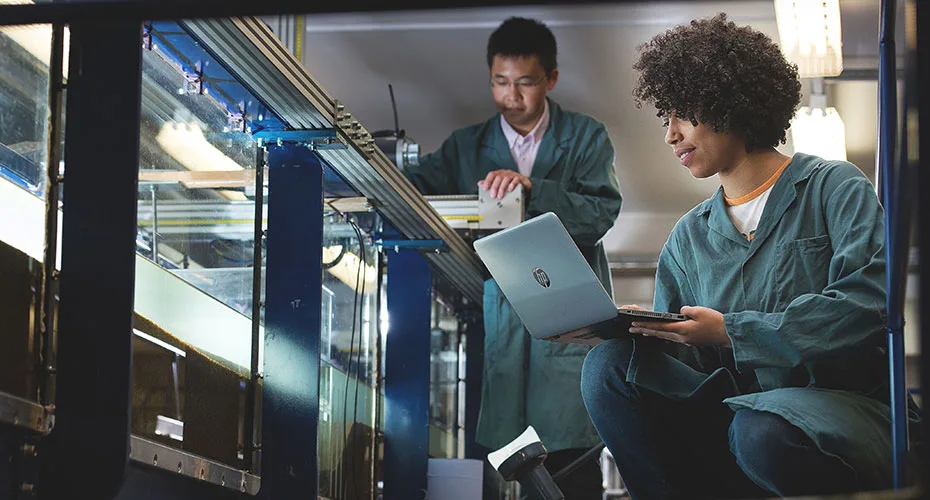
Chemical engineers are in high demand, and our course is designed to equip you with a versatile skill set that is highly sought after by employers. Upon graduation, you’ll be prepared for a diverse range of careers in industries such as food and drink, energy, pharmaceuticals and consumer products.
Our emphasis on project-based learning ensures that you gain core technical skills that are easily transferable across various roles. You’ll build a strong foundation in chemical engineering while also gaining insights into other engineering disciplines. This well-rounded approach will make you a versatile professional, ready to excel in multiple work environments.
Career support
As a University of Exeter student, you will also have access to the Career Zone, providing invaluable support and tailored guidance to help you prepare for your career after university.