MEng Engineering and Entrepreneurship
Please note: This page is for 2026 entry. Click here for 2027 entry.
| UCAS code | H700 |
|---|---|
| Duration | 4 years |
| Entry year | 2026 |
| Campus | Streatham Campus |
| Typical offer | A-Level: AAB-ABB |
|---|---|
|
A-Level: BBB-BBC |
| UCAS code | H701 |
|---|---|
| Duration | 5 years |
| Entry year | 2026 |
| Campus | Streatham Campus |
| Typical offer | A-Level: AAB-ABB |
|---|---|
|
A-Level: BBB-BBC |
Why study MEng Engineering and Entrepreneurship at Exeter?
- MEng Engineering and Entrepreneurship is a pioneering programme designed to support innovators and entrepreneurs in the fields of mechanical and electronic engineering.
- Throughout the course, you’ll unleash your creativity and technical skills using Exeter’s ‘think-try-do' process of innovation, with the goal of launching your very own company.
- Your entrepreneurial mindset will flourish within our supportive environment as we encourage you to take risks, develop your ideas and learn from mistakes.
- We place a strong emphasis on real-world projects, equipping you with the teamwork, management and entrepreneurial skills required for a successful career.
- At the end of your third year, you will pitch your engineering idea to a panel for the chance to receive £10,000 to start a business with the support of the University.

Expertise in energy policy, marine renewables, biofuels, electrical power and networks, wind, photo-voltaic and thermal technologies

Chance to launch your own business in the UK
If you need a visa to work in the UK you’ll be pitching for an endorsement from the University and visa application costs to apply for a one year start up visa

Top 15 in the UK for General Engineering
13th in the Complete University Guide 2026

£6.5million investment in our teaching labs, workshop spaces and equipment
Entry requirements (typical offer)
| Qualification | Typical offer | Required subjects |
|---|---|---|
| A-Level | AAB-ABB | A-Level grade B in Mathematics, Pure Mathematics or Further Mathematics, and B in another science subject* |
| IB | 34/665-32/655 | HL 5 in Mathematics (Analysis and Approaches or Applications and Interpretations) and HL 5 in another science subject. |
| BTEC | DDD-DDM | See below under 'read more' for further information |
| GCSE | 4 or C | Grade 4/C in GCSE English language |
| Access to HE | 24 L3 credits at Distinction Grade and 21 L3 credits at Merit Grade. | 12 L3 credits at Distinction Grade in an acceptable Mathematics subject area and 12 L3 credits at Distinction Grade in another science subject area. |
| T-Level | Distinction | T-Level in Design and Development for Engineering and Manufacturing, or T-Level in Design, Surveying and Planning for Construction. GCE A-Level Maths is still required. |
| Contextual Offer | A-Level: BBB-BBC |
Specific subject requirements must still be achieved where stated above. Find out more about contextual offers. |
| Other accepted qualifications | ||
| English language requirements |
International students need to show they have the required level of English language to study this course. The required test scores for this course fall under Profile B1. Please visit our English language requirements page to view the required test scores and equivalencies from your country. |
|
NB General Studies is not included in any offer.
Grades advertised on each programme webpage are the typical level at which our offers are made and provide information on any specific subjects an applicant will need to have studied in order to be considered for a place on the programme. However, if we receive a large number of applications for the programme we may not be able to make an offer to all those who are predicted to achieve/have achieved grades which are in line with our typical offer. For more information on how applications are assessed and when decisions are released, please see: After you apply
*Accepted A-Level science subjects include: Biology/Human Biology^; Chemistry; Computing; Design and Technology; Economics; Electronics; Environmental Science; Environmental Studies; Geography; Geology; Maths/Pure Maths/Further Maths^; Physical Education; Physics; Psychology; Science (applied); Statistics.
^If more than one of these is taken they would only count as one 'science' but could count as two A-levels towards our general requirements.
BTEC Extended Diploma
Applicants studying one of the following BTEC Extended Diplomas will be considered without a GCE A-Level science subject (GCE A-Level Maths is still required): Applied Science, Aeronautical Engineering, Building Services Engineering, Construction and the Built Environment, Civil Engineering, Operations and Maintenance Engineering, Computer Engineering, Electrical/Electronic Engineering, Engineering, Manufacturing Engineering, Mechanical Engineering, Environmental Sustainability.
BTEC Diploma or BTEC Extended Certificate
Applicants studying Applied Science or Engineering in the BTEC Diploma or BTEC Extended Certificate will be considered without a GCE A-Level science subject. GCE A-Level Maths is still required.
For any questions relating to entry requirements please contact the team via our online form or 01392 727272.
Exeter is a fantastic place to live and an even better place to learn. The opportunities and equipment available to us here is just absolutely phenomenal. It's unmatched. I've had the most amazing time and I’m looking forward to my fourth year.
I love engineering because of the diversity it gives you and the multitude of avenues that you have available to you. You could decide to be a pure mechanical engineer, or you can go more down the route I've chosen and use your engineering skills and become an entrepreneur. At Exeter, you have the option to do a range of different modules to make yourself more well-rounded.
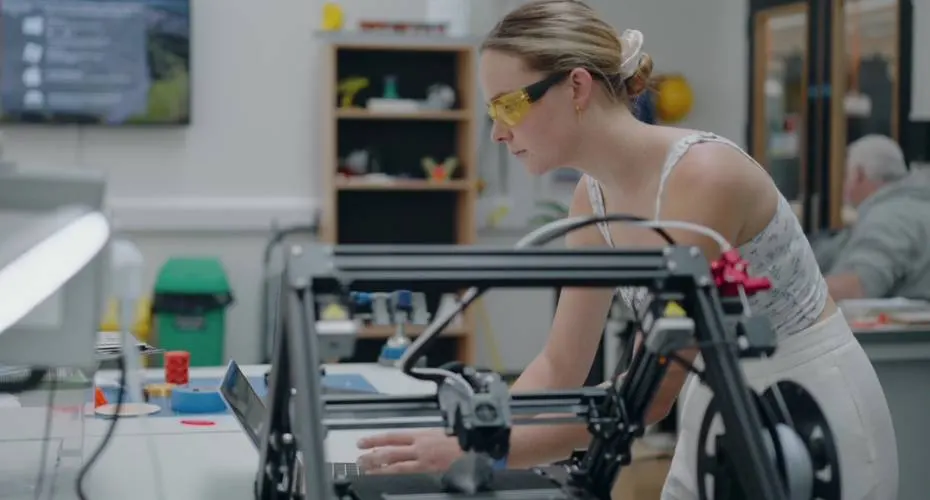
At the end of my third year, I successfully pitched my business idea and I’m going to receive £10,000 to pursue my own business next year as part of my degree. The business 3D prints patient specific instrumentation for hip surgeries. We're creating drill guides and custom surgical instruments which surgeons can use to make their operations better.
Eleanor
MEng Engineering and Entrepreneurship
Course content
This course blends technical engineering with the many factors that contribute towards the successful development of innovative products, processes or services.
Collaborative modules in your first year will give you a broad knowledge across all core engineering disciplines.
In addition to academic lectures, you will attend talks and seminars given by experienced entrepreneurs and business leaders.
Modules in your third year will focus on the primary areas of engineering and entrepreneurship, such as: operations management, quality control and improvement, global entrepreneurial marketing, industrial awareness, management and leadership.
You’ll also complete a hands-on design and build project that challenges you to develop, prototype (at scale) and explore the market for a solution to an engineering challenge.
You will be encouraged to put your knowledge and ideas into practice, learning through personal experience while fully supported by your tutors and an industry mentor.
Your final year will see you launching and reflecting upon your own start-up or engineering project, providing the perfect springboard for a prosperous professional future.
You may notice changes to some of our modules over the coming months. This is because we are making space for the following:
- Minors: Future Skills Pathways - Alongside your main degree you may be eligible (depending on your course) to choose modules from another subject to broaden your skills and interests.
- Skills to Thrive built into every degree - Essential skills for your future, including communication, problem-solving, teamwork and digital confidence.
- Increased innovation and wellbeing - More room for creative learning, real-world projects and a healthier study rhythm.
The modules below provide examples of what you can expect to learn on this degree course based on recent academic teaching. The precise modules available to you in future years may vary depending on staff availability and research interests, new topics of study, timetabling and student demand.
Please note that the module information displayed here is subject to change.
120 credits of compulsory credits.
Compulsory modules
| Code | Module | Credits |
|---|---|---|
| Compulsory 1 | ||
| Engineering Mathematics and Scientific Computing | 30 | |
| Multi-Disciplinary Group Challenge Project | 30 | |
| Fundamentals of Mechanics | 15 | |
| Fundamentals of Materials | 15 | |
| Fundamentals of Electronics | 15 | |
| Fundamentals of Engineering | 15 | |
ENG1002: Engineering Mathematics and Scientific Computing
This module introduces modern Engineering Mathematics by teaching maths alongside programming.
What you learn in this module will support mathematical content in core modules throughout your programme. You will be introduced to core mathematical tools for modelling Engineering systems which will be developed further in Year 2. You will learn about statistical methods of analysis that are vital tools for Engineers in the 21st century.
An elementary introduction to programming in Python will be provided which will equip you with valuable data processing and modelling skills. The teaching of Python will mirror mathematical content, building on knowledge of specialist packages for matrices, differential equations and statistics.
This module aims to provide you with all mathematical tools to tackle modern Engineering problems. It will allow you to develop strong quantitative skills, such that mathematical tools become second nature so you can focus directly on Engineering challenges and concepts. An important aspect of this is to provide a solid foundation in programming so that it will help you develop new ways of Engineering thinking and cutting-edge solutions to ever-changing societal challenges.
ENG1005: Multi-Disciplinary Group Challenge Project
The University declared an environment and climate emergency in May 2019. The future of our planet and community is at stake. We know though that simply declaring an environment and climate emergency is not enough so you will be part of a team involved in this real-world Project Based Learning (PBL) module to show our commitment to leading the change required. Your career as a professional engineer will require you to work effectively with multi-disciplinary teams on complex and challenging projects. In preparation for this working environment your first task as a new engineering student will be to work on energy harvesting during this multidisciplinary challenge project.
The PBL driving question is ‘How can we harness ocean energy and convert it into reliable, sustainable and cost-competitive electricity that can be used to power homes, transport, and industries’.
The purpose of this module is to:
- Address the climate emergency through a team project focused on energy harvesting. The PBL project will facilitate the application of the core engineering knowledge gained in Fundamentals of Mechanics, Materials and Electronics.
- Develop 21st century skills in creativity, collaboration, communication, critical thinking, problem solving, leadership and technology literacy.
- Gain valuable experience in research/study skills, sketching, technical communication, 3D modelling and prototyping.
- Steering projects through the design process and creating prototypes for a final PBL ‘Public Product’.
ENG1007: Fundamentals of Mechanics
In this module we focus on classical mechanics. At the heart of any engineering analysis is the need to understand an object’s response to its environment, whether it’s the forces imparted by traffic as it traverses a bridge or the forces of lift that allow an aircraft to fly. None of this analysis is possible without first understanding classical mechanics. In this module you will cover foundational mechanics theory.
This module aims to equip you with fundamental knowledge and skills in Mechanics. It also consolidates a common knowledge base and begins the development of a learning methodology appropriate to a professional engineer. Through both continuous assessment and the end of year exams, the module encourages you to actively manage your own learning and seeks to develop your ability to communicate your understanding of engineering theory and concepts in a professional manner.
ENG1008: Fundamentals of Materials
In this module, we focus on two sub-disciplines, fracture mechanics and additive manufacturing. At the heart of any engineering analysis is the need to understand an object’s response to the applied conditions, whether it is the allowed stress level to avoid catastrophic failure of pressurised vessels, or altering material micro- and nanostructures to provide improved ductility, strength, or resistance to fracture. None of this analysis is possible without first understanding basic materials.
You will work through new topics each week with the aid of extensive learning materials, lectures, tutorials, and experimental activities. You will undertake several online continuous assessments throughout the module, which will allow you to evaluate your understanding of the material and diagnose areas that require further attention. Continuous assessments provide ongoing feedback and support you to actively manage your learning.
The module is taught using a flipped learning methodology. Each week, you will review background materials. A flipped learning methodology allows you to extract more benefit from guided tutorials but also requires more upfront work by you in preparation.
ENG1009: Fundamentals of Electronics
This module introduces the key building blocks of modern electronic systems, focusing on both analogue and digital electronics. You will learn how components like diodes and transistors help control and amplify signals, and how operational amplifiers are used in everyday devices. On the digital side, you’ll explore how computers and digital systems make decisions using logic, learning about the basic rules (Boolean algebra) and building blocks (logic gates, flip-flops, and counters) that underpin digital technology. The module blends theory with hands-on activities to help you understand how electronic circuits work and how they are used in real-world applications.
You will also take part in assessed practical electronic laboratories that introduces and develops your practical electronic skills in soldering and wiring. These practical laboratories will also develop the familiarity with using test and measurement equipment and applies your knowledge in both analogue and digital fields and demonstrate applications of their circuits.
ENS1000: Fundamentals of Engineering
This module exemplifies the unique approach taken here at Exeter to nurturing the next generation of multidisciplinary engineers. It will introduce engineering concepts and theory across the areas of Mechanics, Materials and Electronics and will provide you with a solid grounding on which to build in later modules.
In this module we focus on two sub-disciplines of materials, material science and material engineering, with topics spamming from material properties, material structures, material failure and material applications. At the heart of any engineering analysis is the need to understand an object's response to the applied conditions, whether it is the allowed stress level to avoid catastrophic failure of pressurised vessels, or altering material micro- and nanostructures to provide improved ductility, strength, or resistance to fracture. None of this analysis is possible without first understanding basic materials.
We also focus on classical mechanics. At the heart of any engineering analysis is the need to understand an object's response to its environment, whether it's the forces imparted by traffic as it traverses a bridge or the forces of lift that allow an aircraft to fly. None of this analysis is possible without first understanding classical mechanics. In this module you will cover foundational mechanics theory.
Please note that the module information displayed here is subject to change.
120 credits of compulsory credits.
Compulsory modules
| Code | Module | Credits |
|---|---|---|
| Compulsory 1 | ||
| Leadership and Management: Fundamentals of Practice | 15 | |
| Making Innovation and Entrepreneurship Happen | 15 | |
| Entrepreneurship 2 | 15 | |
| Modelling of Engineering Systems | 15 | |
| Solid Mechanics | 15 | |
| Introduction in Economics and Company Finance | 15 | |
| Entrepreneurship and Management Challenge Project | 30 | |
BEM2000: Leadership and Management: Fundamentals of Practice
This module is for students selecting the ‘Minor in Leadership and Management’ who are based outside the Business School. It is available at the Exeter campuses. Students at the Penryn campus can select BEP2006: Leadership and Management: Fundamentals of Practice.
The module has two major aims:
- to introduce you to major contemporary trends in our business environment and to their current and future implications for the leadership and management of organisations
- to explore the major functions, objectives and challenges associated with leading and managing contemporary organisations
BEM2058: Making Innovation and Entrepreneurship Happen
The module is offered within the Innovation and Entrepreneurship Minor. It is available at the Exeter campuses. Students at the Penryn campus can select BEP2005: Making Innovation and Entrepreneurship Happen. https://www.exeter.ac.uk/study/future-skills-pathways/innovation-and-entrepreneurship/
Innovation and entrepreneurship show up in the everyday fabric of work, not just in start-ups. Whether you end up in business, public sector, charity, healthcare, creative industry, engineering, or something that does not yet have a name, you will be expected to notice what is shifting, shape a response, and turn ideas into outcomes that others can use.
ENG2004: Entrepreneurship 2
Welcome to this new and exciting module on Entrepreneurship. This course continues the study initiated in ENG1006 to propel you into the next level of your entrepreneurship skills development. This module aims to immerse you in new technologies including Machine Learning or Generative AI. You will learn from project launch lectures with inspirational entrepreneurs and design engineers and project-based collaboration.
You will be pitching yourself against competitors to promote your strengths and specialist areas to potential co-founders of the future spin-out companies at the University of Exeter. Mock company teams will be formed to answer discipline specific driving questions on Machine Learning and/or Generative AI.
The newly formed mock company teams will go through the Stage Gate Innovation Process to filter out the best products, services, components, materials or techniques from the initial brainstorming sessions. A partial Business Model Canvas (BMC) will be submitted as a midway checkpoint with a focus on:
Value Proposition
Infrastructure Aspects
Market Aspects
Financial Aspects
ENG2009: Modelling of Engineering Systems
This module is designed to introduce second year undergraduates to mathematical modelling techniques for engineering systems, and their implementation using scientific computing (e.g. python).
1. To strengthen mathematical and computational skills for solving mathematical challenges arising in the modelling of engineering systems.
2. To acquire a large variety of analytical, numerical and mathematical techniques to be used for those engineering problems.
3. To build practical skills in translating engineering problem statements into mathematical models / questions, and then analysing, simulating and solving the problem by writing a software programme.
4. Understand the concept of analytical and numerical approximation, and learn methods to validate and test your mathematical formulation and programme.
ENG2011: Solid Mechanics
This module will provide students with extended understanding of the theories in Solids Mechanics and their applicability in stress/strain analysis, including motion/equilibrium equations, compatibility equations, Hooke's law, elasticity and plasticity, boundary conditions for complex engineering problems, and energy methods for stress and deformation analysis. Such essential engineering knowledge will equip students with commonly required capabilities in mechanics modelling, solving a mechanics model for stress and deformation on a practical problem, conducting stress concentration analysis, interpolating experimental data and associating with industrial problems, and performing basic finite element analysis on structure behaviours. Students are expected to comprehensively use the knowledge and skills attained above to solve various real-life engineering problems in their senior- year modules, individual and group projects, and future career.
This module aims to illustrate the fundamental principles of stress and deformation in a solid under complex loading associated with the elemental structures/components in civil and mechanical engineering. The understanding of solids mechanics will provide the ability to analyse problems in terms of strength and deformation in relation to the design, manufacturing and maintenance of machines, vehicles, structures, and devices in the above-mentioned engineering areas.
ENG2016: Introduction in Economics and Company Finance
This module will provide essential knowledge on economics and company finance. A special focus will be on managing high-growth, early-stage enterprises, especially those with innovation-based products and services. You will work in teams to develop skills and approaches necessary to becoming effective entrepreneurial leaders and managers. The topics include understanding business models, analysing key operational metrics, modelling cash flow and capital requirements, evaluating sources of financing, and managing the interplay between ownership and growth. You will learn how to produce standard financial documents such as balance sheets, income statements, cash flow forecasts, and profit and loss statements. You will also learn how to do simple manufacturing and project costing.
This module will provide you with essential knowledge for all engineers, which will benefit you in your future career. You will gain basic training in standard financial documents: balance sheets, income statements, cash flow forecasts, and profit and loss statements. You will also learn how to do simple manufacturing and project costing. Financial management is explored, primarily in a project context
ENS2006: Entrepreneurship and Management Challenge Project
This module challenges students to apply their engineering knowledge to real-world problems aligned with the United Nations Sustainable Development Goals (SDGs) through a collaborative, project-based learning experience. Working in multidisciplinary teams, students respond to the driving question: How can engineering solutions be developed as socially and commercially viable ventures that address global challenges?
The module integrates engineering design, sustainability, and entrepreneurship. Students will identify a genuine need, undertake user and market research, generate and evaluate concepts, and develop a product, service, or process that delivers technical performance, social value, and economic viability. Designs will be iteratively refined through modelling, analysis, and prototyping using appropriate workshop and digital manufacturing facilities.
Building on skills developed in Stage 1, the module advances students’ capability in design thinking, systems thinking, and engineering decision-making. Students will consider performance, manufacturability, cost, environmental impact, ethics, and inclusivity, ensuring solutions are technically robust and contextually relevant. The project also introduces the role of engineering within a business environment, including value proposition development, stakeholder engagement, and routes to implementation.
Through this process students will strengthen their ability to:
Please note that the module information displayed here is subject to change.
120 credits of compulsory credits.
Compulsory modules
| Code | Module | Credits |
|---|---|---|
| Compulsory 1 | ||
| Rethinking Innovation and Entrepreneurship | 15 | |
| Operations Management | 15 | |
| Decision Making Systems and Decision Theory | 15 | |
| Management and Leadership | 15 | |
| Quality Control and Improvement | 15 | |
| Introduction to Design for Sustainability | 15 | |
| Entrepreneurship and Management Design and Build: Part 1 – Research | 15 | |
| Entrepreneurship and Management Design and Build: Part 2 – Development | 15 | |
BEM3090: Rethinking Innovation and Entrepreneurship
The module is offered within the Innovation and Entrepreneurship Minor. https://www.exeter.ac.uk/study/future-skills-pathways/innovation-and-entrepreneurship/
Innovation shapes futures, and this module equips you to actively shape them. By rethinking innovation and entrepreneurship, you will challenge the assumptions that quietly govern how we imagine, design and enact change.
In a dynamic, interdisciplinary, research-led environment, innovation and entrepreneurship are explored as relational, reflective, and speculative practices. You will engage with innovation not as a fixed or linear process, but as a site for philosophical, ethical, emotional, material, and ecological inquiry. Through co-creation and collaborative experimentation, you will uncover hidden assumptions, everyday biases, and inherited frameworks that shape and often limit what we can imagine for innovation, entrepreneurship, and our shared futures.
ECM3164: Operations Management
When managing operations, there are many aspects to consider, which can determine the success of a business. For instance, is it best to make your product with hand tools, or do you want to mass produce with moulds but face huge costs when a design changes and you must re-tool? Designing a company's resources is central to operations management and a key focus of this module.
This module provides you with practical, hands-on experience using operations management-related software to analyse operations, supported by case exercises and video discussions. You’ll also gain exposure to Big Data analytics and its transformative potential in operations management—no prior technical or programming knowledge is required. A laboratory session will introduce you to Industry 4.0 concepts in the Exeter Digital Enterprise System (ExDES) laboratory, highlighting their relevance to modern operations management.
This module explores the current approaches to running engineering operations facilities and strategies, as well as giving you an introduction to computer tools. The module combines lectures with case exercises and video discussions to enhance your learning experience. You will also gain hands-on exposure to operations management software, explore Industry 4.0 concepts using the Exeter Digital Enterprise System (ExDES) laboratory demonstrator, and apply Big Data techniques to modern operations management challenges.
ENG3002: Decision Making Systems and Decision Theory
In today’s business environment, procedural decision-making is a routine daily activity for managers. Decisions must be made in dynamic and complex environments and factor in many risks and uncertainties. It is therefore crucial for managers and policy makers to understand the nature of decision-making processes and to develop strategies for choosing best alternatives among all possible options. In this module, you will learn about the theories and motivations behind decision-making processes, individual and group decision-making, and descriptive and prescriptive approaches. Moreover, decision analysis will be conducted via modelling the uncertainty and risks on daily examples and solution approaches using machine learning techniques such as Bayesian Statistics, Decision Trees, Game Theory, Monte Carlo simulation. Further, theories and techniques for multi-criteria decision-making processes will be demonstrated. Finally, you will explore applied decision support systems through case study analyses.
ENG3011: Management and Leadership
As engineering students, becoming engineering managers may not be your final objective of your career development but will be a milestone during your career life after graduation. In this sense, a sound knowledge base with good understandings of both mature and advanced management methods and tools is an important quality driver for you to effectively manage and control an engineering project or company. This module will provide you with such a knowledge base, as well as standing you in good stead should you aspire to an engineering management position in the future. In this module, we will lead you to the interior of a manufacturing/engineering company so as to provide you with a working knowledge base, by which you can easily realise and locate where you are working, what you are working for, how you can work effectively, and who you can liaise with in your work. This knowledge base includes organisational structure, business functions and processes, strategic management, and methods and practices for business operations. Furthermore, you will have the invaluable opportunity to learn about essentials of leadership and human resource management, as well as the legal framework in which business operates.
ENG3017: Quality Control and Improvement
This module focuses on the fundamentals of total quality planning and improvement for both manufacturing and service organisations. The main focus is to monitor and control quality, and the way in which quality can be continually improved within an organisation. This module covers the importance and history of quality, definition of quality and total quality, the contribution of quality gurus, total quality tools and the improvement cycle (i.e., the seven quality control tools, statistical process control, Taguchi loss function method, and process capability), and root cause analysis; ultimately to improve product and/or service quality, increase customer satisfaction, and improve profitability and competitiveness. In this module, quality management related software will be introduced to tackle bigger and more complex quality datasets.
This module aims to systematically provide you with:
ENS3016: Introduction to Design for Sustainability
Design can be an incredibly beneficial tool to uncover hidden insights and address challenges of sustainability in a net-zero emission future. This module will introduce the concepts, approaches, and tools you need to get started with shaping a better sustainable world.
You will learn the fundamental principles and basic frameworks of design for sustainability. Technologies such as design for X, life cycle assessment, material flow analysis, data analytics, and uncertainty quantifications will be studied. You will have a chance to explore how advanced design strategies, e.g. data-driven, bioinspiration, artificial intelligence (AI), digital twins, etc., can address sustainability challenges. Moreover, you will gain an advantage in developing innovative solutions to practical problems.
The module is suitable for non-specialist students.
The module is recommended for interdisciplinary pathways.
This module is to help you develop a general understanding of the basic concepts and principles of the Design for Sustainability (DfS) and its applications from a systemic perspective. You will be able to practice your knowledge of the DfS to address real-world problems. The knowledge, skills, and advantages you acquire in this module, by using the frameworks and tools of the DfS, will stand you in an enviable position in future exploration.
ENS3017: Entrepreneurship and Management Design and Build: Part 1 – Research
To be successful in any industry requires a keen awareness of the environmental and commercial landscape in which you operate. In this project you and your team will complete a hands-on design and build project that challenges you to develop, prototype and explore the market for a solution to a current global environmental challenge. This project emphasis the combination of environmental challenges, commercial awareness and the application of sound engineering knowledge. You will have creative freedom and be encouraged to develop innovative engineering solutions to real-world 'blue earth' problems and market opportunities. This project will put you and your team in the enviable position of having the time and resources to deploy your creativity and engineering knowledge towards a commercial opportunity related to themes inspired by The Blue Earth Summit. Will your project lead to the next innovation in sport and adventure, identify an opportunity for innovation in our future built environment, perhaps focusing on nature-based solutions, will you develop a method to regenerate our a part of our natural world, develop climate tech to assist in the delivery ow carbon energy or will you identify a market opportunity to assist in the development a truly regenerative ocean economy?
ENS3018: Entrepreneurship and Management Design and Build: Part 2 – Development
This module continues directly from where you left off in term 1. You have undertaken the research, now it's time to develop potential solutions. You and your team have 11 weeks to develop your concept into a physical prototype, capable of being mass produced and delivered to the market. You will leverage all of your previous experience in analysis, design and prototype development to iterate your way towards a viable product that satisfies your initial objective. In parallel with your product development, you and your team will need to develop a brand and customer awareness strategy. One of the most effective ways to build an audience is to 'develop in public'. You are encouraged to publicly document your progress as part of a strategy to build an audience of potential customers (for mass market consumer products) and/or future investors (for larger scale enterprise products). At the end of your 11-week cycle of rapid product development, there will be a product presentation and evaluation where you and your team will reflect on progress to date, the commercial viability of your product and what next steps would be taken if investment was obtained.
Every student taking this module is encouraged not to just think about this as a university project but to view it as an opportunity to develop a solution to a real problem with commercial opportunity. This module aims to highlight the real-world value you can deliver as an engineer.
Please note that the module information displayed here is subject to change.
If you are studying ‘with Year in Industry’ you will spend your fourth year on placement and carry out a 120 credit module. For more information about the ‘with Year in Industry’ programme, please see the course variants.
Please note that the module information displayed here is subject to change.
This MEng programme has two different routes into Year 4. At the beginning of Term 2 of Year 3 you will submit an application for your start-up funding. If your application is successful, you will enrol onto the Start-up Pathway. All other students enrol onto the Innovation Pathway.
Start-up pathway
The Start-up pathway sees successful students enrolling onto the Business Start-Up module in which you will spend your final year launching your own company with the support of the University.
Innovation pathway
In your final year you will complete a 45 credit individual project in collaboration with an academic supervisor. This is the largest single part of your degree and provides you with the opportunity to develop deep knowledge and understanding in an area of your choice. The fourth year culminates in the Exeter Engineering Conference where you will be able to showcase your work from your final projects to staff and guests from industry. This event is a great opportunity to put your best work in front of potential employers.
30-120 credits of compulsory credits, 0-90 credits of optional modules.
If you are doing the doing Business Start-Up Route, you must take both ENGM011 and ENGM005.
If you are doing the Project Route, you must take ENGM011 and 90 credits of optional modules.
Compulsory modules
| Code | Module | Credits |
|---|---|---|
| Compulsory 1 | ||
| Entrepreneurship 3 (E3) | 30 | |
| Project Route | ||
| Business Start-up Project | 90 | |
ENGM011: Entrepreneurship 3 (E3)
This module brings together and consolidates all your learning from Entrepreneurship 1, Entrepreneurship 2 and other experiences during your degree to give you tips from inspirational guest speakers on subjects such as 'selecting the right team and leveraging your experts', 'Brand Essence' and 'Design Thinking' to hone your skills, confidence and ability to launch your own business or become an intrapreneur in a larger business. Each session will be highly immersive, featuring conversations with entrepreneurial guest speakers and facilitated PBL support sessions. Regular reflection reports on guest lectures will help you consider your personal values and principles to inform decisions as you grow your business and serve as building blocks for individual and company principles frameworks such as selecting your company and team and exploring your organisation and culture.
Your final capstone assignment will help you refine your ideation process, decision-making and reflect on how individual perspectives can be reconciled to forge a set of shared team values and principles.
This course continues study initiated in ENG2004.
ENGM005: Business Start-up Project
This innovative and unique module will see selected students truly learning by doing as they start-up their own businesses based on the ideas developed over the third year and commissioned by the ‘Boyden Enterprise Board’. Housed in the Innovation Centre, students will be part of a dynamic learning environment in offices alongside high-technology businesses undertaking research and development. Each student will be assigned a Mentor from industry in addition to an Academic Tutor from the Engineering Department. Students will form a collaborative and co-operative peer network and they will be supported throughout by the Innovation Centre team.
Optional modules
| Code | Module | Credits |
|---|---|---|
| Project Route | ||
| Agile, Lean and Competitive Enterprise | 15 | |
| MEng Individual Investigative Project | 45 | |
| Sustainable Manufacturing | 15 | |
| Supply Chain Quality Management | 15 | |
| Modelling, Simulation and Machine Learning for Operations Management | 15 | |
ECMM113: Agile, Lean and Competitive Enterprise
In an ever changing world, businesses can stay ahead of the game by using competitive operation and supply chain strategies. Manufacturing and service are two industries that benefit from employing a range of enterprise concepts and techniques, including lean enterprise and agile manufacturing, which have implications to both internal operations as well as supply chains.
Lean production concerns the creation of quality products, consuming less human energy and using less equipment, time and space. Agile manufacturing, on the other hand, is related to bringing new products into changing markets in a responsive way and the ability to be innovative and to thrive in a changing environment. These two operation strategies have significant implications to and are closely related to supply chain management.
The module will be run in two sub-streams - lean enterprise, and agile manufacturing and others. There will also be advanced topics looking at recent development in operational and manufacturing strategies. One of the key aims is to encourage independent learning, so, while lectures will serve as a guide to topics, you will learn mostly through directed reading, class discussions and a research dissertation.
ENGM015: MEng Individual Investigative Project
The MEng Individual Project module will enable you to put into practice your research, project management and engineering skills, in the investigation of an engineering research question. This is a research focused project that will give you the opportunity to develop a deep level of understanding in a research area of your choice. You will work with engineering academics in their areas of expertise and contribute towards engineering innovation.
Upon selecting of an area of research interest, you will, in collaboration with your research supervisor, develop a research question based on your review and assessment of the existing literature. You will develop a hypothesis and set about designing a programme of research that allows you to test your hypothesis. Projects may range from heavily experimental to purely theoretical or numerical.
You will disseminate your research findings by producing an academic paper and presentation. A goal throughout your project will be the production of publishable work that advances the state of knowledge. To this end, you will produce an academic paper. Should your work have made a contribution to the state of knowledge on your chosen topic and be endorsed by your supervisor, your paper will be submitted for publication in an academic journal.
ENGM023: Sustainable Manufacturing
This module aims to broaden your understanding of how to make “manufacturing” more sustainable. We are currently living in a highly globalised world, in which most of our products are manufactured in one country while sold in another country. In the manufacturing process, huge amounts of energy and materials are consumed, a large amount of waste is generated, and various social concerns are raised. Most of the current production and consumption systems are linear, adopting a “take, make and dispose” model and thereby contributing to the depletion of natural resources. To achieve sustainable growth, firms need to shift from linear to circular economy models. In recent years, new technologies are emerging, the international trading policies are changing, and sustainability issues are becoming more important. It is important to understand how these would affect the manufacturing system and supply chain management.
The module provides you with a comprehensive view of sustainable manufacturing from theories and practices. In this module, you will learn the theoretical concepts of sustainable design, business model innovation for sustainability, sustainable supply chain, circular economy, and digital solutions for sustainable manufacturing, understanding the cutting-edge challenges in the context of sustainable manufacturing, and use the practical methods/tools to solve problems. Case studies, methods and tools from the latest research will be provided in the module.
ENGM033: Supply Chain Quality Management
The total quality management philosophies is as an integral part within operations and supply chain management. It emphasises on continually improving operations within a supply chain framework by integrating total quality concepts and improvement techniques (i.e., selecting a supplier or locating a facility by taking into account quality/ risk criteria or designing logistics/ supplier chain service by applying Quality Function Deployment methodology). You will also learn the role of service quality in a supply chain network to deliver customer-driven excellence within an organisation as well as new challenges and the future of managing quality in a supply chain network. This module encompasses supplier selection and facility location selection in a supply chain network, incorporating JIT quality philosophy to contiously improve logistics chain service, the importance of digital technologies (software-based approaches) to measure customer satisfaction, total quality management applications for a resilient supply chain, among others.
ENGM039: Modelling, Simulation and Machine Learning for Operations Management
The knowledge you gain within this module will enhance your ability of the use of mathematical modelling techniques, computer simulation, and machine learning to tackle modern operations and supply chain management problems, as well as, to make informed strategic decisions.
This module aims to deliver an in-depth understanding of operations research, computer simulation, and machine learning to analyse and solve important managerial problems in engineering by using operational research methods, simulation modelling, and machine learning techniques. The knowledge you gain on this module will help you to appreciate a range of associated courses, especially in manufacturing and service system modelling and simulation, operations and supply chain analysis, Industry 4.0 technologies such as IoT and digital twins of manufacturing and supply chain processes.
The module will train you to use specific software tools in linear programming and discrete event simulation . This module will also aim to provide you with hands-on experience within the Exeter Digital Enterprise System (ExDES) laboratory using the Industry 4.0 demonstrator, IoT gateway and its associated software.
Course variants
MEng Engineering and Entrepreneurship with Year in Industry
UCAS code: H701
Our five year ‘with Year in Industry’ programme includes a paid placement in business or industry for the duration of your third year. Work experience is a real advantage when entering the graduate job market. It’s also a great way to try out different jobs and to make contacts within companies you’re interested in working for.
Does it count towards my degree?
Yes, it’s worth 120 credits.
How does it affect my tuition fee?
During this year you will pay a reduced tuition fee. Visit the Tuition Fees page for more information.
How do I apply?
You can apply for this programme through UCAS using the code at the top of this page, or transfer onto this option at the end of your first year in an Exeter-based Engineering degree.
Preparation and support
We will help you to prepare for your work placement from early in your studies. A special module 'Employability and Placement Preparation for Engineers' takes place at the start of your second year. This is an opportunity to start thinking about your placement well in advance. You’ll also be invited to attend workshops offering guidance and support.
Fees
Tuition fees for 2026 entry
UK students: £9,790 per year
International students: £31,200 per year
Scholarships
The University of Exeter offers a wide range of scholarships to support your education, with £7 million available for international students applying to study with us in the 2026/27 academic year, including our prestigious Exeter Excellence Scholarships*. We also provide scholarships for sport, music and other achievements, alongside regional and partner awards such as Chevening, The Beacon Trust and the British Council. Financial support is available for students from disadvantaged backgrounds, lower income households and other under-represented groups to help them access, succeed and progress through higher education.
* Terms and conditions, including deadlines, apply. See our website for details.
Learning and teaching
You’ll typically have between 25 and 32 hours of direct contact time per week with your tutors and you will be expected to supplement your lectures with independent study. You should expect your total workload to average about 40 hours per week during term time.
In addition to lectures you’ll also have access to our workshops and laboratories where you’ll be trained to use specialist equipment, supporting and developing what you’ve learnt in the classroom and enabling you to put what you’ve learnt into practice.
A research and practice led culture
All our academic staff are internationally-recognised scientists working across a wide range of topics. Your course will draw on the very latest ideas, research discoveries and new technologies in the field. You’ll be able to participate directly with current research at various stages throughout your degree.
Student projects are often linked to our research activities and may involve working with industrial partners.
Assessment
Modules are assessed by a combination of continuous assessment through small practical exercises, project work, essay writing, presentations and exams. You must pass your first year assessment in order to progress to the second year, but the results do not count towards your degree classification.
Project work is a core element of this degree, providing invaluable experience of problem-solving, engineering design and team working. Projects are typically industrially driven, are commercially relevant and often directly involve a company.
At the end of the third year I successfully pitched my business idea which was based on a product design and business plan I’d come up with through my coursework. I received £10,000 funding to take the proposal forward in my final year.
I’ve spent some of my budget on research and development for products and travelling to get to places to speak to people and learn things such as a recent trip to University of California, Berkeley, where I attended a boot camp for entrepreneurs. If you’re interested in wanting to be your own boss, starting a business and combining this with engineering then this course is a no brainer.
Lewis
MEng in Engineering and Entrepreneurship

Your future
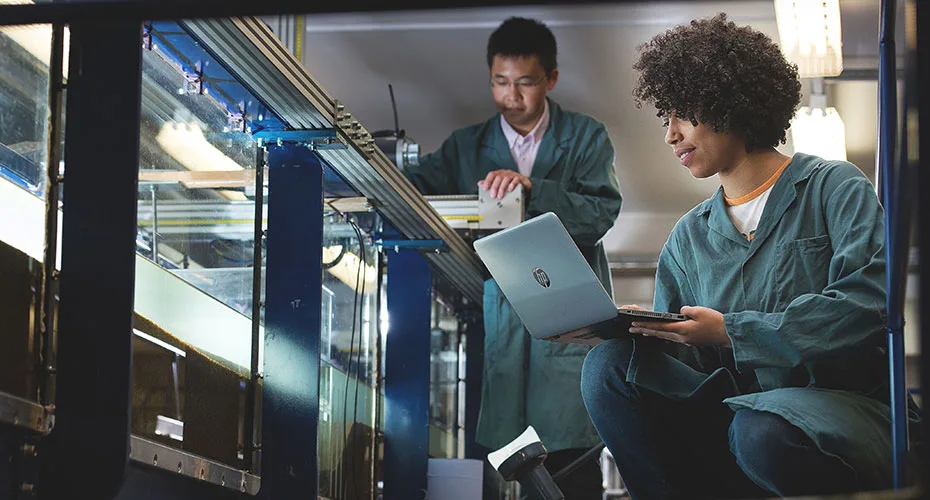
Our engineering and entrepreneurship degrees aim to help you develop an entrepreneurial mind-set. You will graduate with the practical toolkit necessary to inspire innovative ideas, create entrepreneurial engineering solutions to real-world challenges, undertake rigorous market validation and develop and launch viable and sustainable new enterprises.
Engineers have a reputation as being articulate, numerate, problem solvers, who claim great job satisfaction. Typically, salaries are significantly higher for engineering graduates than the average for other graduates.
Exeter has an excellent reputation with graduate recruiters and a strong employment record. Our graduates excel in specialist engineering fields and across a broad range of other sectors and some have also gone on to successfully launch their own businesses, taking their engineering solutions to market.
External visits
Throughout your degree you’ll attend talks and seminars given by experienced entrepreneurs and business leaders. You’ll also have the opportunity to meet with graduate employers. Professional engineers visit the university to hold mock interviews, allowing you to discuss your career opportunities at an early enough stage to inform your choice of modules and placement decisions.
Career paths
The broad-based skills acquired during your degree will give you an excellent grounding for a wide variety of careers, not only those related to Engineering but also in wider fields. Examples of roles recent graduates are now working as include:
- Aerospace Engineer
- Chartered and Certified Accountant
- Civil Engineer
- Electronics Engineer
- Engineering Project Manager
- Project Engineer
- Information Technology Professional
- Mechanical Engineer
- Programmer
- Software Developer