BA Arabic with Islamic and Middle East Studies
| UCAS code | T607 |
|---|---|
| Duration | 4 years |
| Entry year | 2027 |
| Campus | Streatham Campus |
| Typical offer | A-Level: ABB |
|---|---|
|
A-Level: BBC |
Why study BA Arabic with Islamic and Middle East Studies at Exeter?
- Build your Arabic language skills alongside critical knowledge of Islamic thought, history and contemporary Middle Eastern societies.
- Spend your second year abroad, developing your language skills and experiencing life in an Arabic-speaking environment and culture.
- Study at the Institute of Arab and Islamic Studies, one of the UK's leading specialist centres for the study of the Arab world, Islam and the Middle East.
- Learn from internationally recognised researchers with expertise in Arabic literature, Islamic theology, political Islam and modern Middle Eastern history.
- Graduate with strong Arabic language and analytical skills valued by employers in diplomacy, international development, journalism, law and the public sector.


3rd in the UK for African & Middle Eastern Studies

Work placements overseas to support career development

First for student satisfaction in six out of seven themes
National Student Survey 2026: Arab and Islamic Studies
Entry requirements for 2027 entry (typical offer)
| Qualification | Typical offer | Required subjects |
|---|---|---|
| A-Level | ABB | N/A |
| IB | 32/655 | N/A |
| BTEC | DDM | N/A |
| GCSE | C or 4 | English Language |
| Access to HE | 24 L3 Credits at Distinction Grade and 21 L3 credits at Merit Grade. | N/A |
| T-Level | Distinction | N/A |
| Contextual Offer | A-Level: BBC |
Specific subject requirements must still be achieved where stated above. Find out more about contextual offers. |
| Other accepted qualifications | ||
| English language requirements |
International students need to show they have the required level of English language to study this course. The required test scores for this course fall under Profile B1. Please visit our English language requirements page to view the required test scores and equivalencies from your country. |
|
NB General Studies is not included in any offer.
Grades advertised on each programme webpage are the typical level at which our offers are made and provide information on any specific subjects an applicant will need to have studied in order to be considered for a place on the programme. However, if we receive a large number of applications for the programme we may not be able to make an offer to all those who are predicted to achieve/have achieved grades which are in line with our typical offer. For more information on how applications are assessed and when decisions are released, please see: After you apply
Who we're looking for
We welcome applications from students with a strong academic background and interest in Arabic, Islamic studies or the Middle East. No prior knowledge of Arabic is required to join this programme.
We consider each application individually, taking into account the full range of your academic achievements and personal statement. Find out more about how we assess undergraduate applications.
Course content and modules
This programme combines intensive Arabic language study with a broad introduction to Islamic thought, history and contemporary Middle Eastern affairs. In your first year, you'll build your Arabic language and analytical skills, alongside core modules in Islamic and Middle East studies.
In your second year, you'll spend time abroad or on an approved placement. Options include studying at one of our recommended language schools in an Arabic-speaking country, taking part in a British Council partnership or completing a home placement. You'll put your Arabic language skills into practice and develop your understanding of Arabic-speaking cultures.
Returning to Exeter for Years 3 and 4, you’ll develop your interests by choosing from a range of optional modules and complete an independent research dissertation. Throughout your degree, you'll continue to build your knowledge while developing the transferable skills and global awareness necessary to support your future career.
Year 1 – Foundations
You'll study Arabic through intensive and structured teaching. Alongside your language studies, core modules will introduce you to the history, religion, politics and cultures of the Arab world and the wider Middle East. You’ll develop your reading, writing and critical skills, giving you a strong foundation for the rest of your degree.
Year 2 – Year abroad
Your second year is spent abroad or on placement, an integral and assessed part of your degree. The main option is a year at one of the world's leading centres for Arabic language instruction. You may also take part in a placement through a British Council partnership scheme or, where appropriate, a home placement.
Whichever route you take, your year abroad is designed to accelerate your Arabic language development and deepen your cultural understanding. You'll be supported throughout your year abroad by your academic tutor and the University's year-abroad team.
Year 3 – Development
When you return to Exeter, you'll be able to focus on your interests in greater depth and continue to develop your language skills alongside optional modules covering areas such as Islamic theology, political Islam, Arabic literature, gender in the Middle East and regional politics. You also begin preparing for your final-year dissertation.
Year 4 – Specialism and independent research
In your final year, you complete an independent dissertation on a topic of your choosing within the broad field of Arabic, Islamic or Middle East studies. You also take a further selection of advanced optional modules, allowing you to focus your studies in the areas most relevant to your academic and career interests. This year consolidates your expertise and prepares you for graduate employment or further postgraduate study.
Modules
You may notice changes to some of our modules over the coming months. This is because we are making space for the following:
- Minors: Future Skills Pathways - Alongside your main degree you may be eligible (depending on your course) to choose modules from another subject to broaden your skills and interests.
- Skills to Thrive built into every degree - Essential skills for your future, including communication, problem-solving, teamwork and digital confidence.
- Increased innovation and wellbeing - More room for creative learning, real-world projects and a healthier study rhythm.
The modules below provide examples of what you can expect to learn on this degree course based on recent academic teaching. The precise modules available to you in future years may vary depending on staff availability and research interests, new topics of study, timetabling and student demand.
Please note that the module information displayed here is subject to change.
105 credits of compulsory modules, 15 credits of optional modules.
| Code | Module | Credits |
|---|---|---|
| Compulsory 1 | ||
| Politics and Economy of the Contemporary Middle East | 15 | |
| Introduction to Islam | 15 | |
| Elementary Arabic Language I | 30 | |
| Elementary Arabic Language II | 30 | |
| Histories of the Middle East, 600-1800 C.E. | 15 | |
ARA1010: Politics and Economy of the Contemporary Middle East
This module will introduce you to the politics and political economy of the Middle East and give you the foundational knowledge to understand the contemporary challenges that the region is facing. The module will familiarise you with the main themes through which the region's politics and economy have been studied and debated in the academia, from the legacy of colonialism, to the politics of Islam and latest waves of popular mobilization, looking into the political dynamics of key states (Egypt, Iran, the Gulf states, Iraq, etc).
The module aims to provide you with a general introductory survey of the politics and political economy of the Middle East, covering topics such as the Arab-Israeli conflict, the legacy of colonialism, the political economy of oil, the resilience of authoritarianism, the issue of political Islam and popular mobilization. It will provide you with an understanding of the key themes and issues pertinent to the academic study of the Middle-East region, and will seek to expand your ability to engage critically and analytically with issues facing the Middle- East region in the 21st century by situating them in historical and theoretical context, forming the basis for your studies in subsequent years.
ARA1018: Introduction to Islam
This module will introduce you to Islam as both a textually based religious tradition and as a lived practice. It is an essential module that introduces you to themes and ideas that will be useful for your study of Islam and the Middle East in modules you may take in the future. As such, it is for the beginner with no prior knowledge and takes an inter-disciplinary approach using history, theology, law, literature, the arts and philosophy as a way to introduce the religious traditions of over 1.5 billion people worldwide. Starting from an introduction to the basic textual sources of the Qur'an and the practice of the Prophet Muhammad, we consistently ask what significance the history of the faith has for believers both in the past and in the future, and conclude with discussions on who speaks for Islam in the contemporary world and the difficulty of that very question.
ARA1033A: Elementary Arabic Language I
Arabic is a modern language spoken by hundreds of millions of people and a foundational language of human civilisation. This elementary-level module introduces you as a complete beginner to the fundamentals of the language, enabling you to acquire basic reading, writing, oral and aural skills to level A1 (breakthrough/beginner) on the Common European Framework of Reference for Languages (CEFRL). Through language, it will introduce you to aspects of Arab cultures. You will use a textbook as well as a variety of learning materials chosen by your lecturers.
No previous knowledge of Arabic is required to study in this module. If you have prior knowledge of Arabic acquired outside of your degree, your level will be assessed by the module convenor in order to establish whether this module is suitable for you—admission in such cases is not guaranteed.
The module will enable you to achieve basic proficiency in the language. You will first be introduced to the Arabic script, followed by the basics of Arabic grammar and syntax. Using a mixture of narrative-based and authentic content, both written and audio-visual, you will work on all language-related skills, including reading, listening, speaking, writing and cultural knowledge. You will be encouraged to practice learned material independently.
ARA1033B: Elementary Arabic Language II
Arabic is a modern language spoken by hundreds of millions of people and a foundational language of human civilisation. This elementary-level module continues your introduction the fundamentals of Arabic, enabling you to develop basic reading, writing, oral and aural skills and take your language to level A2 (waystage/elementary) on the Common European Framework of Reference for Languages (CEFRL).Through language, it will further introduce you to aspects of Arab cultures.
You will use a textbook and a variety of learning materials selected by your lecturers.
This module is for students who have successfully completed ARA1033A. It aims to enhance your reading, writing and communication skills in Arabic. The module aims to develop all language-related skills, including reading, listening, speaking, writing—plus cultural knowledge—by means of written texts and audio-visual clips. By the end of the module, you are expected to be ready to embark on intermediate-level study of the language.
ARA1036: Histories of the Middle East, 600-1800 C.E.
Few other regions of the world have provoked more interest and controversy than the Middle East. This module will provide you with an introductory overview of the historical, political, economic and strategic factors that shape the modern Middle East, examining key issues in the politics and society of the region from the Prophet to the end of the eighteenth century. It is designated to highlight the multi-faceted nature of Middle Eastern polities and to provide a continuity/change perspective on themes of regional unity versus political fragmentation. It also aims at providing you with the concepts and tools necessary to develop an analytical approach to understanding the Middle East.
| Code | Module | Credits |
|---|---|---|
| Optional 1 | ||
| Introduction to Persian History and Culture | 15 | |
| Introduction to Islamic Archaeology | 15 | |
| Elementary Turkish I | 15 | |
| Elementary Turkish II | 15 | |
| Religious Communities of the Middle East: Culture, Endangerment and Survival | 15 | |
ARA1021: Introduction to Persian History and Culture
This module introduces you to the great civilization and culture of Persia (including modern-day Iran, as well as historically speaking parts of Central Asia such as Afghanistan and Tajikistan, not to mention much of modern-day Anatolian Turkey and Iraq) from ancient until modern times. The module covers about 7000 years of Persian history, proceeding chronologically, beginning with pre-Islamic Persia around 5000 B.C.
The study of Iranian civilization and culture is the most neglected aspect of Islamic Studies today. This course remedies this shortcoming, introducing you to one of the world's greatest empires, its classical Islamic civilization, its contemporary body-politic and its vibrant national culture.
This is primarily a discussion-seminar course, and the small-group format will require your intensive, active participation in and preparation for the class. Classes will be introduced by 45-60 minute powerpoint-illustrated lecture, followed by directed discussions based on pre-assigned questions drawn from the readings.
ARA1030: Introduction to Islamic Archaeology
In this multidisciplinary module you will be introduced to the importance of material culture as a way of understanding Muslim societies of the past, and of better understanding Islam in the present. The module aims to familiarise you with the rich diversity of Islamic culture through archaeological, historical and ethnographic evidence.
You will develop critical skills in the following areas: the theory of material culture and archaeology with particular reference to Islamic cultures; the treatment of Islam and Islamic societies within the history of art, archaeology and material cultural studies; the use ethnography as a tool of research; and the methodologies and practices of archaeology.
Beyond the use of archaeology to merely understand historical phenomena, you will be introduced to innovative approaches to the study of Islamic societies, in particular, to the combined use of textual documentation, ethnological analogies, and the archaeological record.
This multidisciplinary module is designed to introduce students to the importance of material culture as a way of understanding Muslim societies of the past, and of better understanding Islam in the present. The module aims also to familiarise students with the rich diversity of Islamic culture through archaeological, historical and ethnographic evidence.
ARA1031: Elementary Turkish I
Turkish is a modern Turkic language spoken by some 80 million native speakers, largely in the Republic of Turkey, where it has official status. This is an elementary-level Turkish module that introduces you as a complete beginner to the fundamentals of the language, enabling you to communicate orally and to engage with text on a basic level. It provides you with the means and opportunity for you to take your reading, writing, oral and aural skills in Turkish to level A1 (breakthrough/beginner) on the Common European Framework of Reference for Languages (CEFRL). Through language, it will introduce you to aspects of Turkish cultures. You will use a textbook as well as a variety of learning materials chosen by your lecturers.
If you have prior knowledge of Turkish, your level will be assessed by the module convenor in order to establish whether this module is suitable for you—admission in such cases is not guaranteed.
The module will enable you to achieve basic proficiency in the language. You will first be introduced to the Turkish alphabet and pronunciation, followed by the basics of grammar and syntax. Using a mixture of narrative-based and authentic content, both written and audio-visual, you will work on all language-related skills, including reading, listening, speaking, writing and cultural knowledge. You will be encouraged to practice learned material independently.
ARA1032: Elementary Turkish II
Turkish is a modern Turkic language spoken by some 80 million native speakers, largely in the Republic of Turkey, where it has official status. This is an elementary-level Turkish module that continues your introduction to the fundamentals of the language, enabling you to communicate orally and engage with text on a basic level.
It provides you with the means and opportunity for you to take your basic reading, writing, oral and aural skills in Turkish to level A2 (waystage/elementary) on the Common European Framework of Reference for Languages (CEFRL). Through language, it will further introduce you to aspects of Turkish cultures. You will use a textbook as well as a variety of learning materials chosen by your lecturers.
If you have prior knowledge of Turkish acquired outside of your degree programme or have not completed the prerequisite modules, your level will be assessed by the module convenor in order to establish whether this module is suitable for you—admission in such cases is not guaranteed.
This module aims to enhance your basic reading, writing and communication skills in Turkish. It aims to develop all language-related skills, including reading, listening, speaking and writing—plus cultural knowledge—by means of written texts and audio-visual clips. By the end of the module, you are expected to be ready to embark on intermediate-level study of the language.
ARA1041: Religious Communities of the Middle East: Culture, Endangerment and Survival
This module takes you to the heart of the struggle for survival of some unique religious communities of the Middle East, many of which have existed for many hundreds of years but which may not live beyond our lifetime. You will not only learn about the rich traditions of Eastern Christianity but also about the much smaller groups who challenge our received ideas of what a 'religion' is and what it must consist of.
Over the term we will take you historically from Late Antiquity up until the last few years, when violence displaced many minorities from their homelands. You will read academic, media and faith sources and will be invited to consider what prejudices, colonial or otherwise, might underly all these sources. No knowledge of any of the local languages is required, nor is it necessary to have studied the 'Introduction to Islam' module - though if you have, you will find that the two modules complement each other.
You will develop knowledge of the cultural complexity of the Middle East and the environment in which this arose. You will develop your ability to evaluate sources, both for accuracy and for underlying prejudice and bias. You will learn to use the principle of religious literacy.
Please note that the module information displayed here is subject to change.
120-credit compulsory module.
| Code | Module | Credits |
|---|---|---|
| Compulsory 1 | ||
| Year Abroad with Work Placement | 120 | |
ARA2174: Year Abroad with Work Placement
Having completed the first year at IAIS, you will spend your second year of the MArabic programme in an Arabic-speaking country. There you will advance your knowledge of MSA as well as dialect of Arabic. This year is an excellent opportunity to immerse yourself in an Arabic-speaking environment and to gain first-hand experience of Arab society and culture. It is a great opportunity for you to interact with Arabic-speakers and to become fluent in an Arabic dialect. The experience you gain from studying abroad will feed into your third and fourth year at IAIS. During the year abroad you will be supported in your studies by both colleagues in the host institution and by IAIS colleagues who will visit you abroad. The Module Convenor will act as your named IAIS contact. There will also be scheduled regular contact with IAIS colleagues online.
Pre-requisites: successful completion of ARA1033A and ARA1033B (Elementary Arabic Language) with a grade average of 50 or higher
There are 120 credits associated specifically with the year abroad, and students need to 'pass' the year abroad to progress to year 3 of the MArabic. Marking conventions will be applied to the host institution's assessments.
Please note that the module information displayed here is subject to change.
30 credits of compulsory modules, 90 credits of optional modules.
| Code | Module | Credits |
|---|---|---|
| Compulsory 1 | ||
| Intermediate Arabic Language II | 30 | |
ARA2139: Intermediate Arabic Language II
Arabic is a modern language spoken by hundreds of millions of people and a foundational language of human civilization. This is an intermediate-level module that extends as your knowledge of the language, introducing you to new and more abstract fields of communication and providing you with the means and opportunity to take your Arabic beyond level B2 to C1 (vantage/upper intermediate or proficiency/advanced) on the Common European Framework of Reference for Languages (CEFRL). Through language, the module will continue your exposure to Arabic cultural expression.
Through your prior studies, you will have acquired a deeper knowledge of Arabic language and culture, as well as at least one dialect. This module helps you build on this experience and develop active and passive learning of the language through a wide range of written and audio-visual materials. You will strengthen your awareness of the various styles and registers of Arabic and develop your skills in composition and translation. You will also consolidate your knowledge of colloquial Arabic. You will use a variety of materials chosen by course tutors.
The pre-requisites are successful completion of ARA1033A, ARA1033B and Year Abroad (or equivalent).
| Code | Module | Credits |
|---|---|---|
| Optional 1 | ||
| Regions and Empires in Islamic Archaeology | 15 | |
| Magic and the Abrahamic Religions | 15 | |
| Islamist Movements: From the Muslim Brothers to the Islamic State | 15 | |
| Gender-Identity and Modernity in the Middle East | 15 | |
| Islamic Law and Society | 15 | |
| Ethnography of the Middle East | 15 | |
| Conflict and Peacemaking Palestine/Israel | 15 | |
| Classical Islamic History | 15 | |
| Arabic for Beginners II | 30 | |
| Muslims in Britain | 15 | |
| Political Economy of Development in the Middle East | 15 | |
| Intermediate Turkish I | 15 | |
| Intermediate Turkish II | 15 | |
| A History of the Modern Middle East, 1900-2014 | 15 | |
Please note that the module information displayed here is subject to change.
60 credits of compulsory modules, 60 credits of optional modules.
| Code | Module | Credits |
|---|---|---|
| Compulsory 1 | ||
| Advanced Arabic Language | 30 | |
| Dissertation | 30 | |
ARA3103: Advanced Arabic Language
Arabic is a modern language spoken by hundreds of millions of people and a foundational language of human civilisation. This is an advanced-level module that extends your knowledge of the language, honing your ability to communicate orally and textually on a full compliment of subjects and register. It provides you with the means and opportunity to take your Arabic reading, writing, oral and aural skills to level C1 or C2 (mastery-proficiency) on the Common European Framework of Reference for Languages (CEFRL). Through language, the module will deepen your exposure to Arabic cultural expression. You will use a variety of learning materials chosen by your lecturers.
The pre-requisites are successful completion of ARA2139. If you have prior knowledge of Arabic acquired outside of your degree programme or have not completed the prerequisite modules, your level will be assessed by the module convenor in order to establish whether this module is suitable for you—admission in such cases is not guaranteed.
ARA3106: Dissertation
The dissertation is a substantial individual research project, which provides you with the opportunity to engage in in-depth and sustained research on a subject of interest. You should choose your topic in consultation with a supervisor from the Institute.
This project aims to allow you to acquire knowledge of a particular subject, to benefit from one-to-one tuition from a specialist in the field, and to develop their research skills. These include the ability to collate, assess, analyse and order material from relevant types of sources, and the ability to communicate ideas, arguments and findings in academic prose.
| Code | Module | Credits |
|---|---|---|
| Optional 1 | ||
| From Home Lands to Host States: Migration, Displacement and Diaspora in the Middle East | 15 | |
| Drugs: Histories, Science, Policy | 15 | |
| Nationalisms in the Middle East | 15 | |
| The History and Political Development of Iraq | 15 | |
| The Kurds: History and Politics | 15 | |
| Iranian History, 1500-the Present | 15 | |
| Armed Islamist Movements: Jihadism and Beyond | 15 | |
| Britain in the Middle East, 1798-1977 | 15 | |
| Politics and Reform in the Gulf | 15 | |
| Intermediate Arabic Language | 30 | |
| The Arabian Nights: Perception and Reception | 15 | |
| Gender, Sexuality and Violence in Palestine/Israel | 15 | |
| Queer Theory in a Global Context | 15 | |
| The Politics of Authoritarian Rule | 15 | |
| Violence and Revolution in the Modern Middle East | 15 | |
Fees
Tuition fees for 2027 entry
UK students: £10,050 per year
International students: £25,700 per year
Scholarships
The University of Exeter offers a wide range of scholarships to support your education, with £8 million available for international students applying to study with us in the 2027/28 academic year, including our prestigious Exeter Excellence Scholarships*. We also provide scholarships for sport, music and other achievements, alongside regional and partner awards such as The Beacon Trust. Financial support is available for students from disadvantaged backgrounds, lower income households and other under-represented groups to help them access, succeed and progress through higher education.
For more information on scholarships and other financial support, please visit our scholarships and bursaries page.
* Terms and conditions, including deadlines, apply. See our website for details.
Learning and teaching
You will be based at the University of Exeter's Streatham Campus, home to the Institute of Arab and Islamic Studies. The Institute is a specialist centre with dedicated teaching, seminar and research facilities. During your second year you will study at an approved institution abroad.
Teaching on this course combines small-group Arabic language classes with seminars, lectures and independent study. Language classes are deliberately small to allow regular interaction, oral practice and close feedback on written work. Seminars in Islamic and Middle East studies encourage discussion, debate and critical engagement with primary and secondary sources.
Assessment
Assessment varies by module and is designed to develop a wide range of skills. You can expect a combination of:
- written essays
- language examinations
- oral assessments
- written translations
- presentations
- and a substantial independent dissertation in your final year.
We design assessment methods to reflect authentic academic and professional tasks.
A research and practice-led culture
The Institute of Arab and Islamic Studies is one of the UK's leading specialist research centres for the study of the Arab world, Islam and the Middle East. As a student here, you benefit directly from that research culture - attending research events, engaging with cutting-edge debates and, in your final year, conducting your own original research project.
Facilities
The Institute has dedicated library resources, including specialist Arabic-language collections and access to major international research databases. The University of Exeter also offers well-equipped IT facilities, study spaces and a vibrant student community.
Events and opportunities
You'll have opportunities to get involved in a wide range of activities put on by the Institute through public lectures, visiting speaker events and student societies. Engagement with Arabic-language media and cultural events is actively encouraged throughout the programme.
Optional modules outside of this course
Each year, if you have optional modules available, you can take up to 30 credits in a subject outside of your course. This can increase your employability and widen your intellectual horizons.
Minors: Future Skills Pathways
You can study a Future Skills Pathway alongside your main degree by choosing up to 30 credits of modules from a different subject area in your second and final years.
Your future
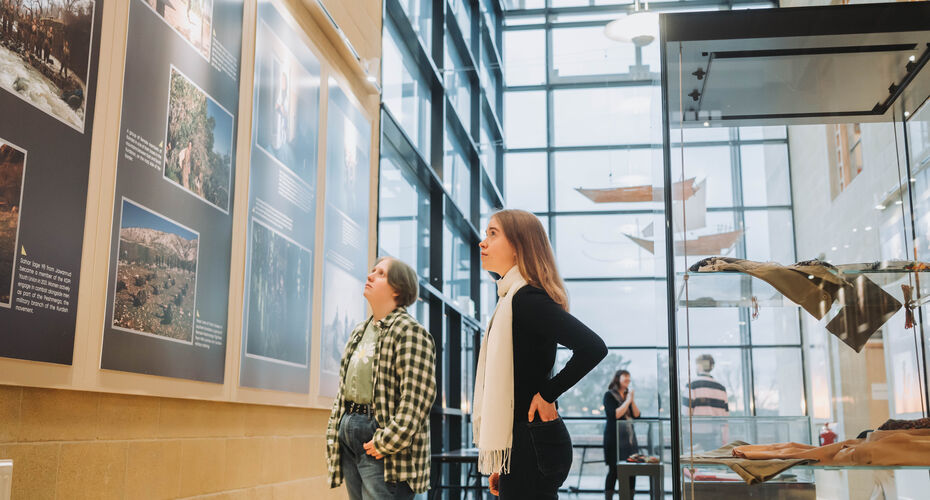
An exhibition in the Institute of Arab and Islamic Studies
Develop employer-recognised skills
Graduates of this course develop a distinctive combination of skills:
- advanced Arabic language ability (reading, writing, speaking and listening)
- critical and analytical thinking
- cross-cultural understanding
- independent research skills
- and the ability to communicate complex ideas clearly.
These capabilities are highly valued by a broad range of employers.
Future career paths
A University of Exeter Arabic and Islamic Studies degree can open up career opportunities in a range of sectors, including:
- diplomacy and foreign affairs
- government and the civil service
- international development and NGOs
- journalism and media
- education
- law
- translation and interpreting
- international business.
Careers support
Our Careers and Employability Service provides guidance throughout your degree, including support with CVs, applications, interview preparation and work experience.
The Institute also has links with specialist employers and organisations active in the Middle East region.
Further study
This degree provides excellent preparation for postgraduate study. At Exeter we offer a range of relevant postgraduate programmes through the Institute of Arab and Islamic Studies, including MA Islamic Studies, MA Middle East Politics, MA Palestine Studies and MA Kurdish Studies. Institute graduates also progress to postgraduate study at other leading universities in the UK and internationally.
Find out more about studying at Exeter








Sign-up for more information about studying with us
If you're thinking about studying BA Arabic with Islamic and Middle East Studies with us, signing up to our emails is the best way to discover if we’re the right university for you.