BA Archaeology
| UCAS code | V400 |
|---|---|
| Duration | 3 years |
| Entry year | 2027 |
| Campus | Streatham Campus |
| Typical offer | A-Level: ABB-BBB |
|---|---|
|
A-Level: BBC-BCC |
| UCAS code | V401 |
|---|---|
| Duration | 4 years |
| Entry year | 2027 |
| Campus | Streatham Campus |
| Typical offer | A-Level: ABB-BBB |
|---|---|
|
A-Level: BBC-BCC |
| UCAS code | V402 |
|---|---|
| Duration | 4 years |
| Entry year | 2027 |
| Campus | Streatham Campus |
| Typical offer | A-Level: ABB-BBB |
|---|---|
|
A-Level: BBC-BCC |
Why study BA Archaeology at Exeter?
- Learn important techniques and skills archaeologists use to engage with the past.
- Fieldwork opportunities in the UK or abroad; recent examples include excavations of prehistoric settlements in Kazakhstan and environmental archaeology of the Amazon basin.
- Tailor your BA Archaeology degree to your areas of interest, such as exploring specific historical periods of cultures, or examining human bones and artefacts.
- Exeter is unique in its setting, surrounded by some of the country’s richest archaeological sites. We also have outstanding on-site facilities for practical work and research, including a variety of laboratories, and an extensive reference collection.
- Professional placement available in the UK or abroad.
- Opportunity to combine Archaeology with other subjects as part of our Combined Honours courses.

Top 10 in the UK for Archaeology and Forensic Science

Top 40 in world subject rankings for Archaeology
QS World University Subject Rankings 2026

4th in the UK for internationally excellent Archaeology research
Based on research rated 4* and 3* in REF 2021

Applied experience and fieldwork opportunities in the UK and abroad
Accredited by the CIFA and UAUK
This degree is accredited by the Chartered Institute for Archaeologists (CIfA) and University Archaeology UK (UAUK) as meeting the National Occupational Standards for Archaeology.
Accreditation recognises this course as providing training in the practical and professional skills for a career in the historic environment, and embedding professional standards into our teaching. We were particularly commended for our 'inclusive and encouraging learning environment' and 'outstanding laboratory facilities that support cutting-edge teaching and research across a broad range of archaeological specialisms.'
As a student on this programme you will be eligible for student membership of CIfA, with access to e-learning modules, specialist professional networks, The Archaeologist magazine and Jobs Information Service bulletins.
Accreditation applies to BA Archaeology, BA Archaeology with Study Abroad and BA Archaeology with Employment Experience Abroad.
Entry requirements for 2027 entry (typical offer)
| Qualification | Typical offer | Required subjects |
|---|---|---|
| A-Level | ABB-BBB | n/a |
| IB | 32/655-30/555 | n/a |
| BTEC | DDM | n/a |
| GCSE | C or 4 | English Language |
| Access to HE | 24 L3 credits at Distinction Grade and 21 L3 credits at Merit Grade | N/A |
| T-Level | Merit | N/A |
| Contextual Offer | A-Level: BBC-BCC |
Specific subject requirements must still be achieved where stated above. Find out more about contextual offers. |
| Other accepted qualifications | ||
| English language requirements |
International students need to show they have the required level of English language to study this course. The required test scores for this course fall under Profile B1. Please visit our English language requirements page to view the required test scores and equivalencies from your country. |
|
NB General Studies is not included in any offer.
Grades advertised on each programme webpage are the typical level at which our offers are made and provide information on any specific subjects an applicant will need to have studied in order to be considered for a place on the programme. However, if we receive a large number of applications for the programme we may not be able to make an offer to all those who are predicted to achieve/have achieved grades which are in line with our typical offer. For more information on how applications are assessed and when decisions are released, please see: After you apply
"Choosing to study a BA Archaeology at the University of Exeter has been one of the most successful decisions of my life.
I was born in Romania but completed an International Baccalaureate in Canada before choosing a university and it was a difficult decision for me. But what really stood out and made me certain of my decision was the world-class teaching provided by an array of lecturers with very different backgrounds, coupled with the beautiful campus."
On top of this, I have been able to be a part of amazing opportunities such as the internship at the Digital Humanities Lab and participate in field projects as part of my degree in the United States and Romania. I have been so pleased with what the university has to offer that I decided to continue my studies through a Masters in Roman Archaeology, which I am very excited to start next year.
Ciprian
BA Archaeology

Course content and modules
You may notice changes to some of our modules over the coming months. This is because we are making space for the following:
- Minors: Future Skills Pathways - Alongside your main degree you may be eligible (depending on your course) to choose modules from another subject to broaden your skills and interests.
- Skills to Thrive built into every degree - Essential skills for your future, including communication, problem-solving, teamwork and digital confidence.
- Increased innovation and wellbeing - More room for creative learning, real-world projects and a healthier study rhythm.
The modules below provide examples of what you can expect to learn on this degree course based on recent academic teaching. The precise modules available to you in future years may vary depending on staff availability and research interests, new topics of study, timetabling and student demand.
Module information for this programme can be viewed on StudyGuide.
Course variants
BA Archaeology with Study Abroad
UCAS code: V401
Our four-year ‘with Study Abroad’ degree offers you the possibility of spending your third year abroad, studying with one of our many partner universities.
Why study abroad?
Living and studying in a different country is an exciting experience that broadens your academic and cultural horizons, as well as giving you the opportunity to widen your circle of friends. Students who have studied abroad demonstrate initiative, independence, motivation and, depending on where they stay, may also have gained a working knowledge of another language – all key qualities that employers are looking for in today’s competitive employment environment.
Where can I study abroad?
We have partnership arrangements with many prestigious institutions across the globe. Exactly where you can apply to study will depend on the subjects you are studying at Exeter. For a full list please visit the Study Abroad website.
Are there any academic requirements to study abroad?
Yes. If you wish to study abroad as part of this degree course, you must achieve an overall grade of at least 60% (a 2:1) for your first year of study. This applies to all students, even if you are registered on the 'with Study Abroad' variant from the start of your degree.
Does it count towards my degree?
Credit for academic work during your year abroad is arranged by agreement between the University of Exeter and the host institution. These marks are then translated back into your degree at Exeter. If you are Studying Abroad for a semester or full year, your time abroad will count toward your final degree.
How does it affect my tuition fee and funding?
For the year that you spend studying abroad you will pay a significantly reduced tuition fee to Exeter, but nothing to your host university – for more information visit our fees pages. If you were previously eligible, you will continue to receive a maintenance loan whilst on your Study Abroad year.
BA Archaeology with Employment Experience
UCAS code: V402
Our four-year ‘with Employment Experience’ degree offers you the option of spending your third year carrying out a graduate-level work placement or placements, within the UK or abroad, as part of your degree.
Why choose to include Employment Experience?
Undertaking graduate-level work during your degree unlocks a world of experience that allows you to develop essential employability and interpersonal skills that relate to your degree and future career.
A work placement will dramatically boost your confidence, enhance your CV and develop graduate-level skills and competencies that employers are looking for.
Where will I do my work placement?
The sector and country you choose to work in is very much your choice, as you will be responsible for finding and organising your placement. We will provide plenty of guidance and support during your first and second years which will prepare you to research and apply for placements. Ultimately, the university will give final approval to your placement to make sure you have a valuable experience.
How does it affect my tuition fees and funding?
For your ‘Year In Industry’ you will pay a significantly reduced tuition fee to Exeter – for more information visit our fees pages. If you were previously eligible, you will continue to receive a maintenance loan whilst on your year of work placement/s.
Is the placement paid?
You will be paid in accordance with the rules of the country you work in and there may be visa restrictions or requirements which you need to consider when applying.
Find out more
Fees
Tuition fees for 2027 entry
UK students: £10,050 per year
International students: £25,700 per year
Scholarships
The University of Exeter offers a wide range of scholarships to support your education, with £8 million available for international students applying to study with us in the 2027/28 academic year, including our prestigious Exeter Excellence Scholarships*. We also provide scholarships for sport, music and other achievements, alongside regional and partner awards such as The Beacon Trust. Financial support is available for students from disadvantaged backgrounds, lower income households and other under-represented groups to help them access, succeed and progress through higher education.
For more information on scholarships and other financial support, please visit our scholarships and bursaries page.
* Terms and conditions, including deadlines, apply. See our website for details.
Learning and teaching
How will I learn?
You will be taught through a combination of lectures, seminars, tutorials, field trips, and computer-led learning, led by internationally respected academics at the forefront of research. As well as a considerable self-guided study and research focus, you will be encouraged to complete group tasks. You will develop a range of skills of analysis and interpretation as well as a wide range of transferable skills, both practical and intellectual.
Will I get practical experience?
You will carry out a large amount of practical work, as you complete assignments and put into practice different archaeological and scientific techniques. We frequently employ experiments in our teaching about ancient technologies (e.g. flint knapping, pot making, bronze smelting and casting). Our students complete at least four weeks’ practical work, usually during the first summer vacation, and we have excellent provision of technical equipment for field study, including GPS, total station theodolite and geophysical equipment.
Teaching hours
You will have between 1 and 3 hours of teaching per module per week and will need to allow for additional hours of private study. You should expect your total workload to average about 40 hours per week during term time, with at least 10 hours of this being contact time with staff.
Research-led teaching
Our teaching is inspired by the latest research, ensuring lectures are cutting-edge and you will benefit from access to the latest thinking, equipment and resources. All staff teach third year options, which are linked to their own area of research, which include topics such as bioarchaeology and Egyptology. You will be encouraged to participate in research projects and be able to choose a dissertation topic that contributes to original research to a project.
Academic support
All students have a Personal Tutor who is available for advice and support throughout your studies. You will also benefit from our first-year tutorial system, which will support you with your study methods and core skills. There are also several services on campus where you can get advice and information, including the Students’ Guild Advice Unit.
Assessment
You will be assessed by a variety of methods. Some modules require you to sit exams, whilst others are assessed by essays and projects. Practical modules are examined by the preparation of written reports, portfolios of work, oral presentations, practical assignments, fieldwork notebooks, or take-away papers to allow time for research and perhaps appropriate field or museum visits.
You must pass your first year in order to progress to the second year: these results do not count towards your degree classification. The assessments in the second year, year abroad (if applicable) and final year will contribute to your final degree classification.
Optional modules outside of this course
Each year, if you have optional modules available, you can take up to 30 credits in a subject outside of your course. This can increase your employability and widen your intellectual horizons.
Minors: Future Skills Pathways
You can study a Future Skills Pathway alongside your main degree by choosing up to 30 credits of modules from a different subject area in your second and final years.
Facilities
As a member of the Archaeology Department and key part of our student community you will have full access to our exceptional, modern facilities:
- Experimental Archaeology Labs
- Bioarchaeology Lab
- Clean Lab and fume cupboards for preparing stable isotope samples
- Landscape archaeology project office
- Microscope room equipped with high-specification microscopes and image processing facilities
- Digital Humanities Lab
- Wet labs for artefact and environmental sample processing
- Digital x-ray facilities and equipment for elemental analysis
- State-of-the-art surveying equipment
- Outdoor experimental space
SHArD 3D Laboratory
The University of Exeter's Science, Heritage and Archaeology Digital 3D (SHArD 3D) Laboratory, is a state-of-the-art facility dedicated to digitally replicating and preserving biological and cultural artefacts. Funded by nearly £893,000 from the Arts and Humanities Research Council (AHRC), SHArD 3D employs advanced scanning and microscopy techniques to create detailed 3D models, enhancing the study of archaeological finds and bio-cultural heritage.
This cutting-edge laboratory offers students unparalleled opportunities to engage with the latest digital preservation technologies, including portable 3D scanning equipment for fieldwork and a microCT scanner for non-destructive imaging of artefacts. Collaborations with institutions like Exeter’s Royal Albert Memorial Museum will further enrich the learning experience, providing practical skills in digital archiving and analysis.
By studying Archaeology at the University of Exeter, students will be at the forefront of innovative research methods, preparing them for dynamic careers in heritage preservation and forensic analysis.
Learn more about our facilities
Collections
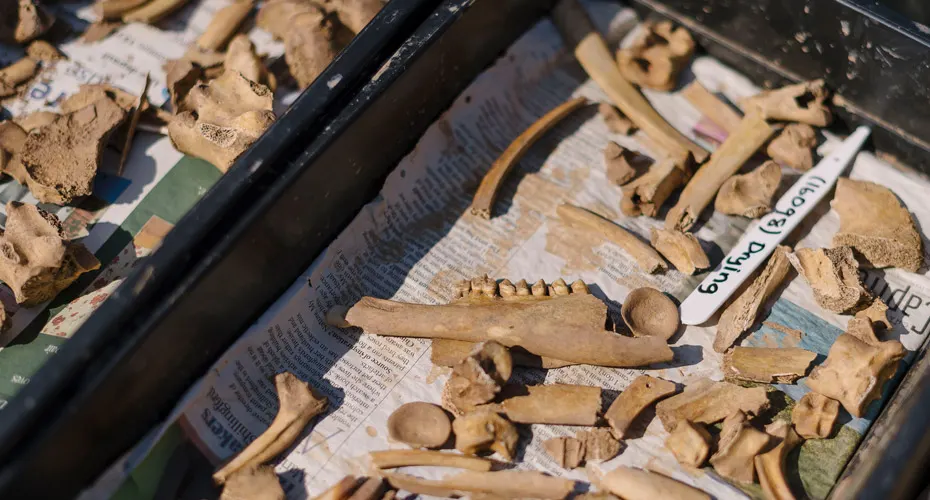
On top of all that we also have extensive reference collections of artefacts, animal bones and plant remains. So whatever your specific interests within archaeology we have the kit for it.
And of course you will have access to the wider resources of the University too, including the Library and Special Collections.
"Students consistently highlight the exceptional support provided by the academic and professional staff. The academic and technical team is known for being approachable, responsive, and genuinely invested in student success, offering guidance not only in academic matters but also in career development and personal wellbeing.
Students particularly value the open-door culture and the willingness of staff to go above and beyond to provide feedback, advice, and mentorship throughout their studies."
Professional Development & Practice Coordinator, Chartered Institute for Archaeologists (CIfA)
 Anna Welch" />
Fieldwork
Fieldwork is an essential part of our undergraduate Archaeology courses and you will have the opportunity to attend regular trips to museums, archives and archaeological sites.
All students have the opportunity to spend time in the field, usually over the summer between the first and second year. This will often take place on a university-led excavation, but students may also register on approved external digs.
Excavation may take you far from home, or just around the corner; over recent years Exeter students have experienced fieldwork in as diverse locations as Argentina, Sri Lanka, Kazakhstan, South Dakota,Texas, Hungary and here in Devon. In some cases, fieldwork may consist of archaeological work in a museum rather than excavation.
Your future with an Archaeology degree
Archaeology combines humanities and scientific disciplines, providing good opportunities to develop the skills that are attractive to employers. This course is designed to develop your skills of analysis, assessment and interpretation, as well as the production of written and oral reports. Teamwork, problem solving, analysis, research, presentation and organisational skills are all developed through a programme that is both practical and theoretical. Your employability skills are also enhanced through a range of careers initiatives we offer that are specific to the profession, including ‘professional modules’ involving work experience.
Career support
We have a dedicated, award-winning Careers Service, ensuring you have access to careers advisors, mentors and the tools you need to succeed in finding employment in your chosen field on graduation. The Exeter Award and the Exeter Leaders Award schemes encourage you to participate in employability related workshops, skills events, volunteering and employment which will contribute to your career decision-making skills and success in the employment market. Our graduates compete very successfully in the employment market, with many employers targeting the University when recruiting new graduates.
Career paths
The broad-based skills acquired during your degree will give you an excellent grounding for a wide variety of careers, not only those related to archaeology but also in wider fields such as teaching, media and business.
An Ofsted report on recurrent funding for 2021/22 describes Archaeology graduates as “crucial to the sustainability of the UK workforce in development-led archaeology”. It highlights the national shortage of archaeologists due to the huge increase in major construction projects with field workers being recruited abroad to make up the deficit.
They’ve highlighted Archaeology as a recognised construction skill and a “necessary part of the supply chain for the delivery of housing and infrastructure development, for instance HS2, Crossrail, and the A14 corridor project.” It’s also essential to meet planning policy requirements, particularly when it comes to delivering sustainable development.
One comment in the report also noted that “at least 50 per cent of exiting archaeology undergraduates will need to enter the profession to feed the current forecast pipeline of work. Actual numbers of archaeology graduates currently entering the profession are close to 10 per cent of the annual cohort […] currently 90 per cent of professional archaeologists in the UK have at least one undergraduate qualification in the subject. There is currently no alternative training pipeline for this kind of expertise on the scale required.”
Examples of roles recent graduates are now working as include:
- Anatomical Pathologist Technologist
- Archaeological Researcher
- Campaigns Officer
- Intern Ranger
- Field Archaeologist
- Museum Digital Archive Assistant
- Quality Coordinator
- Rural Policy Adviser
- Site Assistant
- Solutions Coordinator
Further study
Many of our students successfully progress to postgraduate study or training in a range of areas. We offer a range of relevant Masters degrees for further study, including MA Archaeology, MA Classics and Ancient History, MA History and MA International Relations.
Find out more about studying at Exeter







Sign-up for more information about studying with us
If you're thinking about studying BA Archaeology with us, signing up to our emails is the best way to discover if we’re the right university for you.